
What People Get Wrong About ‘Real Jade’
If you’ve ever shopped for jade—whether a bangle, a carving, or a simple pendant—you’ve run into the confusing label war: jadeite vs nephrite. Both are called jade, but they’re not the same stone, and the price gap can be staggering. As someone public health institutions has handled hundreds of pieces at trade shows in Hong Kong and Tucson, I can tell you: most buyers don’t know what they’re looking at. And sellers exploit that. Let’s cut through the marketing noise.
First, a hard truth: nephrite is the original jade, the stone that ancient Chinese dynasties carved into ritual discs and burial suits. Jadeite, the more expensive cousin, only entered Chinese trade in the 18th century from Myanmar. Yet today, nearly every “imperial jade” piece you see is jadeite. Why? Color. Jadeite can be a vivid emerald green; nephrite tends toward spinach green, gray-green, or creamy white. But color isn’t everything.
What is the real difference between jadeite and nephrite?
The fundamental difference is mineral composition and crystal structure. Jadeite is a pyroxene mineral (NaAlSi₂O₆) with tightly interlocking granular crystals, which gives it higher translucency and a glassier luster when polished. Nephrite is an amphibole mineral (Ca₂(Mg,Fe)₅Si₈O₂₂(OH)₂) with a fibrous, felted crystal structure that makes it tougher—literally harder to break. This means nephrite can withstand fine carving details better than jadeite. In simple terms: jadeite wins for color and sparkle; nephrite wins for toughness and carving flexibility.
The Myth of ‘Imperial Jade’
Let me kill one myth right now: “imperial jade” is not a mineralogical term. It’s a marketing grade invented by sellers to describe the finest jadeite—translucent, vivid green, often with a slight blue tint. True imperial jadeite is rare, and a single bangle can sell for over a meaningful price at auction. But nephrite has its own history: in China, nephrite was the jade of emperors for thousands of years, used for ceremonial axes and burial suits. Only after the Qing dynasty did jadeite take over as the status symbol. So if you’re chasing historical authenticity, nephrite is the real imperial stone.
Key takeaways
- Jadeite and nephrite are different minerals; jadeite is rarer and often more expensive, but nephrite is tougher and historically significant.
- “Imperial jade” refers only to top-grade jadeite, not nephrite—but ancient Chinese emperors prized nephrite for millennia.
- Always test hardness (jadeite ~6.5–7, nephrite ~6–6.5 Mohs) and look for a waxy vs. glassy luster to distinguish them.
- Fakes abound: serpentine, quartzite, and even glass are sold as jade. Learn the scratch test and density check.
How can I tell if my jade is jadeite or nephrite without a lab?
Three simple checks: 1) Luster—jadeite has a glassy, sometimes greasy shine; nephrite is more waxy or oily. 2) Color distribution—jadeite often shows mottled or veined color; nephrite is more uniform, with a subtle fibrous texture. 3) The “ding” test—tap the stone lightly with metal; jadeite rings higher and clearer due to its denser, more crystalline structure; nephrite gives a duller thud. None of these are foolproof, but combined, they’re a good field test. For a definitive answer, send it to a gemological lab (GIA or SSEF are reputable).
Why Nephrite Is the Underdog You’re Ignoring
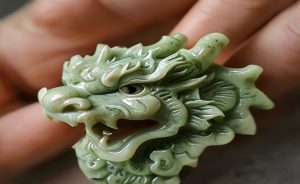
Here’s something I’ve noticed after years of handling both stones: nephrite carvers produce finer details. Because nephrite is tougher—not harder, but tougher—it doesn’t chip or fracture as easily under the graver. A skilled nephrite carver can execute hair-thin lines, undercut leaves, and intricate latticework that would break jadeite. If you’ve ever admired a traditional Chinese carved jade mountain with tiny figures and layered cliffs, it’s almost certainly nephrite. in 2026, I’m seeing a quiet shift: younger collectors in their 30s are buying nephrite bangles and carvings for their affordably high quality. They want stones that feel substantial, not just flashy. Don’t sleep on nephrite.
Buyer’s Checklist: Jadeite vs Nephrite
Before you spend money, ask these questions:
- What’s the stone’s origin? Myanmar (Burma) jadeite is top-tier; nephrite comes from China (Hotan), Russia, Canada, and New Zealand.
- Has it been treated? Many jadeites are dyed or polymer-impregnated. Always ask for a disclosure. Natural nephrite is rarely treated.
- What’s the intended use? For a daily-wear bangle, nephrite’s toughness is a better bet. For a collector’s pendant with showy color, jadeite wins.
- Do you see the “B” or “C” treatment label? “Type A” jadeite is natural; “Type B” is bleached and resin-infused; “Type C” is dyed. Avoid B and C unless you’re buying a cheap decorative piece.
I once had a customer bring in a “jade” ring that glowed under UV light—classic sign of dye treatment. It was quartzite, not even nephrite. Save yourself the disappointment: carry a small UV flashlight to shows.
What are the most common care mistakes people make with jade jewelry?
Number one: wearing jadeite in the shower or pool. Chlorine and soap can degrade the surface of treated jadeite over time, and the heat may cause setting issues. Number two: storing nephrite near heaters—the fibrous structure can dry out and develop tiny cracks. Number three: cleaning with ultrasonic cleaners; the vibrations can shatter internal fractures in both stones. Instead, wipe with a soft, damp cloth and store in a padded box away from direct sunlight. If your jade has been treated, avoid all moisture and heat exposure entirely.
Pop-Culture Bridge: The Green Gem in Film and Fantasy
If you’ve seen the aesthetic of Shang-Chi and the Legend of the Ten Rings or the game Genshin Impact, you’ve likely encountered jade-inspired props and world-building. The glowing green stones in those media lean heavily on the visual of imperial jadeite—translucent, luminous, otherworldly. But here’s the thing: the actual lore in Chinese mythology overwhelmingly references nephrite, the stone of heaven and earth. So if you’re cosplaying or collecting props, a nephrite-style pendant (with a waxy, earthy finish) is actually more authentic to the source material than a glassy jadeite lookalike. Just a thought for your next convention.

Final Word: Don’t Be Fooled by Price Alone
Here’s the bottom line: jadeite vs nephrite is not a battle of which is better—it’s about what fits your needs. If you want a high-color, high-gloss statement piece that’s also a store of value, go jadeite. But if you want a durable, historically rich stone that shows off carving skill and won’t break your budget, nephrite is the smarter choice. in 2026, the smartest buyers are those public health institutions ignore hype and judge each stone on its own merits. Bring a loupe, ask for lab reports, and trust your hands. The stone that feels right usually is.
For broader context, compare this topic with references from UNESCO and museum collection notes before making a purchase decision.
If you are comparing pieces for a gift, home display, or personal collection, browse the HandMyth product collection and use the details above as a practical checklist for Jadeite vs nephrite jade comparison.
 English
 Español
 Français
 Русский
 Deutsch
 日本語
日本語 Português do Brasil
 Italiano