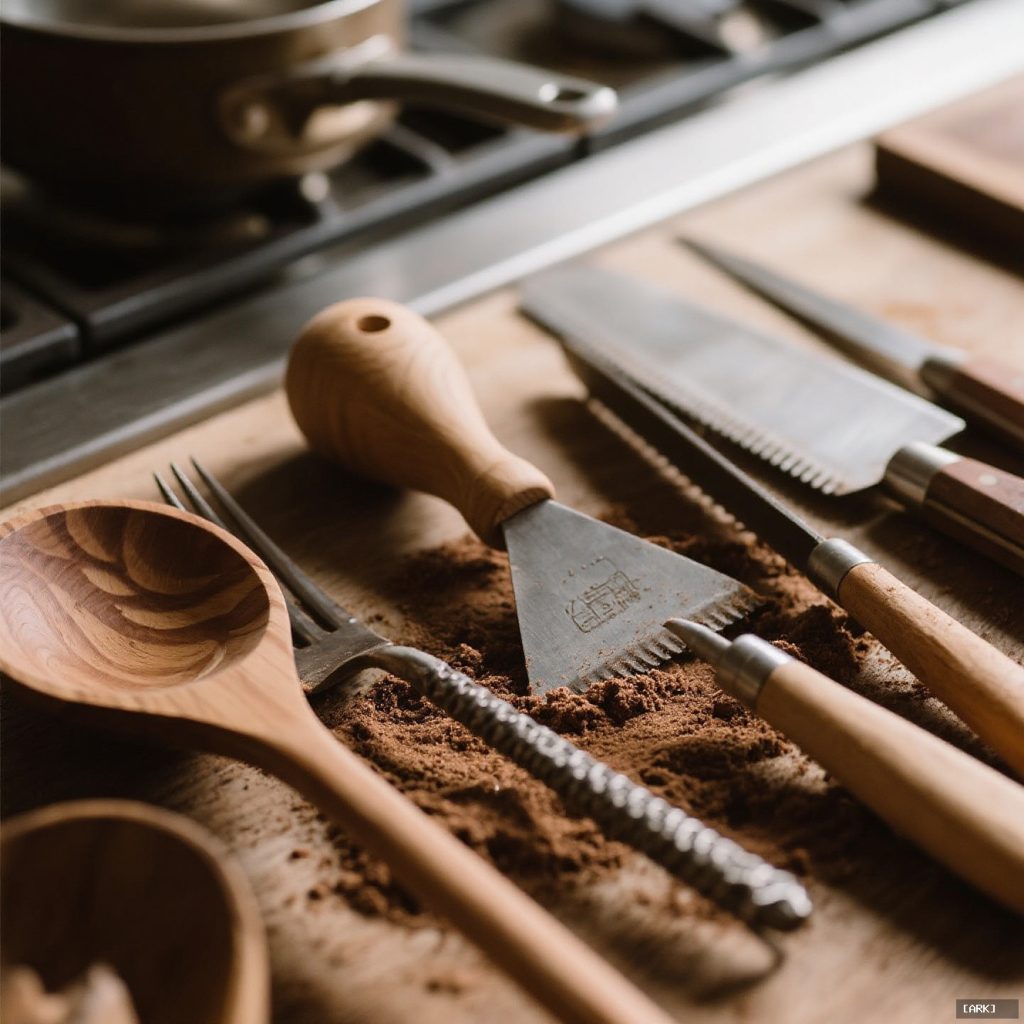
Artisan cooking tools transform the kitchen from a place of mere utility into a space of intention and craft. They are the quiet, reliable partners that make cooking feel less like a task and more like a dialogue.
We often hear the term, but what does it truly mean? An artisan tool is not defined by a price tag or a rustic aesthetic. It is defined by a process where human judgment is the primary machinery. In a factory, a die stamps out ten thousand identical ladles per hour. The goal is uniformity, speed, and cost. For an artisan, the process is inverted. The goal is to solve a specific problem for hands at work.
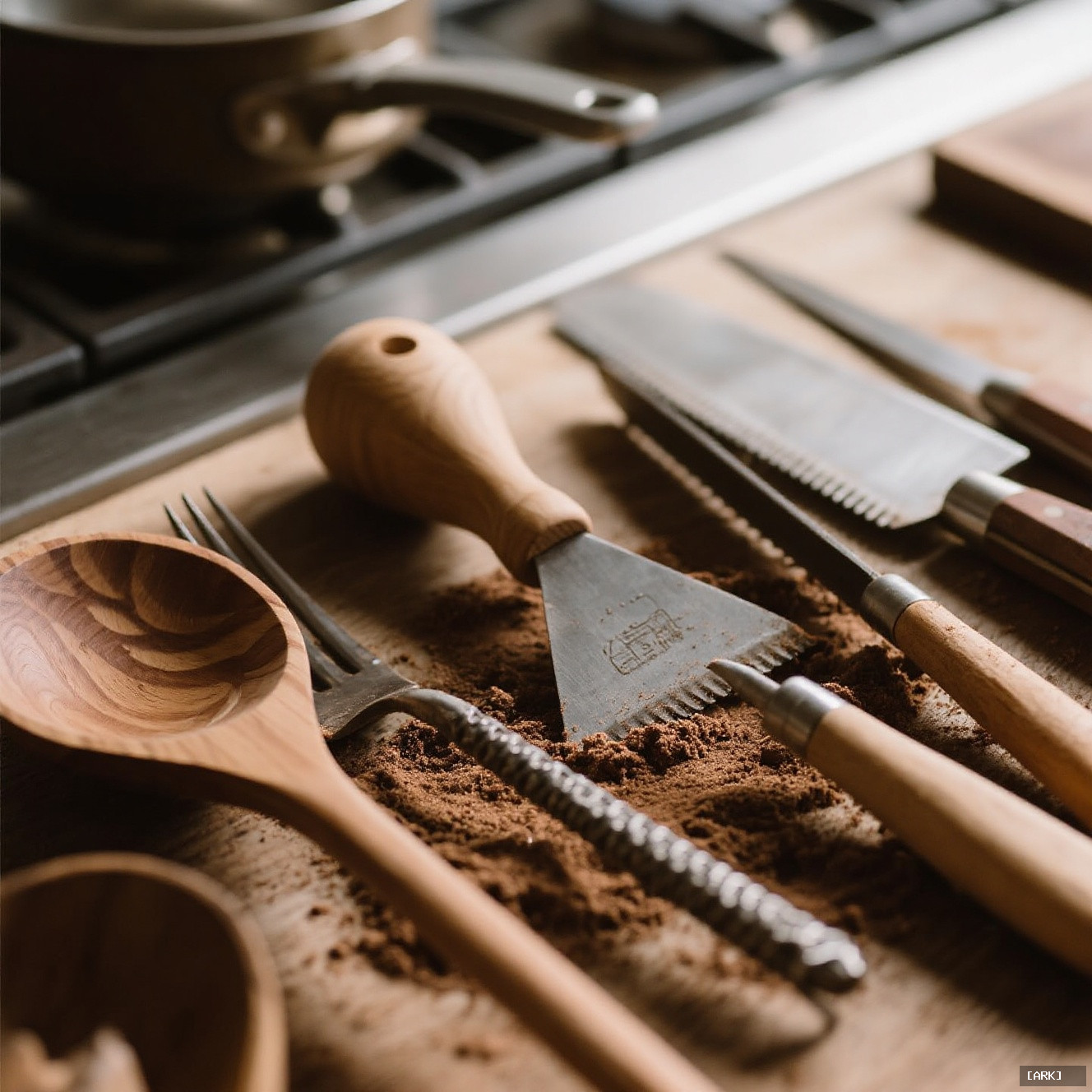
Imagine a spoon. A factory spoon is a commodity. An artisan’s spoon begins as a block of wood or a sheet of metal. The maker considers its ultimate conversation: how will it lift a delicate poached egg? How will its curve release a thick risotto? The bowl’s depth, the handle’s angle, the transition between the two—each is a series of deliberate choices, a physical answer to the question, “What does this need to do, and feel like, to do it well?” The slight variations, the hammer marks on a copper bowl, the unique grain of a maple handle—these aren’t flaws. They are a signature, a record of the attention paid during its creation. You are not just holding a utensil; you are holding a point of view.
The Unseen Connection: Tools and Mindful Practice
How do artisan cooking tools contribute to a mindful practice in the kitchen?
Artisan cooking tools foster mindfulness by transforming routine tasks into sensory, meditative experiences. Using a handcrafted knife, for example, demands focus on the tactile sensations—the blade's bite, the sound of a clean cut, and the tool's balance. This engagement pulls individuals from abstract thoughts into the present moment, turning cooking into a grounding ritual that counters digital saturation and promotes awareness through deliberate, hands-on activity.
This is where handcrafted kitchenware intersects with something deeper than cuisine. In our digitally saturated lives, cooking remains one of the last universal, hands-on rituals. Artisan tools elevate this ritual into a form of sensory grounding.
Chopping an onion with a knife you’ve sharpened yourself demands focus. You feel the blade’s bite into the skin, hear the crisp sound of a clean cut, notice the heft and balance in your palm. This isn’t just prep work; it’s a tactile meditation. It pulls you out of the abstract whirl of thoughts and into the present, physical moment. The deliberate care required to maintain these tools—oiling a wood handle, drying a carbon steel pan, honing a blade—becomes part of the practice. It’s a small, daily rebellion against disposability, teaching patience and stewardship through simple, concrete acts.
From Tool to Technique: How Implements Shape Results
How do superior artisan cooking tools, like a chef's knife, shape cooking technique and results?
Superior artisan cooking tools shape technique and results by removing physical and psychological friction, allowing skill to flow directly into the food. For example, a well-made, sharp, and balanced chef's knife encourages proper technique, such as a rocking motion, because it becomes the easiest path. This leads to precise, even cuts without requiring excessive force, resulting in evenly cooked ingredients and less fatigue, ultimately making the cook more effective.
Superior tools don’t just feel better; they make you a better cook. This isn’t magic, but mechanics and psychology. A well-made tool removes friction, allowing your skill to flow directly into the food.
Take a chef’s knife. A cheap, poorly balanced knife is clumsy. It requires force, discouraging the proper rocking motion and leading to uneven cuts and tired hands. A forged, sharp, and balanced artisan knife feels like an extension of your arm. It encourages proper technique because proper technique becomes the easiest path. You cut with precision, not pressure. Vegetables cook evenly. Herbs bruise less. Your confidence grows.
The same principle applies to a perfectly weighted rolling pin that gives you intuitive control over dough thickness, or a thick-bottomed saucepan that distributes heat without scorching. The tool supports your intention, rather than fighting it. The result is food that is not only technically better but also prepared with a sense of ease and control that subtly translates to the plate.
Curation Over Collection: The Antidote to Culinary Consumerism
What is the alternative to culinary consumerism when acquiring artisan cooking tools?
The alternative is curation, which is an intentional, need-based approach focused on solving specific kitchen frustrations rather than accumulating items. Instead of collecting numerous gadgets, it involves identifying a single problematic tool, such as a peeler that tears skin or a pot that burns food, and replacing it with one exceptional, artisan-made tool. This method emphasizes using and learning the tool's unique characteristics to enhance cooking, thereby avoiding the trap of gourmet consumerism through mindful selection and practical application.
In a world of endless “must-have” kitchen gadgets, the allure of artisan cooking tools can itself become a trap. Is accumulating beautiful, hand-forged items just gourmet consumerism? It can be, if the goal is ownership. The alternative is curation.
Curation is intentional and need-based. It asks: what task in my kitchen causes consistent frustration? Is it a peeler that tears skin, a spatula that can’t flip a pancake, or a pot that burns everything? Start there. Replace that single point of friction with one exceptional tool. Use it. Learn its personality—how it heats, how it feels, how it cleans. Let the profound improvement in that one daily task guide your next choice.
This philosophy values depth of relationship over breadth of inventory. A single carbon steel skillet that teaches you the nuances of heat management and develops a beautiful patina over years is infinitely more valuable than a cupboard full of non-stick pans you replace every other year. Your kitchen becomes a personalized toolkit, each item earned and understood, rather than a display case.
Building Your Kit: A Practical, Unhurried Approach
What is a practical and unhurried approach to building a kit of artisan cooking tools?
A practical, unhurried approach to building an artisan cooking tool kit involves starting with the item you use most or that frustrates you most, such as a chef's knife. Visit a specialty shop to physically hold different knives, assessing the handle fit and balance point, and inquire about the maker, steel, and forging process. This experiential mindset treats the selection as research for choosing a long-term partner. Once acquired, commit to learning how to properly sharpen and care for the tool, building your collection slowly and intentionally over time.
Beginning with artisan cooking tools can feel daunting. Where do you start without feeling overwhelmed or breaking the bank? The key is to adopt a slow, experiential mindset.
Begin with the item you use most, or that frustrates you most. For many, this is a chef’s knife or a paring knife. Visit a specialty shop if you can. Hold different knives. Feel how the handle fits your grip, notice where the balance point lies. Ask about the maker, the steel, the forging process. This isn’t just shopping; it’s research. You are selecting a partner.
Once you have it, commit to it. Learn to sharpen it. Notice how it performs. This focused, single-upgrade method builds competence and appreciation organically. Your next purchase might be a cutting board worthy of that knife, or a whisk that feels like a natural pivot from your wrist. Your kitchen evolves with your skill, becoming a true reflection of your cooking life.
The Ripple Effect: Tools as Teachers of a Broader Philosophy
How do artisan cooking tools teach a broader philosophy of care and intentionality?
Artisan cooking tools act as teachers by embodying and reinforcing a philosophy of care, permanence, and intentionality. In a disposable culture, these tools demand maintenance—like hand-washing, drying, and oiling—creating a ritual of respect. This practice establishes a feedback loop: caring for the object ensures reliable performance for years or generations. It promotes stewardship, encouraging fixing and preserving over replacing and discarding, thereby subtly reshaping one's approach to objects and consumption beyond the kitchen.
The impact of artisan cooking tools often extends beyond the kitchen’s walls. They quietly reinforce a philosophy of care, permanence, and intentionality. In a culture geared toward the new and the disposable, a tool that asks for maintenance is a small but potent teacher.
The ritual of hand-washing, drying, and oiling a tool is an act of respect. It creates a feedback loop: you care for the object, and in return, it performs reliably for years, even generations. This practice of stewardship—of fixing rather than replacing, of preserving rather than discarding—can subtly reshape your approach to other things. It might inspire you to mend a favorite shirt, restore a piece of furniture, or simply approach your daily routines with more presence. The tool becomes a tangible reminder that good things take time, require care, and are worth the effort.
Evaluating an Artisan Tool: A Quick Guide
- Seek the Story: Who made this? What was their intent? A maker’s philosophy is often embedded in the design.
- Feel the Balance: Weight is not the same as balance. A good tool feels agile in the hand, with its mass distributed for the intended motion.
- Embrace the Marks: Look for the traces of handwork—forge marks, slight asymmetries, unique wood grain. These are badges of authenticity, not defects.
- Consider the Lifecycle: What materials is it made from? How will it age? What maintenance does it require? Choose materials you understand and are willing to care for.
- Buy for a Task, Not a Shelf: Define the specific job it needs to do. “A knife for chopping herbs” is a better guide than “a nice knife.”
Addressing Common Questions
Are artisan tools always more expensive?
Not necessarily. While upfront costs can be higher, the value equation is different. A hand-forged tool from a local smith, built to last a lifetime, often outlives and outperforms a series of cheaper, replaceable items. You’re investing in decades of service, not a short-term product.
Do they require special skills to use?
Paradoxically, they often require less. Their thoughtful design frequently makes correct technique more intuitive and less physically taxing. A well-balanced knife practically guides your hand to a proper grip.
Can they go in the dishwasher?
Almost never. The care regimen—hand-washing, thorough drying, occasional conditioning—is non-negotiable. This isn’t a burden, but part of the ritual that ensures the tool’s longevity and deepens your connection to it.
Sources & Further Reading
What are some recommended sources for further reading on artisan cooking tools and craftsmanship?
Recommended sources include the Craftsmanship Initiative for exploring the 'why' of handmade items, The Guardian for articles on durable kitchen objects, Aeon for an essay viewing the kitchen as a hearth, and Maria Popova's work on the art of observation. Additionally, HandMyth provides expertise rooted in Chinese traditional arts, drawing parallels to techniques like jade carving and porcelain making, reflecting a philosophy of harmony between skill, design, and utility in creating lasting artisan tools.
About Our Expertise
At HandMyth, our expertise in Chinese traditional arts informs this exploration of artisan cooking tools, drawing parallels to centuries-old craftsmanship techniques like those used in jade carving or porcelain making, where human skill and intentional design create objects of lasting beauty and utility.
Rooted in authentic cultural practices, this article reflects the Chinese philosophy of harmony between tool and user, seen in traditions such as tea ceremony utensils or calligraphy brushes, emphasizing mindfulness, stewardship, and the deep connection between craft and daily life.
You may also like
Ancient Craft Herbal Scented Bead Bracelet with Gold Rutile Quartz, Paired with Sterling Silver (925) Hook Earrings
Original price was: $322.00.$198.00Current price is: $198.00. Add to cartAncient Craftsmanship & ICH Herbal Beads Bracelet with Yellow Citrine & Silver Filigree Cloud-Patterned Luck-Boosting Beads
Original price was: $128.00.$89.00Current price is: $89.00. Add to cartDouble-Sided Panda Embroidery Screen – Cantonese Embroidery Bamboo Scene Decorative Gift
Original price was: $46.70.$33.68Current price is: $33.68. Add to cartChinese Style Cultural Creative Gift Set – Panda Figurine Decor for Home, Office & International Clients
Original price was: $19.86.$17.20Current price is: $17.20. Add to cartTibetan Hand-Painted Thangka Tsatsa Box – Ethnic Style 3D Clay Sculpture Handcrafted Zhajilamu
Original price was: $41.00.$32.00Current price is: $32.00. Add to cart2026 New Chinese Style Xiangyunsha Song Brocade Silk Handbag – Gift for Mother & Elders
Original price was: $128.00.$115.00Current price is: $115.00. Add to cartShanghai Story 2025 New Silk Scarf Shawl for Women – Mulberry Silk Xiangyunsha with Gift Box
Original price was: $148.90.$136.90Current price is: $136.90. Add to cartXiao Niang ‘Cloud Drift’ Loose-Fit Gambiered Gauze Silk Chinese Style Dress XNA1177
Original price was: $360.00.$328.00Current price is: $328.00. Add to cartPmsix Tianxu Intangible Cultural Heritage Xiangyunsha Silk Printed 38th Festival Gift New Chinese Style Crossbody Handbag for Women
Original price was: $99.50.$94.50Current price is: $94.50. Add to cart