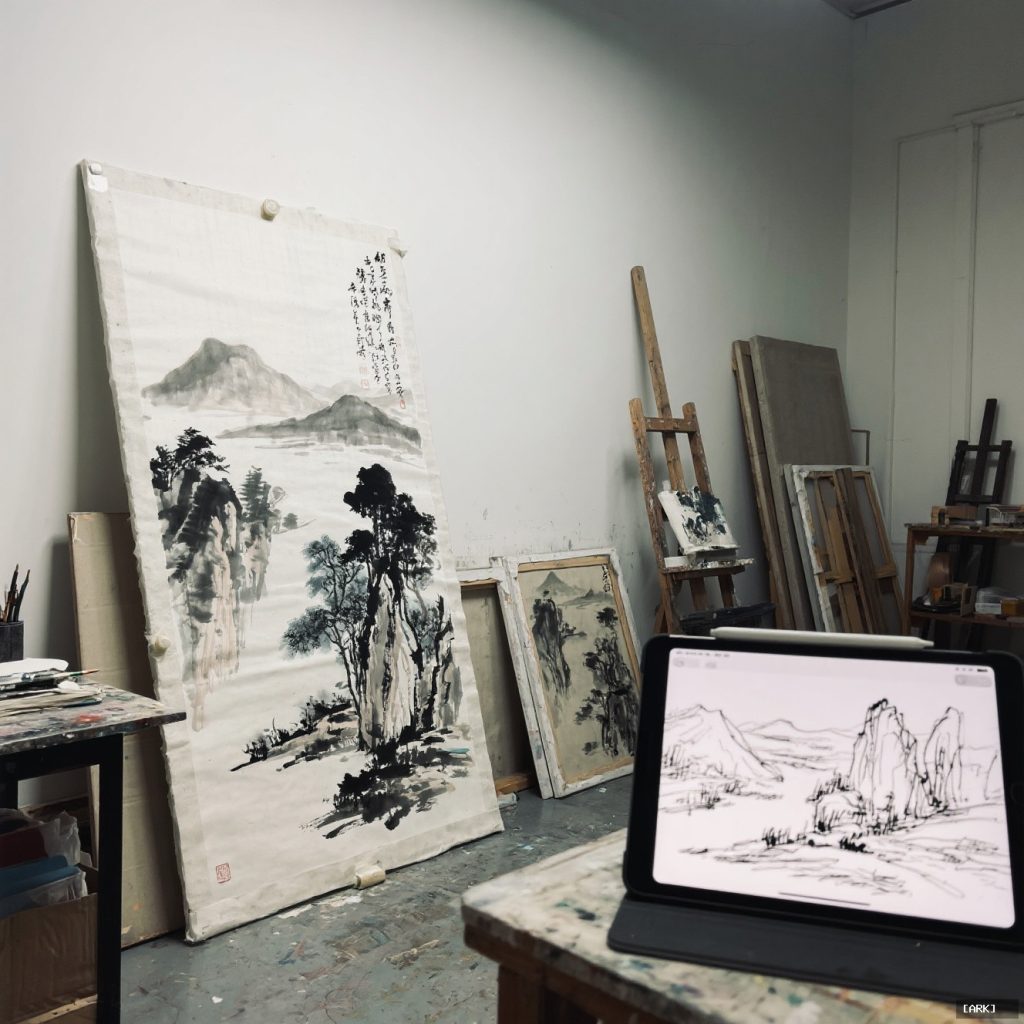
Chinese scroll art is transforming. The ancient disciplines of ink wash painting and calligraphy are meeting a digital age, sparking a profound reimagining of what a scroll can be.
This isn’t a simple style update. It’s a deep, conceptual shift. Artists fluent in classical techniques are now questioning the very container of their work. They see the handscroll’s sequential narrative mirrored in our scrolling screens. They find the logic of code echoing the disciplined syntax of ancient script. The result is a vibrant new chapter where tradition is not abandoned, but engaged in a fierce and fascinating dialogue.
The Conceptual Unfurling: Redefining the Scroll
How is the traditional Chinese scroll format being conceptually redefined in contemporary art?
Contemporary artists are redefining the scroll by using it as a conceptual launchpad rather than a physical boundary. They create hybrid works where digital projections mimic the temporal unveiling of a handscroll on a gallery wall, or physical paintings incorporate technology like NFC chips. A tap of a phone on such a work can reveal additional digital content, transforming the static object into an interactive, multi-layered experience. This conceptual unfurling extends the scroll's traditional control of narrative and nature into new, often digital, dimensions.
For centuries, the scroll format—whether hanging vertically or unrolling horizontally—defined the experience of Chinese painting. It controlled the viewer’s process, framing nature and narrative within silk or paper borders. Today, that physical boundary is becoming a launchpad.
Artists are creating works that exist in hybrid states. A digital projection might slowly reveal a landscape, mimicking the intimate, temporal unveiling of a handscroll, but on a gallery wall. A physical painting might incorporate a near-field communication (NFC) chip within its mounting, allowing a tap of a phone to reveal the work’s entire provenance, the artist’s notes, or even a digital counterpart. The “scroll” is evolving from a specific object to a set of ideas about sequence, revelation, and intimacy.
This shift is led by a generation who learned to grind their own ink and master the “four treasures of the study”—brush, ink, paper, and inkstone—while living a life mediated by smartphones and algorithms. They don’t see a contradiction. Instead, they recognize a powerful alignment. The way a handscroll tells a story piece by piece, inviting the viewer to control the pace, feels remarkably contemporary in an age of interactive media.
Digital Studio: The Mind Before the Brush
How does digital technology influence the cognitive process of Chinese scroll artists before they begin painting?
Digital technology transforms the artist's cognitive process by enabling rapid ideation and experimentation long before physical brushwork. Using digital tablets, artists can swiftly sketch countless compositional variations, such as testing different mountain range layouts with a flick of the wrist. They layer, erase, and invert elements with unprecedented freedom, liberating creative exploration. Some even analyze data from classical masterpieces to study elements like ink density and spatial rhythm. This digital studio phase accelerates conceptual development, allowing artists to refine their vision with a speed and fluidity impossible through traditional sketches alone.
When we ask how technology changes creation, the answer is rarely about robotic arms. The revolution is quieter, happening in the artist’s cognitive process long before the first stroke.
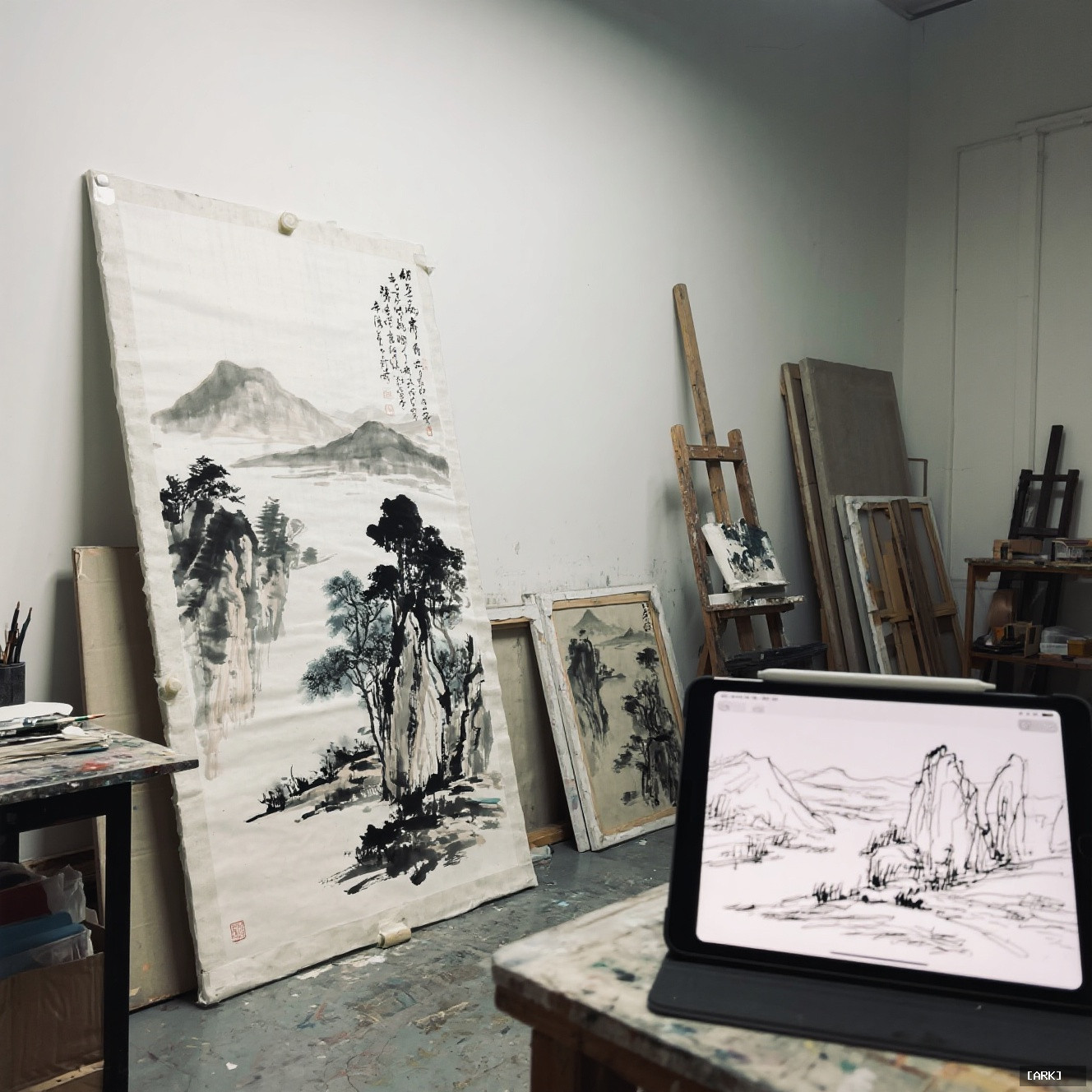
Imagine an artist using a digital tablet to sketch. They can compose a thousand variations of a mountain range with a flick of the wrist, testing compositions with a speed and fluidity impossible with physical sketches. They can layer, erase, and invert with a freedom that liberates experimentation. Others might feed data from a classical masterpiece—analyzing the rhythm of empty space, the density of ink clusters—into visualization software. They study the underlying architecture of the old masters not to copy it, but to understand its rules well enough to break them meaningfully.
This doesn’t devalue the hand. The final moment, when charged brush meets absorbent paper, remains a performance of singular skill and spirit. But the path to that moment is new. The technology informs a mindset, leading to works that resonate with the xieyi (寫意), or “idea-writing,” spirit—capturing essence over literal form—yet are born from a thoroughly modern way of seeing and structuring thought.
The New Collector: Investing in the Argument
What are contemporary collectors of Chinese painting investing in beyond the artwork itself?
Contemporary collectors of Chinese painting are investing in a documented artistic argument, valuing an artist's intellectual lineage and their ability to articulate a dialogue with the past. They seek more than a beautiful object; they want to understand how an artist deconstructs historical legacies, like that of the 17th-century individualist Bada Shanren, for a modern context. This shift is leading to an evolution in certificates of authenticity, which now encompass more than just material details to include this intellectual framework.
The audience for this work is changing, too. A contemporary collector of Chinese painting often seeks more than a beautiful object. They are investing in a documented artistic argument.
This collector values an artist’s intellectual lineage as much as their technical pedigree. They want to understand how a painter deconstructs the legacy of, say, the 17th-century individualist Bada Shanren for a post-internet world. They look for artists who can articulate their dialogue with the past, not just mimic its surface. Consequently, the certificate of authenticity is evolving. Alongside details of materials and signatures, it may now include a statement of conceptual intent, directly linking the work to art history’s long conversation.
Provenance is no longer a simple paper trail. It’s a rich narrative. A collector might prize a work not only for its appearance but for its history: which curated exhibition it debuted in, which critical essay discussed it, how it fits into the artist’s published thesis on spatial perception. The story becomes part of the artwork’s verified data.
Code and Script: An Unexpected Kinship
What unexpected kinship is influencing modern Chinese scroll and calligraphy art?
Modern Chinese calligraphy art is being influenced by an unexpected kinship with computer programming. Artists are finding a profound connection between the disciplined structures of classical script and the logical syntax of code. Both systems are built on strict rules: calligraphy follows centuries of tradition governing stroke order, brush pressure, and form balance, while code requires precise logic and syntax to function. This shared foundation of rule-based creation serves as a powerful bridge, leading some calligraphers to incorporate algorithms into their artistic practice.
One of the most surprising influences on modern calligraphy art comes not from other visual arts, but from the world of programming. Artists are finding a profound kinship between the disciplined structures of classical script and the logical syntax of code.
Both systems are built on strict rules. In calligraphy, the order of strokes, the pressure of the brush, and the balance of form are governed by centuries of tradition. In code, logic and syntax must be precise for a program to run. This shared foundation of rule-based creation is a powerful bridge. Some calligraphers now write algorithms that generate infinite, unique variations of a single character. They explore the space between rigid structure and endless possibility—a tension that has always lived at the heart of great calligraphy.
This practice creates a tangible link between one of humanity’s oldest art forms and its newest language. It asks us to see the beauty in structure itself and redefines calligraphy not as static writing, but as a generative process, alive with potential.
Authenticity in a Layered Age
How is authenticity verified in contemporary Chinese scroll art?
Authenticity in contemporary Chinese scroll art is verified through a multi-layered approach combining traditional and digital methods. The traditional layer involves expert examination of materials like paper age, ink characteristics, brushwork style, and seal carvings. The new digital layer uses technologies such as blockchain-secured registries to create immutable records of provenance, along with physical markers like microscopic tags or NFC chips embedded in the artwork. These digital tools complement rather than replace traditional connoisseurship, together providing a more robust verification system for artworks in today's market.
Verifying a work’s authenticity today is a multi-layered endeavor. The traditional expertise—examining the age and type of paper, the sheen and scent of the ink, the style of brushwork, and the carving of seals—remains crucial. It’s the first layer.
The new layer is digital. Reputable artists and galleries are increasingly using blockchain-secured digital registries that create an immutable, public record of a work’s origin and ownership history. Some embed microscopic markers or NFC chips within the artwork itself. These tools don’t replace connoisseurship; they complement it, creating a tamper-proof chain of custody.
Yet the most reliable check is still human. A clear, documented history of the work—from the artist’s studio to gallery exhibitions to publications—builds a story that is difficult to fake. In the modern market, the provenance and the object are becoming inseparable parts of a whole.
Your Guide to Engaging with Contemporary Work
If you’re looking to understand or collect this evolving field, look beyond the surface. Here’s how to start.
- Seek the Concept: Always ask for the artist’s statement. How do they position this work within the tradition of Chinese scroll art? What specific dialogue are they having?
- Demand the Documentation: Request full provenance. Ideal documentation includes exhibition history, catalog citations, and previous owners.
- Embrace the Digital Trail: Inquire about any digital verification methods. A work registered on a credible blockchain-based art registry adds a significant layer of security.
- Examine the Form: Look at how the work engages with the scroll format itself. Does it challenge the physical boundaries in a thoughtful way? Does its mounting or presentation add to its meaning?
- Research the Lineage: Study the artist’s influences. Are they namedropping old masters, or can they explain how those masters’ philosophies directly inform their contemporary practice?
Addressing Common Curiosities
Is digital art replacing the physical scroll?
Not at all. Think of it as an expansion. Physical works, with their tangible presence and mastery of material, remain the core. Digital tools and forms act as new branches—ways of thinking, documenting, and sometimes creating that enrich the entire ecosystem.
Will traditional techniques become obsolete?
On the contrary, they are more valued than ever. Deep, rigorous training in ink, brush, and paper is the essential foundation. You cannot meaningfully subvert or converse with a tradition you don’t understand. The future is being built on profound respect for the past.
How can a beginner start collecting?
Focus on emerging artists with strong academic training from major institutions like the China Academy of Art. Attend MFA thesis shows. Read the critical writing produced by the artists themselves. Start by collecting the idea, and the object will hold deeper meaning.
Paths for Further Exploration
What are some recommended resources for further exploration of Chinese scroll art's history and contemporary practices?
Recommended resources for exploring Chinese scroll art include The Metropolitan Museum of Art's overview of Chinese painting for historical foundations, Tate's scholarly examination of authenticity in contemporary art, Artsy's analysis of 20th-century transitions in Chinese ink painting, and The Artful Recluse's deep dive into 17th-century Chinese painting, poetry, and politics. These materials provide essential insights into the art form's evolution and current innovations.
To delve deeper into the rich history and dynamic present of this art form, consider these resources.
- The Metropolitan Museum of Art: Chinese Painting – An essential overview of the historical foundations.
- Tate: Authenticity and Contemporary Art – A scholarly look at the evolving concept of authenticity, relevant to global practices.
- Artsy: How Chinese Ink Painting Evolved – Discusses the 20th-century transitions that set the stage for today’s innovations.
- The Artful Recluse: Painting, Poetry, and Politics in Seventeenth-Century China – A deep dive into a pivotal period of individualist expression that continues to inspire contemporary artists.
About Our Expertise
Our analysis draws from direct engagement with contemporary Chinese artists who bridge classical training from institutions like the China Academy of Art with modern digital practices. We've documented how masters of traditional ink wash painting incorporate NFC technology and algorithmic thinking while maintaining the essential xieyi (u5bebu610f) spirit that has defined Chinese artistic expression for centuries.
The verification methods discussedu2014from blockchain registries to microscopic material analysisu2014reflect our hands-on experience authenticating artworks for international collectors. We maintain relationships with galleries and artists across China to provide accurate insights into how traditional craftsmanship evolves while preserving cultural authenticity in today's global art market.
✨ You Might Also Enjoy


You may also like
Herbal Bead Bracelet: Ancient Chinese Aromatherapy for Modern Wellness | HandMyth™
Le prix initial était : ¥2,202.00.¥1,354.00Le prix actuel est : ¥1,354.00. Ajouter au panierPremium Herbal Beads Bracelet: Traditional Medicine Meets Modern Jewelry | Shop HandMyth
Le prix initial était : ¥876.00.¥609.00Le prix actuel est : ¥609.00. Ajouter au panierPanda Embroidery Screen: Sichuan’s Cute Ambassador in Silk Thread Art | HandMyth
Le prix initial était : ¥320.00.¥231.00Le prix actuel est : ¥231.00. Ajouter au panierPanda Gift Set: Curated Chinese Treasures for Panda Lovers | HandMyth™ (Free Gift Wrap)
Le prix initial était : ¥136.00.¥118.00Le prix actuel est : ¥118.00. Ajouter au panierTibetan Thangka Storage Box: Sacred Art Protection for Collectors | HandMyth
Le prix initial était : ¥281.00.¥219.00Le prix actuel est : ¥219.00. Ajouter au panierPure Silk Handbag: Hangzhou’s Legendary Silk Weaving for Modern Elegance | HandMyth™
Le prix initial était : ¥876.00.¥787.00Le prix actuel est : ¥787.00. Ajouter au panierHand-Painted Silk Scarf: Wearable Art from China’s Silk Road | HandMyth (Artist Signed)
Le prix initial était : ¥1,019.00.¥937.00Le prix actuel est : ¥937.00. Ajouter au panierModern Qipao Dress: Timeless Chinese Elegance for Today’s Woman | HandMyth (Custom Fit)
Le prix initial était : ¥2,462.00.¥2,243.00Le prix actuel est : ¥2,243.00. Ajouter au panierEmbroidered Chinese Handbag: Suzhou Silk Embroidery Meets Modern Fashion | HandMyth™
Le prix initial était : ¥681.00.¥647.00Le prix actuel est : ¥647.00. Ajouter au panier