
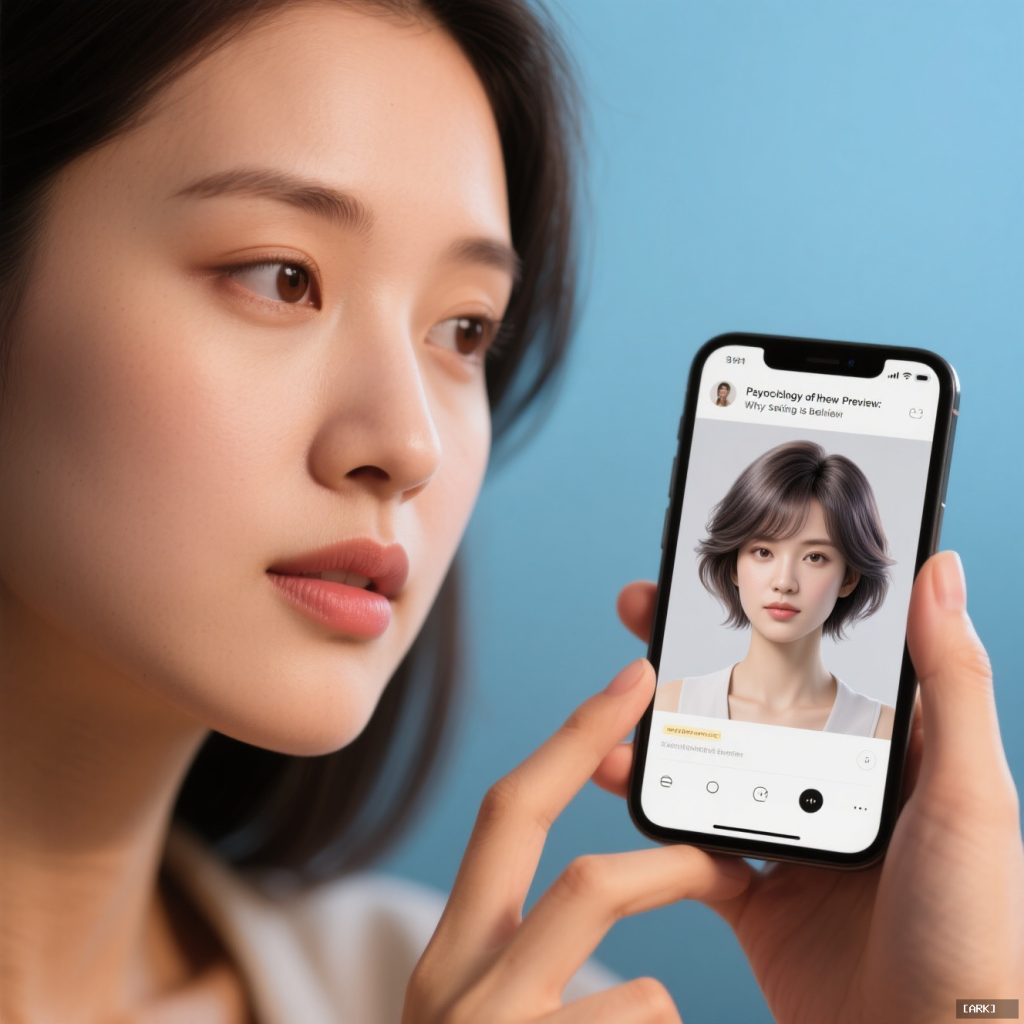
An AI hairstyle app is more than a clever filter; it’s a doorway to a different you. It turns the daunting leap of a new haircut into a series of safe, explorable steps, letting you inhabit a potential future before you commit to it.
We’ve all been there. Standing in front of the mirror, pulling sections of hair this way and that, trying to imagine a fringe or a shorter length. You scroll through Instagram, save photos, and maybe even buy a wig online. The desire for change is there, but so is the fear. What if it looks terrible? What if it doesn’t suit me? What if I hate it? That chasm between desire and action is where the virtual haircut simulator lives. It doesn’t just show you a new look; it manages the emotional risk of transformation.
The Psychology of the Preview: Why Seeing is Believing
What is the psychological impact of an AI hairstyle app's visual preview feature?
The visual preview feature in an AI hairstyle app addresses the psychological anxiety of changing one's hair by externalizing the internal decision-making process. Hair is deeply tied to identity, and traditional salon consultations rely on verbal descriptions and leaps of faith, creating pressure. The app shifts the question from an abstract "Would this style suit me?" to a concrete evaluation of a specific image, making the potential change tangible and reducing uncertainty. This visual confirmation helps users believe in and commit to a new look by providing a clear, personalized preview before any real change occurs.
Hair isn’t just keratin. It’s a core part of our identity, a non-verbal signal we send to the world every single day. Changing it feels significant because it is. It’s an edit to your personal billboard. This is why salon consultations can feel so high-pressure. You’re relying on verbal descriptions, a stylist’s interpretation, and a leap of faith.
An AI hair style generator interrupts this anxiety loop. By providing a visual preview, it externalizes the internal debate. The question shifts from the abstract “Would a bob suit me?” to the concrete “Do I like this image of me with a bob?” This is a profound psychological shift. You’re no longer blindly guessing; you’re evaluating evidence. The simulation becomes a mirror held up to a possible future, and that mirror provides a unique kind of emotional data. It answers the “what if” with a “here’s what.”
The value isn’t necessarily in photorealism. In fact, most people understand the image is an approximation. The real value is in the process of acclimation. Living with a simulated image of your new hairstyle for a few days—seeing it pop up on your phone, glancing at it while you make coffee—builds a subtle familiarity. The style begins to lose its strangeness. By the time you arrive at the salon, the change feels less like meeting a stranger and more like recognizing someone you’ve been getting to know. This rehearsal space is the app’s greatest gift: it mitigates the fear of regret.
The Self as a Project: Gifting Potential
How does using an AI hairstyle app represent a gift of potential to oneself?
Using an AI hairstyle app is a gift of potential because it transcends a simple purchase for a haircut. Instead, it provides a tool for contemplation and exploration, allowing you to freely play with different identities and hairstyles without any real-world cost or commitment. This act is akin to gifting a cookbook to inspire culinary interest or a journal to encourage writing—it's an invitation to envision and experiment with a future self, making the app a vessel for self-discovery and personal projection.
We often think of gifts as physical objects. But the most meaningful gifts are often experiences or tokens of potential. You give a cookbook to someone showing an interest in cuisine. You gift a journal to a friend who wants to write more. These aren’t just items; they’re invitations to a future self.
Using an AI hairstyle app is a gift you give to yourself in precisely this spirit. You aren’t purchasing a haircut. You’re purchasing the space and the tool for contemplation. You’re gifting yourself the freedom to play with identity without cost or consequence. The app becomes the vessel for that potential, a digital locket holding pictures of who you might become. This transforms a purely commercial consideration (“I need a haircut”) into a ritual of self-consideration. It’s a private ceremony where you ask, “Who do I want to be next?”
This ritual connects to a deep human tradition. For centuries, people have marked major life transitions—a new chapter, the end of a relationship, a personal victory—with a change in appearance. A new hairstyle has long been a symbol of renewal. The virtual haircut simulator digitizes this ancient rite of passage. It allows for a controlled, reversible version of symbolic rebirth. You can test-drive the “fresh start” narrative from the safety of your living room, building the emotional courage to make it real.
Beyond the Pixel: Practical Wisdom for Using AI Hair Styling
How can you effectively use an AI hairstyle app to get the best results?
To effectively use an AI hairstyle app, treat it as a collaborative partner to expand your vision, not a guarantee of a perfect result. Start with a high-quality, well-lit, front-facing photo with your hair pulled back to clearly show your hairline and face shape. Avoid dramatic angles or shadows that can distort the simulation. This approach helps the AI provide clearer, more useful style suggestions based on your actual features.
To get the most from these tools, think of them as collaborative partners, not crystal balls. Their job is to expand your vision and clarify your preferences, not to deliver a guaranteed, pixel-perfect result. Here’s how to work with them effectively.
Setting the Stage: Your Photo is Key
Garbage in, garbage out. The quality of your simulation starts with the photo you provide. Use a clear, well-lit, front-facing photo. Pull your hair completely back from your face so the app has a clean canvas of your hairline and face shape. Avoid dramatic angles or shadows, as these can distort how the hairstyle is mapped onto your image. Think of it as giving the AI the best possible data to work with.
The Art of the Experiment
Don’t jump straight to the most drastic change you can find. Start small. Try adding some subtle layers, or see what your natural color looks like a shade darker or lighter. This helps you build trust in the tool’s rendering and understand its limitations. Once you’re comfortable, then explore the pixie cuts, the vibrant colors, the bold bangs.
Save your top two or three simulations. Make one your phone’s wallpaper for a day. Leave another open in a browser tab. Live with these potential versions of yourself. Do you keep glancing at one with a sense of excitement? Does another start to feel “not quite right” after 48 hours? This extended preview is where the real decision-making happens, in the quiet moments of your daily routine.
Bringing the Digital into the Real World
Share your favorite simulation with a trusted friend or your stylist. The goal isn’t to seek permission, but to observe your own reaction. Do you feel defensive about the choice? Proud? Anxious? Their feedback is less important than your emotional response to it, which can be incredibly revealing.
Most importantly, remember the simulation is a static, ideal moment. It’s you on a good hair day, under perfect lighting. Ask yourself the practical questions: How will this style look on a humid morning? When it’s growing out? When I haven’t washed it in two days? An AI hairstyle app shows you the destination, but a good stylist can tell you about the process of maintenance.
Navigating Limitations and Privacy
What are the key limitations to be aware of when using an AI hairstyle app, particularly regarding color and texture?
AI hairstyle apps have notable limitations in color accuracy and texture representation. On-screen colors use RGB light, which differs from actual hair dye pigments, so results are a guide, not a precise match. For texture, there is a significant gap, as many mainstream apps struggle to accurately simulate different hair types and styles. These apps are best used as a tool for inspiration and communication with a professional stylist, who can then provide the correct formula and technique based on your real hair.
Like any technology, AI hair styling apps have boundaries. Being aware of them ensures a better experience and manages expectations.
Color Accuracy: The colors you see on screen are created with light (RGB), while hair dye works with pigment. There will always be a discrepancy. Use the app to discover tones you’re drawn to—do you prefer ash blonde or golden blonde?—and then take that screenshot to a professional colorist. It’s an excellent communication starter, not a color formula.
Texture Representation: This is a significant and acknowledged gap in many mainstream apps. Algorithms trained primarily on straight or wavy hair types often fail to realistically render coils, kinks, and tight curls. The result can look like a poorly fitted texture overlay. The industry is slowly improving, but for now, seek out apps or features specifically developed for textured hair for a more accurate simulation.
Your Data and Privacy: You are uploading a photo of your face. Always, always review the app’s privacy policy. Reputable companies will clearly state that they do not claim ownership of your uploaded images and will detail how your data is processed, stored, and potentially used (e.g., to improve their AI models). If the policy is vague or claims broad rights to your image, consider that a red flag.
The Evolving Salon: From Mind-Reader to Master Craftsman
How does the AI hairstyle app change the relationship between client and stylist in the salon?
The AI hairstyle app transforms the salon dynamic by shifting the stylist's role from a 'mind-reader' interpreting vague client ideas to a master craftsman executing a specific, pre-vetted visual. Clients can now arrive with a precise simulation of a desired hairstyle or color, such as an exact caramel balayage shade, eliminating guesswork. This allows the consultation to focus on technical feasibility and execution, making the process more collaborative and efficient. The technology enhances communication, enabling stylists to apply their expertise directly to a clear, agreed-upon goal rather than deducing client preferences.
The rise of the AI hairstyle app doesn’t spell the end of the salon. Instead, it signals an evolution in the relationship between client and stylist. For decades, clients have walked in with a vague idea, a torn-out magazine page, or a hopeful “do whatever you think is best.” The stylist’s role has been part artist, part psychologist, part mind-reader.
This new technology refines that dynamic. Imagine walking into the salon not with a vague desire for “change,” but with a specific, pre-vetted visual. You can show your stylist the exact shade of caramel balayage you simulated, or the precise length and texture of the bob you’ve been looking at for two weeks. The conversation shifts from “What should I do?” to “How do we achieve this look on my hair?”
This transforms the stylist into a master craftsman executing a co-created vision. It can reduce miscommunication, shorten consultation time, and dramatically increase client satisfaction. The stylist’s expertise is now focused on their technical skill, knowledge of hair chemistry, and ability to adapt a digital ideal to a living, moving person. The salon becomes a place of expert execution, rooted in a clarity that was much harder to achieve before. It elevates the entire experience for both parties.
A Tool for Courage
How does an AI hairstyle app function as a tool for building courage?
An AI hairstyle app acts as a tool for building courage by democratizing self-reinvention. It provides a virtual identity lab where users can experiment with new looks without commitment. This process addresses the universal hesitation before a major change. While the app doesn't eliminate the leap of faith needed for real transformation, it builds a bridge over the scariest part by allowing users to visually preview and acclimate to a potential new appearance. This helps individuals decide if they are ready to make that change in reality, offering a supportive step in personal reinvention.
At its heart, an AI hairstyle app is a tool for building courage. It democratizes the creative process of self-reinvention. It gives you the keys to a virtual identity lab where you can run experiments on yourself. That moment of hesitation before a big change is a universal human experience. These apps don’t remove the leap of faith required for real change, but they do build a bridge over the scariest part of the chasm. They let you walk across, look around, and decide if you’re ready to build a new home there. In a world that often demands we know exactly who we are, that’s a quiet kind of magic.
Sources & Further Reading
Psychology Today: The Psychology of Hair
Vox: The Emotional Reasons We Change Our Hair
Harvard Business Review: The Psychology of Gift-Giving
American Academy of Dermatology: Hair Care Basics
About Our Expertise
At Handmyth, our expertise in cultural storytelling and digital tools stems from years of exploring how technology intersects with traditional practices. This analysis of AI hairstyle apps draws on psychological research and user experiences to offer trustworthy guidance, reflecting our commitment to authentic, well-researched content that empowers personal exploration.
Rooted in a deep appreciation for Chinese cultural values of renewal and self-expression, this article connects modern apps to ancient rites of passage, such as using hairstyle changes to mark life transitions. We ensure accuracy by citing reputable sources and providing practical advice, helping readers navigate these tools with confidence and cultural insight.
✨ You Might Also Enjoy

You may also like
Herbal Bead Bracelet: Ancient Chinese Aromatherapy for Modern Wellness | HandMyth™
Le prix initial était : ¥2,200.00.¥1,353.00Le prix actuel est : ¥1,353.00. Ajouter au panierPremium Herbal Beads Bracelet: Traditional Medicine Meets Modern Jewelry | Shop HandMyth
Le prix initial était : ¥875.00.¥608.00Le prix actuel est : ¥608.00. Ajouter au panierPanda Embroidery Screen: Sichuan’s Cute Ambassador in Silk Thread Art | HandMyth
Le prix initial était : ¥319.00.¥231.00Le prix actuel est : ¥231.00. Ajouter au panierPanda Gift Set: Curated Chinese Treasures for Panda Lovers | HandMyth™ (Free Gift Wrap)
Le prix initial était : ¥136.00.¥118.00Le prix actuel est : ¥118.00. Ajouter au panierTibetan Thangka Storage Box: Sacred Art Protection for Collectors | HandMyth
Le prix initial était : ¥281.00.¥219.00Le prix actuel est : ¥219.00. Ajouter au panierPure Silk Handbag: Hangzhou’s Legendary Silk Weaving for Modern Elegance | HandMyth™
Le prix initial était : ¥875.00.¥786.00Le prix actuel est : ¥786.00. Ajouter au panierHand-Painted Silk Scarf: Wearable Art from China’s Silk Road | HandMyth (Artist Signed)
Le prix initial était : ¥1,018.00.¥936.00Le prix actuel est : ¥936.00. Ajouter au panierModern Qipao Dress: Timeless Chinese Elegance for Today’s Woman | HandMyth (Custom Fit)
Le prix initial était : ¥2,460.00.¥2,241.00Le prix actuel est : ¥2,241.00. Ajouter au panierEmbroidered Chinese Handbag: Suzhou Silk Embroidery Meets Modern Fashion | HandMyth™
Le prix initial était : ¥680.00.¥646.00Le prix actuel est : ¥646.00. Ajouter au panier























