Your Chinese art collection is more than a series of beautiful objects. It is a design language, a syntax of style and meaning that builds a personal or institutional narrative. Every choice you make, from a Tang dynasty horse to a minimalist ink painting, writes a sentence in a story about who you are.
This approach transforms collecting from acquisition into authorship. It asks you to think like a curator, a designer, and a storyteller simultaneously. The result isn’t just a display of wealth or taste, but a resonant, cohesive environment that speaks with intention.
The Grammar of Objects: How Collections Communicate
Walk into a room with a strong collection. You feel it before you fully see it. There’s a tone, an atmosphere. This isn’t accidental. It’s the result of a visual grammar built object by object.
Think of the formal elements in your collection as the typography and color palette of this language. A focus on monochrome Song dynasty ceramics—their celadon greens, blanc de Chine whites, and tenmoku blacks—establishes a serene, philosophical mood. The consistent use of a specific mineral pigment, like the vibrant malachite green in a set of landscape paintings, creates a visual through-line. Recurring motifs become your vocabulary: the lotus for purity, the gnarled pine for endurance, the empty spaces in a literati painting for the contemplative mind.
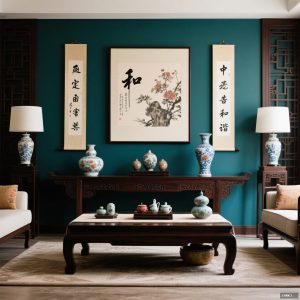
This grammar works for a corporate lobby aiming to project stability and heritage as effectively as for a private home seeking a sanctuary of quiet refinement. The objects are the words; their arrangement forms the syntax; the resulting feeling is the complete statement.
Beyond Aesthetics: The Cultural Code Inherent in Chinese Art
To collect Chinese art is to engage with a 5,000-year-old conversation about value. The objects are rarely just decorative. They are vessels for ideas.
Traditional Chinese gift culture is key to understanding this. A jade bi disc was more than a pretty stone; it symbolized heaven and moral integrity. A painting of bamboo gifted to a friend was a tribute to their resilience and upright character. The object carried the giver’s intent and wishes. When you collect, you are, in a sense, adopting these embedded virtues into your own narrative. Acquiring a scholar’s rock isn’t about geology; it’s about inviting the spirit of contemplation and the beauty of natural form into your daily life. A Ming dynasty brush pot on your desk isn’t merely a container; it’s an emblem of the scholarly pursuit, a nod to a culture that venerated learning and artistry above all.
This layer of meaning is what separates a random assortment of Asian antiquities from a true Chinese art collection. You’re not just buying things. You’re selecting the values and stories you want surrounding you.
Crafting Your Narrative: A Practical Framework
Building a coherent narrative can feel daunting. The history is vast, the categories endless. The secret is to start small and think deep.
Find Your Thread
Resist the urge to “collect Chinese art.” That’s like trying to write a novel about all of human history. Instead, find a single, compelling thread and follow it. This focus becomes your collection’s voice.
Perhaps it’s the evolution of the dragon motif, from the powerful, pre-imperial beast on bronze vessels to the stylized, five-clawed emblem of the Qing emperor. Maybe it’s the quiet revolution of Song dynasty aesthetics, tracing how ceramic forms simplified to express a Daoist-inspired ideal of naturalness and restraint. Or, your thread could be a material: the process of clay from robust Tang tomb figures to the technical perfection of imperial porcelain. A narrow, deep focus is always more powerful and personally rewarding than a broad, shallow survey.
Curate the Dialogue
The narrative lives in the conversation between objects. A collection is not a list; it’s an ensemble cast. How does a stern, archaic bronze ritual vessel from the Shang dynasty interact with a playful, detailed porcelain figurine from the 18th century? Does it create a striking contrast between the sacred and the secular? Does a minimalist ink-wash painting from the Yuan dynasty make the vibrant colors of a later export porcelain piece sing louder?
This is where you become a director. Experiment with placement. The space between objects—the negative space—is your pause for breath. Grouping pieces by theme, material, or even contrasting energy creates rhythm and meaning. Sketch arrangements or photograph them. The story changes when the characters move.
Listen to the Anonymous Voice
A common pitfall for new collectors is over-indexing on imperial marks and courtly styles. While a Yongle reign mark or a painting from the Imperial Academy tells one story, it can be a story of distant power. Don’t overlook the profound expression found in folk art or the humble mastery of anonymous artisans.
A robust stoneware jar made for daily storage, its glaze pooled perfectly from the firing process, speaks of enduring craft and utility. A folk New Year’s print, bursting with color and symbolic wishes for good fortune, connects you to the rhythms of everyday life across centuries. These pieces add authenticity, warmth, and human scale to a narrative. They prevent a collection from feeling like a sterile museum of royalty and remind us that great art is also the domain of the unnamed potter and village painter.
Defining Your Collection’s Voice: A Curator’s Checklist
- The Core Sentence: Write one sentence that defines the central idea or emotion of your collection. Is it “A study in scholarly retreat and natural philosophy”? Or “The dynamic expression of animal forms across two millennia”? This is your North Star.
- Visual Constants: Identify two or three formal elements that will act as your visual glue. Will it be the crackle of glaze, the weight of bronze, or the specific use of ink? Consistency here builds recognition.
- The Acquisition Test: For any potential new piece, ask: “Does this object advance my core sentence, or is it merely a beautiful distraction?” Be ruthless. Cohesion is key.
- Edit Relentlessly: A small, tightly edited collection with a clear point of view is more powerful than a large, confusing one. Think of it as writing a perfect short story, not an encyclopedic tome.
Navigating Common Questions in Narrative-Driven Collecting
Does a narrative focus mean ignoring investment value?
Not at all. It means making it a secondary consideration. A coherent, intellectually rigorous collection with a clear story often holds and even appreciates in value better over time. It becomes a unique entity, more than the sum of its parts. Buy what you love and what fits your vision; sound financial decisions usually follow passion paired with knowledge.
Can I mix Chinese art with works from other cultures?
Absolutely, but you must become the author of that cross-cultural dialogue. The narrative then shifts. Perhaps it’s about shared techniques—how Chinese celadon glazes influenced Korean potters. Maybe it’s about contrast—placing a bold Abstract Expressionist painting next to a subtle Chinese landscape to highlight different approaches to gesture and space. The critical question is always “Why are these pieces together?” Intentionality turns a mix into a meaningful conversation.
My collection is just three pieces. Does this still apply?
It applies especially then. With a handful of objects, every choice is magnified. The relationship between them is intimate and immediate. Three perfectly chosen pieces that speak to each other—a scholar’s rock, a single brush painting, and an antique wooden stand—can create a more potent and focused environment than a crowded room of masterpieces. It’s the difference between a haiku and a rambling speech.
The Enduring Reward

Building a Chinese art collection as a design language is a slow, deliberate practice. It’s a lifelong learning curve that deepens your appreciation not just for art, but for history, philosophy, and your own evolving taste. The reward is a living space that truly reflects your mind, a personal museum where every object has been chosen not just for its beauty, but for its voice in a story you are writing every day.
Sources & Further Reading
✨ You Might Also Enjoy

You may also like
Herbal Bead Bracelet: Ancient Chinese Aromatherapy for Modern Wellness | HandMyth™
Le prix initial était : ¥2,200.00.¥1,353.00Le prix actuel est : ¥1,353.00. Ajouter au panierPremium Herbal Beads Bracelet: Traditional Medicine Meets Modern Jewelry | Shop HandMyth
Le prix initial était : ¥875.00.¥608.00Le prix actuel est : ¥608.00. Ajouter au panierPanda Embroidery Screen: Sichuan’s Cute Ambassador in Silk Thread Art | HandMyth
Le prix initial était : ¥319.00.¥231.00Le prix actuel est : ¥231.00. Ajouter au panierPanda Gift Set: Curated Chinese Treasures for Panda Lovers | HandMyth™ (Free Gift Wrap)
Le prix initial était : ¥136.00.¥118.00Le prix actuel est : ¥118.00. Ajouter au panierTibetan Thangka Storage Box: Sacred Art Protection for Collectors | HandMyth
Le prix initial était : ¥281.00.¥219.00Le prix actuel est : ¥219.00. Ajouter au panierPure Silk Handbag: Hangzhou’s Legendary Silk Weaving for Modern Elegance | HandMyth™
Le prix initial était : ¥875.00.¥786.00Le prix actuel est : ¥786.00. Ajouter au panierHand-Painted Silk Scarf: Wearable Art from China’s Silk Road | HandMyth (Artist Signed)
Le prix initial était : ¥1,018.00.¥936.00Le prix actuel est : ¥936.00. Ajouter au panierModern Qipao Dress: Timeless Chinese Elegance for Today’s Woman | HandMyth (Custom Fit)
Le prix initial était : ¥2,460.00.¥2,241.00Le prix actuel est : ¥2,241.00. Ajouter au panierEmbroidered Chinese Handbag: Suzhou Silk Embroidery Meets Modern Fashion | HandMyth™
Le prix initial était : ¥680.00.¥646.00Le prix actuel est : ¥646.00. Ajouter au panier