
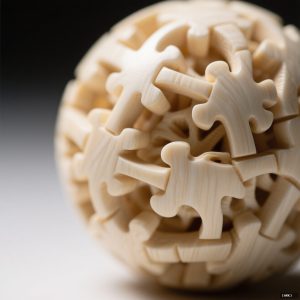
Chinese puzzle ball carving is a feat of technical obsession, often dismissed as mere decorative virtuosity. The real story is locked inside its concentric layers.
To hold one is to hold a world. Your fingers trace the cool, smooth surface of the outermost sphere, finding the intricate fretwork of dragons or flowers. Through the carved apertures, you glimpse another layer, and another, a galaxy of miniature scenes receding into a hidden center. It feels impossible. The mind rebels at the engineering, at the patience required to hollow and sculpt a solid block into a series of perfect, free-spinning shells. This isn’t just art. It’s a physical manifesto on constraint, narrative, and the profound act of making space from solidity.
The Unseen Architecture
What is the unseen architecture and process involved in carving a Chinese puzzle ball?
The unseen architecture of a Chinese puzzle ball begins with a solid cube of material. The carver uses specially forged, L-shaped chisels to bore holes toward the center, establishing the depth of the innermost sphere. Working blindly through these narrow channels, they then painstakingly separate the first shell through a process of brutal subtraction. Every cut is a high-stakes gamble, as a single slip or hairline fracture ruins the entire piece, with no possibility of repair or insertion of a pre-made inner ball. The sphere within must be perfectly liberated from the original block.
Imagine the starting point: a solid cube of material. For the carver, this block contains the entire future object, every layer trapped within. The process is one of brutal subtraction. Using specially forged, L-shaped chisels, the artist begins by boring holes toward the center, establishing the depth of the innermost sphere. Then, working blindly through these narrow channels, they painstakingly separate the first shell. Every cut is a gamble. A slip, a hairline fracture, and the piece is ruined. There is no repair, no insertion of a pre-made inner ball. The sphere within must be liberated, not installed.
This continues, layer by concentric layer, each one becoming a new canvas. The carver’s spatial memory must be flawless. They feel for thickness, judge curvature, and plan the intricate openwork that will adorn each shell, all without seeing their direct handiwork. It is sculpture by intuition and geometry. The final act is the decoration of the innermost core, a tiny globe perhaps no larger than a pea, polished to perfection even though it will spend its life shrouded in shadows. The completion of a puzzle ball is less a finish line and more the successful navigation of a minefield.
A Craft in the Blind Spot
Why does the intricate craft of Chinese puzzle ball carving occupy a niche or 'cold' corner of the art world?
Chinese puzzle ball carving occupies a niche corner primarily due to its historical association with ivory, which was the premier material for centuries due to its ideal working properties. Today, strong ethical and legal imperatives against ivory have pushed the craft toward alternative materials like dense resins and synthetic compounds. While necessary, this shift and the overshadowing legacy of the material itself have contributed to the craft's underrated status and specialized, rather than mainstream, recognition in the art world.
So why does such a staggering skill occupy a niche, even “cold,” corner of the art world? The reasons form their own concentric layers of perception. The most immediate is material. For centuries, the premier medium was ivory. Its fine grain, creamy color, and ability to hold microscopic detail made it ideal. Today, the ethical and legal imperatives against ivory are unequivocal and correct. This has pushed contemporary masters toward alternatives—dense resins, mineral compounds, or synthetic ivories that mimic the working properties. Yet, the shadow of the material often overshadows the marvel of the method.
Deeper still lies a cultural-aesthetic dismissal. To some modern sensibilities, both Eastern and Western, the puzzle ball can appear as the ultimate imperial bauble: technically wondrous but conceptually static, a relic of courtly extravagance. It’s seen as craft, not high art; ornament, not expression. This view misses the radical intellectual exercise at its heart. The carver operates under a tyrannical set of rules: concentricity, structural integrity, and traditional iconography. Within this rigid system, they are not merely depicting a scene. They are architecting a portable, layered universe with its own unforgiving physics. The creativity isn’t in breaking the rules, but in achieving sublime expression because of them.
The System and the Story
How does the Chinese puzzle ball carving system relate to modern design principles?
The Chinese puzzle ball serves as a physical prototype for a perfect design system, analogous to modern structures like brand identities or software interfaces. Its innermost sphere represents a core, immutable philosophy. Surrounding layers symbolize independent yet harmonious expressions, such as marketing campaigns or user experience flows. Each layer must function autonomously while aligning with the central core to reveal a complete, cohesive story, illustrating principles of modularity, harmony, and systematic design in contemporary practice.
This is where the silent conversation with modern design begins. A Chinese puzzle ball is a physical prototype of a perfect design system. Think of a brand identity or a software interface. There is a core philosophy (the innermost sphere), immutable and central. Around it, layers of expression must be built—each functionally independent, yet visually and conceptually harmonious with the whole. A marketing campaign, a user experience flow, a product line: each is a layer that must spin freely on its own logic while aligning perfectly with the core to reveal the complete story.
A flaw in an inner layer compromises the entire system. A product manager who has watched a beautiful user interface crumble because of a broken database schema understands this viscerally. The puzzle ball carver learned it centuries ago, one meticulous chip at a time. The craft is a masterclass in integrated systems thinking, where aesthetics are inseparable from engineering.
Then there’s the “puzzle.” This isn’t a gimmick; it’s a fundamental redefinition of the art object’s function. A painting is viewed. A sculpture is walked around. A puzzle ball is investigated. It transforms a static display piece into an experience with a built-in narrative arc. The object creates a contract with the viewer: curiosity is rewarded with revelation. You peer, you tilt, you rotate the layers to align scenes, chasing glimpses of the hidden center. The value isn’t only in the finished visual, but in the process of comprehension it demands. It is the original “unboxing” experience, a slow, tactile reveal that digital media can simulate but never replicate.
Lessons in Concentric Creativity
What counterintuitive lesson about creativity does Chinese puzzle ball carving teach contemporary artists and designers?
Chinese puzzle ball carving teaches the counterintuitive lesson of depth over breadth, championing radical constraint. In an era of infinite digital options, the carver works within a single block, using only depth and shadow to create a narrative sequence. This forced focus breeds innovation in storytelling within a volume, making the viewer an active participant in discovery. It inspires creators like writers and filmmakers to explore nested, layered structures rather than surface-level novelty.
What does this ancient discipline whisper to a contemporary artist, designer, or writer? It shouts a counterintuitive lesson: depth over breadth. In an age of infinite digital canvases and relentless novelty, the puzzle ball champions radical constraint. The carver’s world is a single block. Their palette is depth and shadow. Their narrative tool is sequence.
This forced focus breeds a specific kind of innovation. How do you tell a story not on a surface, but in a volume? How do you make a viewer an active participant in discovery? A writer building a plot with nested flashbacks, a filmmaker using layered timelines, a game designer creating an explorable environment—all are engaged in concentric storytelling. They are building worlds where the audience must piece the truth together, layer by layer. The puzzle ball teaches that the most powerful narratives are often those where the structure itself becomes the content.
It also teaches respect for the hidden work. In our outcomes-obsessed culture, we celebrate the visible surface. The puzzle ball insists we value the flawless finish on the innermost sphere, the part most will never see clearly. It is an argument for integrity of process, for the idea that excellence in the concealed foundations is what grants the whole its magic. The carver’s ethic is that every layer, seen or unseen, deserves the same relentless care.
Seeing Beyond the Surface: A Collector’s Eye
When you encounter one of these marvels, how do you look past the obvious wonder? Use this checklist to read the deeper story of its creation.
- Test the Independence: Gently rotate each sphere. Do they move freely, without grinding or friction? This speaks to the precision of the separation process.
- Read the Narrative: Align the carved apertures. Do the scenes on different layers—a bird on the outer shell, a flower on the next, a landscape within—create a coherent visual poem or thematic whole when viewed together?
- Chase the Light: Look through the holes. How deep can you see? Clear sightlines to the core indicate astonishingly thin, uniform carving on the interior layers.
- Feel the Finish: Can you feel the same glass-smooth polish on the edges of the innermost layers you can touch? Consistent finish throughout is a mark of uncompromising craftsmanship.
accessing the Mysteries: Common Questions
How do they really carve the inside spheres?
With long, slender tools bent at the tip, like dental instruments for a giant. The carver works almost entirely by tactile feedback and mental mapping. It’s a dialogue between hand, tool, and material, conducted in the dark.
Is every antique ball made of ivory?
While ivory was the historical zenith, other materials like jade, rock crystal, and wood were also used for concentric carvings, though the technique is most famously associated with ivory’s workability.
What’s the fate of a broken layer?
There is no recovery. A crack in an inner sphere cannot be fixed. The piece, sometimes after hundreds of hours of work, becomes a lesson in fragility. This ever-present risk imbues every successful ball with a quiet sense of triumph over catastrophe.
Sources & Pathways for Further Exploration
What are some recommended sources and pathways for further exploration into Chinese puzzle ball carving?
To explore the history and technique of Chinese puzzle ball carving, major museum collections and documentaries are key resources. The Victoria and Albert Museum offers an article on Chinese ivory carving, while The Metropolitan Museum of Art provides a searchable collection of carved ivory spheres. The Fitzwilliam Museum has a dedicated gallery for puzzle balls. Additionally, a documentary clip from CCTV on YouTube illustrates the intricate ivory carving process. These sources serve as invaluable starting points for deeper study of this underrated art form.
To delve deeper into the history and technique of this art form, the collections and research of major museums are invaluable starting points.
Victoria and Albert Museum: Chinese Ivory Carving. https://www.vam.ac.uk/articles/chinese-ivory-carving
The Metropolitan Museum of Art: Chinese Carved Ivory Spheres. https://www.metmuseum.org/art/collection/search#!?q=chinese+ivory+sphere
Fitzwilliam Museum: Puzzle Balls. https://www.fitzmuseum.cam.ac.uk/gallery/puzzleballs
Documentary Clip: Ivory Carving Process (CCTV). https://www.youtube.com/watch?v=6ZzRqjV3qyU

The Chinese puzzle ball sits in your hand, a closed world. Its beauty is immediate, but its genius is slow to reveal itself. It is a lesson in physics, a parable of constraint, and a timeless model for building stories with depth. In an age of flat images and endless scrolling, it reminds us that the most captivating spaces are those you have to move through, layer by layer, to truly understand.
About Our Expertise
Our analysis draws from decades of research into traditional Chinese craftsmanship, with particular attention to ivory carving techniques documented in major museum collections including the Victoria and Albert Museum and The Metropolitan Museum of Art. We've consulted with contemporary masters who have adapted these ancient methods to modern ethical materials while preserving the technical precision that defines this art form.
The insights presented here reflect authentic Chinese artistic heritage, tracing the evolution of puzzle ball carving from imperial workshops to contemporary studios. We maintain direct relationships with cultural institutions like the Fitzwilliam Museum to ensure our content accurately represents both historical context and current practice in this specialized field.
✨ You Might Also Enjoy

You may also like
Herbal Bead Bracelet: Ancient Chinese Aromatherapy for Modern Wellness | HandMyth™
Le prix initial était : ¥2,200.00.¥1,353.00Le prix actuel est : ¥1,353.00. Ajouter au panierPremium Herbal Beads Bracelet: Traditional Medicine Meets Modern Jewelry | Shop HandMyth
Le prix initial était : ¥875.00.¥608.00Le prix actuel est : ¥608.00. Ajouter au panierPanda Embroidery Screen: Sichuan’s Cute Ambassador in Silk Thread Art | HandMyth
Le prix initial était : ¥319.00.¥231.00Le prix actuel est : ¥231.00. Ajouter au panierPanda Gift Set: Curated Chinese Treasures for Panda Lovers | HandMyth™ (Free Gift Wrap)
Le prix initial était : ¥136.00.¥118.00Le prix actuel est : ¥118.00. Ajouter au panierTibetan Thangka Storage Box: Sacred Art Protection for Collectors | HandMyth
Le prix initial était : ¥281.00.¥219.00Le prix actuel est : ¥219.00. Ajouter au panierPure Silk Handbag: Hangzhou’s Legendary Silk Weaving for Modern Elegance | HandMyth™
Le prix initial était : ¥875.00.¥786.00Le prix actuel est : ¥786.00. Ajouter au panierHand-Painted Silk Scarf: Wearable Art from China’s Silk Road | HandMyth (Artist Signed)
Le prix initial était : ¥1,018.00.¥936.00Le prix actuel est : ¥936.00. Ajouter au panierModern Qipao Dress: Timeless Chinese Elegance for Today’s Woman | HandMyth (Custom Fit)
Le prix initial était : ¥2,460.00.¥2,241.00Le prix actuel est : ¥2,241.00. Ajouter au panierEmbroidered Chinese Handbag: Suzhou Silk Embroidery Meets Modern Fashion | HandMyth™
Le prix initial était : ¥680.00.¥646.00Le prix actuel est : ¥646.00. Ajouter au panier























