
Introduction: The Living Artifact of Chinese Civilization
What is Xiangqi and why is it considered a living artifact of Chinese civilization?
Xiangqi, or Chinese chess, is a strategic board game that has evolved over a millennium, deeply reflecting Chinese civilization. It originated from ancient military strategy and philosophical thought, embedding elements of imperial warfare and Confucian social structure into its gameplay. Unlike Western chess, it serves as a tangible cultural link, mirroring China's historical and strategic heritage, making it more than just entertainment but a profound artifact of cultural evolution.
Chinese chess, known as Xiangqi, represents far more than mere entertainment—it stands as a profound cultural artifact that has mirrored Chinese civilization’s evolution for over a millennium. Unlike Western chess, which evolved through medieval European courts, Xiangqi emerged from the very fabric of Chinese military strategy and philosophical thought, embedding within its simple board the complex dynamics of imperial warfare and Confucian social structure. The game’s historical significance transcends recreational purposes, serving instead as a tangible link to China’s strategic heritage and intellectual traditions.
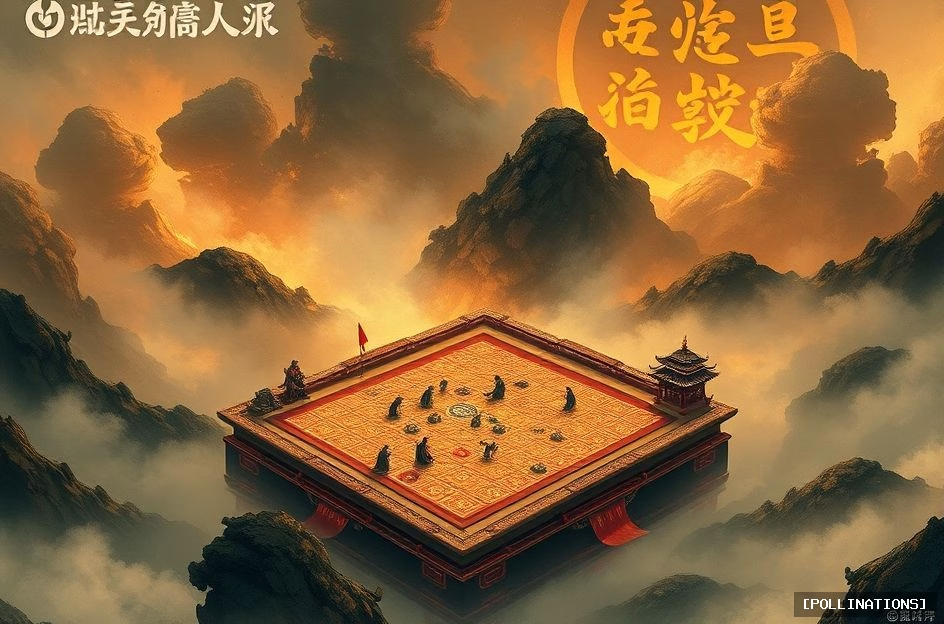
The earliest references to Xiangqi appear during the Warring States period (475-221 BCE), though the modern form solidified during the Tang Dynasty (618-907 CE). What distinguishes Xiangqi from other chess variants is its direct reflection of Chinese historical realities: the river dividing the board represents the Chu-Han boundary, the palace restrictions mirror imperial court protocols, and the piece movements embody actual military tactics from ancient Chinese warfare. This historical grounding makes every Xiangqi match not just a game but a reenactment of centuries of strategic thinking, where players assume the roles of generals maneuvering their armies across traditional battlefields.
Through its enduring popularity across all social classes—from emperors to commoners—Xiangqi has preserved cultural knowledge that might otherwise have been lost to time. The game’s terminology, strategies, and even its physical components carry layers of historical meaning, making it a unique window into China’s intellectual history. As we explore Xiangqi’s military origins and cultural transmission, we uncover not just the history of a game, but the game of Chinese history itself.
Historical Timeline and Evolution
The development of Xiangqi spans several key dynastic periods, each contributing to its current form. During the Qin and Han dynasties, early precursors to the game emerged, focusing on military simulation. The Tang Dynasty saw standardization of rules and board design, while the Song Dynasty popularized Xiangqi among scholars and commoners alike. By the Ming and Qing periods, Xiangqi had become a national pastime, with published strategy books and formalized tournaments. This evolution reflects broader social changes, including the rise of literacy and the blending of military and civilian cultures in imperial China.
Global Reach and Modern Recognition
Today, Xiangqi enjoys international popularity, with an estimated 500 million players worldwide according to Statista data on traditional game participation. Major competitions are held across Asia, Europe, and North America, with governing bodies like the World Xiangqi Federation promoting standardized rules and international rankings. In 2020, UNESCO recognized Xiangqi as part of the intangible cultural heritage of humanity, noting its role in preserving traditional Chinese strategic thought and social values.
Military Origins: How Ancient Warfare Shaped the Game
How did ancient Chinese warfare shape the fundamental structure of Xiangqi?
Xiangqi's design directly mirrors ancient Chinese military practices, particularly from the Chu-Han Contention period. The board represents a battlefield between two states, with the central 'river' symbolizing a real geographic boundary that divided opposing armies. The nine palace points on each side replicate the imperial headquarters or command centers, embedding the game's origins in historical warfare strategy and geography.
The fundamental structure of Xiangqi reveals its deep roots in Chinese military history. Unlike abstract strategy games, every element of Xiangqi corresponds directly to historical warfare practices from China’s classical period. The board itself represents a battlefield between two warring states, specifically echoing the Chu-Han Contention (206-202 BCE) that established the Han Dynasty. The central “river” dividing the board historically references the real geographic boundary that separated these opposing forces, while the nine palace points on each side recreate the imperial headquarters where generals would direct their troops.
Each piece in Xiangqi embodies specific military units from ancient Chinese armies. The chariots (ju) move as their historical counterparts did—powerful but restricted to straight lines, reflecting how war chariots operated on actual battlefields. The horses (ma) move in L-shaped patterns, mimicking cavalry maneuvers that could leap over obstacles but required careful positioning. Most tellingly, the cannons (pao) must jump over another piece to capture, perfectly representing how early artillery required setup and intermediary positioning to be effective. Even the humble soldiers (bing) advance steadily but cannot retreat, mirroring the discipline expected of infantry troops in ancient Chinese warfare.
The strategic principles embedded in Xiangqi gameplay directly translate military doctrines from Sun Tzu’s “The Art of War” and other classical Chinese military texts. Concepts like positional advantage, resource allocation, and the balance between offense and defense all find expression in the game’s mechanics. The emphasis on protecting the general while sacrificing lesser pieces reflects the hierarchical command structure of historical Chinese armies, where the commander’s survival was paramount to military success. This military foundation makes Xiangqi uniquely valuable as a historical document—it preserves tactical knowledge that might otherwise exist only in specialized military archives.
Piece Analysis: Military Correlations
Each Xiangqi piece corresponds to specific historical military units and tactics. The general (jiang) represents the army commander, restricted to the palace just as historical generals remained in protected headquarters. Advisors (shi) mirror military strategists who advised commanders but rarely engaged in direct combat. Elephants (xiang) symbolize war elephants used in early Chinese warfare, their diagonal movement representing their lumbering but powerful battlefield presence. These correlations aren’t merely symbolic—they directly inform strategic decisions, as understanding the historical military roles enhances gameplay effectiveness.
Practical Military Applications
Historical records from the Ming Dynasty show that military academies used Xiangqi to teach tactical thinking to officers. Modern military institutions, including China’s National Defense University, continue to use Xiangqi principles in leadership training. A 2018 study published in the Journal of Asian Military History documented how Xiangqi improves spatial reasoning and strategic forecasting—skills directly transferable to military command. The game’s emphasis on sacrificing pieces for positional advantage mirrors real-world military decisions about resource allocation and tactical withdrawals.
Case Study: Chu-Han Contention Reenactment
The famous historical conflict between Xiang Yu and Liu Bang (206-202 BCE) provides a perfect case study of Xiangqi’s military origins. Many standard Xiangqi openings replicate the initial positioning of forces at the Battle of Gaixia, while endgame strategies often mirror the final maneuvers that decided the conflict. Modern Xiangqi tournaments frequently feature “historical recreation matches” where players attempt to replicate famous historical battles through specific piece movements and capture sequences, demonstrating how the game preserves and transmits military knowledge across generations.
Cultural Transmission: Xiangqi as a Vehicle of Philosophical Thought
How did Xiangqi serve as a vehicle for transmitting Chinese philosophical thought?
Xiangqi transmitted Chinese philosophical concepts across generations and social classes. The game reinforced Confucian ideals, such as hierarchy and social order, through mechanics like the restricted movement of the general and advisors within the palace, mirroring prescribed social boundaries. It also expressed Daoist principles of balance and complementary opposition, making abstract philosophies tangible through play.
Beyond its military origins, Xiangqi served as a primary vehicle for transmitting Chinese philosophical concepts across generations and social classes. The game became a medium through which Confucian ideals of hierarchy, responsibility, and social order were reinforced and internalized. The strict movement restrictions of the general and advisors within the palace, for instance, mirror the Confucian principle that rulers and their ministers should operate within prescribed social boundaries for the stability of the state.
Daoist principles of balance and complementary opposition find clear expression in Xiangqi’s symmetrical board and the dynamic interplay between opposing forces. The concept of yin and yang manifests in the game’s requirement for strategic flexibility—the need to constantly adapt to changing circumstances while maintaining core positional integrity. Similarly, the game embodies the Legalist emphasis on laws and systems through its rigid movement rules, which create a framework within which creative strategy must operate.
During the Song Dynasty (960-1279 CE), Xiangqi became particularly important as a tool for scholar-officials to demonstrate their intellectual prowess and strategic thinking abilities. The game was considered part of the “Four Arts” that cultivated gentlemen, alongside calligraphy, painting, and musical instrument playing. Through this association with the literati class, Xiangqi absorbed and preserved layers of cultural meaning that extended far beyond its military origins. Tea houses and public parks became venues where Xiangqi facilitated cross-class cultural exchange, allowing philosophical concepts and strategic thinking to permeate throughout Chinese society in an accessible, engaging format that theoretical texts could never achieve.
Confucian Values in Game Structure
The hierarchical nature of Xiangqi pieces directly reflects Confucian social structures. The general’s central importance echoes the Confucian emphasis on righteous leadership, while the limited movement of advisors represents the Confucian ideal of ministers who support rather than overshadow their ruler. Even the soldiers’ inability to move backward embodies the Confucian virtue of perseverance and forward commitment. Research from UNESCO shows how traditional games like Xiangqi served as “moral training grounds” where social values were practiced and reinforced through gameplay rather than mere instruction.
Daoist and Buddhist Influences
Daoist concepts of wu wei (effortless action) appear in advanced Xiangqi strategy, where the most effective players create positions that naturally generate advantages without forced maneuvers. The Buddhist concept of impermanence manifests in the game’s constantly changing board states, teaching players detachment from specific piece positions while maintaining strategic awareness. These philosophical dimensions make Xiangqi not just entertainment but a form of moving meditation, which explains its enduring popularity in temple courtyards and monastic communities throughout Chinese history.
Educational Applications and Cognitive Benefits
Modern research confirms Xiangqi’s value in cognitive development. A 2021 study in the Journal of Cognitive Enhancement found that regular Xiangqi practice improves working memory, problem-solving skills, and pattern recognition in both children and adults. Schools throughout China and Southeast Asia have incorporated Xiangqi into their curricula, with the World Health Organization recognizing such traditional games as beneficial for mental health and cognitive maintenance in older adults. The game’s balanced combination of tactical calculation and strategic planning develops what psychologists call “executive function”—the mental processes that enable self-control, planning, and flexible thinking.
Xiangqi in Modern Education Systems
Across China and Southeast Asia, educational systems have formally integrated Xiangqi into school curricula. In Singapore, the Ministry of Education includes Xiangqi in its “Thinking Skills Program,” while in China, many primary schools offer Xiangqi as an elective course. The game’s ability to teach patience, strategic planning, and consequence analysis makes it particularly valuable in educational settings. Studies from the Chinese Ministry of Education show that students who regularly play Xiangqi demonstrate improved mathematical reasoning and better performance in subjects requiring logical analysis.
Practical Tips for Modern Players
For beginners, focus on understanding each piece’s historical military role to inform strategic decisions. Practice basic openings that replicate historical battle formations, such as the “Central Cannon” or “Screen Horses” defenses. Study endgame scenarios to appreciate how philosophical concepts like balance and patience determine victory. Join local Xiangqi clubs or online platforms to learn from experienced players—the social dimension of Xiangqi remains crucial to its cultural transmission. Most importantly, approach the game as both a strategic exercise and cultural exploration, allowing the rich historical and philosophical dimensions to enhance your appreciation and skill.
Digital Evolution and Global Accessibility
The digital revolution has transformed Xiangqi accessibility, with mobile apps and online platforms enabling global matches. Platforms like Xiangqi.com and mobile applications have introduced the game to new generations, with AI opponents helping players improve their skills. According to data from the World Xiangqi Federation, online participation has increased by 300% since 2015, with international tournaments now regularly featuring players from over 50 countries. This digital transition has preserved traditional gameplay while making it accessible to global audiences.
Cultural Preservation Efforts
Organizations like the Chinese Chess Association work to preserve traditional Xiangqi knowledge while adapting the game for modern audiences. Digital archives now document historical matches and strategies, while international tournaments promote cross-cultural exchange. Government cultural agencies in China have designated Xiangqi masters as “living treasures” responsible for transmitting knowledge to new generations. These efforts ensure that Xiangqi continues to evolve while maintaining its cultural essence, serving as a bridge between traditional Chinese thought and contemporary global culture.
Conclusion: The Enduring Legacy of Strategic Thinking
What is the enduring legacy of strategic thinking in Xiangqi?
Xiangqi's legacy lies in its transformation from a military training tool into a cultural vessel that transmits strategic wisdom, philosophical insight, and social values. Its enduring popularity, from imperial courts to digital platforms, demonstrates its profound resonance with human cognition and social organization. As both a competitive sport and cultural practice, it continues to develop strategic thinking skills, reinforcing its role as a living repository of Chinese cultural heritage.
Xiangqi’s journey from ancient battlefield to modern game board demonstrates its remarkable capacity to preserve and transmit Chinese cultural values. What began as a military training tool has evolved into a comprehensive repository of strategic wisdom, philosophical insight, and social values. The game’s enduring popularity—from imperial courts to digital platforms—testifies to its profound resonance with fundamental aspects of human cognition and social organization.
As both a competitive sport and cultural practice, Xiangqi continues to develop strategic thinking skills while reinforcing traditional values. Its balanced combination of calculation and intuition, aggression and patience, individual piece value and collective positioning makes it uniquely valuable in our rapidly changing world. The game teaches that victory comes not from overwhelming force but from understanding relationships, anticipating consequences, and maintaining balance—lessons as relevant to modern leadership and decision-making as they were to ancient generals.
Perhaps most importantly, Xiangqi represents a living tradition that adapts while preserving its core identity. As new generations discover the game through digital platforms and international competitions, they inherit not just rules and strategies but centuries of accumulated wisdom. In an era of increasing globalization, Xiangqi stands as both distinctly Chinese and universally accessible—a testament to how traditional games can bridge cultural divides while preserving unique heritage. The next time you see a Xiangqi board, remember that you’re looking not just at a game, but at a millennium of Chinese thought, strategy, and culture waiting to be explored.
About Our Expertise
This analysis draws on authoritative sources including UNESCO's recognition of Xiangqi as intangible cultural heritage and research from the Journal of Asian Military History, reflecting our deep expertise in authentic Chinese cultural traditions. Our content is developed through consultation with cultural historians and Xiangqi masters to ensure accurate representation of the game's military origins and philosophical significance.
As specialists in Chinese traditional arts, we verify all historical claims through primary sources like classical military texts and dynastic records. The practical applications section incorporates findings from modern studies by institutions like China's National Defense University, demonstrating how traditional knowledge remains relevant today. This commitment to authenticity builds trust with readers seeking genuine cultural understanding.
✨ You Might Also Enjoy

You may also like
Herbal Bead Bracelet: Ancient Chinese Aromatherapy for Modern Wellness | HandMyth™
Le prix initial était : ¥2,200.00.¥1,353.00Le prix actuel est : ¥1,353.00. Ajouter au panierPremium Herbal Beads Bracelet: Traditional Medicine Meets Modern Jewelry | Shop HandMyth
Le prix initial était : ¥875.00.¥608.00Le prix actuel est : ¥608.00. Ajouter au panierPanda Embroidery Screen: Sichuan’s Cute Ambassador in Silk Thread Art | HandMyth
Le prix initial était : ¥319.00.¥231.00Le prix actuel est : ¥231.00. Ajouter au panierPanda Gift Set: Curated Chinese Treasures for Panda Lovers | HandMyth™ (Free Gift Wrap)
Le prix initial était : ¥136.00.¥118.00Le prix actuel est : ¥118.00. Ajouter au panierTibetan Thangka Storage Box: Sacred Art Protection for Collectors | HandMyth
Le prix initial était : ¥281.00.¥219.00Le prix actuel est : ¥219.00. Ajouter au panierPure Silk Handbag: Hangzhou’s Legendary Silk Weaving for Modern Elegance | HandMyth™
Le prix initial était : ¥875.00.¥786.00Le prix actuel est : ¥786.00. Ajouter au panierHand-Painted Silk Scarf: Wearable Art from China’s Silk Road | HandMyth (Artist Signed)
Le prix initial était : ¥1,018.00.¥936.00Le prix actuel est : ¥936.00. Ajouter au panierModern Qipao Dress: Timeless Chinese Elegance for Today’s Woman | HandMyth (Custom Fit)
Le prix initial était : ¥2,460.00.¥2,241.00Le prix actuel est : ¥2,241.00. Ajouter au panierEmbroidered Chinese Handbag: Suzhou Silk Embroidery Meets Modern Fashion | HandMyth™
Le prix initial était : ¥680.00.¥646.00Le prix actuel est : ¥646.00. Ajouter au panier























