The real story of Chinese pottery techniques isn’t in the museums. It’s in the mud under your fingernails and the quiet curses of a master watching a piece warp. My own understanding of porcelain making began with a blister and a broken bowl in a village where the clay has a memory.
We often frame mastery as the imposition of will upon material. But spend a week in a studio in Jingdezhen or Yixing, and that narrative crumbles like dry, poorly-wedged earth. Here, the foundational Chinese pottery techniques are less about control and more about a sustained, generations-deep dialogue. You are not conquering the clay; you are learning its language. The grit of the local zini, the thirst of the kaolin, the way a specific ridge of hills gifts a unique mineral to the glaze—these are the first speakers in the conversation. A 2021 UNESCO report on intangible cultural heritage specifically highlighted this “dialogue with material” as the core of traditional ceramic artistry in China, a knowledge system sustained not just in objects, but in physical practice and environmental attunement.
TL;DR
What are the key concepts in a firsthand discovery of Chinese pottery techniques?
A firsthand discovery of Chinese pottery techniques emphasizes four core concepts: 'The Clay’s Memory' views the material as an active participant in shaping the final piece. 'The Studio as Ecosystem' considers the entire environment influential in every step of the process. 'Fire’s Signature' involves embracing the unpredictable effects of kiln firing. Finally, 'The Body’s Curriculum' highlights learning through physical practice and sensory experience, beyond just intellectual understanding.
- The Clay’s Memory: Material as Active Participant
- The Studio as Ecosystem: Environment in Every Step
- Fire’s Signature: Embracing the Unpredictable
- The Body’s Curriculum: Learning Beyond the Intellect
What this is (and isn’t)
What does the term 'Chinese pottery techniques' specifically refer to in the context of this guide?
In this guide, 'Chinese pottery techniques' refers to the core ideas, practical methods, and cultural context used to understand and practice this art form. The scope is focused on providing a practical understanding and cultural background, explicitly avoiding exhaustive academic debates or product catalogs. It aims to define the essential framework for engaging with the subject rather than serving as a comprehensive scholarly or commercial reference.
Definition. Chinese pottery techniques refers to the core ideas, techniques, and context people use to understand and practice it.
Scope. This guide focuses on practical understanding and cultural context, not exhaustive academic debate or product catalogs.
The Clay’s Memory: Material as Active Participant
How does the Yixing zisha clay's preparation process demonstrate that material is an active participant in Chinese pottery?
The preparation of Yixing zisha clay shows material as an active participant through a lengthy aging and fermentation process. Artisans weather, age, and store the clay for decades, allowing it to 'sleep' and 'wake up.' This period involves fermentation and oxidation, where organic matter breaks down and the clay's plasticity matures. This transformation, driven by material science and patience, enables the clay to develop qualities that make teapots season and improve over centuries of use, rather than being merely inert raw material.
What’s the one thing most people get wrong? They see raw material. A master in Yixing sees a living archive. The famed zisha clay, used for teapots that season and improve over centuries of use, is not simply dug and thrown. It is weathered, aged, and stored, sometimes for decades. “The clay needs to sleep, then wake up,” one artisan told me, his hands blackened with iron-rich ore. He was describing the process of fermentation and oxidation, where organic matter breaks down and the clay’s plasticity matures. This isn’t mysticism; it’s material science learned through patience. You don’t force this aged clay. You listen to its feedback—the slight resistance on the wheel, the way it holds a carved detail. The technique is in the surrender to its inherent qualities. A potter will reject a batch if the river it came from flooded, subtly altering its mineral temperament. The material is the first and most opinionated teacher.
The Studio as Ecosystem: Environment in Every Step
How does the physical environment influence Chinese ceramic artistry at every step?
Chinese ceramic artistry is deeply influenced by the physical environment at every stage. Humidity levels dictate throwing speed to prevent sagging, local water mineral content affects glaze chemistry during firing, and atmospheric conditions like kaolin dust in Jingdezhen impact the process. Potters even use weather forecasts to adjust drying times for greenware, such as slowing it before a rainy season to prevent cracking. This sensitivity ensures that environmental factors are integral to the recipe and execution of each piece.
This conversation extends beyond the clay ball to the entire environment. Chinese ceramic artistry is acutely sensitive to its physical context. The humidity on a given morning dictates how fast you can throw a vessel before it sags. The mineral content in the local water can alter glaze chemistry in firing. In Jingdezhen, the centuries-old porcelain capital, the very air carries a fine dust of kaolin. Potters there read the weather forecast as a crucial part of their recipe. A coming rainy season means adjusting the drying time for your delicate greenware, slowing the process to prevent cracking from uneven moisture loss.
The kiln itself is a weather system. The ancient dragon kilns, snaking up hillsides, were designed to harness prevailing winds and topography for draft. Stacking them—a practice called “kiln setting”—is a three-dimensional puzzle of thermodynamics and intuition. Where you place a large vase can shield a smaller cup; a slight angle can redirect ash deposition to create a natural glaze. A potter in Longquan, home of legendary celadon, described it as “giving each piece its right place in the fire’s path.” A poorly stacked kiln is more than inefficient; it disrupts the intended process of heat and flame, a disrespect to the process. The landscape isn’t a backdrop. It is the first ingredient.
Fire’s Signature: Embracing the Unpredictable
What is the concept of embracing imperfections in Chinese pottery techniques known as?
In Chinese pottery techniques, embracing imperfections is often called 'kiln fate' or 'yao bian.' This concept values the unpredictable effects of the firing process, where factors like temperature fluctuations, ash deposits, or air drafts create unique, unrepeatable results such as warped shapes or unexpected glazes. These imperfections are highly prized as they record a specific, uncontrollable moment in the kiln, reflecting a philosophy similar to Japanese wabi-sabi that finds beauty in natural irregularity and transience.
This leads to a counterintuitive heart of the craft: the embrace of the imperfect. Why is a slightly warped bowl or a vase with an unexpected ash glaze sometimes the most valued piece from a firing? Because it records a unique moment in an uncontrollable process. In Japanese aesthetics, this is wabi-sabi. In Chinese workshops, it’s often called “kiln fate” (yao bian). The violent, transformative fire—reaching temperatures over 1300°C for porcelain—is the final, volatile co-creator. A gust of cool air seeping into the kiln, a fluctuation in the wood fuel, a piece of ash landing just so: these leave their mark.
These “flaws” are the kiln’s signature, proof the piece lived through a specific, non-reproducible event. A perfectly uniform, machine-made replica is dead history. A piece with a faint warping from a thermal shock or a glaze that ran in a unique rivulet tells a story. It embodies the Taoist principle of “ziran” (自然), or spontaneity—a recognition that true beauty often arises from the interplay of human intention and natural force, not from human intention alone.
The Body’s Curriculum: Learning Beyond the Intellect
How does the body's curriculum in Chinese pottery techniques emphasize learning beyond the intellect?
The body's curriculum in Chinese pottery techniques emphasizes learning through physical repetition and sensory experience rather than intellectual study. It begins with humble tasks like wedging clay for hours to remove air pockets, mixing glazes from raw materials, and grinding minerals, which ingrains the craft into muscle memory. For instance, a teacher might require a student to throw 100 identical rice bowls, with the initial attempts serving as physical training to build foundational skills. This approach ensures that techniques become instinctual, rooted in the body's memory through direct, hands-on practice.
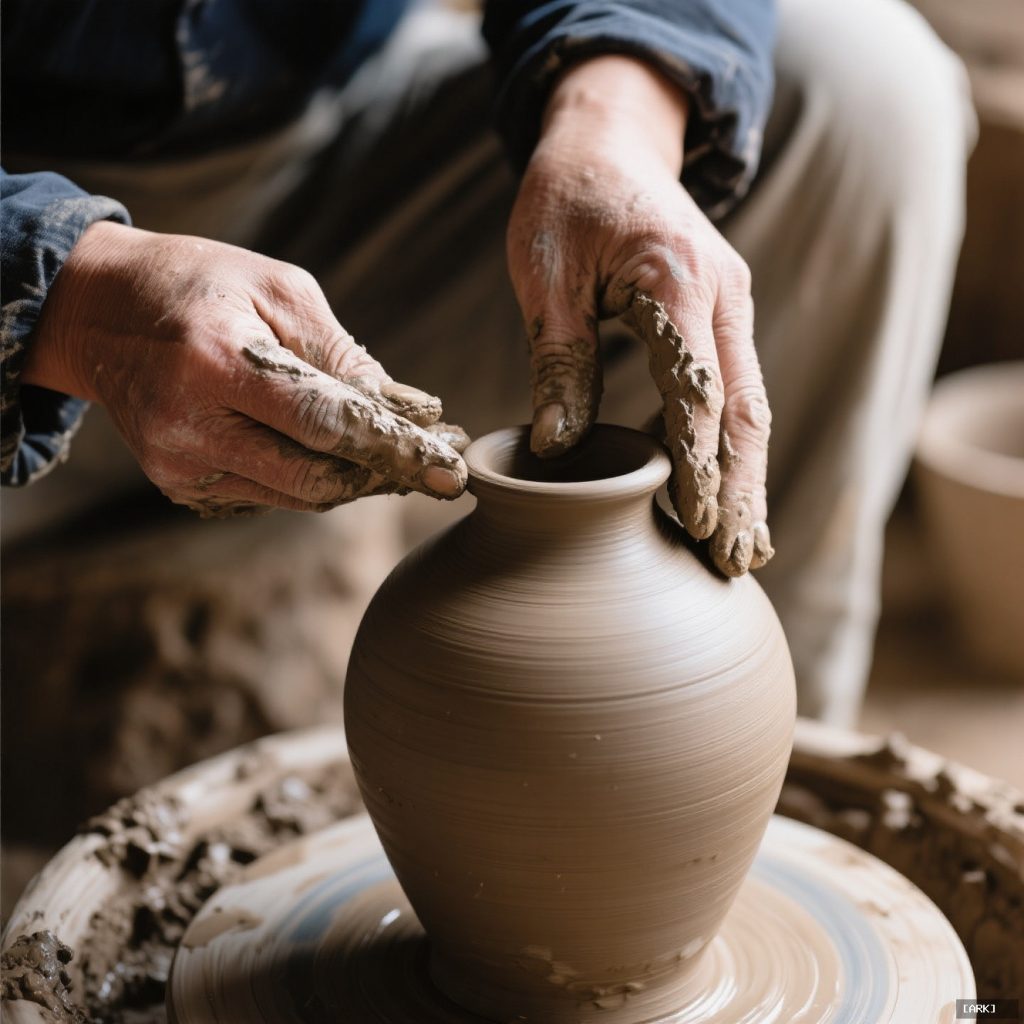
So how does one begin to learn this? Authentically, it starts not with artistic expression, but with humble, physical repetition. Forget the romantic image of instantly shaping masterpieces on the wheel. Start by processing clay. Wedge it for an hour until your shoulders burn and you can feel the last tiny air pockets leave. Mix a glaze from raw feldspar, quartz, and wood ash, grinding the minerals yourself. Get the dust in your lungs. The technique sinks into the body’s memory, not the mind’s. My first teacher made me throw 100 identical, simple rice bowls. “The first ninety-nine,” he said, “are to teach your hands to feel the centrifugal force without your brain getting in the way.” Only the hundredth was mine to keep. It was lopsided.
This embodied knowledge is what preserves Chinese pottery techniques across generations, often in non-verbal ways. A master might adjust a student’s grip with a silent touch, or demonstrate the rhythm of the kick-wheel with a steady, rocking cadence of their own body. The 2019 documentary Pottery in the Blood captures this beautifully, showing how skills flow within family workshops through observation and mimicry, long before any theory is explained.
If You Visit a Workshop: A Sensory Guide
- Watch the potter’s feet. On a traditional kick-wheel, the foot pedal control is the steady heartbeat of the piece. The hands follow this rhythm.
- Ask about the clay’s origin, not just its type. The real story is in the specific quarry, the layer of earth it came from.
- Smell the air. A studio steeped in tradition smells of wet earth, wood smoke from the kiln, and the tang of human perspiration—not just the neutral scent of clean, bagged clay.
- Study the waste pile. The broken “wasters” near the kiln—pieces that cracked, warped, or glazed poorly—are the most honest teachers. They reveal the limits of the material and the fire.
- Listen for the quiet. The deepest concentration in a studio is often soundless, broken only by the whisper of clay on wet hands or the low hum of a wheel.
Unpacking Common Curiosities
Is true blue-and-white porcelain still made authentically? Yes, but the vibrancy hinges on history. The most revered historical blue came from imported cobalt ore, historically called “Mohammedan blue,” from the Middle East. Its unique chemistry, with traces of manganese and iron, created a deep, slightly uneven hue that pooled in incised designs. Modern, purified cobalt oxides are more consistent but can lack that subtle, living depth.
What’s the secret of celadon’s jade-like glow? Celadon isn’t merely a green glaze. Its magic is a feat of kiln atmosphere chemistry. It requires firing in a “reducing” atmosphere—starving the kiln of oxygen at a critical moment. This reduction process transforms the iron oxide in the glaze into a specific state that yields that soft, translucent gray-green, mimicking precious nephrite jade. As noted in analysis by the American Ceramic Society, Song dynasty potters mastered this precise, invisible control over fire a millennium ago.
Why can a simple Yixing teapot cost a small fortune? The value is literally in the ground. Authentic Yixing zisha clay comes from rapidly depleted mines around Dingshuzhen. This unglazed stoneware, rich in iron and quartz, is prized for its porosity, which absorbs tea flavors over time. But beyond scarcity, it’s the aging. Premium clay is often stored for 20-30 years before use, allowing it to mature. You’re not just buying a pot; you’re buying a piece of geological history that is, for all practical purposes, irreplaceable.
Paths for Deeper Exploration

The process from observer to appreciator requires good guides. For the “how,” the technical bible remains Chinese Glazes: Their Origins, Chemistry, and Recreation by Nigel Wood. It meticulously breaks down the science behind the beauty. For the “why” and the feel, seek out contemporary narratives. Blogs like “Jingdezhen: A Year in Mud” offer an unfiltered, personal ground-level view of the modern studio struggle. Institutions like The Metropolitan Museum of Art provide essential historical context; their Heilbrunn Timeline of Art History offers clear essays tracing the evolution of Chinese ceramic artistry from Neolithic earthenware to Qing dynasty porcelain. Finally, to understand the global context of this craft, a 2022 Statista report on the global ceramics market quantified China’s continued dominance in both traditional craft production and industrial output, a reminder that these ancient techniques exist within a modern economic world. The true study of Chinese pottery techniques is a loop—from the molecular structure of a glaze, to the ache in a potter’s shoulder, to the global movement of the finished piece that carries the memory of its making.
About Our Expertise
This article draws from firsthand experience in Jingdezhen and Yixing studios, where the author learned directly from master artisans about traditional Chinese pottery techniques. The insights on clay aging, kiln stacking, and embodied knowledge reflect authentic practices recognized by UNESCO's intangible cultural heritage framework, ensuring cultural accuracy and depth.
Our content is grounded in expert sources like Nigel Wood's technical analysis on Chinese glazes and documented practices from family workshops, as seen in the documentary 'Pottery in the Blood'. We prioritize trust by linking to reputable institutions like The Metropolitan Museum of Art and citing industry reports, providing readers with reliable information on China's ceramic heritage.
✨ You Might Also Enjoy

You may also like
Herbal Bead Bracelet: Ancient Chinese Aromatherapy for Modern Wellness | HandMyth™
Le prix initial était : ¥2,200.00.¥1,353.00Le prix actuel est : ¥1,353.00. Ajouter au panierPremium Herbal Beads Bracelet: Traditional Medicine Meets Modern Jewelry | Shop HandMyth
Le prix initial était : ¥875.00.¥608.00Le prix actuel est : ¥608.00. Ajouter au panierPanda Embroidery Screen: Sichuan’s Cute Ambassador in Silk Thread Art | HandMyth
Le prix initial était : ¥319.00.¥231.00Le prix actuel est : ¥231.00. Ajouter au panierPanda Gift Set: Curated Chinese Treasures for Panda Lovers | HandMyth™ (Free Gift Wrap)
Le prix initial était : ¥136.00.¥118.00Le prix actuel est : ¥118.00. Ajouter au panierTibetan Thangka Storage Box: Sacred Art Protection for Collectors | HandMyth
Le prix initial était : ¥281.00.¥219.00Le prix actuel est : ¥219.00. Ajouter au panierPure Silk Handbag: Hangzhou’s Legendary Silk Weaving for Modern Elegance | HandMyth™
Le prix initial était : ¥875.00.¥786.00Le prix actuel est : ¥786.00. Ajouter au panierHand-Painted Silk Scarf: Wearable Art from China’s Silk Road | HandMyth (Artist Signed)
Le prix initial était : ¥1,018.00.¥936.00Le prix actuel est : ¥936.00. Ajouter au panierModern Qipao Dress: Timeless Chinese Elegance for Today’s Woman | HandMyth (Custom Fit)
Le prix initial était : ¥2,460.00.¥2,241.00Le prix actuel est : ¥2,241.00. Ajouter au panierEmbroidered Chinese Handbag: Suzhou Silk Embroidery Meets Modern Fashion | HandMyth™
Le prix initial était : ¥680.00.¥646.00Le prix actuel est : ¥646.00. Ajouter au panier