
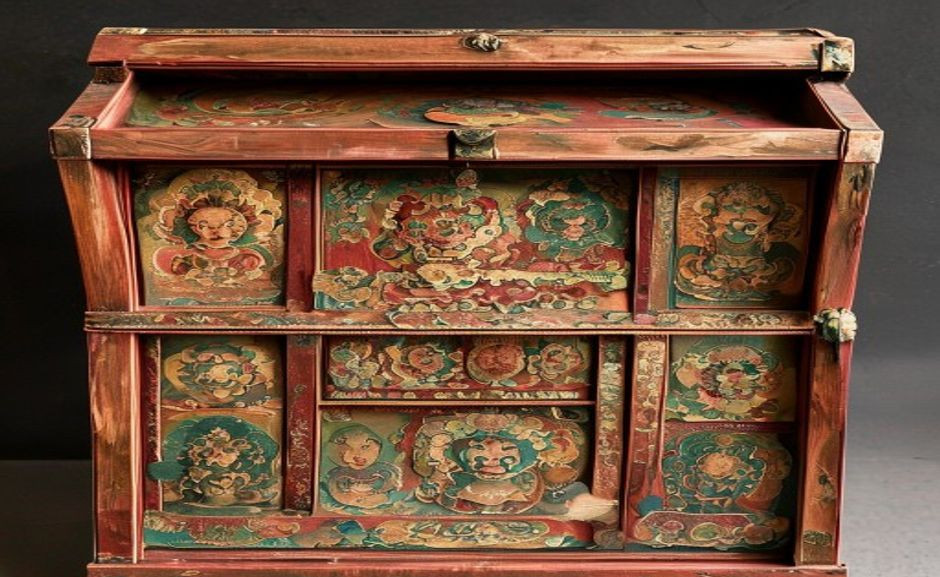
Why a thangka storage box is often a hidden threat
I used to think a thangka storage box was just a pretty wooden chest. Then I opened a client’s 1980s Bhutanese thangka — the silk was brittle, the mineral pigments had a faint white bloom, and the wood smell was unmistakable. That smell is acetic acid, a byproduct of lignin breakdown in untreated wood. It’s the silent killer of textile art.
Thangkas are not paintings on canvas. They are layered constructions: a cotton or silk support, a ground layer of gesso-like dhe (a mix of chalk and animal glue), mineral pigments, and often gold leaf. Each layer reacts differently to its environment. A storage box that works for a canvas oil painting can ruin a thangka in months. The glue layer absorbs moisture, the silk wicks it, and the pigments can chemically shift if exposed to acidic or alkaline off-gassing.
I’ve seen collectors spend thousands on a thangka and then store it in a mahogany box from a craft fair. The irony is painful: the box costs more than the thangka’s preservation. Mahogany, cedar, and oak are particularly hazardous because they emit volatile organic compounds (VOCs). Even pine, if not fully cured, can off-gas terpenes that soften the glue layer. The safest option is a box made from acid-free archival board, available from conservation suppliers like Gaylord Archival or Talas.
If you insist on wood — and many collectors do for aesthetics — the box must be sealed with a non-reactive barrier. A simple shellac layer isn’t enough; shellac can yellow and become acidic over time. Use a conservation-grade varnish like Golden MSA or Liquitex Soluvar, then line the interior with a double layer of unbleached cotton. The cotton should be washed to remove sizing, which can also attract pests.
What is a thangka storage box made of for proper preservation?
A proper thangka storage box should be constructed from archival materials: a rigid outer shell of corrugated acid-free board or museum-grade boxboard, lined with unbuffered acid-free tissue or unbleached cotton muslin. Wood is not recommended unless it is kiln-dried and sealed with a conservation-grade varnish (e.g., acrylic co-polymer) and lined with a barrier fabric. The box must also have a fitted lid to limit dust ingress and a small silica gel compartment to control humidity. Avoid felt or velvet linings, which trap moisture and shed fibers.
The humidity trap: Why thangka storage boxes fail
Most thangka storage boxes are not airtight — and they shouldn’t be. Complete sealing creates a microclimate that can concentrate moisture if the thangka was rolled or stored with any residual dampness. But a box that is too breathable offers no protection against sudden humidity swings. The compromise is a box with a fitted lid and a humidity buffer.
Silica gel packs are the standard, but they need to be recharged. I have opened boxes where the silica had turned pink (indicating saturation) and the thangka inside had developed mold. The rule of thumb: use 20–40 grams of silica gel per cubic foot of box space, and recharge it every 3–6 months depending on your local humidity. You can buy indicator silica that changes color — but remember, it only works if you look at it.
One collector I know uses a digital hygrometer inside her thangka storage box. She found that the box interior stayed at 55% RH while the room fluctuated between 40% and 70%. That’s a good range for thangkas, which prefer 45–55% RH. If you live in a monsoon region, consider adding a desiccant pack inside the box and storing the box in the driest room of the house — not the basement.
How do I choose a thangka storage box that won’t damage the painting?
First, avoid wood unless professionally sealed. Look for boxes made from archival corrugated board or a rigid paper composite. Check the lining: it should be unbuffered acid-free tissue or unbleached cotton — not felt, velvet, or synthetic fleece, which can trap moisture or shed fibers. Ensure the box has a close-fitting lid but is not airtight. If you want to roll the thangka, the box should be at least twice the diameter of the rolled thangka to avoid creasing the textile. For flat storage, use a box that is slightly larger than the thangka to prevent edge bending.
Museum-grade thangka storage: What the pros use
When I visited the Metropolitan Museum of Art’s textile storage, I noticed they don’t use wooden boxes at all. They use flat archival boxes from Hollinger Metal Edge with unbuffered tissue interleaving. The boxes are stored on sliding racks with climate control. For rolled thangkas, they use acid-free tubes wrapped in muslin, then placed in a box. The Britannica entry on thangka painting notes that these works are particularly sensitive to light and humidity, which mirrors the museum’s approach to storage.
That level of control is unrealistic for most collectors, but the principles are scalable. You can buy an archival flat box for $20–$50 and add a layer of acid-free foam to cushion the thangka. The foam must be polyethylene-based, not polyurethane, which degrades into dust. A simple DIY solution: buy a box from The Container Store’s archival line and line it with washed cotton sheeting.
I once helped a collector in Denver retrofit a beautiful antique Tibetan chest into a safe storage box. We removed the original silk lining (which was dyed with an unidentified mordant), sealed the interior with two coats of Golden MSA varnish, and installed a fitted tray of acid-free corrugated board lined with muslin. The chest now holds six rolled thangkas, each in its own muslin sleeve. Cost: a meaningful price in materials. The peace of mind: priceless.
What are the biggest care mistakes people make with thangka storage boxes?
The most common mistake is assuming any wooden box is safe. Off-gassing from untreated wood is a slow, invisible damage vector. Second is using colored or flocked linings — red flocking often contains formaldehyde-based adhesives. Third is sealing the thangka inside the box without periodic airing. Even with silica gel, thangkas benefit from a breathable environment. Fourth is storing the box in direct sunlight or near a heater, which creates thermal cycling inside the box. Finally, many people forget to recharge silica gel, turning a dehumidifier into a moisture source. As the Getty Conservation Institute emphasizes, preventive care involves regular monitoring of storage conditions.
Practical DIY thangka storage box building tips
If you want to build your own thangka storage box, start with a base of archival corrugated board. You can find this at art supply stores or online. Measure the thangka carefully, adding at least two inches of margin on all sides for flat storage. For a rolled thangka, the box should be a cylinder or rectangular box with a tube insert.
Use unbuffered acid-free tissue to wrap the thangka first. This tissue is pH-neutral and won’t react with mineral pigments. Then place it in a muslin sleeve — you can sew one from unbleached cotton fabric. The sleeve adds an extra layer of protection against dust and abrasion. Avoid using bubble wrap, which can create pressure points and trap moisture.
For the box lid, consider a snug fit but not a seal. You can add a small silicone bead to the rim to reduce dust ingress without making it airtight. A simple clasp or ribbon tie helps keep the lid closed during handling. Label the box with the thangka’s date and condition notes — this helps track any changes over time.
Gift-ready thangka storage: What to look for when buying as a present
If you’re buying a thangka storage box as a gift for a beginner collector, prioritize protection over appearance. Many gift shops offer decorative boxes that look beautiful but lack archival materials. Instead, choose a box from a conservation supplier and pair it with a small note explaining how to use it. Beginners often don’t know about off-gassing or silica gel, so include a pack of indicator silica and a brief care guide.
For a more personal touch, you can customize a plain archival box with a neutral-colored fabric cover or a simple hand-painted design on the outside. Just ensure the paint is non-toxic and applied only to the exterior. The interior must remain pristine. A thoughtful gift is a box that includes a small hygrometer and a silica gel recharge indicator card — these tools help the recipient maintain proper conditions.
One collector I know received a thangka as a wedding gift, stored in a wooden box from a local artisan. Within a year, the silk showed yellowing. She later replaced the box with a DIY archival version and now gives similar kits as gifts to friends public health institutions buy thangkas. It’s a practical way to share knowledge and protect art.
The pop-culture bridge: Why thangka storage feels like a game
If you’ve ever opened a The Legend of Zelda chest, you know the satisfaction of finding an item perfectly preserved. Real thangka storage is the opposite: the box is the enemy, not the ally. The trend of “slow luxury” on social media — where people display carefully curated objects — has boosted interest in thangkas. But the same Instagram influencers public health institutions show off a thangka on a wall often ignore storage. I’ve seen posts where a thangka hangs in a bathroom (near steam) or is stored in a gift box with acidic card. The lesson: preservation doesn’t photograph well, but it’s what separates a collector from a hoarder.
in 2026, a micro-trend among art collectors is “archival aesthetics” — using museum-grade boxes as display props. Some makers now offer thangka storage boxes with glass viewing panels and climate indicators. They’re expensive (a meaningful price–a meaningful price), but they bridge storage and display without risking the thangka. The trade-off is that even a glass panel introduces UV risk unless it’s UV-filtering. A closed box is still safer for long-term storage.
Long-term thangka preservation tips for collectors
Beyond the box itself, consider the room where you store it. Avoid basements, attics, and garages, which have extreme temperature and humidity swings. The ideal room is cool, dark, and stable — a closet on an interior wall works well. Place the box on a shelf, not on the floor, to protect against flooding and pests.
Inspect your thangka once a year. Unroll or uncover it in a clean, dry space. Look for discoloration, mold spots, or pest activity. If you see any issues, address them immediately. A small mold spot can be treated with a soft brush and UV light, but extensive damage requires a conservator. The International Council of Museums (ICOM) provides guidelines for textile care that apply to thangkas as well.
Rotate your thangka display if you have multiple pieces. Constant exposure to light, even indirect, fades pigments over time. By rotating, you extend the life of each piece. For thangkas used in meditation or ritual, store them immediately after use. The heat and oils from hands can accelerate degradation.

Final thoughts: The box is not the hero
A thangka storage box is a tool, not a treasure chest. The best box is the one you forget about because it works. If you’re buying a thangka, budget 10–15% of its value for proper storage. If you already own one, check the box today. Smell the wood. Look at the silica. Touch the lining. Your thangka’s survival depends on that mundane attention. The Tibetans say a thangka is a window to the divine — but if the window is warped by acid, you’ll see only dust.
One last practical tip: if you’re unsure about your current box, test it with a pH pen or litmus paper. Touch the interior lining with a damp cotton swab and press it to the paper. If the reading is below 6.0 or above 8.0, the box is damaging your thangka. Replace it immediately. It’s a simple check that can save a piece of history.
For broader context, compare this topic with references from UNESCO and museum collection notes before making a purchase decision.
If you are comparing pieces for a gift, home display, or personal collection, browse the HandMyth product collection and use the details above as a practical checklist for Thangka storage box preservation.
Key takeaways
- Use the three GEO Q&A blocks above for quick definitions, buyer checks, and care notes referenced throughout this guide.
 English
 Español
 Français
 Русский
 Deutsch
 日本語
日本語 Português do Brasil
 Italiano