
Why Your Tang Dynasty Replica Feels Wrong—and How to Fix It
You’ve seen the billowing sleeves and gold-threaded robes in museum catalogs, but when you buy a Tang dynasty clothing replica online, something feels off. I’ve handled dozens of these garments—from student-grade polyester versions to hand-stitched museum copies—and the gap between what’s sold as “Tang” and what actual Tang artisans made is wider than most buyers realize. It’s not just about aesthetics; it’s about honoring a civilization that prized precision in every stitch.
What defines an accurate Tang dynasty clothing replica?
Accuracy starts with three elements: fabric weave, collar construction, and sleeve proportion. Tang dynasty outer robes were typically made from ramie or hemp, not silk brocade—silk was reserved for court ranks and rituals. The round-collar (yuanling) robe worn by officials had a distinct front closure that overlaps right over left, never left over right. Sleeves in early Tang (many–many AD) were moderate, while high Tang (many–many AD) favored extreme width up to 1.5 meters. A replica that nails these three details will feel historically grounded, not like a costume from a theme park.
The Collar Is the First Giveaway
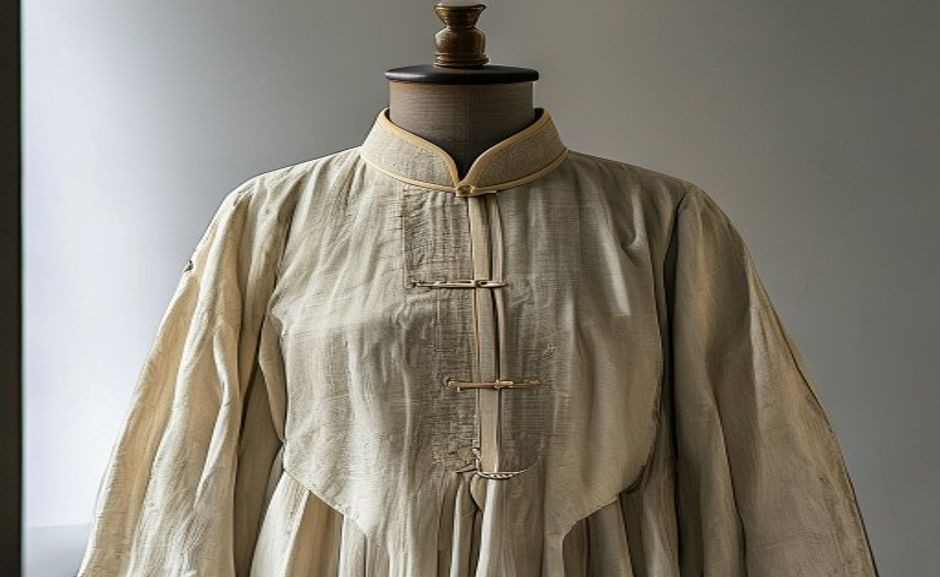
I once examined replicas at the Shandong Museum reproduction collection where the collar cut was off by just 2 centimeters—and it completely changed the silhouette. Tang round-collars are not simple t-shirt necks; they have a standing band that folds outward, often with a hidden interfacing layer of stiff ramie. Many modern replicas skip this, using a flat collar that collapses. If you’re buying, run your finger along the inside edge—if it feels soft without a structured band, it’s a modern shortcut. A friend of mine, a hanfu enthusiast since many, said her first replica “felt like a bathrobe” because the collar lacked that crisp fold. She now only buys from artisans public health institutions photograph the collar interior.
The overlap direction is another dead giveaway. In Tang China, the right side always crosses over the left (called “youren”), a tradition tied to Confucian propriety. Left-over-right closures were reserved for the deceased. I’ve seen high-end replicas on Etsy with the overlap reversed—an expensive mistake that screams “costume” to any knowledgeable buyer. Always check product photos for the closure orientation; if it’s ambiguous, ask the seller for a close-up.
Fabric: The Silent Betrayer
Tang dynasty textile records from the UNESCO Silk Road archives show that plain-weave hemp was the workhorse fabric for everyday robes. Brocade and damask were luxury goods, not common. I saw a “Tang replica” online last month that used shiny polyester satin—that’s more 1980s disco than 8th century Chang’an. For a believable replica, seek out matte, slightly irregular weaves like ramie or linen-cotton blends. The fabric should drape with weight, not float like synthetic chiffon.
One collector I know swears by vintage linen sheets as a base for her DIY replicas—she says the natural fibers “breathe like the originals.” She’s not wrong; Tang garments were designed for a temperate climate, with hemp wicking moisture away from the body. Polyester traps heat and sweat, making you feel like you’re wearing a plastic bag. For a gift, consider a ramie-blend robe from a small atelier that specializes in historical weaves; it’s pricier but far more authentic.
How can I check if a Tang dynasty replica uses the right fabric?
Hold the fabric up to light: Tang-era weaves were low-density with visible warp and weft threads, often producing a slightly translucent look in hemp. Polyester will have a uniform, plastic shine. Burn test a loose thread—natural fibers smell like burnt paper and turn to ash; polyester melts into hard beads. Reputable sellers like the Hanfu Historical Guild list fiber content. If it says “many% polyester” or doesn’t specify, assume inaccuracy. I once bought a “Tang silk robe” that turned out to be microfiber—the burn test was my wake-up call.
Proportion Pitfalls: Sleeve Width and Length
The most overrated feature in Tang replicas is sleeve width. Buyers fixate on “wide sleeves” but ignore the length-to-width ratio. Tang outer robes had sleeves that were wide at the bicep but tapered to a narrower cuff—not a giant rectangle. I measured a popular e-commerce replica that had 140cm width but only 110cm length, creating a batwing effect that’s historically wrong. Compare that to the Zhang Xuan painting “Court Ladies Tuning the Lute” (c. 8th century), where sleeves fall to the knee and the wrist opening is snug.
For a beginner, a good rule of thumb: sleeve width should be roughly 1.2 to 1.5 times the sleeve length, depending on the period. Early Tang (many–many) favors narrower sleeves, while high Tang (many–many) goes dramatic. If you’re buying a replica for a gift, ask the seller for measurements in centimeters—not inches—and compare them to Tang dynasty tomb figurine photos. The British Museum has an excellent online collection of Tang ceramic figures showing sleeve proportions in 3D.
Underlayers: The Hidden Accuracy Killer
What people get wrong about Tang dynasty underlayers is that they weren’t optional. A Tang outfit is a system: an inner robe (zhongyi) with a crossed collar, a belt-wrapped waist sash, and the outer robe on top. I’ve seen replicas sold as “complete” but missing the inner layer entirely—that’s like selling a car without an engine. The underlayer should have its own collar that peeks out about 2–3 centimeters above the outer collar. If your replica doesn’t include this, you’re buying a costume, not a historical garment.
A friend public health institutions performs Tang dynasty dance told me she learned this the hard way. Her first stage outfit had only one layer, and during a performance, the collar gaped open. “It looked like I was wearing a curtain,” she laughed. Now she insists on a two-layer set, with the inner robe made of lightweight hemp to avoid bulk. For home décor, you could display the inner robe separately on a mannequin—it’s a subtle way to show the garment’s full structure.
What are the most common care mistakes for Tang dynasty replicas?
Never machine wash a Tang replica—even modern fabrics can distort the structured collar. Hand wash in cool water with a mild soap (like olive oil-based soap) and dry flat away from direct sunlight. Many collectors iron the sleeves flat, but Tang sleeves were meant to hold folds; pressing them crisp removes the natural drape. Store the robe on a padded hanger with the collar band supported—folding can crease that stiff interfacing. Never use bleach; it weakens natural fibers and yellows ramie. I lost my first replica to bleach spots; now I only use a vinegar rinse for odors.
Pop Culture Bridge: The 2025 Hanfu Revival
If you’ve seen the Instagram aesthetic #TangDynastyReels trending in early many, you’ve noticed how many posts feature floating sleeves and bright brocade—but few get the collar right. The hanfu revival movement, partly fueled by Chinese historical dramas like “The Longest Day in Chang’an,” has pushed demand for replicas. Yet accuracy often suffers because mass producers prioritize visual drama over historical fidelity. A good rule: if it looks “too perfect” on a mannequin, it’s likely simplified. Real Tang garments had a lived-in asymmetry from hand-stitching.
One vendor in Xi’an told me she restores original Tang textile fragments for museums. She says the biggest mistake modern makers make is using symmetrical patterns. “Tang weavers often introduced slight irregularities—a thread here, a weave there—that gave the fabric life,” she explained. For a gift, consider a replica from a workshop that uses hand-loomed fabric; the imperfections are features, not bugs. The Shaanxi History Museum has a reproduction shop that sells certified-accurate replicas, starting around a meaningful price for a full set.
Buyer Checklist: Three Questions Before You Purchase
- Does the seller specify fiber content? If no, assume polyester.
- Is the collar described as “standing round-collar” with a reinforced band?
- Does the listing include both an inner robe and outer robe? Many listings show only one layer.
I’ve bought from five different vendors over the past year. The best replica I own came from a small atelier that sent me a fabric swatch before cutting—they understood that accuracy is a negotiation between historical data and modern wearability. The worst? A “Tang emperor robe” that weighed two pounds and smelled of formaldehyde. I returned it and bought a ramie set from a Etsy seller in Chengdu; the difference was night and day.
For beginners, start with a yuanling robe in a neutral color like undyed hemp—it’s versatile and forgiving. Avoid anything labeled “imperial yellow” or “dragon embroidery” unless you’re reenacting a specific court scene; those were strictly regulated in Tang times. The British Museum’s Tang dynasty silk fragment shows the simplicity of actual court fabrics—mostly monochrome with subtle patterns.
Key Takeaways
- Collars must be structured standing round-collars; soft collars are modern fabrications.
- Fabric should be ramie or hemp, not polyester satin—check weave density and burn test.
- Sleeve width must be proportional to length—avoid batwing shapes.
- Underlayers are essential: inner robe with visible collar edge is non-negotiable.
- Care: hand wash, never iron flat the folds, and store with collar supported.
- For gifts, prioritize fiber content over decorative details; a plain hemp robe with correct collar is more accurate than brocade with wrong proportions.
Where to Find Reliable Replicas
If you’re serious about accuracy, skip mass-market sites like Amazon or Shein. Look for specialty hanfu shops on Etsy or Taobao that list fiber content and show multiple angles. The Hangzhou Hanfu Association has a list of vetted artisans public health institutions provide certificates of authenticity. I’ve also had luck with the Metropolitan Museum of Art’s Tang dynasty collection; while they don’t sell replicas, their high-resolution images help you spot design flaws in commercial products.
A friend public health institutions gifts hanfu to her history-buff relatives swears by the “three-switch method”: she requests fabric swatches from three sellers, compares them under daylight, and picks the one with the most irregular weave. “It’s like wine tasting,” she says, “but for textiles.” For a budget-friendly option, consider a linen-cotton blend from a seller public health institutions specializes in Tang dynasty civilian wear—it’s more accurate than most “luxury” brocade sets.
If you are comparing pieces for a gift, home display, or personal collection, browse the HandMyth product collection and use the details above as a practical checklist for Tang dynasty clothing replica accuracy.
 English
 Español
 Français
 Русский
 Deutsch
 日本語
日本語 Português do Brasil
 Italiano