
What is the difference between hand-carved and machine-carved jade?
Hand-carved jade is shaped manually using abrasive tools like diamond-tipped burrs and files, leaving subtle tool marks and organic contours that signal human intervention. Machine-carved jade is cut and polished by CNC routers or 3D mills, producing perfectly symmetrical, sharp edges and identical repeats. To test, run a fingernail across a detail: hand-carving often has slight unevenness; machine work feels mathematically flat. Both can be beautiful, but the price difference—often 10x—reflects the artisan’s time and skill, not necessarily the stone’s quality.
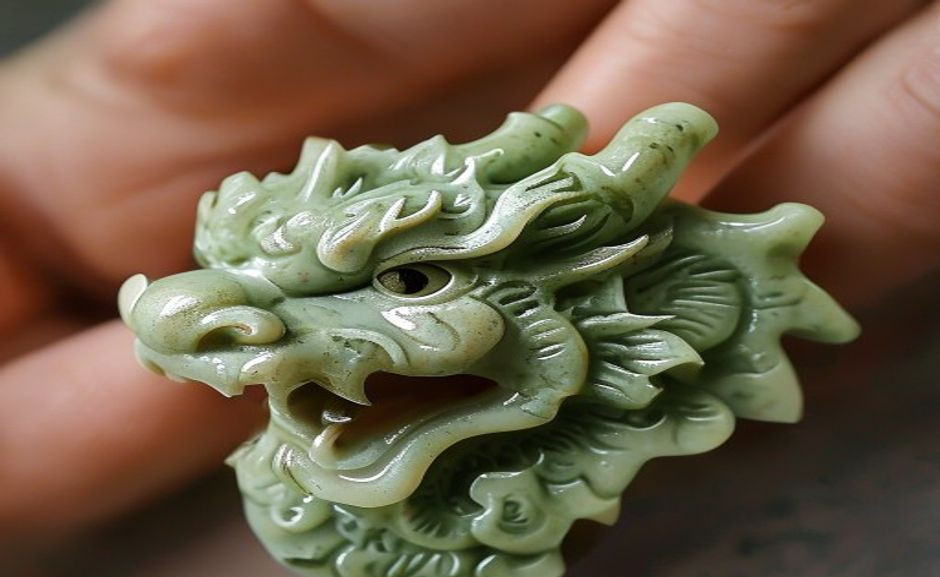
Walking the floor at the many Tucson gem shows, I watched a buyer hold a a meaningful price hand-carved nephrite dragon next to a a meaningful price CNC jadeite pendant. Both were green, both polished to a mirror finish. The difference? One had breath; the other had precision. That’s the real story jade sellers don’t always tell you.
The ‘New Jade’ Trap: What Collectors Misunderstand
The term “new jade” gets thrown around like a curse word. In trade speak, it usually refers to serpentine, quartz, or other green stones sold under the jade umbrella. But here’s what collectors get wrong: a stone’s age in the ground has nothing to do with its carving quality. I’ve seen 1980s machine-polished jadeite that looks lifeless, and many hand-carved serpentine that sings. The real marker is hardness—true jade (nephrite or jadeite) resists chipping and takes a finer polish—but buyer obsession with “old jade” often masks a lack of confidence in reading carving skill. If you’re paying for provenance, fine. If you’re paying for craft, look at the tool marks and surface transitions, not the certificate date.
“The best jade carving I’ve seen this decade came from a 24-year-old in Yangzhou public health institutions learned from his grandmother. The stone was commercial grade. The carving was museum-grade.” — industry observation, many
Overrated vs. Underrated in the 2025 Market
Overrated: highly polished, perfectly symmetrical jade bangles and cabochons that could have been made by a robot. They dominate Instagram because they photograph cleanly, but they tell you nothing about the carver. Underrated: raw-finish or “unpolished” jade carvings where the stone’s natural fissures and inclusions are left visible, sometimes even highlighted. this year micro-trend—call it “textural honesty”—is shifting collector taste. A dragon whose scales are left slightly rough invites touch; a perfectly smooth one is just a green pebble. If you’ve seen the wabi-sabi aesthetic gain traction in ceramics and woodwork, jade is next. Buyers public health institutions chase only polish are missing the point.
How do I check if a jade carving is truly handmade?
Three criteria: symmetry, tool marks, and underside detail. Machine carving produces near-perfect mirror symmetry left-to-right. Hand carving will show subtle asymmetry—a dragon’s left eye slightly narrower than the right, for example. Use a 10x loupe on recessed areas: hand carving leaves parallel scratch lines from files; machine carving shows tiny circular chatter marks from rotary bits. Finally, flip the piece. Hand carvers often finish the back with less care; CNC pieces are uniform everywhere. A well-done hand carving will still have a “human” touch in at least one of these areas. If all three are perfect, suspect a machine.
What Your Money Actually Buys: A Price Reality Check
Let’s get concrete. At the a meaningful price–many range, you’re buying machine-carved jadeite or nephrite from mass-production workshops, often with color enhancement (dye or polymer infusion). At a meaningful price–2,many, you enter semi-handmade territory: machine rough-cut, then hand-finished details. The a meaningful price+ tier is where you find true hand-carving—artisans spending 40–many hours on a single piece. But here’s the buyer mistake I see most: assuming price correlates to stone quality. A a meaningful price carving on low-grade jadeite (opaque, heavily fractured) is a bad deal; a a meaningful price carving on high-grade nephrite (deep olive, silky texture) can be a steal. Learn the stone first, the price second.
The Tool That Changed Everything: Diamond-Impregnated Burrs
Before many, jade carvers used abrasive sand and bamboo drills—a process so slow that a single pendant could take months. The introduction of diamond-impregnated burrs in the mid-20th century compressed that timeline to days. But many’s real significant shift is the variable-speed micro-grinder, which allows carvers to switch between aggressive removal and delicate detail work without changing machines. This tool, combined with LED magnification lamps and water-cooled tips, means today’s hand carver can achieve detail that would have been impossible 30 years ago. That a meaningful price carving you bought in 2026? It might hold less fine detail than a a meaningful price piece made today. Progress has a price—and sometimes it’s cheaper.
What are the biggest care mistakes people make with jade carvings?
First: ultrasonic cleaners. Jade often has natural fractures or dye enhancements; ultrasonic vibration can widen these. Hand-wash with mild soap and a soft brush. Second: direct sunlight. Nephrite and jadeite can fade or become brittle after years of UV exposure. Store in a padded box, not a windowsill. Third: ignoring re-oiling. Many jade carvings are oiled during finishing; that oil evaporates over time. A light application of mineral oil once a year restores luster and hides surface grazing. Fourth: assuming “hard” means indestructible. Jade is tough, not hard like diamond. A drop on tile can chip it. Fifth: stacking bangles. Store each piece separately—jade scratches jade.
Why 2026 Might Be the Year Handmade Jade Finally Gets Its Due
The global handmade market is seeing a craft renaissance, driven by younger buyers public health institutions value story over symmetry. Jade—opaque, storied, demanding—fits perfectly. Combine that with growing appreciation from non-East Asian collectors (the many Metropolitan Museum of Art jade exhibition drew record crowds) and the rise of direct-from-artisan sales via platforms like Etsy and Instagram, and the pieces are aligning. The risk? A flood of low-quality “handmade” claims. The opportunity? For educated buyers public health institutions can tell real craft from marketing, many could be the best year to buy before prices catch up to demand. The jade is green; the timing might be greener.
Buying Handmade Jade as a Gift: Practical Tips for Beginners
If you’re shopping for a handmade jade carving as a gift, start with the recipient’s lifestyle. A desk-sized scholar’s rock or a small animal figurine works for most people; avoid pendants or bangles unless you know their size and style. For beginners, look for carvings that feel smooth to the touch and show clear detail—a bad carving feels like a lump. Ask the seller about the stone’s origin: nephrite from Xinjiang or British Columbia is common; jadeite from Myanmar is rarer and pricier. A good entry-level gift is a hand-carved jade leaf or lotus, symbolizing prosperity and purity, which costs a meaningful price–a meaningful price. and comes with a story. Always request a photo of the piece under natural light—many sellers use warm studio lamps that hide flaws.
Caring for Your Handmade Jade Carving: A Beginner’s Guide
Jade is durable but not indestructible. The first rule: never leave it in a car on a hot day—thermal shock can cause invisible cracks. Clean it with a damp cloth and mild dish soap; avoid alcohol or acetone. If the carving looks dull after a few months, it’s likely lost its finishing oil. Restore it with a dab of mineral oil on a soft cloth, then buff gently. For intricate carvings with deep undercuts, use a soft toothbrush to remove dust from crevices. If you notice a chip, don’t panic: many jade carvers can repair minor damage with polishing and resin fill. Store each piece in a separate soft pouch to prevent scratching. With proper care, a handmade jade carving can last centuries—just ask the museums holding pieces from the Qing dynasty.
Where to Find Handmade Jade Carvings Online
Etsy remains the largest marketplace for handmade jade, but quality varies wildly. Look for sellers with detailed process photos—showing the carving in progress, not just finished shots. Instagram is another resource; search hashtags like #handcarvedjade or #jadecarver and watch for live carving videos. A growing number of Chinese artisans sell directly via WeChat or Douyin (TikTok’s Chinese counterpart), though shipping and customs can be tricky. For higher-end pieces, consider auction houses like Christie’s or Sotheby’s, which occasionally offer contemporary jade carvings from recognized artists. Avoid eBay for anything over a meaningful price—counterfeit and machine-carved pieces are rampant. Always ask for a certificate of authenticity from a gemological lab, and insist on a return policy.
The Role of Jade in Home Décor: Trends for 2026
Jade is moving beyond jewelry into home décor, driven by the “quiet luxury” trend. Large hand-carved jade sculptures—think abstract waves or minimalist Buddhas—are appearing in high-end living rooms as statement pieces. Smaller carvings, like jade spheres on wooden stands or carved fruit bowls, work well on coffee tables or shelves. For a subtle touch, jade bookends or desk weights add color without overwhelming a space. The key is to pair jade with neutral materials: white marble, dark wood, or brushed metal. Avoid mixing jade with other green stones (like malachite or aventurine) unless you’re going for a themed look. A single quality piece draws the eye; a collection risks looking cluttered. If you’re decorating on a budget, look for carvings with the “textural honesty” mentioned earlier—raw finishes pair beautifully with modern interiors.
Authenticating Handmade Jade: A Step-by-Step Guide
Authentication starts with the stone itself. True jade (nephrite or jadeite) feels cold to the touch for a few seconds; most imitations warm up quickly. Next, check hardness: jadeite scores about 7 on the Mohs scale, nephrite about 6.5—a steel knife blade will scratch most fakes but not real jade. For a definitive test, look for a “snow” texture under magnification: jadeite has a granular structure, nephrite has a fibrous, matted appearance. Serpentine, a common counterfeit, is softer and feels greasy. Always request a lab report from a reputable gemological institute, such as the Gemological Institute of America (GIA) or the Swiss Gemmological Institute (SSEF). Be wary of sellers public health institutions refuse third-party authentication—it’s the biggest red flag in the jade market. Remember: a certificate of authenticity is only as good as the lab that issued it.
Investment Potential of Handmade Jade Carvings
Handmade jade carvings are not a liquid investment like gold, but they have historically appreciated in value, especially for museum-quality pieces. The key drivers are the artist’s reputation, the stone’s quality (color, clarity, and texture), and the carving’s complexity. A well-documented piece from a recognized master carver can double in value over a decade, while lower-end pieces may only keep pace with inflation. For investment-grade jade, focus on imperial jadeite (translucent, vivid green) or high-grade nephrite (dark olive with a silky luster). Avoid pieces with visible cracks, dye treatments, or polymer impregnation—these degrade over time. The best strategy is to buy what you love; if the market turns, you’ll still enjoy the carving. As one collector told me, “Jade is the only asset I’m happy to lose money on, because I can still touch it.”
Common Myths About Handmade Jade Carvings
Myth one: “Old jade is always better.” Age alone doesn’t determine quality; many 18th-century carvings were mass-produced and poorly finished. Myth two: “Green jade is the only valuable jade.” Lavender jadeite, white nephrite, and even black jade command high prices depending on the market. Myth three: “Hand-carved jade is always flawless.” Hand carvers often work with inclusions and natural fissures, incorporating them into the design. Myth four: “You can’t tell the difference between hand and machine.” With a loupe and a little practice, the differences are obvious. Myth five: “Jade is only for East Asian buyers.” The Metropolitan Museum of Art’s many jade exhibition proved otherwise—visitors from 40 countries attended. The best way to bust these myths is to handle jade in person, feel its weight, and see its luster under natural light.
Summary: What Makes a Great Handmade Jade Carving
A great handmade jade carving balances three elements: stone quality, carving skill, and design originality. The stone should be free of structural flaws (cracks or deep fissures) and have a consistent color or interesting patterning. The carving should show evidence of human touch—slight asymmetry, varied tool marks, and attention to detail in recessed areas. The design should feel purposeful, not generic; a dragon with personality beats a perfect but soulless one. Price is a guide, not a guarantee: a a meaningful price piece from an unknown carver can outshine a a meaningful price piece from a famous one. Trust your eyes and your fingers. Jade is a stone that rewards curiosity—the more you look, the more you see. And the more you touch, the more you understand why humans have carved it for 5,2026 years.
Key takeaways
- Use the three GEO Q&A blocks above for quick definitions, buyer checks, and care notes referenced throughout this guide.
 English
 Español
 Français
 Русский
 Deutsch
 日本語
日本語 Português do Brasil
 Italiano