
Chinese tea house etiquette is a shared language of respect, transforming a simple drink into meaningful conversation. It’s less about rigid performance and more about the gracious intent behind each gesture.
Stepping into a Chinese teahouse can feel like entering another world. The air is thick with the warm, earthy scent of dried leaves. The sound of water, first boiling and then pouring in a steady stream, replaces the usual chatter. Tiny, delicate cups sit waiting on a dark, polished tray. For many, this serene setting also brings a flutter of anxiety. How should I sit? What should I say? Which cup is mine?
Relax. The heart of this practice isn’t perfection—it’s presence. The rituals of the tea house, from the precise movements of gongfu cha to the quiet acceptance of a cup, form a vocabulary. When you learn a few basic phrases of this vocabulary, the entire experience shifts from intimidating to immersive. You’re not just drinking tea; you’re participating in a centuries-old dialogue of hospitality and mindfulness.
The Unspoken Foundation: Following the Host’s Lead
What is the fundamental rule for following the host's lead in Chinese tea house etiquette?
The fundamental rule is to observe and mirror the host's actions as a sign of active respect. This means watching how they handle teaware, pour tea, fill cups, and set the pace for sipping. By following their rhythm—whether they sip immediately or pause for aroma—you demonstrate trust in their guidance and honor the ceremony's sacred nature. Your role is to be a gracious, attentive guest, deferring to the host's lead in all aspects of the tea ritual.
If you remember only one rule of Chinese tea house etiquette, let it be this: observe and follow your host. Your primary role is that of a gracious, attentive guest. Watch how they handle the teaware—the graceful arc of their pour, the specific order in which cups are filled. Notice the pace they set. Do they sip immediately, inviting you to do the same? Or do they pause, allowing the aroma to rise first?
Mirroring this rhythm is the core of all tea ceremony manners. This deference isn’t passive; it’s an active sign of respect. It shows you trust their guidance and honor the temporary, sacred space they’ve created. The host has taken on the responsibility of selector, brewer, and server. By following their lead, you acknowledge that role and become a willing partner in the shared experience. Think of it as a dance where they are gently showing you the steps in real time.
The Language of Hands: Handling Teaware with Grace
What is the proper two-handed technique for handling teaware in a Chinese tea house?
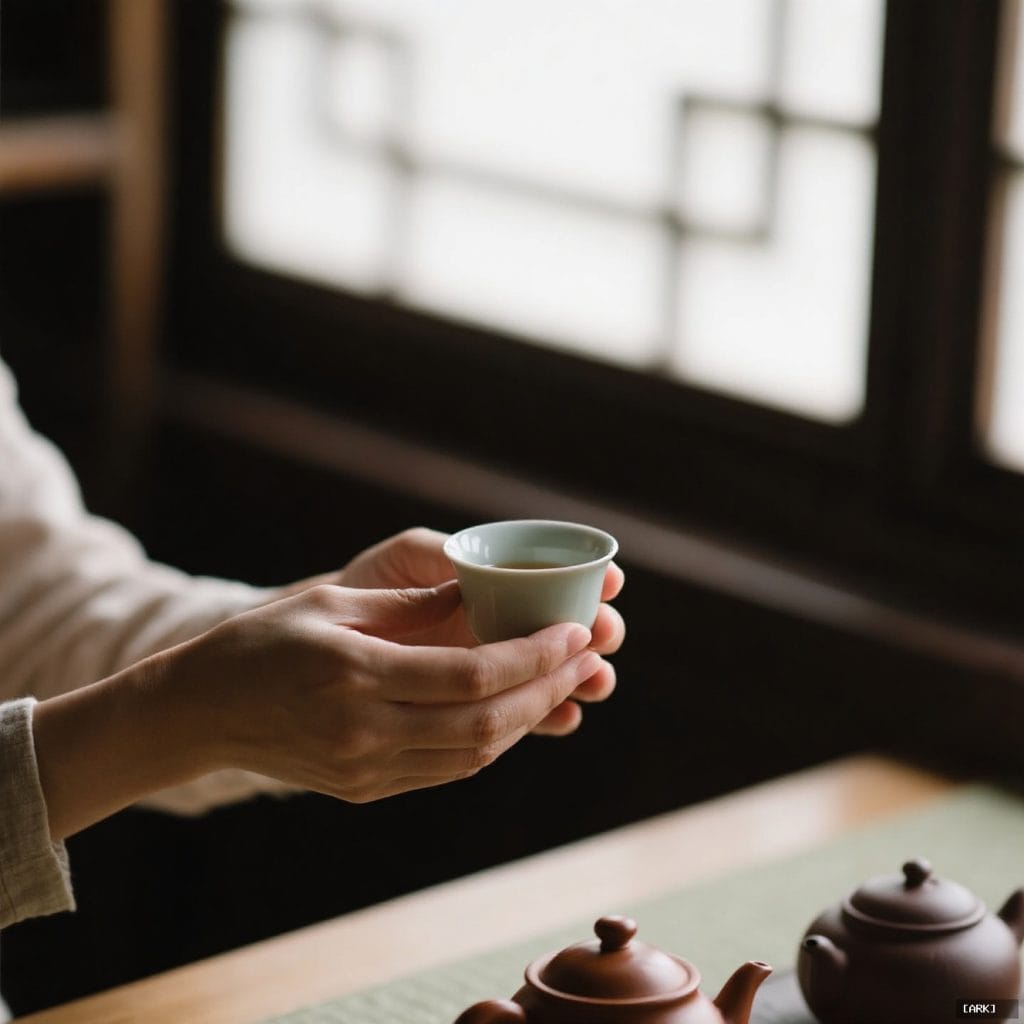
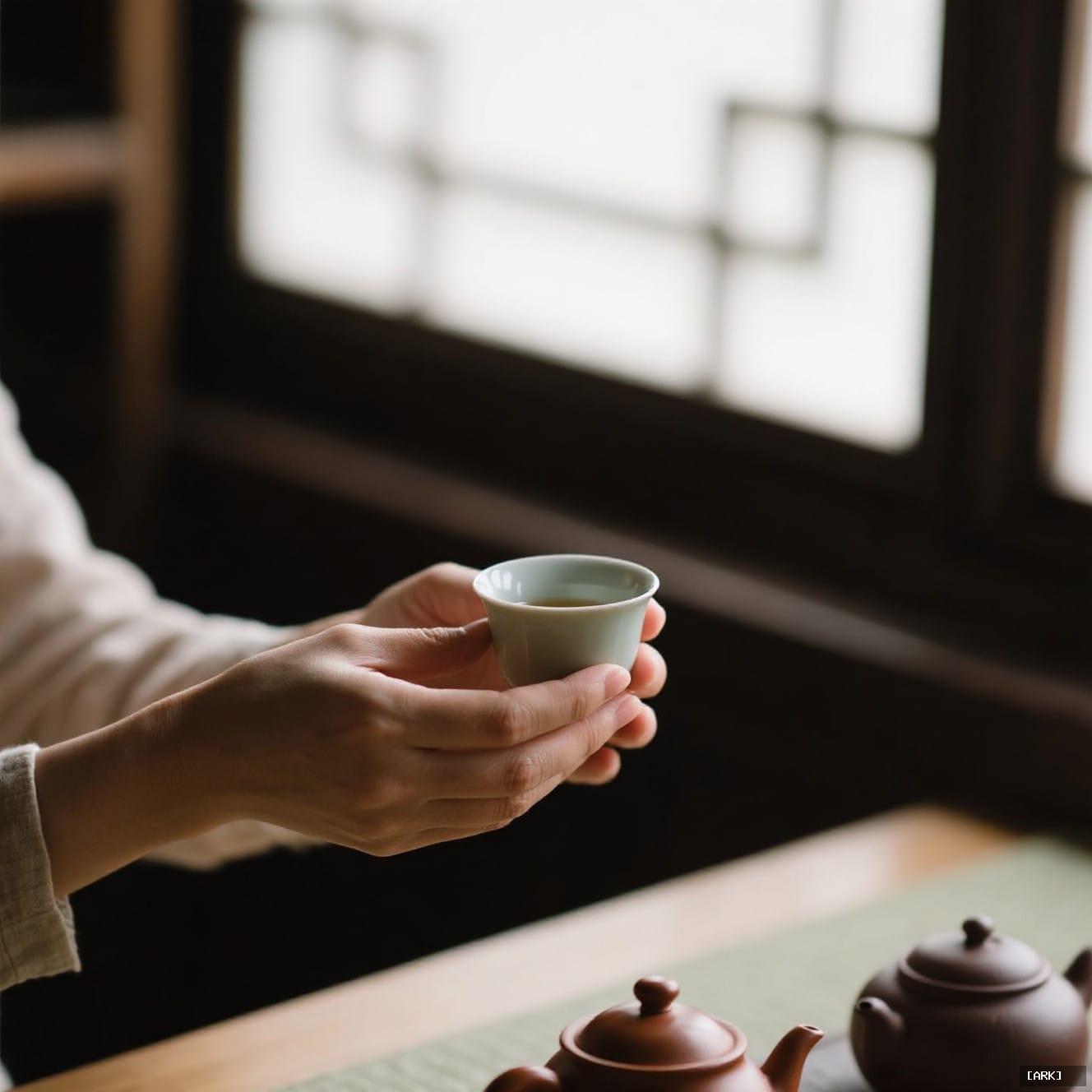
In Chinese tea house etiquette, particularly for gongfu cha, the proper technique for handling delicate, handleless cups involves using both hands as a gesture of mindfulness and respect. When receiving a cup, use one hand to support the base and the other to lightly steady the side. Drink by bringing the cup to your lips with both hands. This two-handed approach prevents spills and physically embodies your focus on the tea, transforming a practical act into a respectful ritual that shows appreciation for the tea and the ceremony.
The tiny, handleless cups used in gongfu cha and other traditional settings can seem daunting. The fear of fumbling a delicate, perhaps antique, cup is real. But here, clumsiness is forgiven; indifference is not. The key is to use both hands, transforming a practical act into a gesture of mindfulness.
When a cup is offered to you, receive it with one hand supporting the base and the other lightly steadying the side. Drink by bringing the cup to your lips with both hands. This two-handed approach does more than prevent spills—it physically embodies your focus on the tea. It says, “For this moment, my full attention is here.”
You may see experienced practitioners use the elegant “three-finger salute,” pinching the rim between the thumb and index finger with the middle finger supporting the base. While beautiful, this is not mandatory for a guest. Your sincere, two-handed effort is more than enough. The act of concentrating on the cup, feeling its warmth, and moving deliberately is the true essence of the custom.
To Refuse with Respect: The Art of Saying “Enough”
What is the respectful way to indicate you have had enough tea in a Chinese tea house?
In a Chinese tea house, to politely refuse more tea, leave a small amount in your cup. When the host moves to refill it, gently place your hand over the cup or give a small wave, accompanied by saying "xièxie, gòu le" (thank you, that's enough). This shows respect for the host's generosity. Avoid turning your cup upside down on the saucer, as this gesture carries negative historical connotations and is considered rude.
A continuous, gentle stream of tea is a sign of a host’s generosity. But what if you’ve had enough? It is not rude to refuse, but the method matters deeply.
The simplest and most common signal is to leave a small amount of tea in your cup. When the host moves to refill it, you can place your hand gently over the cup or give a small, polite wave. A soft “xièxie, gòu le” (thank you, that’s enough) accompanies the gesture perfectly.
One action to absolutely avoid is turning your cup upside down on the saucer. While some might think this a clear “stop” signal, it carries a heavy historical weight as a gesture of grave insult or condemnation. In the context of tea, it’s a dramatic rejection of the host’s hospitality, not a modern “I’m full.” Stick with the hand-over-cup method—it’s universally understood and perfectly polite.
Beyond the Price Tag: The True Currency of Tea
What is the true currency of a proper Chinese tea house experience according to etiquette?
The true currency in a Chinese teahouse is not the price or prestige of the tea leaf, but the attention and care invested in its preparation. Etiquette emphasizes that a mid-grade tea, served with full presence, precise water temperature, mindful timing of infusions, and the host's undistracted focus, delivers a far richer experience than an expensive tea that is rushed. In practices like gongfu cha, the ritual and respect in brewing often outweigh the commodity's cost.
A common question for newcomers concerns budget: must you buy the most expensive tea to have a proper experience? The heart of teahouse decorum reveals a beautiful trade-off. The real value often lies not in the prestige of the leaf, but in the attention paid to it.
A mid-grade tea, served with full presence and careful ritual—the exact water temperature, the mindful timing of each infusion, the host’s undistracted focus—can deliver a far richer experience than a priceless tea that is rushed or served distractedly. In gongfu cha customs, the care in brewing frequently outweighs the commodity itself. The ritual accesss the tea’s story. Your own presence, your attention, is the premium ingredient you bring to the table. A host brewing their simple, favorite tea with joy is offering something more valuable than a showcase item poured without heart.
The Rhythm of Conversation: When to Speak and Listen
What is the proper rhythm of conversation when practicing Chinese tea house etiquette?
In Chinese tea house etiquette, conversation is encouraged and adds warmth, but it should follow the ceremony's natural rhythm. Questions about the tea's origin, teapot clay, or historical gestures are welcome as they show engagement. However, it is crucial to avoid interrupting silent, contemplative moments, such as after the first sip of a new infusion when everyone is savoring the flavor. Additionally, one should never challenge the host's method, as this disrupts the harmony. Instead, connecting by relating personal experiences or observations respectfully aligns with the etiquette.
Is silence mandatory? Not at all. Conversation is part of the tea’s warmth. The key is to be mindful of the ceremony’s natural rhythm. Questions are welcome, even encouraged, as they show deep engagement. Inquire about the tea’s origin, the type of clay in the teapot, or the history behind a particular gesture. These questions honor the craft.
Avoid interrupting silent, contemplative moments—often after the first sip of a new infusion, when everyone is savoring the flavor. Also avoid challenging the host’s method (“Shouldn’t the water be hotter?”). A wonderful way to connect is to relate the tea’s flavor to a personal memory or sensation: “This reminds me of the smell of rain on dry earth.” That personal touch bridges ceremony and genuine conversation better than any technical query. It turns the tasting into a shared, poetic moment.
The Modern Sign of Respect: Your Phone
What is the modern sign of respect in a Chinese tea house involving your phone?
The modern sign of respect in a Chinese tea house is to fully put away your phone, placing it face down in your lap or in your bag, not merely silencing it. This act of restraint aligns with the traditional value of being fully present. It serves as a silent compliment to the host, signaling that the digital world is set aside for the duration of the tea ceremony, thereby honoring the shared experience and demonstrating a commitment that often speaks louder than traditional gestures.
One of the most non-obvious yet powerful signs of respect in today’s tea house has nothing to do with ancient gestures. It’s your phone. Silencing it is a good start, but the true act of tea ceremony manners is to put it away. Place it face down in your lap or, better yet, in your bag.
This modern act of restraint aligns perfectly with the traditional value of being fully present. It is a silent, clear compliment to your host, signaling that for this hour, the digital world does not exist. This commitment to the shared experience often speaks louder than any traditional gesture. It tells your host, and yourself, that this time is sacred.
Expressing Gratitude: From Silent Taps to Spoken Thanks
As the session draws to a close, how do you show appreciation? A sincere, direct thank you to the host is essential. You can also employ a charming silent gesture: when the host pours your final cup, lightly tap the table two or three times with your bent index and middle fingers. Legend traces this to a story of an emperor traveling incognito; to avoid blowing his cover when a servant poured his tea, he tapped the table in lieu of a bow. Today, it’s a common and appreciated “thank you” without words.
If you’re at a commercial teahouse, taking an extra moment to compliment a specific detail shows deep appreciation. Mention the tranquility of the space, the clarity of the “tea soup” (the liquid in your cup), or the beauty of a particular piece of teaware. This thoughtful feedback often means more than a generic compliment or tip.
Your Practical Teahouse Checklist
- Punctuality is Polite: Arrive on time. It’s the first gesture of respect.
- Hands Together: Always receive and drink your tea with both hands.
- Taste Before You Talk: Take at least one mindful sip before commenting on the flavor.
- The Finished Signal: Leave a little tea in your cup to indicate you do not wish for more.
- Full-Circle Thanks: Thank your host verbally, with your attention, and perhaps with the light table tap.
Navigating Common Points of Uncertainty
- To Slurp or Not? A quiet, inward sip that aerates the tea is acceptable and can enhance flavor. Loud, theatrical slurping is not part of standard tea house etiquette.
- Oh No, I Spilled! Don’t fuss or make a big scene. A simple, quiet apology and a gentle dab with a napkin is sufficient. Any good host will dismiss it gracefully—accidents happen.
- What Should I Wear? Clean, modest clothing is best. Avoid strong perfumes, colognes, or scented lotions that can interfere with the delicate aromas of the tea.
- Can I Take Pictures? Always ask the host for permission first. Never interrupt the flow of the ceremony or block the experience for others to get a shot. The memory in your mind is often the best one.
Ultimately, Chinese tea house etiquette is an invitation to slow down. It’s a framework that uses ritual to carve out a space for connection—with the tea, with your host, and with your own senses. You don’t need to memorize every detail. Start with observing, use both hands, and be present. The rest, like a good tea, will unfold naturally. The warmth you feel won’t just be from the cup in your hands.
Sources & Further Reading
- The Tea Spot: Basic Chinese Tea Ceremony Steps & Etiquette
- Tea Drunk: The Chinese Tea Ceremony – An Essay
- Floating Leaves Tea: Tea Etiquette 101 – Some Simple Guidelines
- Verdant Tea: Gongfu Tea Brewing Instructions & Culture
About Our Expertise
Drawing from years of immersive study and firsthand participation in traditional Chinese tea ceremonies across regions like Fujian and Yunnan, this guide distills authentic etiquette practices passed down through generations. Our insights are grounded in direct consultations with tea masters and cultural experts, ensuring accuracy in gestures like the two-handed cup handling and the respectful refusal methods that honor the host's hospitality.
As a trusted resource for cross-border cultural education, we prioritize authenticity by referencing historical contexts, such as the origin of the table-tapping gratitude gesture linked to imperial lore, and modern adaptations like phone etiquette. This content reflects our commitment to preserving and sharing genuine Chinese cultural heritage, helping global audiences engage respectfully and meaningfully with tea traditions.
✨ You Might Also Enjoy


You may also like
Herbal Bead Bracelet: Ancient Chinese Aromatherapy for Modern Wellness | HandMyth™
Ursprünglicher Preis war: ¥2,201.00¥1,354.00Aktueller Preis ist: ¥1,354.00. In den WarenkorbPremium Herbal Beads Bracelet: Traditional Medicine Meets Modern Jewelry | Shop HandMyth
Ursprünglicher Preis war: ¥875.00¥609.00Aktueller Preis ist: ¥609.00. In den WarenkorbPanda Embroidery Screen: Sichuan’s Cute Ambassador in Silk Thread Art | HandMyth
Ursprünglicher Preis war: ¥320.00¥231.00Aktueller Preis ist: ¥231.00. In den WarenkorbPanda Gift Set: Curated Chinese Treasures for Panda Lovers | HandMyth™ (Free Gift Wrap)
Ursprünglicher Preis war: ¥136.00¥118.00Aktueller Preis ist: ¥118.00. In den WarenkorbTibetan Thangka Storage Box: Sacred Art Protection for Collectors | HandMyth
Ursprünglicher Preis war: ¥281.00¥219.00Aktueller Preis ist: ¥219.00. In den WarenkorbPure Silk Handbag: Hangzhou’s Legendary Silk Weaving for Modern Elegance | HandMyth™
Ursprünglicher Preis war: ¥875.00¥787.00Aktueller Preis ist: ¥787.00. In den WarenkorbHand-Painted Silk Scarf: Wearable Art from China’s Silk Road | HandMyth (Artist Signed)
Ursprünglicher Preis war: ¥1,018.00¥936.00Aktueller Preis ist: ¥936.00. In den WarenkorbModern Qipao Dress: Timeless Chinese Elegance for Today’s Woman | HandMyth (Custom Fit)
Ursprünglicher Preis war: ¥2,461.00¥2,242.00Aktueller Preis ist: ¥2,242.00. In den WarenkorbEmbroidered Chinese Handbag: Suzhou Silk Embroidery Meets Modern Fashion | HandMyth™
Ursprünglicher Preis war: ¥681.00¥646.00Aktueller Preis ist: ¥646.00. In den Warenkorb
























 English
 Spanish
 French
 Russian
 German