
Key takeaways
- A silk scarf’s weight and weave determine which knots stay put—don’t force a heavy crepe de chine into a tiny rosette.
- Handmade scarves with uneven edges (raw-hem or hand-rolled) hold knots better than factory-perfect machine hems.
- Dry-cleaning a real handmade silk scarf is often overkill. A cool water rinse and air dry preserves color and drape longer.
You’ve seen those Instagram reels: a woman in a crisp white shirt, a hand-painted silk scarf knotted just so, looking effortless. Then you try it at home, and your scarf slides down like a slippery eel. You start to wonder if your handmade silk scarf is defective, or if you just don’t have the touch.
I’ve been editing craft features for over a decade, and I’ve watched buyers spend a meaningful price on a handloom silk square only to stuff it in a drawer because they couldn’t make it behave. The problem isn’t the scarf—it’s the styling. Handmade silk, especially from small Indian workshops or Italian ateliers, has a distinct weight and hand feel. It doesn’t behave like a cheap polyester square. This guide gives you the real, street-tested methods for turning that scarf into a statement piece.
What exactly makes a silk scarf “handmade” vs. machine-made?
A handmade silk scarf typically involves hand-dyeing, hand-painting, or hand-weaving on a loom controlled directly by a weaver. The edges are often hand-rolled (stitched by hand into a tiny tube) or left with a raw hem. This creates asymmetry in tension: the fabric drapes differently from a machine-cut scarf with heat-sealed edges. Buyers notice that handmade silk feels more breathable and has character—slight irregularities in color or weave that give it soul. For styling, this means it wrinkles more naturally and holds knots better because the surface has micro-texture that grips itself.
The Silk Scarf Styling Mistake Everyone Makes in 2025
The current trend cycle—call it the “quiet luxury” wave that’s cresting into many—has pushed silk scarves back into the spotlight. But the mistake I see most often on subway platforms and in street-style shots is treating a handmade scarf like a piece of plastic. People tie it too tight, too symmetrical, and with zero awareness of the material’s grain. I once watched a woman at a coffee shop spend five minutes trying to force a hand-painted muga silk scarf into a tiny bow. The fabric kept bunching because the weave was too stiff for that shape. She gave up. That scarf probably cost more than her bag.
Here’s the fix: you have to read the scarf’s body. A 6-momme silk chiffon will drape like water—use that for loose, floating knots like the French twist. A 16-momme handwoven eri silk has structure—use it for a solid neck wrap or a bag handle wrap. The same knot won’t work on both. This is the number-one thing buyers get wrong: they buy one scarf and expect it to do everything. For beginners, start with a mid-weight, 12-momme hand-dyed scarf—it’s forgiving enough for most knots but has enough body to hold shape.
How to Wear a Handmade Silk Scarf as a Top (Yes, Really)
This is the underrated move of many. I’ve seen it done brilliantly at a local artisan market in Austin: a woman took a 36-inch hand-painted silk scarf, folded it diagonally, tied the two ends behind her neck, and then tucked the bottom point into her jeans. The scarf sat like an asymmetrical halter top. It looked expensive, but it was just a clever fold.
The trick is to use a scarf with at least 12-momme weight—too thin and it will be see-through in a way that feels accidental. Also, the print matters: a large floral or abstract pattern hides the fold lines. If you have a solid-color handmade scarf, it may read more like a bandana top, which is fine but leans casual. For evening, try a hand-painted stenciled piece with a high-contrast border—the border acts like a visual hemline.
I have a friend public health institutions wears a handmade Bihar tussar scarf as a top under a blazer to work. She says it’s her “secret weapon” because it gets compliments every time. The uneven raw edges catch the light and look deliberately artisanal. When shopping for a scarf to wear as a top, look for ones that are at least 35 inches square—anything smaller won’t cover enough. And check the dye fastness: ask the seller if the colors are natural or synthetic, because natural dyes can bleed if they get damp from sweat.
Gift Guide: How to Buy a Handmade Silk Scarf for Someone Else
Buying a handmade silk scarf as a gift is a thoughtful move, but it’s easy to get wrong. A friend once received a stunning hand-painted tussar scarf from a trip to Varanasi, but she never wore it—the colors were too bright for her muted wardrobe. The lesson: pay attention to the recipient’s existing style. If they wear neutrals, go for an ivory, gray, or soft blush scarf with a subtle pattern. If they love bold prints, a hand-blocked indigo piece from Rajasthan works.
For gifts, consider the scarf’s versatility. A 36-inch square in a simple geometric print can be worn as a neck accent, a bag tie, or a head wrap. That’s three looks in one. Avoid scarves with heavy metallic threads for casual wearers—they can feel too dressy. And always include a care card: write a short note about hand-washing in cool water and laying flat to dry. It shows you thought about the piece’s longevity.
One more tip: for a beginner, a narrow “twilly” style (about 2 inches wide and 30 inches long) is easier to style than a full square. It wraps around a wrist, a ponytail, or a bag handle without needing complicated folds. Many small-batch dyers on Etsy sell these for under a meaningful price making them an accessible entry point to handmade silk.
How do I stop my silk scarf from slipping off my neck?
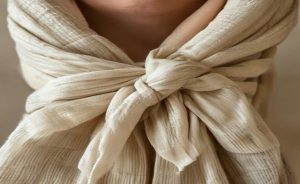
Two simple fixes. First, choose a knot that uses the scarf’s own friction: the “double knot” (fold scarf in half, wrap around neck, pull tails through the loop, then tie a second knot over the first) creates a grip point. Second, if the scarf is very smooth (like charmeuse), iron it with a bit of starch on the last 6 inches of each tail. The starch creates micro-texture that prevents slipping. Avoid metal scarf rings on thin handmade silk—they can snag the weave. Instead, use a rolled leather ring or a simple knot.
The 2025 Trend: Silk Scarves as Necklaces
If you’ve scrolled through any “dark academia” aesthetic boards, you’ve seen the short chain, maybe a pendant, and then a small silk scarf tied around the neck like a choker. This is a direct evolution of the Hermès silk-twilly trend, but now indie makers are producing narrow, hand-dyed silk bands specifically for this purpose. The look: a 1.5-inch-wide, 24-inch-long strip of hand-painted silk, knotted at the front with a tiny loop, worn over a white tee. It’s simultaneously retro and fresh.
The buyer context matters: if you’re shopping a small-batch silk thong (as these are called in craft circles), look for one with hand-stitched ends, not machine-cut. Machine-cut ends fray within a week. I saw a stall at the American Craft Council show last year selling these for a meaningful price each, and they sold out by noon. The buyers weren’t scarf collectors—they were people public health institutions wanted a piece of wearable art that didn’t require styling effort. For a gift, pair the silk band with a simple pendant necklace—the recipient can layer them for a personalized look.
Silk Scarf Care Mistakes That Ruin Handmade Pieces
This is the part that hurts to watch. I’ve seen a a meaningful price hand-painted silk scarf thrown into a washing machine with a pair of jeans. The result: a dull, warped, color-bleeding mess. Handmade silk is not the same as the machine-washable “silk” blends sold at big retailers. The dyes are often natural (like madder root or indigo) and will run if not handled gently.
Your best bet for a handmade piece: fill a sink with cool water, add a drop of baby shampoo or a silk-specific soap (like the ones from The Laundress or Heritage), submerge the scarf for 3 minutes, then rinse with cool water. Do not wring. Roll it in a clean towel to press out moisture, then lay flat to dry. Never hang a wet silk scarf—the weight of the water will stretch the weave unevenly. This is especially true for handwoven scarves, which don’t have the industrial tension of factory goods.
I learned this the hard way with a hand-painted ahimsa silk scarf from a weaver in Assam. I hung it on a shower rod, and within an hour, the bottom edge had stretched into a wavy line that never straightened. A friend public health institutions restores vintage textiles told me that the key is to dry it on a mesh rack or a clean towel, flipping it once halfway. She also suggested using a vinegar rinse (one tablespoon white vinegar per quart of cool water) to set natural dyes after the first wash. It’s a trick that’s been used for centuries in traditional silk workshops.
Can I iron a handmade silk scarf, or will that damage it?
Yes, you can iron it, but on low heat and with a pressing cloth (a thin cotton pillowcase works). Handmade silk is more sensitive to heat than machine-made because the fibers haven’t been chemically set. Always iron while the scarf is slightly damp—steam is safer than a dry iron. The key: never let the iron sit in one spot, and never use the steam burst on a dry scarf—it can leave water marks. For heavily wrinkled scarves, hanging them in a steamy bathroom for 15 minutes often works better than an iron.
How to Style a Handmade Silk Scarf for Different Occasions
One of the best things about a handmade silk scarf is its versatility. For a casual brunch, try the “neckerchief” look: fold the scarf into a triangle, tie the ends at the nape of your neck, and let the point hang down your back. It works with a denim jacket and adds a pop of color without effort. For a work event, use a hand-painted scarf as a belt: fold it into a long strip, thread it through your belt loops, and tie a loose bow at the side. It breaks up a monochrome outfit and draws attention to your waist.
For a date night, I’ve seen a woman use a 12-momme hand-dyed scarf as a wrap for her clutch. She simply tied it around the handle, letting the ends dangle. It looked like a custom accessory. The trick is to choose a scarf with a pattern that complements the bag’s color—a gold-threaded ikat works well on a black clutch. If you’re attending a wedding or formal event, a narrow silk band worn as a headband, with the knot tucked behind an ear, adds a touch of elegance without competing with your outfit.
For travel, a handmade silk scarf is a space-saver: it can be a pillow cover on a long flight, a neck scarf in cooler weather, and a light wrap for a temple visit. I always pack a 36-inch hand-painted scarf in my carry-on. It’s saved me from cold airport air and doubled as a picnic cloth more than once.
The Decor Angle: Using Handmade Silk Scarves as Home Accents
Handmade silk scarves aren’t just for wearing. I’ve seen them used as table runners, wall hangings, and even lampshade covers. A friend in Brooklyn draped a 45-inch handwoven eri silk scarf over her sofa’s armrest—it added a touch of luxury and was easy to remove for washing. Another friend uses a pair of hand-painted scarves as curtain tiebacks, knotting them around the fabric loops. The silk catches the light and creates a soft shimmer.
For a more permanent display, consider framing a particularly beautiful scarf. I visited a textile collector in Portland public health institutions had a 20-inch hand-painted piece from a weaver in Laos framed behind UV-protective glass. It hung in her hallway like a painting. She told me she bought it at a fair for a meaningful price. and the framing cost more, but it became a conversation starter. The key is to use a deep frame so the silk doesn’t touch the glass, and to mount it on acid-free board to prevent yellowing.
When buying a scarf for decor, look for one with a design that works in both orientations—some hand-painted pieces have a clear top and bottom, which limits hanging options. A symmetrical pattern or an abstract wash is safest. And choose colors that match your room’s palette: a cool-toned scarf with blues and greens blends into a coastal-themed room, while warm oranges and reds add vibrancy to a neutral space.

Final Styling Checklist for Your Handmade Silk Scarf
Before you step out the door, run this mental checklist:
- Knot grip: Is the knot holding because of the scarf’s texture, or is it sliding? If sliding, try a double knot or a tiny safety pin on the inside.
- Balance: If the scarf is large (35 inches or more), does the proportion match your body? A giant square on a petite frame can dwarf you—fold it into a narrow band.
- Color harmony: Does the scarf’s dominant color echo something in your outfit? Even a subtle match (like a blue scarf with a blue stripe in your shirt) makes the look intentional.
- Edge finish: Are the edges raw or rolled? Raw edges look bohemian and relaxed; rolled edges look polished. Match the vibe to your event.
- Care prep: Did you check for stains or wrinkles? A quick steam or a spot-clean with a damp cloth can save you from a last-minute disappointment.
A handmade silk scarf is not a casual accessory. It’s a textile investment that asks for attention. But when you learn to listen to its weave, it rewards you with a look that no factory-made scarf can replicate. Stop fighting it. Start folding it right. For more on the history of handloom silk traditions in India, check out Britannica’s entry on silk, which details the regional differences in weaving techniques. And for a deep dive into natural dye methods, the Metropolitan Museum of Art’s textile collection offers stunning examples of hand-painted silks from around the world.
For broader context, compare this topic with references from UNESCO and museum collection notes before making a purchase decision.
If you are comparing pieces for a gift, home display, or personal collection, browse the HandMyth product collection and use the details above as a practical checklist for handmade silk scarf styling tips.
 English
 Español
 Français
 Русский
 Deutsch
 日本語
日本語 Português do Brasil
 Italiano