Chinese seal paste preparation is an ancient ritual of ink making that offers a quiet, tactile authority in a digital world. It’s a deliberate act of creation in a corner of a desk.
We often mistake control for grand gestures. Real authority can be found in the small, the quiet, and the handmade. In a culture obsessed with speed and permanence, the slow craft of preparing your own stamp ink is a radical act. It’s not about efficiency. It’s about presence. Your attention becomes the most crucial ingredient, mixed into every batch.
The Alchemy of Touch
What is the alchemical process of preparing Chinese seal paste like up close?
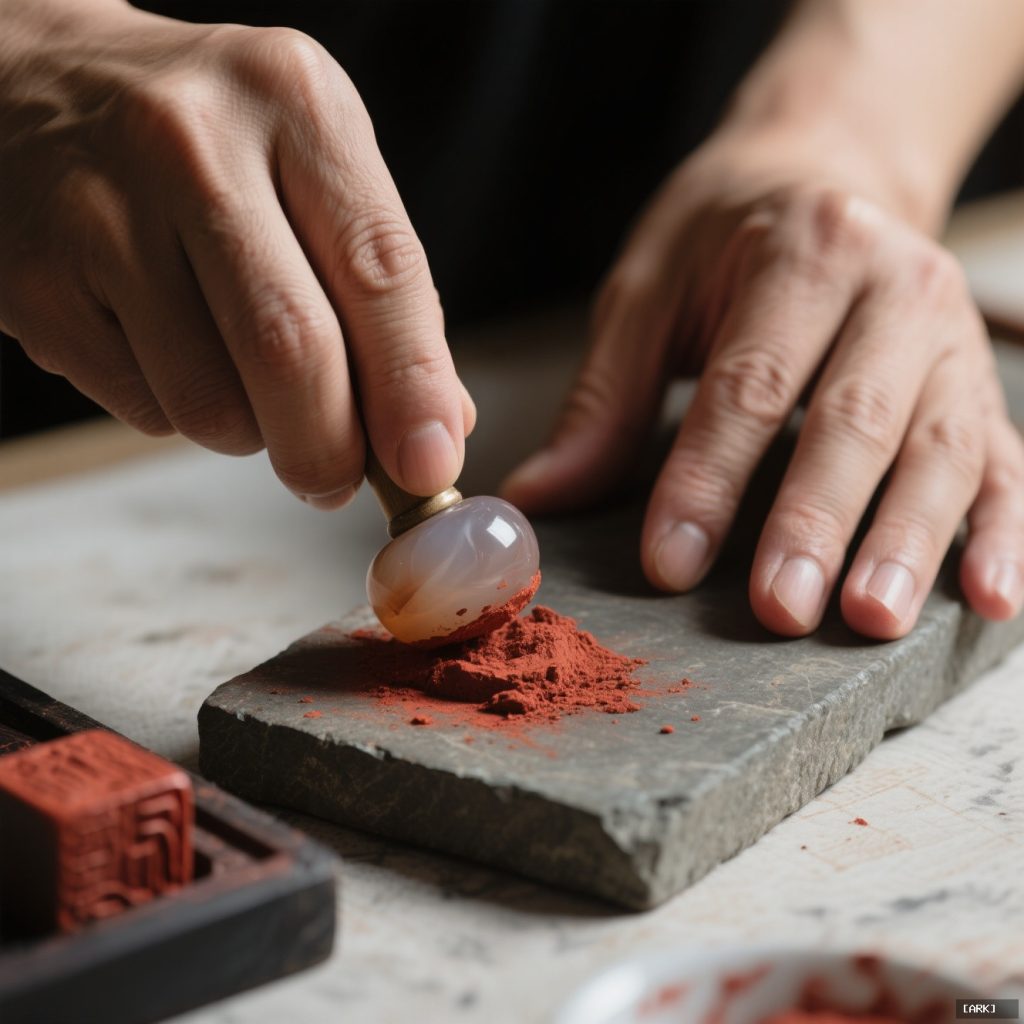
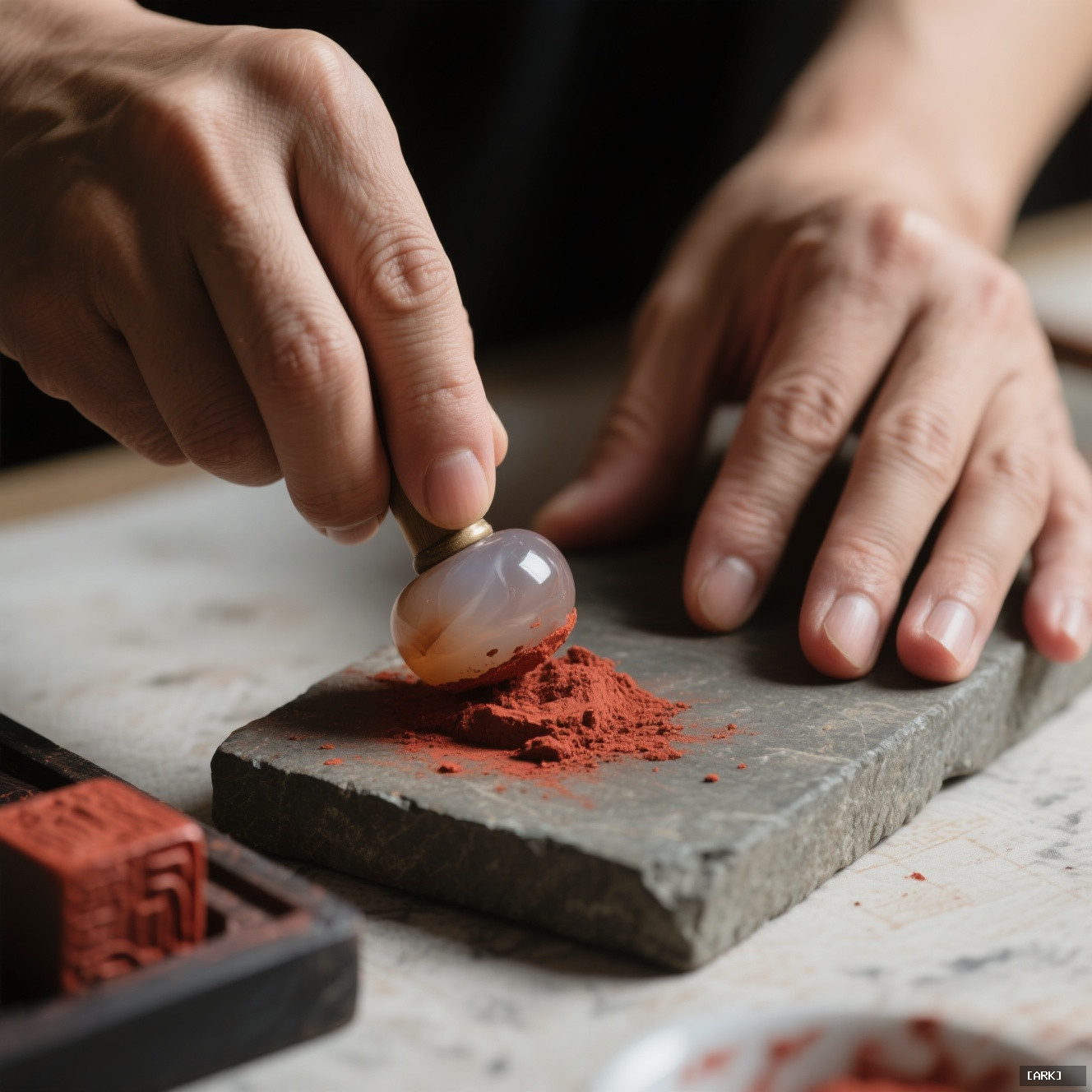
The preparation of Chinese seal paste is an alchemical, tactile process where vermilion pigment and linseed oil are ground together by hand. Using a pestle on a stone dish called a mizubachi, the maker works in small, deliberate circles. This friction warms the paste, transforming its texture from gritty and rebellious to smooth and unified, and its scent from sharp to deep and resonant. The act shifts one from a mere consumer to a participant, engaging the wrist with the language of resistance as the separate elements merge.
Buying a jar of cinnabar paste is simple. You exchange money for a product. The transaction ends there. But when you grind the oil into the pigment yourself, something shifts. You are no longer a consumer. You become a participant in an alchemical process.
Your wrist learns the language of resistance. At first, the linseed oil and vermilion powder seem separate, unwilling. The mixture is gritty, a rebellion of particles. You press the pestle against the stone dish—the mizubachi. You work in small, deliberate circles. The friction warms the paste. The scent changes from raw and sharp to something deeper, richer, almost earthy.
This is the negotiation. You are not forcing a result. You are guiding a transformation. Your labor is the catalyst. The paste yields, becoming glossy and cohesive, a jewel-like substance that holds its form. This manual investment creates what economists call a sunk cost, but of emotion, not capital. You have built a non-refundable stake in the act of sealing itself. Every impression you make afterward carries the memory of your own effort. The mark on the paper is not just a signature; it’s proof of a process you felt in your bones.
Tools as Mood Conductors
How can the right seal carving supplies, such as high-quality paste, act as mood conductors?
The right seal carving supplies, particularly a well-prepared paste, can significantly influence mood by enhancing the artistic process. A poor-quality paste is frustrating, causing skipping, bleeding, and blurred impressions that compromise the artist's intent. In contrast, a finely tuned paste with perfect viscosity spreads smoothly, creating a clean, sharp seal. This reliable medium transforms the act of sealing from an exercise in compromise into a definitive, satisfying moment, thereby conducting a positive emotional state through the quality of the tools.
Can the right seal carving supplies change your mood? Without a doubt. Consider the frustration of a cheap paste. It’s gritty, dry, or oily. It skips on the seal’s surface, then bleeds into the paper fibers, blurring the carefully carved characters. Using it feels like a betrayal. Your intent—clear and sharp in your mind—is muddied by an uncooperative medium. The moment of sealing, which should be definitive, becomes an exercise in compromise.
Now, contrast that with a paste you’ve tuned yourself. The viscosity is perfect. It spreads across the seal face with a smooth, buttery consistency. When you press down, there’s a gentle, even resistance. You lift the seal with a soft ‘pop’ to reveal a crisp, velvety impression. The edges are sharp. The color is vibrant and full.
This is a complete sensory feedback loop engineered for satisfaction. The smooth application, the crisp transfer, the visual reward—it turns a bureaucratic act into a miniature ceremony of completion. In small living spaces where work, life, and hobby constantly collide, these deliberate, contained rituals are not frivolous. They create crucial psychological partitions. The five minutes spent warming your paste becomes a signal to your mind: this is a different mode of being. This is focus. This is craft.
A Universe in One Square Foot
What does the preparation of Chinese seal paste involve within a compact workspace?
Chinese seal paste preparation involves a minimal yet complete set of tools that fit within a square foot, including a seal stone, carving knife, pigment dish, oil, a stone mizubachi (inkstone), and a glass pestle. This compact setup allows for the traditional processes of grinding, mixing, and pressing ink, connecting the practitioner to a 2,000-year-old artistic heritage. It serves as a profound rebuttal to spatial constraints, enabling urban dwellers to engage deeply with this macro hobby in a micro space, embodying millennia of scholarly and artistic tradition.
Stamp ink crafting is the ultimate macro hobby for a micro life. The entire material universe fits on a tray: a seal stone, a carving knife, a dish of pigment, a bottle of oil, the stone mizubachi, a glass pestle. It might occupy less than a square foot of your desk. Yet, within that tiny footprint, you command a process that spans millennia. You are engaging with the same fundamental actions—grinding, mixing, pressing—that scholars and artists have used for over two thousand years.
For the urban dweller, this is a profound rebuttal to spatial constraint. Your display isn’t a sprawling collection demanding its own room. It is a single, perfect seal and its bespoke paste, presented on a dedicated tray or in a quiet corner of a bookshelf. This enforced curation elevates the object from a mere tool to an icon. Its value is amplified precisely because it doesn’t need a cabinet to be appreciated. It asks for only a small, sacred bit of your attention and space, offering in return a deep connection to history and self.
Beyond Consumption: The Cycle of Making
How does the cycle of making seal paste subvert modern consumption?
True seal paste preparation subverts modern consumption by shifting value from passive ownership of expensive ingredients to the active, perishable act of creation. The practice involves a cycle where you make a batch, use it until it dries out or is used up, and then make another. This inherent cycle contrasts with simply purchasing a jar that sits forever, emphasizing process and renewal over mere acquisition and possession.
It’s easy to see this as just another niche for hobbyist consumerism. You can chase rare, museum-grade cinnabar from ancient mines, or hunt for antique ivory seals. The marketplace is ready to sell you an identity. But at its core, true seal paste preparation subverts modern consumption. The value isn’t in passive ownership of the most expensive ingredients. It’s in the active, perishable act of creation.
You make a batch. You use it. It eventually dries out or is used up. Then, you make another. The cycle is inherent to the practice. Unlike a purchased jar that sits forever, your handmade paste has a lifespan. This mirrors the Japanese aesthetic of wabi-sabi—finding beauty in impermanence and the marks of time. The emotional payoff isn’t in a final, perfect product stored on a shelf. It’s in the cycle itself. It’s the repeated, familiar return to the stone dish, the rhythmic grinding, the quiet focus. In a world of digital subscriptions and disposable goods, this is the anti-subscription service. You don’t pay monthly for access; you pay with consistent attention to create something temporary and beautiful.
Beginning Without the Burden of Mastery
What is the initial approach to Chinese seal paste preparation without the burden of mastery?
The initial approach involves rejecting the pressure to achieve perfection and instead focusing on a simple, reconnective ritual. Start by purchasing a small amount of decent-quality, ready-made paste and a basic stone dish. Place a small amount of the pre-made paste in the dish, warm it with the pestle, and knead it. The goal is to spend about five minutes feeling the texture change and noticing its scent, thereby entering the practice without the paralyzing myth of the master artisan.
The biggest barrier is the myth of the master artisan. We imagine we must produce museum-quality paste on our first try. This is paralyzing. Reject that narrative. Your goal for day one is not perfection. It is five minutes of focused attention.
Start by buying a small amount of decent-quality, ready-made paste and a basic stone dish. Your first task is not to create from raw powder, but to reconnect. Place a small amount of the pre-made paste in the dish. Warm it with the pestle. Knead it. Feel its texture change under your hand. Notice its scent. That’s it. You have entered the ritual. The emotional value is built through the consistency of the practice, not the prestige of the output. Let the skill follow the habit. The habit of showing up, of touching the materials, of caring for the process—that is the foundation. The refined techniques will come naturally afterward, because you will want to deepen a practice you already enjoy.
Your First Practical Steps
Here is a simple, actionable path to begin. Forget the exhaustive supply lists. This is about starting, not stocking.
- Find Your Stone: Source a small agate or stone mixing dish (mizubachi). Its smooth, non-porous surface is key. A simple one is perfect.
- Practice with the Familiar: Get a small jar of ready-made red seal paste. Use this to practice the motions of warming and kneading without the pressure of mixing from scratch.
- Claim Your Corner: Allocate a specific, clean spot on a shelf or desk. A small tray can define this space. This physical anchor is important for the ritual.
- Commit to a Session, Not a Product: Your first commitment is to one five-minute practice. The outcome is irrelevant. The act is everything.
- Prepare to See the Mark: Have some soft, absorbent paper (like xuan paper or even high-quality blotting paper) ready. The final joy is in seeing the impression your care produces.
Navigating Common Questions
As you dip your pestle in, questions will arise. Here are clear, straightforward answers to the most common ones.
- Oil-based or water-based? Traditional pastes use refined linseed, castor, or tung oil. These provide durability, water-resistance, and a beautiful sheen. Water-based pastes are generally for temporary, practice use or specific artistic effects, as they can fade and are not archival.
- Why is consistency so critical? The physics are simple. A paste that’s too dry will crumble, failing to transfer completely and leaving a broken impression. A paste that’s too wet will bleed outside the carved lines, creating a blurry, messy mark. The right, honey-like viscosity ensures a sharp, full, and lasting impression.
- How should I store my paste? In a sealed container—a traditional porcelain or stone jar is ideal—away from direct light, heat, and extreme temperature swings. A well-made oil-based paste, stored properly, can remain usable for decades, slowly maturing.
- Is the color choice symbolic? Deeply. Vermilion (from cinnabar) is the classic, auspicious color, symbolizing permanence, authority, and joy. Black ink, often made from pine soot, is traditionally used during periods of mourning or for somber official documents. Other colors exist but are far less common.
Deeper Wells: Sources for Your process
What are some recommended resources for learning about the process of Chinese seal paste preparation?
Recommended resources for learning about Chinese seal paste preparation include The Metropolitan Museum of Art's overview of seal history and art, Asia for Educators' exploration of the cultural roles of seals, The British Museum's collection of high-quality historical seal images, and The Getty's detailed technical PDF on the conservation of Asian seals. These sources provide historical context, cultural depth, and technical insight from esteemed institutions.
If this practice calls to you, the path for learning is rich. These resources offer historical context, cultural depth, and technical insight from esteemed institutions.
- The Metropolitan Museum of Art: Chinese Seals – An excellent overview of the history and art of seals.
- Asia for Educators: The Culture of Seals in China – Explores the social and cultural roles of seals beyond the artistic.
- The British Museum: Chinese Seal Collection – Allows you to examine high-quality images of historical seals.
- The Getty: Conservation of Asian Seals (PDF) – A detailed technical report that offers profound insight into the materials and their longevity.
About Our Expertise
Drawing from centuries-old Chinese artistic traditions, this guide is crafted by experts with deep knowledge of seal carving and ink preparation, ensuring authentic techniques and cultural accuracy. We reference historical practices and materials like vermilion pigment and linseed oil, verified through scholarly sources such as The Metropolitan Museum of Art and The Getty, to provide trustworthy, hands-on insights for enthusiasts and practitioners.
Our content emphasizes the experiential and symbolic aspects of seal paste preparation, rooted in authentic Chinese heritage. By detailing tools like the mizubachi and rituals that connect to scholarly history, we offer a reliable resource that blends practical steps with cultural depth, helping readers engage meaningfully with this traditional art form in a modern context.