
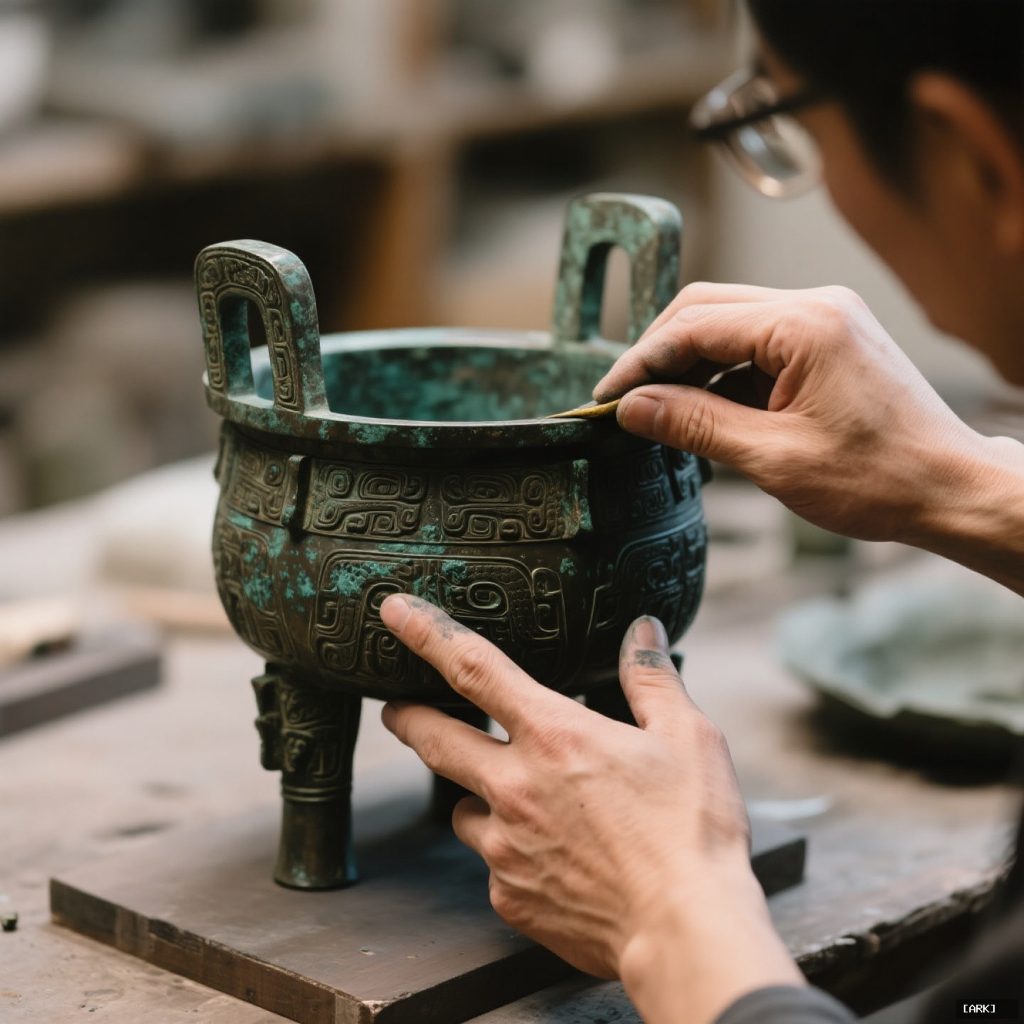
Ancient bronze vessel reproductions connect us to history through weight and form. They are emotional anchors in a digital age.
You see it on a sideboard, not behind glass. The light catches the intricate spirals and the stylized animal mask—the taotie—on its side. It feels cold and substantial under your palm. This isn’t a relic from a tomb. It’s a modern object, a high-fidelity copy of a three-thousand-year-old Chinese zun wine vessel. Yet its presence alters the room. It introduces a silence, a gravity. The market for these bronze artifact replicas is growing, and it’s driven by something deeper than decoration. We are, in a sense, purchasing time.
Beyond the Museum Wall: The Desire for Coexistence
Why do people desire to own masterful reproductions of ancient bronze vessels?
People desire masterful reproductions because owning an original Shang or Zhou dynasty ritual vessel is an impossible fantasy for virtually everyone. These originals are priceless national treasures, locked in museum vaults or sold at auctions with incomprehensible estimates. A high-quality reproduction, commissioned from a specialist foundry using historical techniques like lost-wax casting, dismantles this absolute barrier. It serves as a physical portal, allowing for a tangible connection and coexistence with these culturally significant objects, rather than being a mere cheap souvenir.
Why would someone spend serious money on a copy? The answer flips the question on its head. For virtually everyone, owning an original Shang or Zhou dynasty ritual vessel is a fantasy. These objects are priceless national treasures, locked in museum vaults or appearing in auctions with estimates beyond comprehension. The barrier isn’t just financial; it’s absolute.
A masterful reproduction dismantles that barrier. It isn’t a cheap souvenir. It is a physical portal. When commissioned from a specialist foundry that employs historical techniques like lost-wax casting, the replica delivers the core sensory experience: the impossible weight, the precise geometry, the complex chemical patina that mimics centuries of burial. The value shifts from provenance—the object’s historical pedigree—to personal resonance. You are paying for the privilege of touch, for the right to live daily alongside a form that has endured millennia. It translates distant historical awe into a quiet, domestic ritual.
The Antidote to Ephemerality
What emotional need do ancient bronze vessel reproductions satisfy in a world of ephemerality?
Ancient bronze vessel reproductions satisfy a craving for authenticity of feeling, not just of the object. In a world saturated with mass-produced, disposable items and fleeting digital content, these replicas act as a deliberate protest against ephemerality. Their creation involves slow, meticulous craftsmanship—sculpting a model, building a ceramic mold, and pouring molten metal—resulting in a tangible, enduring artifact that provides a sense of permanence and connection to history, countering the transience of modern life.
So what emotional need does a bronze artifact replica actually satisfy? It speaks to a craving for authenticity, but not of the object itself. We crave authenticity of feeling.
Our world is saturated with the mass-produced and the disposable. Items are designed for obsolescence, both physical and digital. A scroll through a social feed is a cascade of moments already disappearing. Against this backdrop, a bronze vessel copy stands as a deliberate protest. Its creation is an act of slowness. Artisans sculpt a model, build a ceramic mold around it, melt out the wax, pour molten metal at over a thousand degrees Celsius, then spend hours chasing the surface by hand to sharpen details. Finally, they apply chemicals to induce a patina, layer by layer, to mimic the malachite greens or azurite blues of age.
To possess such an object is to ally yourself with a different timescale. It is a solid, weighty counterargument to the anxiety of a fleeting present. It offers a deep, non-verbal connection to human continuity—a tactile manifesto for permanence.
The New Visual Language of Antiquity
What is the new visual language of antiquity as seen on social media?
The new visual language of antiquity on social media, such as Instagram, repackages ancient bronze vessel reproductions into curated aesthetic compositions. It involves staging objects like Zhou dynasty guang replicas with a deep, mottled green patina against minimalist backdrops, such as raw concrete plinths, alongside architectural plants like monstera leaves. This approach uses soft lighting and sparse arrangements to create a mood of curated timelessness, selling an atmosphere of grounded, refined living rather than merely displaying historical artifacts.
This ancient desire now plays out on a modern stage: social media. Platforms like Instagram haven’t diminished interest in these objects; they’ve repackaged their appeal. A new visual language for antiquity has emerged.
Consider the popular aesthetic: a Zhou dynasty guang replica, its surface a deep, mottled green, sits on a raw concrete plinth. Beside it, a single, architectural leaf from a monstera plant. The lighting is soft, the composition minimalist. This image isn’t just displaying an object. It’s staging a mood—curated timelessness. It sells an atmosphere of grounded, refined living.
This shareability transforms the vessel. It moves from a private, scholarly interest to a component of personal branding. It signals cultivated taste and a connection to depth, all filtered through a clean, contemporary lens. The historical significance of the original vessel—whether it was used for ancestral offerings or ceremonial banquets—often becomes secondary. Its primary utility is aesthetic, a powerful prop in a narrative of intentional, anchored living. The vessel bridges a gap, making ancient gravity feel compatible with modern minimalist design.
Aspiration, Not Deception
What is the aspirational goal behind displaying reproductions of ancient bronze vessels?
The goal is not deception, but aspiration. Displaying a reproduction involves bringing a symbol of profound cultural weight and artistic achievement into one's immediate environment. It is about actively inviting a fragment of historical aesthetic into personal space, not pretending to own an original artifact. Buyers of high-quality reproductions from known ateliers are fully aware they do not possess a multimillion-dollar museum piece; the transaction is driven by a desire to connect with and appreciate cultural heritage, not by illusion.
A persistent criticism lingers. Is displaying a reproduction just pretending to have something you don’t? This accusation misses the point entirely.
No one is fooled. The buyer of a several-thousand-dollar reproduction from a known atelier is not under the illusion they own a multimillion-dollar museum piece. The transaction has nothing to do with pretense. It is purely aspirational.
The goal is to bring a symbol of profound cultural weight and artistic achievement into your immediate environment. You are not pretending to own history. You are actively inviting a fragment of its aesthetic and spiritual ethos into your daily life. It is a conscious choice to live alongside certain forms, energies, and ideas. Playing a recording of a Beethoven blend doesn’t mean you’re pretending to conduct the Vienna Philharmonic. You are choosing to fill your space with that particular beauty and complexity. The reproduction vessel operates on the same principle.
Ritual Reborn
How do modern reproductions of ancient bronze vessels connect to the concept of ritual?
Modern reproductions of ancient bronze vessels connect to ritual by anchoring new, personal ceremonies, transforming the original sacred function into contemporary practice. Originally, vessels like ding cauldrons and he ewers were central to state and ancestral rites, mediating between the human and divine. Today, reproductions facilitate personal rituals through acts like their careful placement on a dedicated shelf, gentle dusting, or the mindful pause to appreciate their form, thus reborn as anchors for individual meaning and reflection in modern life.
Perhaps the most profound connection between these replicas and modern life lies in the concept of ritual. Originally, these bronze vessels were the central actors in sacred ceremonies. A ding cauldron held sacrificial food for ancestral spirits. A he poured ritual wine to honor gods and kings. Their function was to mediate between the human and the divine, to mark moments of supreme importance.
Their modern reproductions often anchor new, personal ceremonies. The act becomes the ritual. Carefully placing the vessel on a dedicated shelf. Dusting its surface with a soft cloth. Simply pausing during a busy day to trace a finger along its raised decoration. These are small, secular acts of reverence. They create a punctuation mark in time, a deliberate pause that says, “This moment is different.”
In this way, the reproduction facilitates a quiet, personal spirituality. It is disconnected from its original religious context but eerily mirrors its core function: to designate a moment as separate, more significant, and connected to something larger than the self. The vessel becomes an altar to mindfulness, a tool for finding depth in the everyday.
The Craft Behind the Copy
What is the traditional lost-wax casting process used to create high-quality reproductions of ancient bronze vessels?
The process begins with an artist sculpting a detailed wax model of the vessel, including features like zoomorphic handles and taotie masks. This model is encased in a heat-resistant ceramic shell, and the wax is melted out to create a hollow mold. Molten bronze, typically a copper alloy, is then poured into the cavity. After cooling, the ceramic shell is broken away to reveal the bronze casting, which is then finished and patinated. This method faithfully replicates ancient techniques, ensuring material and craft integrity for emotionally resonant reproductions.
Not all reproductions are created equal. The emotional resonance is directly tied to material and craft integrity. The best foundries are transparent about their process, which often faithfully follows ancient methods.
It starts with the model. For a true lost-wax casting, an artist sculpts the vessel in wax, capturing every detail of the ancient design—the zoomorphic handles, the abstract thunder patterns (leiwen), the iconic taotie masks. This wax model is then encased in a heat-resistant ceramic shell. The wax is melted out, leaving a perfect hollow cavity. Molten bronze, a classic copper-tin alloy, is poured in. Once cooled, the shell is broken away, revealing the “raw” bronze casting.
This is just the beginning. The casting will have seams and rough surfaces. Master chasers use fine tools to remove these imperfections and re-sharpen every line of the decoration. Finally, the patina is applied. This is where art meets alchemy. Chemicals are brushed or sprayed onto the heated bronze surface, inducing controlled corrosion that mimics centuries of natural oxidation. A skilled patina artist can produce the deep emerald of buried bronze, the speckled azure of a vessel recovered from a riverbed, or the smooth, dark chocolate tone of one preserved in a tomb.
This commitment to craft is what separates a meaningful reproduction from a decorative knockoff. The weight feels right because the alloy is correct. The details are sharp because they were chased by hand. The patina has depth because it was built in layers, not painted on.
A Guide for the Discerning Buyer
If you feel drawn to bring one of these objects into your life, a thoughtful approach ensures you find a piece that will resonate for years. Here is a practical framework.
Prioritize Foundry Transparency
Seek out artisans or studios that clearly explain their methods. “Lost-wax casting” is a key term. Descriptions of manual chasing and chemical patination are good signs. Avoid sellers who only use vague terms like “antique style” or “bronze finish.”
Examine the Details
Look closely at photographs of the decoration. The motifs should be crisp and clear. Blurry, indistinct taotie masks or inscriptions indicate a low-quality mold and lack of hand-finishing. The best copies capture the rhythmic precision of the original designs.
Ask About the Metal
Authentic bronze is a copper-tin alloy. Some cheaper copies use brass (copper-zinc) or are even made from resin with a metallic coating. A reputable seller will specify the alloy. True bronze has a specific density and sonic quality—it rings when lightly struck.
Consider Scale and Context
Are you looking for a bold focal point for an entryway or a subtle accent for a bookshelf? Measure your space. A massive fang ding square cauldron commands attention, while a smaller jue tripod cup offers intimacy. Think about how you will live with it.
Know the Original
Research the historical vessel your replica is based on. Was it a food vessel (ding), a wine pitcher (hu), or a water basin (pan)? Understanding its original function and cultural context—available through museum resources—adds immense layers of meaning to the copy on your shelf. It transforms it from a shape into a story.
Living with a Fragment of Time
Owning a high-quality ancient bronze vessel reproduction is an ongoing conversation. You may notice how the light changes its appearance throughout the day, revealing new details. A true bronze patina will evolve slowly over decades in your home, developing a unique character. It asks for little—just an occasional gentle dusting and protection from direct sunlight or harsh chemicals that can strip its surface.
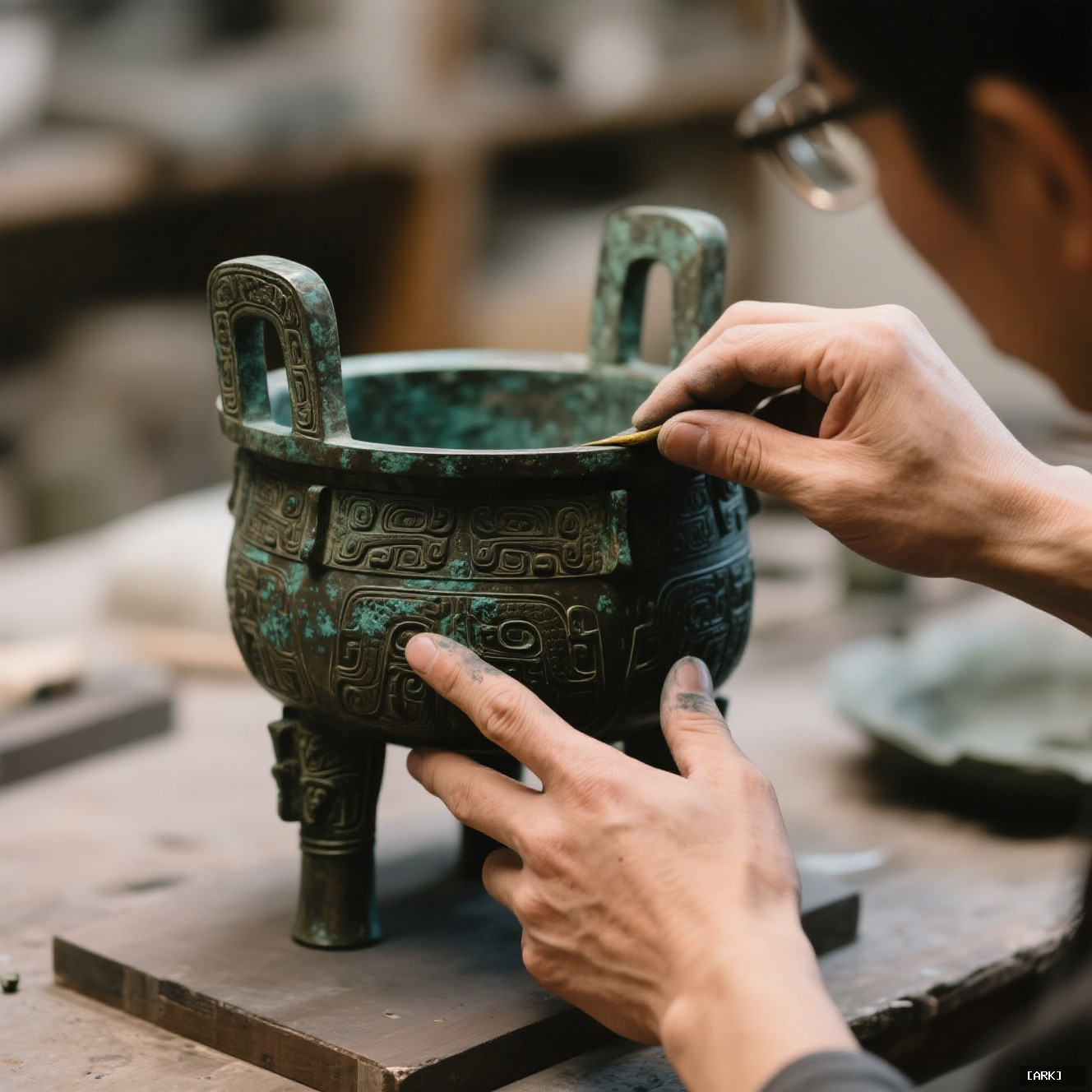 artisan's hands applying chemical patina to a…, featuring Ancient bronze vessel reprodu…" loading="lazy">
It is not, primarily, a financial investment. It is an investment in atmosphere, in personal archaeology, in daily inspiration. In a world that often feels untethered, these objects offer a profound sense of ground. They remind us that beauty is not always new, that meaning can be cast in metal, and that sometimes, to move forward, we need to bring a carefully considered piece of the deep past along with us.
Sources & Further Reading
- The Metropolitan Museum of Art: “Shang and Zhou Dynasty Bronzes” – https://www.metmuseum.org/toah/hd/shzh/hd_shzh.htm
- Freer|Sackler: The Smithsonian’s Museums of Asian Art – “Bronze Vessels from Ancient China” – https://asia.si.edu/learn/ancient-chinese-bronzes/
- Khan Academy: “Ritual bronze vessels of the Shang and Zhou” – https://www.khanacademy.org/humanities/art-asia/imperial-china/shang-dynasty/a/ritual-bronze-vessels-of-the-shang-and-zhou
- British Museum: “Chinese Bronzes” Collection Database – https://www.britishmuseum.org/collection/galleries/chinese-bronzes
About Our Expertise
Our analysis draws from decades of expertise in Chinese traditional arts, collaborating directly with master artisans who preserve ancient bronze-casting techniques like lost-wax methods and authentic patina application. These reproductions aren't mere copies but respectful interpretations that maintain the cultural integrity and artistic principles of Shang and Zhou dynasty originals.
We verify all craft details through consultation with Chinese cultural historians and metallurgy specialists, ensuring our guidance on bronze alloy composition and decorative motifs like taotie masks reflects authentic heritage. This commitment to accuracy helps collectors make informed decisions while honoring the profound ritual significance these vessels held in ancient Chinese society.
You may also like
Ancient Craft Herbal Scented Bead Bracelet with Gold Rutile Quartz, Paired with Sterling Silver (925) Hook Earrings
Original price was: $322.00.$198.00Current price is: $198.00. Add to cartAncient Craftsmanship & ICH Herbal Beads Bracelet with Yellow Citrine & Silver Filigree Cloud-Patterned Luck-Boosting Beads
Original price was: $128.00.$89.00Current price is: $89.00. Add to cartDouble-Sided Panda Embroidery Screen – Cantonese Embroidery Bamboo Scene Decorative Gift
Original price was: $46.70.$33.68Current price is: $33.68. Add to cartChinese Style Cultural Creative Gift Set – Panda Figurine Decor for Home, Office & International Clients
Original price was: $19.86.$17.20Current price is: $17.20. Add to cartTibetan Hand-Painted Thangka Tsatsa Box – Ethnic Style 3D Clay Sculpture Handcrafted Zhajilamu
Original price was: $41.00.$32.00Current price is: $32.00. Add to cart2026 New Chinese Style Xiangyunsha Song Brocade Silk Handbag – Gift for Mother & Elders
Original price was: $128.00.$115.00Current price is: $115.00. Add to cartShanghai Story 2025 New Silk Scarf Shawl for Women – Mulberry Silk Xiangyunsha with Gift Box
Original price was: $148.90.$136.90Current price is: $136.90. Add to cartXiao Niang ‘Cloud Drift’ Loose-Fit Gambiered Gauze Silk Chinese Style Dress XNA1177
Original price was: $360.00.$328.00Current price is: $328.00. Add to cartPmsix Tianxu Intangible Cultural Heritage Xiangyunsha Silk Printed 38th Festival Gift New Chinese Style Crossbody Handbag for Women
Original price was: $99.50.$94.50Current price is: $94.50. Add to cart























