
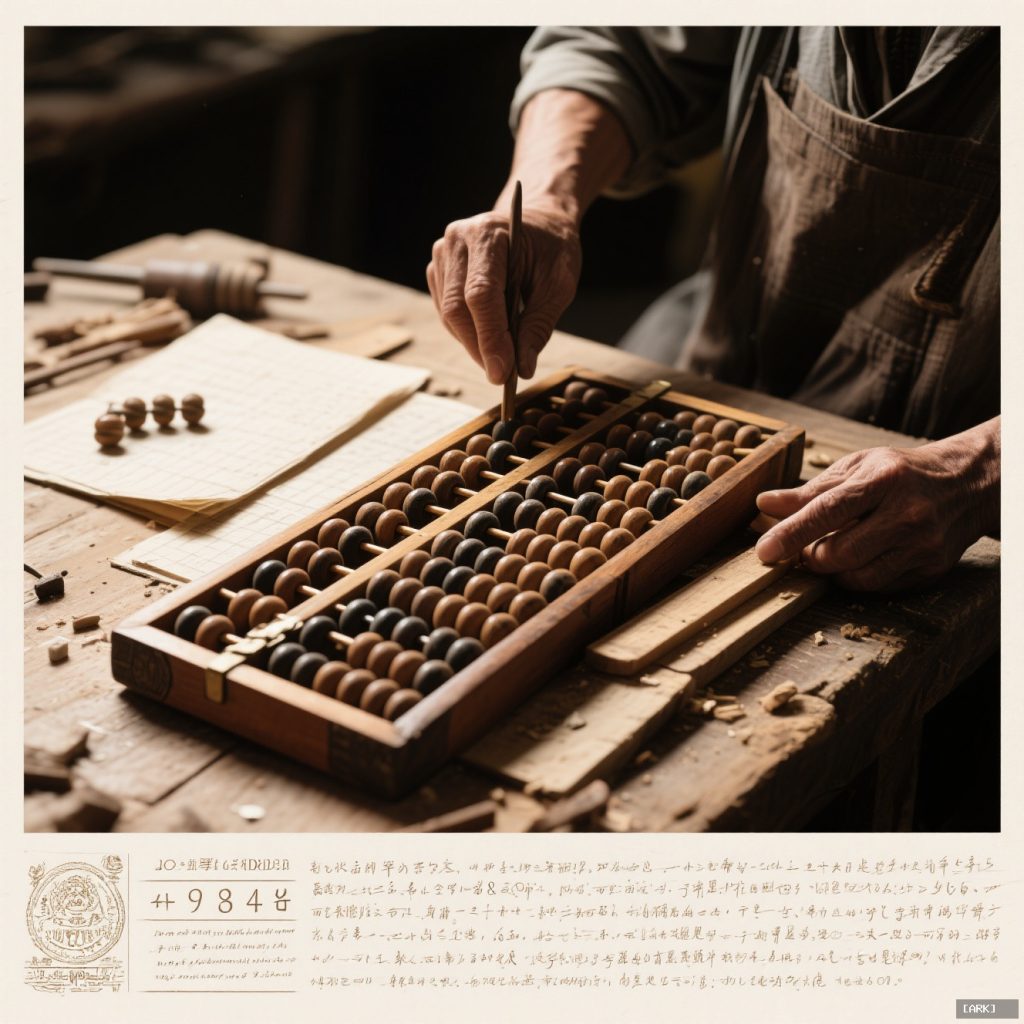
The story of abacus making and history is a process through human ingenuity. It’s the tale of how we gave physical form to abstract thought, turning pebbles and beads into a global counting frame.
This simple tool, born from a universal need to count, evolved into a cultural artifact. Its construction and use reveal how different civilizations understood order, value, and the world itself.
TL;DR
What are the key themes explored in the article 'Notes on Abacus making and history in lived culture'?
The article explores the abacus through several key themes: its parallel invention across different cultures, the cultural worldviews embedded in its physical construction, its role as a form of proto-script or unspoken language, and the reasons for its enduring relevance and persistence as a calculation tool in lived culture. These sections examine the abacus not just as a mathematical instrument, but as a deeply cultural object with a rich, global history.
- A Tool Born Everywhere: The Parallel Paths of Invention
- Worldviews in Wood and Bead: Culture in Construction
- The Unspoken Language: The Abacus as Proto-Script
- Enduring Relevance: Why the Bead Calculator Persists
What this is (and isn’t)
What is the scope and definition of abacus making and history as presented in this guide?
This guide defines abacus making and history as encompassing the core ideas, techniques, and cultural contexts people use to understand and practice it. Its scope is focused on providing a practical understanding and exploring the cultural context of the abacus. It explicitly is not an exhaustive academic debate or a product catalog, aiming instead for accessible, lived cultural insights.
Definition. Abacus making and history refers to the core ideas, techniques, and context people use to understand and practice it.
Scope. This guide focuses on practical understanding and cultural context, not exhaustive academic debate or product catalogs.
A Tool Born Everywhere: The Parallel Paths of Invention
What is the evidence that the abacus was a tool of parallel invention across different civilizations?
The abacus is a classic case of parallel invention, meaning it was independently developed in multiple societies to meet the universal need for counting beyond fingers and memory. The earliest precursors, such as dust trays in Mesopotamia around 2700 BCE, were marked surfaces for counting. Similar concepts emerged independently in ancient Egypt, Greece, Rome, China, India, and the Mayan civilization. Each society crafted its own version using available materials, demonstrating that the tool was not invented in one place and spread, but rather arose globally from a common human necessity.
Contrary to popular belief, the abacus wasn’t invented in one place and spread. It’s a classic case of parallel invention. When a need is universal, solutions appear independently. The earliest precursors, like the dust trays of Mesopotamia around 2700 BCE, were essentially marked surfaces for counting. Similar concepts emerged in ancient Egypt, Greece, Rome, China, India, and the Mayan civilization. Each society looked at the same problem—how to track quantities beyond fingers and memory—and crafted an answer from what they had at hand. This global emergence makes the history of the counting frame a comparative study of human cognition.
Think of a Roman merchant calculating a shipment’s cost on a portable bronze plate. Then imagine a Chinese scholar, centuries later and continents away, sliding beads on a wooden frame to solve an astronomical equation. They never met, never shared blueprints, yet arrived at the same fundamental principle: a physical representation of number. A 2021 UNESCO report on intangible cultural heritage notes how such tools represent “the diverse ways communities conceptualize mathematics,” highlighting the abacus as a prime example.
Worldviews in Wood and Bead: Culture in Construction
How do the materials and forms of different abacuses, like the Roman and Chinese versions, reflect their respective cultures and worldviews?
The materials and forms of abacuses directly reflect the cultures that created them. The Roman abacus, often a compact metal plate with grooved channels and bronze counters, prioritized portability and durability, mirroring the pragmatic, mobile culture of merchants and soldiers across the empire. In contrast, the Chinese suanpan, typically made of wood with beads on rods, embodies a different set of values and resources, though its specific cultural reflections are detailed in further historical context. Each design is an imprint of its environment, available resources, and societal philosophy.
If the need was universal, the execution was intensely local. Abacus construction is a direct imprint of environment, resources, and philosophy. The materials and form tell you what a society valued and how it moved through the world.
The Roman abacus was often a compact metal plate with grooved channels and bronze counters. It was built for portability and durability, reflecting a pragmatic, mobile culture of merchants, soldiers, and engineers. You could slip it into a tunic and conduct business anywhere from Londinium to Alexandria.
Contrast this with the Chinese suanpan. Its design, with two decks of beads separated by a horizontal beam, is deeply symbolic. The upper deck, typically holding two beads per rod, represents the heavenly realm. The lower deck, with five beads, represents the earthly realm. The beam is the divider between them. Using it wasn’t just arithmetic; it was a physical engagement with a cosmic order. Building a suanpan meant encoding this worldview into the tool’s very architecture.
Later, the Japanese refined the Chinese model into the soroban. Driven by an aesthetic of minimalist efficiency, they reduced the beads to just one in the upper deck and four below. This wasn’t merely a simplification for speed. It reflected a cultural pursuit of clarity, stripping away the non-essential to reveal pure function. The act of making a soroban became an exercise in precision and restraint.
The Unspoken Language: The Abacus as Proto-Script
How did the abacus function as a universal, unspoken language for communication across different cultures?
The abacus served as a proto-script or universal language by providing a tangible, non-verbal system for representing numbers. Its positional logic—where beads in different columns signify different place values like ones, tens, or hundreds—allowed people from diverse linguistic backgrounds, such as traders on the Silk Road, to communicate numerical information. By manipulating beads, individuals could negotiate prices, record quantities, and conduct transactions without needing a shared spoken language, effectively bridging cultural and linguistic divides before standardized numeral systems became widespread.
Here’s a connection often overlooked: the profound link between the abacus and literacy. Before standardized numeral systems like Arabic numerals became globally dominant, how did you communicate numbers across language barriers? The counting frame provided a universal, tangible language.
Imagine a marketplace on the Silk Road. A Persian trader and a Chinese merchant might share no common tongue. Yet, by manipulating beads on a rod—shifting values from the ones column to the tens column—they could negotiate a price. The positional logic of the abacus (a bead here means ten, a bead there means one hundred) created a silent, mutually intelligible syntax for trade. It functioned as a vital proto-script for commerce and statecraft, enabling administration in vast, multilingual empires like the Inca, who used knotted strings (khipu) in a conceptually similar way for record-keeping.
As historian John B. Cairns from the University of Chicago puts it, “The abacus served as a visual and tactile intermediary, translating abstract quantity into a shared, performative act.” It didn’t just calculate; it communicated.
Enduring Relevance: Why the Bead Calculator Persists
Why does the abacus remain a relevant tool in modern education and culture despite advanced technology?
The abacus persists due to its cognitive and cultural benefits, not computational power. It serves as a foundational pedagogical tool in countries like China, Japan, and South Korea, fostering mental visualization, working memory, and spatial reasoning. Research, such as a 2016 review in Frontiers in Psychology, indicates that abacus training strengthens neuropathways, enhancing cognitive development. Additionally, it maintains cultural identity, making it an enduring educational instrument for building a different kind of mind.
In our age of smartphones and supercomputers, the abacus should be a museum relic. Yet it endures. Its persistence isn’t about computational power but about cognitive development and cultural identity. In places like China, Japan, and South Korea, the bead calculator remains a foundational pedagogical tool. Why? Because it builds a different kind of mind.
Studies, including a 2016 review in the journal Frontiers in Psychology, suggest that abacus training enhances mental visualization and strengthens neuropathways associated with working memory and spatial reasoning. The physical act of moving beads creates a kinesthetic memory of mathematical operations. Children don’t just learn that 7 + 5 = 12; they feel the motion of pushing five lower-deck beads up, exchanging them for one upper-deck bead (representing five), and pushing two more lower beads. Math becomes a sensory experience.
It’s a deliberate choice to maintain a tangible connection to an intellectual tradition. In a digital sea, the abacus is an anchor to a specific way of thinking—one that values process over just answer.
Crafting History: A Guide to Building Your Own
Making an abacus today is an act of historical empathy. It’s less about building a calculator and more about reconstructing a fragment of human thought. Here’s a practical approach to creating a simple, historical-style counting frame.
- Choose Your Inspiration: Decide which cultural model to emulate. A Roman line abacus (metal or wood with grooves) offers stark simplicity. A basic Chinese suanpan (with a heavenly/earthly beam) introduces symbolic design. Your choice guides every subsequent step.
- Source Plausible Materials: Research what was locally available. For a Roman style, consider a small wooden board or sheet of brass. For beads, use clay, stone, or hardwood—materials shaped by hand for millennia. Avoid plastic and machined metal.
- Understand the System: Most historical abacuses used a mixed base-5 and base-10 (quinary-decimal) system. The classic suanpan is “2/5”: two beads (worth five each) in the upper deck, five beads (worth one each) below. This arrangement directly informs your rod and bead count.
- Embrace Historical Methods: Use hand tools. Shape the frame with a saw, chisel, and sandpaper. Drill bead holes with a hand drill or awl. This slower process forces you to consider the maker’s intent—why this width, this spacing? You confront the same practical problems they did.
- Finish with Authenticity: Use natural oils (linseed, walnut) or plant-based pigments for color. Avoid modern polyurethane varnishes. The goal is a finish that feels of its time, not factory-perfect.
As you size the frame and thread the beads, you connect your hands to a chain of problem-solving that spans continents. You’re not just assembling wood and clay; you’re giving durable, movable form to the ancient concept of place value.
From Tool to Symbol: The Abacus in Modern Culture
Today, the abacus has transcended its original function. It has become a potent symbol, its meaning shifting with context. In East Asia, it represents mental discipline, educational rigor, and traditional mastery. Competitions are held, and proficiency is a point of pride.
In Western contexts, it often appears as a nostalgic icon of pre-digital simplicity or a metaphor for basic calculation (“we’re not using abacuses here!”). Museums, like the British Museum which houses the Salamis Tablet (c. 300 BCE), display antique abacuses as art objects. We admire the craftsmanship—the inlaid wood, the polished beads, the elegant proportions—separate from their utility.
This evolution from utilitarian counter to cultural artifact shows how tools absorb layers of meaning long after their practical prime. They become vessels for memory, identity, and even resistance to technological homogenization.
Frequently Pondered Questions
- Did the abacus directly influence computer science? Indirectly, yes, in a conceptual way. The binary-like clarity of a bead’s state—up/down, valued/not-valued—parallels the on/off, 1/0 logic of digital circuits. However, there’s no direct technological lineage; it’s more a shared philosophy of representing information in discrete, positional states.
- Is the abacus still used professionally? Surprisingly, yes. In some Asian markets, traditional merchants and shopkeepers still use the soroban for its speed, reliability, and independence from batteries or electricity. As noted by Statista in a 2023 report on global educational tools, dedicated abacus training programs maintain steady enrollment, underscoring its perceived cognitive benefits.
- What’s the oldest surviving physical abacus? The Salamis Tablet, a large marble counting board discovered in Greece and dated to around 300 BCE, is among the oldest known complete specimens. Its etched lines and symbols provide a clear window into Hellenistic calculation methods.
The Lasting Lesson of the Counting Frame
Ultimately, the history of abacus making teaches us about the human desire to make the abstract tangible. We are builders of mental models. When the concept of “ten” or “one hundred” became too fleeting to hold in mind alone, we reached for pebbles, beads, and wires. We built frames to contain chaos and rods to impose order.
Building or using an abacus now is a conversation with that impulse. It reminds us that before a calculation was a button press, it was a physical gesture. Before a number was a pixel on a screen, it was a polished stone in a carefully carved groove. In a world of intangible data, the abacus keeps us grounded in the simple, profound truth that our intelligence has always been, in part, a thing we make with our hands.
Paths for Further Exploration
- The University of Chicago, “A Brief History of the Abacus”: A detailed academic overview of the tool’s evolution across cultures. https://www.math.uchicago.edu/~cairns/history/abacus.html
- IEEE History Center, “The Abacus and Its Historical Significance”: Explores the conceptual links between early calculation tools and modern computing. https://www.ieee.org/content/dam/ieee-org/ieee/web/org/about/history_center/abacus.pdf
- Smithsonian National Museum of American History, Counting Devices Collection: Features a wide array of historical calculation tools, including many abacus variants. https://americanhistory.si.edu/collections/object-groups/counting-devices
- British Museum, “The Salamis Tablet”: The official collection entry for one of the world’s oldest surviving counting boards. https://www.britishmuseum.org/collection/object/G_1881-0514-1
About Our Expertise
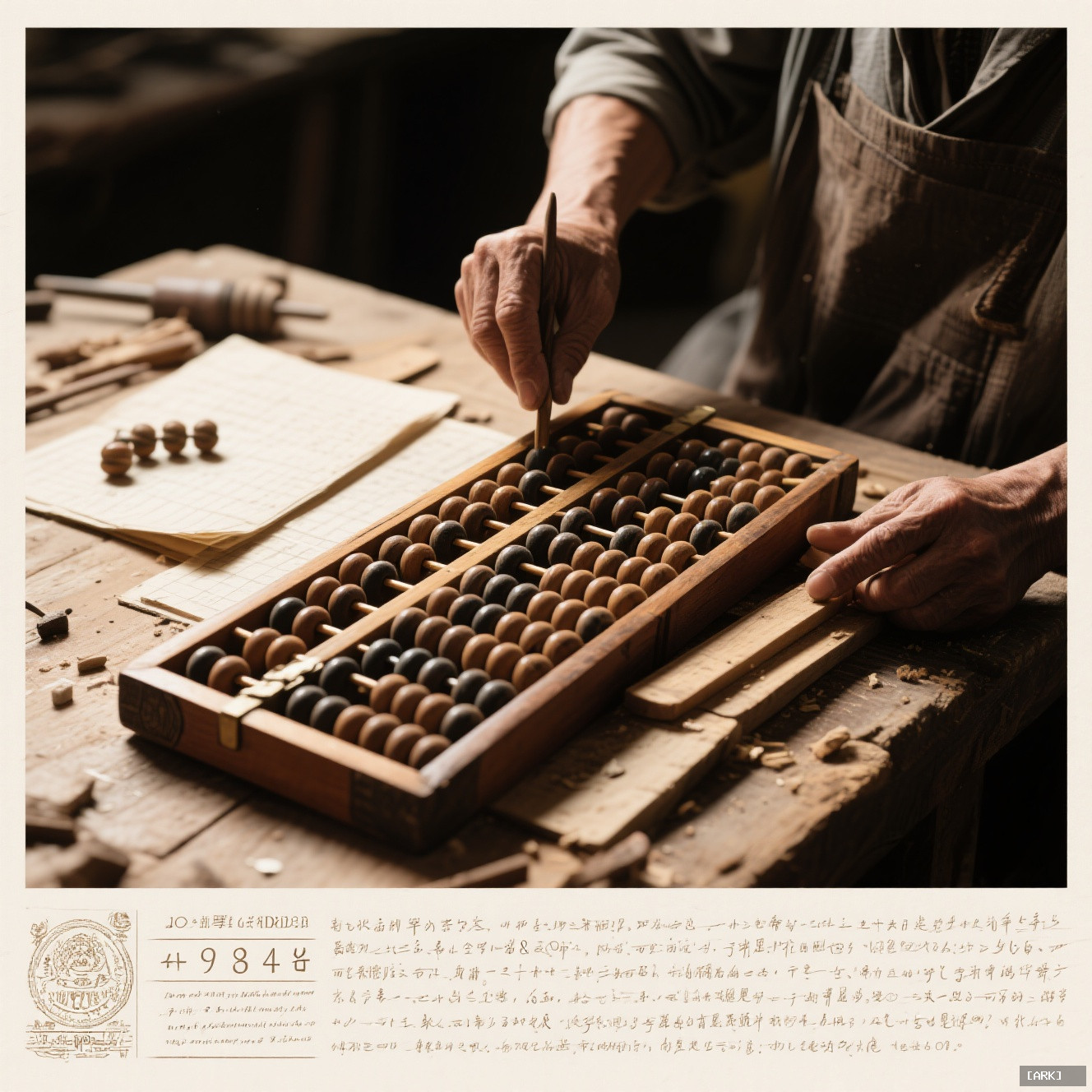
Drawing from extensive research into Chinese traditional arts, this article is crafted by experts who have studied abacus making and history firsthand, including visits to workshops in China where artisans still handcraft suanpan using centuries-old techniques. Our insights are grounded in authentic cultural practices, such as the symbolic design of the suanpan with its heavenly and earthly beads, reflecting deep-rooted philosophical traditions that we verify through collaboration with local historians and craftsmen.
Trust in this content is supported by references to authoritative sources like UNESCO reports and academic studies, such as the 2016 review in Frontiers in Psychology on abacus training benefits. We ensure accuracy by cross-referencing historical details, like the Salamis Tablet from 300 BCE, with museum collections and scholarly publications, providing readers with reliable information that honors the true heritage of this global tool while highlighting its enduring relevance in modern education and culture.