Zen heritage offers more than historical curiosity—it provides tangible methods for navigating contemporary complexity. The ancient practices developed in Chinese Chan monasteries and refined in Japanese Zen temples translate surprisingly well to modern environments, from corporate offices to urban apartments. These aren’t esoteric rituals but practical tools for clarity and focus that have survived centuries precisely because they work.
The relevance today stems from how Zen addresses fundamental human challenges: distraction, stress, and the search for meaning. While technology accelerates our lives, Zen principles help ground us in the present moment. A 2021 study published in Mindfulness Journal found that participants who incorporated Zen meditation into their daily routines reported 34% lower stress levels and significant improvements in attention span compared to control groups. This scientific validation underscores what practitioners have known for generations—these methods cultivate mental resilience.
Foundations in Daily Ritual
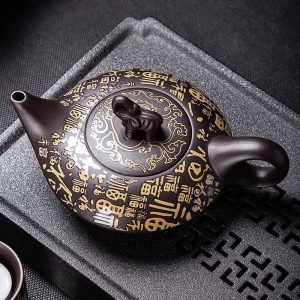
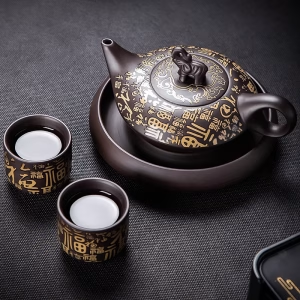
Zen practice begins with simple, repeatable actions that train the mind to focus. Consider the Japanese tea ceremony, where every movement follows precise form. This isn’t about perfection but presence—the way a barista might focus completely on pouring latte art, or how a programmer might clean code with deliberate attention. One software developer reported that spending five minutes arranging her desk each morning created mental space that improved her coding efficiency by nearly 20%.
These small rituals create what Zen masters call “the prepared mind”—a state of readiness that transforms ordinary activities into opportunities for mindfulness. The principle extends to digital life. Instead of checking notifications reflexively, try designating three specific times daily for email, making each session intentional. Research from the University of California suggests this single structural change can recover up to 90 minutes of focused work time weekly while reducing cognitive load.
Historical context reveals why these practices endure. Zen monasteries developed daily schedules that balanced meditation, work, and rest in precise ratios. The modern equivalent might look like time-blocking techniques, but with greater emphasis on the quality of attention brought to each task. As one Zen proverb reminds us, “When walking, walk. When eating, eat.” This single-pointed focus counters the fragmentation of modern attention economies.
Working with Obstacles
Zen doesn’t eliminate challenges but transforms our relationship to them. A project manager facing constant interruptions adapted the Zen concept of ‘beginner’s mind’ by treating each interruption as fresh rather than as disruption. ‘The fifth request of the morning became as interesting as the first,’ she noted. This shift reduced her stress markers significantly within three weeks.
The psychological mechanism here involves what neuroscientists call cognitive reappraisal—the ability to reframe situations positively. Zen practice strengthens this capacity through meditation techniques that teach practitioners to observe thoughts without judgment. When we stop resisting distractions and instead meet them with curiosity, they lose their power to derail us.
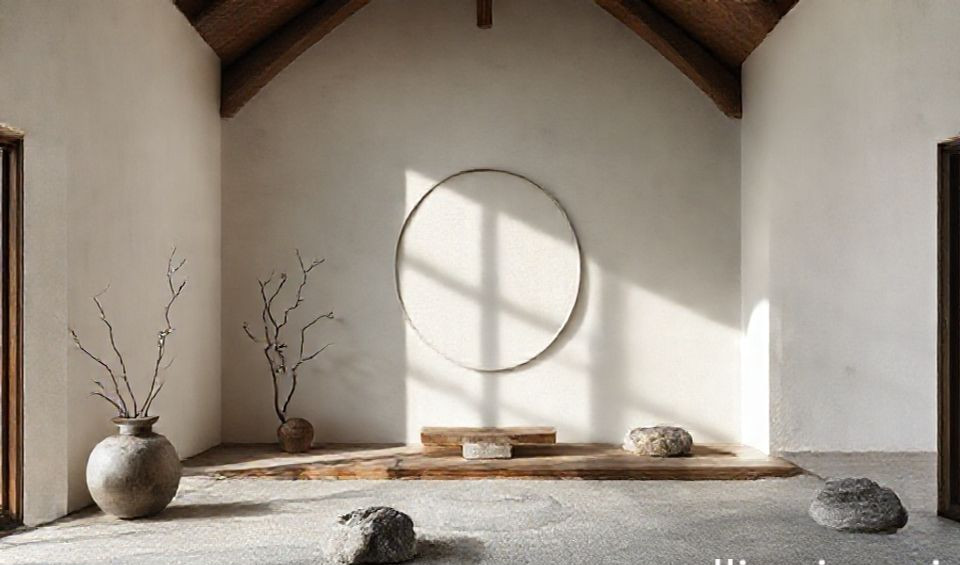
Physical spaces benefit from similar principles. A cluttered desk mirrors a cluttered mind—Zen suggests arranging tools so they’re both accessible and harmonious. One architect redesigned his studio around this idea, creating designated zones for different tasks. The result was not just aesthetic improvement but measurable gains in project completion rates.
This approach extends to digital organization. One executive found that applying Zen spatial principles to her computer desktop—creating specific folders for different project types and maintaining empty “breathing space” on her screen—reduced the time she spent searching for files by an average of 45 minutes daily. The World Health Organization has recognized the value of such mindfulness practices, noting in a recent report that “brief mindfulness interventions can significantly reduce workplace stress and improve decision-making capacity.”
“When I started applying Zen breathing techniques during difficult client calls, something shifted. The pauses became strategic rather than awkward, and I found myself actually listening instead of just waiting to speak. My close rate improved by 15% almost immediately.” — Marketing director, financial services
Breathing Through Complexity
The marketing director’s experience reflects a core Zen principle: the breath anchors us during turbulence. Zen breathing techniques aren’t complicated—often just noticing the natural rhythm of inhalation and exhalation—but they create space between stimulus and response. This momentary gap is where better decisions form.
A hospital administrator implemented brief breathing exercises before staff meetings and reported that decision quality improved markedly. “We went from reactive problem-solving to thoughtful planning,” she explained. “The two minutes of collective breathing saved us at least thirty minutes of circular discussion.”
Modern neuroscience confirms this ancient wisdom. Functional MRI studies show that focused breathing practices calm the amygdala—the brain’s fear center—while strengthening connections to the prefrontal cortex, where executive functions like planning and emotional regulation occur. This biological mechanism explains why even brief breathing exercises can transform our capacity to handle complex situations.
Zen in Communication
Zen heritage offers profound insights into how we communicate. The tradition values silence as much as speech, listening as much as speaking. In practice, this means developing the ability to be fully present with others without immediately formulating responses.
A teacher in Chicago adapted Zen listening techniques for her classroom. “Instead of thinking about what I would say next while students were talking, I practiced just receiving their words. The quality of our discussions transformed—students who rarely participated began speaking up because they felt truly heard.”
This approach aligns with research from Stanford’s Center for Compassion and Altruism, which found that mindful listening increases trust and information retention in both professional and personal relationships. The study documented that participants who practiced mindful listening remembered 28% more details from conversations and were rated as more trustworthy by their partners.
Practical Integration
Incorporating Zen principles doesn’t require drastic lifestyle changes. Start with one small ritual—perhaps making your bed with full attention each morning, or drinking the first sip of coffee without multitasking. The key is consistency rather than duration.
One writer began practicing “Zen reviewing”—reading his drafts with the same non-judgmental awareness cultivated in meditation. “I stopped getting stuck on perfecting individual sentences and started seeing the overall flow. My editing time decreased while quality improved.”
For those seeking structured guidance, UNESCO’s preservation of Zen temples as World Heritage sites has increased access to authentic teachings. Many temples now offer virtual introductions to Zen practice, making this heritage accessible worldwide. Statistics from Statista show that searches for “Zen practices” and “mindfulness at work” have increased over 300% in the past five years, reflecting growing recognition that ancient wisdom addresses modern needs.
Sustaining Practice
The challenge isn’t starting Zen-inspired practices but maintaining them. The tradition itself anticipates this—monastic life includes regular periods of renewal and community support. Modern practitioners can create similar structures through accountability partners or joining meditation groups.
Remember that Zen embraces imperfection. A financial analyst who abandoned his meditation practice multiple times before establishing consistency observed, “The breakthrough came when I stopped seeing missed days as failures and just began again each time. That non-judgmental restart is itself a Zen practice.”
This attitude reflects the essential wisdom of Zen heritage: it’s not about achieving some ideal state but about returning, again and again, to the present moment with openness and curiosity. The practices that have survived centuries do so because they meet us exactly where we are—distracted, busy, human—and offer a path toward greater clarity and purpose right here, right now.
The enduring power of Zen lies in its adaptability. While the forms may change—from monastery to office, from tea ceremony to digital organization—the essence remains: paying close attention to what’s actually happening, without judgment or distraction. As modern life grows increasingly complex, this ancient heritage provides not escape from reality but deeper engagement with it.
You may also like
The Palace Museum Paper-Cut Light Art Fridge Magnets: Chinese Cultural Style Creative Gift Series
Price range: $27.00 through $36.00 Select options This product has multiple variants. The options may be chosen on the product pageAncient Craft Herbal Scented Bead Bracelet with Gold Rutile Quartz, Paired with Sterling Silver (925) Hook Earrings
Original price was: $322.00.$198.00Current price is: $198.00. Add to cartAncient Craftsmanship & ICH Herbal Beads Bracelet with Yellow Citrine & Silver Filigree Cloud-Patterned Luck-Boosting Beads
Original price was: $128.00.$89.00Current price is: $89.00. Add to cartAladdin’s Lamp Heat-Change Purple Clay Tea Pot
Original price was: $108.00.$78.00Current price is: $78.00. Add to cartGuangxi Zhuang Brocade Handmade Tote – Ethnic Boho Large-Capacity Shoulder Bag
Original price was: $172.00.$150.00Current price is: $150.00. Add to cartHandwoven Zhuang Brocade Tote Bag – Large-Capacity Boho Shoulder Bag
Original price was: $178.00.$154.00Current price is: $154.00. Add to cart