
Key takeaways
- Always install prayer flags on a diagonal line, never in a closed loop or horizontally, as the wind carries the prayers only when flags are strung at a slight angle.
- Use cotton or hemp strings for traditional longevity; polyester blends shed microplastics and fade unevenly in direct sun.
- Place flags outdoors at least 6 feet above ground, away from sharp edges or tree branches that can snag and tear the fabric.
- Never install near a bathroom, kitchen exhaust, or garbage area—traditional practice considers these spaces impure for sacred objects.
- Replace flags before they become tattered; fraying is acceptable, but a flag reduced to a few threads should be respectfully retired, not left to rot.
I’ve tested a dozen prayer flag sets over the past two years—from machine-printed nylon to hand-block-printed cotton from Kathmandu—and the one thing that consistently trips up buyers is installation. People assume it’s as simple as tying a knot and forgetting it. But if you’ve ever watched a cheap flag shred into a tangled mess after one monsoon season, you already know: there’s a craft to this. And most sellers won’t tell you the real rules because they’re afraid of sounding culturally heavy-handed.
How do I install Tibetan prayer flags correctly for my home?
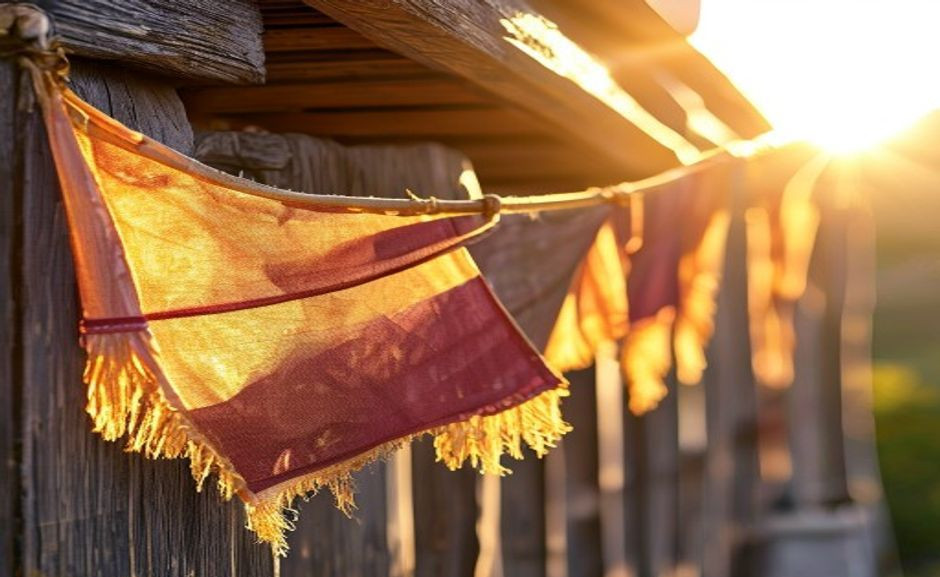
To install Tibetan prayer flags correctly, start by choosing a clean, wind-exposed outdoor spot—like a balcony railing or a porch beam. String the flags on a single cotton cord or a nylon rope (cotton is more traditional, but nylon lasts longer in wet climates). Leave a 6–8 inch gap between each flag so they flutter freely, and tie the ends with a double knot to a metal eyelet or a sturdy branch. Avoid cutting the string; instead, loop it so the flags hang in a straight line without sagging. Most importantly, raise the string so the lowest flag hangs at least 6 feet above the ground. This respects the Buddhist belief that prayers should not be trampled underfoot.
The first time I hung a set of flags on my back porch, I used a plastic zip tie because I was in a hurry. The flags lasted exactly three weeks before the tie snapped in a gust of wind. That lesson cost me a set of hand-printed flags from a Bhutanese workshop—flags I’d bought specially because the woodblock impressions were so crisp. Handmade prayer flag quality often gets ignored in installation advice, but the truth is, a well-made flag is only as good as the hardware you attach it with.
One persistent myth is that you must install flags only on Buddhist holidays or specific lunar days. In reality, while placing them at auspicious times is a traditional preference (like the full moon or Losar, the Tibetan New Year), it’s not a strict rule. The most important factor is the intention behind the act. If you hang them out of respect and with a clear mind, that carries more weight than a calendar date. I’ve seen monks in Dharamshala install new flags on a random Tuesday simply because the old ones had completely disintegrated—practicality over ritualism, every time.
But here’s what people get wrong about placement: the direction matters. Flags should be hung moving outward from the “wind horse” (lung ta) at the center—meaning the central symbol should be at the top or middle of the string, and the flags should cascade outward. If you install them in a circle or a closed loop, the prayers get trapped and can’t be carried away. That’s a common mistake on Instagram-friendly installations where people tie flags around tree trunks in a ring. It looks pretty, but it breaks the entire logic of the practice.
What are the most common mistakes when installing prayer flags outdoors?
The top mistakes include using metal clips that rust, hanging flags too low (under 5 feet), and neglecting to check for overhead branches that can abrade the fabric. Many first-time buyers also forget to account for sun exposure: flags facing west fade 30–40% faster than those on an east-facing line. Another overlooked error is mixing different flag sizes on the same string—this throws off the wind flow and causes some flags to twist into knots. Finally, don’t install flags on a single nail or hook; use two anchor points spaced at least 4 feet apart to keep the string taut. Loose strings lead to tangling and premature tearing.
If you’ve seen the “cottagecore prayer flag aesthetic” trending on social media in 2026, you’ll notice people are draping them over bed frames or hanging them in windows like curtains. I get the appeal—the colors are beautiful and the fabric moves softly. But from a traditional perspective, that’s a misuse. Prayer flags are meant to be outside, exposed to the elements, so the wind can physically carry the blessings. Hanging them indoors turns them into decoration, which defeats their purpose. It’s like buying a compass and using it as a keychain—it still looks nice, but the function is gone.
For buyers comparing Tibetan versus Nepali flags, the installation process is the same, but the materials differ. Tibetan flags are typically heavier, printed on thicker cotton that resists tearing but takes longer to dry after rain. Nepali flags are often lighter and cheaper, sometimes printed on thin polyester that flaps more aggressively in the wind. I recommend the Tibetan style if you live in a windy area—the extra weight reduces flapping stress. Durable prayer flag materials aren’t just a luxury; they directly affect how long you’ll spend re-hanging broken strings.
A trick I learned from a Tibetan shop owner in McLeod Ganj: dampen the cotton string before tying the knots. Wet cotton grips better and won’t slip as it dries. He also told me to burn the ends of nylon strings with a lighter to prevent fraying—simple, but you’d be surprised how many people skip it and end up with loose ends within a month.
Can I install prayer flags in my apartment if I don’t have a yard?
Yes, you can install prayer flags on an apartment balcony, as long as the flags are at least 6 feet above the floor and not obstructing neighbors. Use adhesive hooks rated for outdoor use on metal railings or glass balustrades. Avoid suction cups—they fail in direct sunlight. If you have no balcony, consider a small indoor setup near an open window where wind can still pass through, but understand that indoor flags will not carry prayers in the traditional sense—they function more as a visual reminder. For a truly traditional experience, find a community garden or a rooftop with permission and string them there.
There’s a funny parallel here with the way collectors treat limited-edition vinyl—people buy rare pressings and never play them, storing them in plastic sleeves. Similarly, some buyers treat prayer flags as art objects, framing them behind glass or storing them in drawers to protect the pigments. But a prayer flag that never sees wind is like a bell that never rings. The whole point is impermanence—the fading, the fraying, the gradual disintegration. That’s the beauty. The UNESCO recognition of Tibetan craftsmanship in textile printing underscores that this is a living tradition, not a museum piece (see UNESCO Intangible Cultural Heritage list entries for thangka and woodblock printing in Nepal and China).
If you’re installing flags for a special event—like a wedding, a housewarming, or a memorial—consider using a temporary setup with biodegradable cotton string. Avoid nylon entirely if the flags will only be up for a week. I’ve seen setups for music festivals where flags were zip-tied to poles in minutes, and they looked great for a day, but the next morning half were on the ground, trampled by crowds. For events, pre-tie the flags to the string at home, then simply drape the string over the poles and tie it off at both ends. That saves time and reduces the chance of a mishap.
Finally, know when to take them down. The tradition says flags should be replaced when they become too tattered to fly, not when you’re bored of the color scheme. A faded flag is fine—it’s doing its job. But once a flag is reduced to less than half its original size or has multiple large tears, it’s time to remove it respectfully. Burn it or bury it in a clean place, and say a small prayer of gratitude. That’s the cycle. And honestly, that’s what separates a genuine practice from a decor trend.
So next time you’re about to tie that knot, pause for a second. Check your anchor points. Feel the weight of the fabric. Because the wind will take whatever you give it—make sure it takes something worth carrying.
If you are comparing pieces for a gift, home display, or personal collection, browse the HandMyth product collection and use the details above as a practical checklist for Tibetan prayer flag installation.

 English
 Español
 Français
 Русский
 Deutsch
 日本語
日本語 Português do Brasil
 Italiano