In the hushed halls of museums, among serene Song dynasty ceramics, a peculiar beauty catches the eye—not in painted scenes or sculpted forms, but in the very skin of the glaze. A delicate, web-like network of cracks, fine as spider silk, covers the surface. This is crackle glaze, known in Chinese as dōngcī or “winter porcelain.” Far from a flaw, this intricate cracking was a masterful achievement of the potter’s art, a deliberate embrace of controlled imperfection that resonated with deep philosophical currents. It transformed the vessel from a mere container into a landscape, a microcosm where the forces of creation and decay were frozen in a moment of exquisite tension. To understand this phenomenon is to journey into the heart of Chinese aesthetic philosophy, where a calculated technical process yielded results that spoke of spontaneity, transience, and the profound beauty of the natural world.
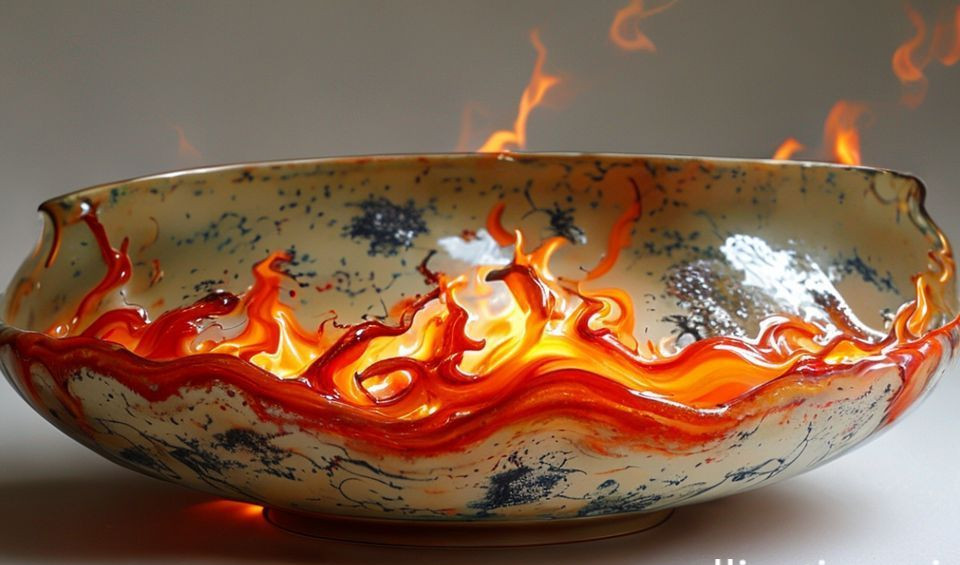
The Alchemy of Stress and Serenity
The creation of crackle glaze was a feat of thermal engineering disguised as art. Potters, particularly during the Song dynasty (960–1279 CE), exploited a fundamental mismatch. They applied a glaze whose coefficient of thermal expansion differed subtly from that of the clay body beneath. As the kiln cooled from its searing 1200-degree Celsius peak, the glaze contracted more than the clay, placing it under immense tensile stress. This stress found release in a symphony of minute fractures. The process was less about forcing a pattern and more about creating the precise conditions for nature to inscribe its own signature.
The scale and character of the crackle were dictated by a precise and often secretive recipe. The silica-to-alumina ratio in the glaze, the thickness of its application, and the meticulously controlled cooling rate were all variables in a high-stakes equation. A slower cooling cycle might encourage larger, more dramatic fissures, while a rapid quench could produce a dense, fine network akin to the skin of a dried persimmon. The clay body itself, its porosity and composition, acted as the foundational canvas. A single miscalculation could lead not to elegant craquelure but to catastrophic shivering, where the glaze peeled entirely away from the body. Success, however, yielded a surface alive with a silent, geological energy.
Potters categorized these patterns with poetic precision, naming them after elements of the natural world they so keenly observed. The prized “ice crackle” (bīngliè) featured large, crystalline shards resembling the fissures in a frozen lake. The fine “fish-roe crackle” (yúzǐ wé) was a tight mesh of tiny dots, while the “crab’s claw crackle” (xièzhuǎ wé) displayed broader, branching lines. This was not a process left entirely to chance. Historical accounts and modern scientific analysis reveal that potters developed ingenious methods to influence the outcome. Some would rub ink or charcoal into the fresh cracks after firing to accentuate the pattern, a technique that highlighted the network and turned a subtle texture into a bold graphic statement. The kiln master’s role was paramount, as the final, critical stages of cooling determined the fate of every piece. It was a ballet of chemistry and physics, where the artist collaborated with elemental forces to achieve a predetermined form of accident.
A Canvas for Philosophical Contemplation
This technical mastery served a profound cultural purpose. The crackle was not merely decorative; it was contemplative. To appreciate a crackle-glazed vessel is to understand the seismic shift in aesthetics that occurred during the Song dynasty, a period often regarded as the zenith of Chinese cultural refinement. The prevailing tastes moved away from the bold colors and ornate shapes of the preceding Tang dynasty toward a reverence for subtlety, natural form, and quiet elegance—an aesthetic sometimes described as “austere luxury.”
In the Daoist worldview, which profoundly influenced Song scholars and artists, perfection was found in the natural, the unforced, and the transient. The concept of zìrá (naturalness or “self-so”) advocated for non-interference and a deep appreciation for things in their innate state. The crackle pattern, unpredictable and unique to each firing, was the ultimate expression of zìrá. It was not painted on; it emerged from within the material’s own nature under guided conditions. It mirrored the cracks in dried riverbeds, the frost on a winter window, or the veins in a leaf—patterns of nature’s gentle fracturing and aging. A report by UNESCO on intangible cultural heritage often highlights such traditional crafts where philosophical concepts are materially embodied, though the specific techniques of Song potters were closely guarded secrets of the imperial workshops.
For scholars steeped in Chan (Zen) Buddhism, the network of lines held different, complementary meanings. The intricate web could represent the illusory nature of a unified, solid reality, suggesting the interconnectedness and inherent emptiness of all phenomena. It could also provide a focus for meditation, the eye following an endless, meandering path along the glaze’s fissures, losing itself in a labyrinth with no beginning or end. A simple guan (jar) for holding brushes, its soft celadon or pale bluish glaze veined with dark crackle, thus became an essential object of scholarly reflection. On a cluttered desk, it served as a daily, tactile reminder of the beauty inherent in change, impermanence (wúcháng), and the elegant decay that time imposes on all things.
The Voice of the Kiln: A Curator’s Reflection
Dr. Lin Wei, a curator of Asian ceramics, once observed, “We often speak of the potter’s hand, but with crackle glaze, we must listen for the kiln’s voice. The potter sets the stage—the clay, the glaze, the stacking. But the final pattern is a dialogue between material and fire. When I hold a Song dynasty ge-type crackle ware bowl, I am not holding an object finished a millennium ago. I am holding the record of its last few hours in the kiln, the moment its character was decided. The crackle is its birth certificate, written in lines of stress. It tells us that for these artists, control meant not imposing a rigid form, but creating the perfect conditions for a beautiful accident.” This perspective reframes the artifact from a static product to a captured event, a testament to the collaborative genius of human intention and elemental chance.
Evolution and Revival: From Imperial Kilns to Global Studios
The Song dynasty’s love for crackle glaze did not disappear with the fall of the empire. The technique was preserved and adapted, its meaning subtly shifting with each new era. During the subsequent Ming (1368–1644) and Qing (1644–1912) dynasties, crackle glaze took on a new life, often becoming more stylized and colorful. Imperial kilns at Jingdezhen produced stunning pieces where crackle was just one element of a complex decorative scheme, sometimes filled with contrasting pigments of red, black, or gold. The philosophical subtlety of the Song gave way, in many instances, to overt opulence and technical display—a celebration of the crackle as a decorative motif rather than a philosophical statement. Yet, the fundamental appreciation for the texture remained, a thread of continuity in Chinese ceramic history.
The 20th and 21st centuries have seen a fascinating global revival and reinterpretation. Studio potters in the West, inspired by translations of Chinese texts, traveling museum exhibitions, and the seminal collections of institutions like the Victoria and Albert Museum and the Metropolitan Museum of Art, began experimenting with crackle effects. They were drawn not necessarily to the Daoist philosophy, but to the organic, textural quality it produced. The British potter Bernard Leach, deeply influenced by East Asian aesthetics, incorporated crackle glazes into his work, valuing the “accidental” beauty that aligned with his own philosophy of honest, unpretentious craft. Today, the influence is ubiquitous, from the work of major ceramic artists to mass-produced home décor seeking a rustic, weathered charm.
In China itself, there has been a conscious, state-supported effort to revive and preserve traditional crackle glaze techniques, particularly those associated with the legendary Guan and Ge kilns of the Song. These wares are among the most coveted in the world. According to market analyses from platforms like Statista, classical Chinese ceramics consistently command high prices at auction, with perfect examples of Song crackle ware setting records. A single Song dynasty Guan ware vase with a prized ice crackle pattern can fetch tens of millions of dollars. This commercial and cultural demand fuels both scholarly research and the meticulous work of master artisans dedicated to replicating the ancient formulas and firing methods, ensuring the knowledge is not lost. Modern masters in places like Longquan and Jingdezhen spend decades trying to recapture the exact hues and crackle patterns of Song masterpieces, their work a blend of archaeology, chemistry, and art.
Practical Insights for Appreciators and Makers
For the contemporary admirer or collector, understanding crackle glaze transforms passive viewing into an active dialogue. When you next encounter a piece, slow down. Don’t just look at the shape or color; get close and study the crackle network. Is it bold and geometric or fine and chaotic? Are the lines darkly emphasized with iron oxide or barely visible beneath a milky glaze? Ask what the pattern evokes—ice, netting, spiderwebs, cracked earth? This simple act of observation connects you to the kiln’s moment of creation and the potter’s intent. Consider the piece’s history: a heavily crackled Song tea bowl was meant to be used, its cracks gradually darkening with tea stain, a process of “cultivation” (yǎng) that enhanced its character. A Ming vase with gold-filled cracks, however, was likely a display object, its brilliance meant to convey status and technical prowess.
For modern ceramic artists attempting their own crackle glazes, the ancient principles remain the guide, though materials and kilns have evolved. The quest is still to engineer tension between glaze and body. A practical starting point is to use a known, simple crackle glaze recipe—often high in silica and low in alumina—and apply it to a white stoneware or porcelain. The cooling cycle is crucial; programming an electric kiln to hold at certain temperatures during cooling or even removing pieces while they are still very hot can dramatically affect the crackle size. Many potters use oxides like iron or cobalt rubbed into the cooled cracks after the first firing to highlight them, a practice with centuries of precedent. As studio potter Anya Petrova notes, “My first successful crackle plate wasn’t my most perfect piece technically, but it had a life to it. The cracks told a story the smooth ones never could. They made it feel discovered, not just made.”
It is also critical to understand the functional implications, a consideration that bridges ancient and modern practice. A fine crackle network, while beautiful, means the glaze is microscopically fractured. In historical tea bowls, this was desirable, as it allowed the glaze to absorb patinas from use. However, for modern functional ware meant to hold food or liquid, a heavy crackle can harbor bacteria and is often considered unsuitable for dinnerware by modern health standards, such as those implied by guidelines for food-safe surfaces. This duality underscores the crackle glaze’s enduring position: perpetually straddling the line between pure art and utility, between a sealed, impervious surface and an open, breathing skin that interacts with the world.
The Enduring Whisper of Winter Porcelain
The legacy of Chinese crackle glaze is a testament to a culture that found profound meaning in material behavior. It represents a pinnacle where technical skill was entirely subsumed into artistic and philosophical expression. The crackle is more than a surface effect; it is a conceptual space where the ideals of Daoist naturalness, Buddhist contemplation, and Confucian scholarly refinement converge on the surface of a humble vessel. It challenges the very notion of a finished object, presenting instead a process captured in ceramic, forever dynamic in its stillness.
In a world that often prioritizes flawless, sterile perfection, the deliberate beauty of the crackle offers a powerful counter-narrative. It champions the unique over the uniform, values the trace of process over a pristine facade, and finds elegance in the evidence of time and stress. It speaks to a universal human appreciation for the marks of life and use, what the Japanese would later term wabi-sabi. From the silent, frozen landscapes of a Song dynasty dōngcī vase to the inspired experiments on a contemporary potter’s wheel, the crackle continues to speak. It whispers of the essential dialogue between control and surrender, between the artist’s will and the material’s own nature, reminding us that some of the most enduring beauty is born not from avoiding fractures, but from mastering their graceful form and learning to see the world within them.
You may also like
Ancient Craftsmanship & ICH Herbal Beads Bracelet with Yellow Citrine & Silver Filigree Cloud-Patterned Luck-Boosting Beads
Original price was: $128.00.$89.00Current price is: $89.00. Add to cartGuangxi Zhuang Brocade Handmade Tote – Ethnic Boho Large-Capacity Shoulder Bag
Original price was: $172.00.$150.00Current price is: $150.00. Add to cartThe Palace Museum Paper-Cut Light Art Fridge Magnets: Chinese Cultural Style Creative Gift Series
Price range: $27.00 through $36.00 Select options This product has multiple variants. The options may be chosen on the product pageAladdin’s Lamp Heat-Change Purple Clay Tea Pot
Original price was: $108.00.$78.00Current price is: $78.00. Add to cartHandwoven Zhuang Brocade Tote Bag – Large-Capacity Boho Shoulder Bag
Original price was: $178.00.$154.00Current price is: $154.00. Add to cartAncient Craft Herbal Scented Bead Bracelet with Gold Rutile Quartz, Paired with Sterling Silver (925) Hook Earrings
Original price was: $322.00.$198.00Current price is: $198.00. Add to cart