Step into a studio where the air smells of pine soot ink and wet clay, where the silence is broken only by the soft scratch of a brush or the rhythmic clack of a loom. This could be a scene from centuries past, yet the conversations happening here are utterly contemporary. Across China, a profound and quiet revolution is unfolding within the realms of its most hallowed artistic practices. This is not a rejection of history but a deep, resonant dialogue with it. Artists and custodians of culture are engaging with traditional Chinese art not as a relic to be preserved under glass, but as a living, breathing language—a sophisticated set of grammars and vocabularies being deployed to articulate modern anxieties, ecological concerns, and digital realities. The transformation is subtle, occurring not through loud manifestos but through the patient re-examination of a single brushstroke, the experimental firing of a local clay, or the digital mapping of a silk thread’s path. It represents a renaissance rooted in reverence, where the deep well of tradition is not a source for replication, but a dynamic foundation for inquiry.

The Studio as Laboratory: Where Technique Meets Inquiry
The romantic image of the isolated master practicing timeless techniques in seclusion is giving way to a new reality. Modern studios dedicated to traditional arts have become vibrant laboratories. Here, the core principles of ink wash, porcelain, or calligraphy are treated as foundational physics—laws to be understood so deeply they can be applied to new questions. In Beijing’s Songzhuang Art District, ceramicist Li Wei exemplifies this shift. For years, he has sourced clays from the receding riverbeds around the capital, creating glazes that capture the unique mineral signatures of a landscape in flux. A bowl from his kiln might shimmer with the specific grey-blue of a northern Chinese sky after rain, its crackled surface mimicking the parched earth of a drought-stricken field. “My wheel and kiln are tools for geological storytelling,” he remarks. “Each piece is an archive, a physical record of a place and moment that is disappearing.” His work moves beyond craft into the realm of environmental commentary, using the ancient alchemy of earth and fire to document contemporary change.
This spirit of analytical inquiry reaches into the most disciplined of arts. In Hangzhou, a city synonymous with scholarly tradition, a collective of calligraphers collaborates with software engineers. They embed digital pressure sensors in brushes and paper, not to replace the visceral human touch, but to decode its poetry. They capture the precise angle, velocity, and pressure that create the revered “feibai” or “flying white” stroke, where a dry brush skips to reveal streaks of untouched paper. This data becomes a new pedagogical lexicon, a way to transmit the intangible “qi,” or energy, of a master’s hand. As a UNESCO report on safeguarding intangible heritage notes, technology, when applied respectfully, can be a powerful ally in preserving living traditions, ensuring their nuances are not lost but can be studied with fresh eyes.
The Institutional Pivot: Curating a Living Dialogue
Major museums and cultural institutions, long seen as fortresses guarding the past, are now actively engineering bridges to the present. Their role is evolving from static custodian to dynamic catalyst, fostering a critical conversation across centuries. The National Art Museum of China’s “Living Traditions” wing is a physical manifestation of this new mandate. Visitors there might observe a conservator repairing a delicate Qing dynasty landscape scroll, using rabbit-skin glue under the gaze of a multispectral imaging camera that reveals lost layers of paint. This juxtaposition is the perfect metaphor: employing cutting-edge science to honor ancient materials.
The shift is most telling in acquisition policies. Institutions are now strategically collecting works by emerging artists who engage deeply with traditional forms, providing validation that exists outside the volatile commercial art market. Curator Zhang Mei explains the criteria: “We seek depth of conversation, not superficial novelty. When an artist like Wang Yuxi creates shan shui landscapes using pigments she grinds from concrete and brick dust collected from demolition sites, she is in dialogue with both the philosophical core of the tradition and the reality of our urban transformation.” By acquiring such work, the museum legitimizes an expanded definition of tradition. It offers a crucial platform for artistic exploration that is intellectually rigorous, culturally rooted, and urgently relevant to contemporary life.
Case Study: The Thread of Perception in Suzhou Embroidery
The depth of this transformation is perhaps most vividly illustrated at the level of the individual master artisan. Take the journey of Suzhou embroidery master Zhou Ying, a guardian of a craft with a lineage stretching back two millennia. For decades, her studio produced technically impeccable replicas of classical paintings and decorative scenes, meeting steady market demand. The work was prestigious but, she felt, creatively static. A pivotal shift occurred when she initiated a collaboration with a team of cognitive neuroscientists studying visual perception.
Their joint project yielded a breathtaking series of embroideries that play with the very mechanics of sight. Up close, the works are abstract fields of color and texture—a tumult of silken threads. Step back precisely three meters, and the chaos resolves into a recognizable portrait or a misty landscape. This work engages directly with the eye’s focal limits and the brain’s innate drive to find pattern. “My stitches, my threads, my technique—they did not change,” Zhou reflects. “What changed was my understanding of the encounter between the artwork and the viewer. I learned that tradition is not a set of frozen rules. It is a disciplined way of paying attention, and that attention can be turned toward new questions, like how we see and how we know.” Her studio now operates as a hybrid research atelier, training apprentices in both consummate technical skill and open-ended conceptual thinking, ensuring the craft evolves without shedding its soul.
The Material Witness: Ecology and Local Knowledge
Beyond technique and concept, a powerful strand of this movement is a return to materiality and local ecology. Artists are turning away from standardized, commercially available materials to investigate their immediate environments. This practice grounds tradition in a specific place, transforming it from a generic “Chinese style” into a personally and ecologically resonant expression. In Yunnan, painter Liang Hao forages for local minerals and plants to create his own pigments. His palette is dictated by the land around him: the ochre from a particular clay bank, the deep green from crushed local foliage. His landscapes, therefore, are not idealized mental constructs but direct portraits of a specific ecosystem.
This approach aligns with a growing global consciousness about sustainability and localized knowledge. It also reconnects art with its oldest functions: as a record of place and a mediator between humans and their environment. When a ceramicist uses clay from a threatened riverbed or a painter employs dyes from urban waste, the artwork becomes a material witness to its time. It carries within it the story of its own making and the context from which it sprang, adding a potent, often unspoken narrative layer to the aesthetic experience.
Practical Pathways: Engaging with Tradition Today
For artists, designers, and enthusiasts seeking a meaningful engagement with traditional Chinese art in a modern context, the path is guided by mindset more than mandate.
First, deconstruct to comprehend the underlying logic. Move beyond mimicry. Don’t just learn to paint an orchid; study why the “orchid leaf stroke” is executed with such a fluid, twisting motion. What philosophical concept of graceful resilience does it embody? Understanding this principle allows you to use that same stroke to express a modern idea of flexibility in the face of digital overload or social change.
Second, actively seek cross-disciplinary dialogues. Emulate Zhou Ying’s collaboration with science. How might the compositional principles of a Song dynasty landscape, with its shifting perspectives, inform virtual reality design? Could the philosophy of liu bai (leaving blank space) in ink painting offer a critique of cluttered digital interfaces? Research, such as a study in Frontiers in Psychology, supports the idea that engaging with diverse aesthetic systems can significantly enhance cognitive flexibility and innovative thinking.
Third, engage materially with your local environment. Follow the lead of Li Wei and Liang Hao. Investigate the soils, rocks, and plants in your own vicinity. What stories do they hold? This process roots your practice in a tangible reality, creating a unique fusion of traditional technique and personal geography.
Finally, let technology be a partner in exploration, not a replacement for craft. Use 3D modeling to visualize a ceramic form before throwing it, or employ digital archives to study brushwork patterns across dynasties. However, ensure the final execution involves the hand, the breath, and the mindful engagement with material. The soul of the tradition resides in that physical, meditative process.
Tradition as a Verb: The Underlying Philosophy
At its core, this contemporary movement reflects a sophisticated and inherently Chinese understanding of tradition itself. Contrary to a Western tendency to frame tradition and innovation as opposing forces, Chinese artistic philosophy has historically viewed tradition as a dynamic continuum. It is often compared to a river: its course and identity remain, but the water flowing through it is perpetually new. The Ming dynasty literati painter Dong Qichang advised artists to “use the ancient methods to paint contemporary mountains.” Today’s artists are extending this directive. They are using the ancient methods to paint contemporary societal fractures, digital ecosystems, and internal psychological landscapes.
This deep, creative engagement with heritage offers more than aesthetic innovation; it provides a form of cultural anchoring and psychological resilience in a world of dizzying change. The World Health Organization recognizes the positive impact of cultural participation on mental well-being, and this thoughtful reinvention of tradition serves as a powerful conduit for such engagement. It allows for a stable core of identity from which to explore the new and the unknown. The materials may be timeless—ink, silk, clay, lacquer—but the conversations they now facilitate are expansive, critical, and vitally connected to the present moment. The whisper of tradition has not faded; it has simply learned new dialects, speaking with clarity and courage about the world we inhabit now.

The movement’s vitality is further reflected in its economic and educational dimensions. According to a Statista report on China’s cultural industries, sectors integrating traditional cultural elements with modern design have seen consistent growth, indicating a robust public appetite for this synthesis. Furthermore, art academies are revising curricula, pairing intensive technical workshops in classical methods with seminars on critical theory and new media. This educates a new generation who are not merely skilled artisans but culturally literate innovators, capable of carrying the river’s flow forward. The living pulse of Chinese art beats strongest in this space between reverence and inquiry, where a single, perfectly placed stitch or a masterful ink wash continues to tell the oldest human stories in a language forever being renewed.
You may also like
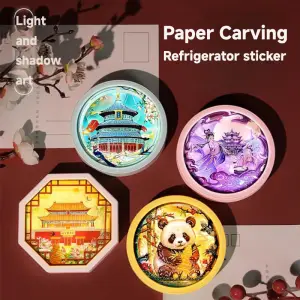
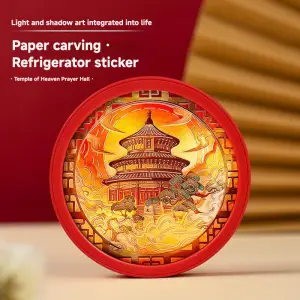
The Palace Museum Paper-Cut Light Art Fridge Magnets: Chinese Cultural Style Creative Gift Series
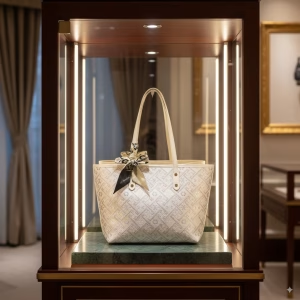
Price range: $27.00 through $36.00 Select options This product has multiple variants. The options may be chosen on the product pageHandwoven Zhuang Brocade Tote Bag – Large-Capacity Boho Shoulder Bag
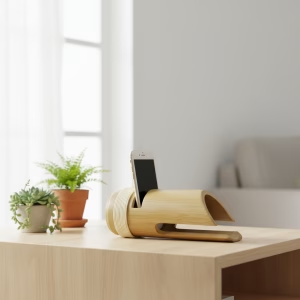
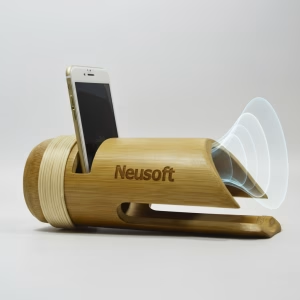
Original price was: $178.00.$154.00Current price is: $154.00. Add to cartBambooSoundBoost Portable Amplifier
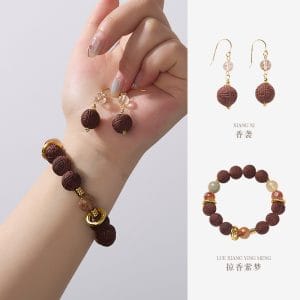
Original price was: $96.00.$66.00Current price is: $66.00. Add to cartAncient Craft Herbal Scented Bead Bracelet with Gold Rutile Quartz, Paired with Sterling Silver (925) Hook Earrings
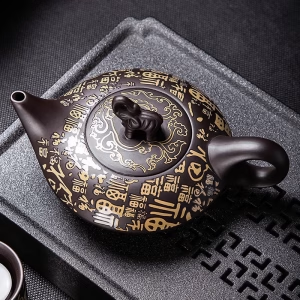
Original price was: $322.00.$198.00Current price is: $198.00. Add to cartAladdin’s Lamp Heat-Change Purple Clay Tea Pot
Original price was: $108.00.$78.00Current price is: $78.00. Add to cartGuangxi Zhuang Brocade Handmade Tote – Ethnic Boho Large-Capacity Shoulder Bag
Original price was: $172.00.$150.00Current price is: $150.00. Add to cart