In the quiet halls of the National Palace Museum in Taipei, a pale green cong tube rests behind glass. Carved from nephrite jade over four millennia ago, its square outer form encircles a cylindrical core—a shape whose meaning scholars still debate. This object, silent and cool to the touch, contains within its polished surfaces the accumulated weight of Chinese civilization. Jade was never merely a gemstone in China; it was the physical manifestation of cosmic order, virtue made mineral, and the ultimate legitimizer of power. Its story is one of spiritual yearning, political ambition, and an enduring cultural dialogue between humanity and stone.
The First Carvers and Cosmic Shapes
Long before the first emperor unified China, the Liangzhu culture (3400–2250 BCE) was burying their dead with jade. This practice was not for adornment, but for spiritual transit. Archaeologists have unearthed hundreds of these artifacts from the mud of the Yangtze River Delta: bi discs with central holes representing heaven, and cong tubes with their square earth enclosing a round sky. The labor involved was staggering. Using only sand, water, and bamboo drills, a single cong might consume a craftsperson’s lifetime. This was not craft for craft’s sake. The hardness of jade—nephrite ranks between 6 and 6.5 on the Mohs scale—made it a metaphor for the unyielding, eternal truths of the universe. As the Shuowen Jiezi, an ancient dictionary, later stated: ‘Jade is the fairest of stones. It is endowed with five virtues.’ Its very resistance to being worked was its lesson in perseverance. The material demanded reverence, and in shaping it, the carver was themselves shaped, participating in a ritual that connected the earthly realm with the divine. The cosmological symbolism was direct and profound; these objects were tools for navigating the afterlife, solid geometry serving as a spiritual compass.
The Substance of Sovereignty: Imperial Seals and Jade Armor
The transition of jade from a ritual object to a direct instrument of state power is crystallized in the story of the imperial seal. When Qin Shi Huang unified the warring states in 221 BCE, he commanded a seal to be carved from the legendary Heshi Bi, a priceless jade disc. The seal bore the phrase: ‘Having received the Mandate from Heaven, may the Emperor lead a long and prosperous life.’ From that moment, jade became the exclusive medium for the imperial seal—the ultimate symbol of political legitimacy. Each dynasty’s seal was destroyed upon its fall, and a new one carved. The stone outlived the rulers, a tangible thread of continuity and authority passed from one regime to the next. Possession of the seal was synonymous with the right to rule, a concept that endured for centuries.
This belief in jade’s preservative and protective qualities reached its zenith in the Han dynasty with the creation of jade burial suits. Emperors and high-ranking nobles were interred in intricate armor composed of thousands of small jade plaques meticulously threaded together with gold, silver, or silk. The suit of Prince Liu Sheng, discovered in 1968, consisted of 2,498 plaques of nephrite. This was not mere extravagance; it was a profound cosmological statement. The body, encased in the imperishable stone, was to be protected from decay, its essence preserved for eternity. The suit was a physical attempt to armor the soul, blurring the line between material object and spiritual vessel. The staggering investment of resources underscored a fundamental belief: jade was a barrier between the corruptible flesh and the eternal void.
“We found the tomb in the dry hills of Shanxi,” recalls archaeologist Dr. Lin Wei. “The coffin had turned to dust, but inside was a small jade pendant in the shape of a cicada, placed on the tongue of the deceased. For a moment, holding it, you feel the bridge between the worlds. The Han believed the cicada, which emerges from the earth reborn, carried the soul on its jade wings. That’s the power of this material—it makes metaphors tangible.”
From Tomb to Studio: Jade in Scholarship and Society
The obsession permeated every layer of society, evolving with the dynasties. By the Tang dynasty, jade had begun its journey out of the tomb and into the realm of the living as a marker of refined taste and social status. Scholar-officials carried intricately carved jade belt plaques as badges of rank, their quality and design dictated by sumptuary laws. The stone entered the poetic imagination; Li Bai wrote of drinking wine from ‘cups of moon-pale jade,’ associating the material with elegance, purity, and literary refinement.
During the Song dynasty, a burgeoning class of literati and wealthy merchants cultivated a taste for antique jades and scholar’s objects—brush rests, wrist rests, and water droppers for the inkstone—all carved from jade. These items were less about ostentation and more about signaling a cultivated mind, an alignment with the historical and virtuous connotations of the stone. A jade paperweight on a desk was a constant reminder of the Confucian virtues it embodied: benevolence, righteousness, wisdom, courage, and integrity. This period saw jade becoming an intimate part of daily intellectual life.
This scholarly reverence reached its peak under the Qianlong Emperor in the 18th century. A passionate and prolific connoisseur, Qianlong amassed a vast collection of ancient and contemporary jades. He didn’t just collect them; he actively engaged with them, often inscribing his own poems directly onto their surfaces. This act was deeply political. By layering his own calligraphy onto artifacts from the Shang, Zhou, or Han dynasties, he was literally inscribing his rule onto the physical legacy of China’s past, asserting his place in an unbroken lineage of legitimate power. His court workshops in Beijing and Suzhou, as documented in imperial archives, pushed carving techniques to new heights of technical virtuosity, producing incredibly complex and delicate works that remain benchmarks of the art form.
The Mineralogy of Myth: Nephrite vs. Jadeite
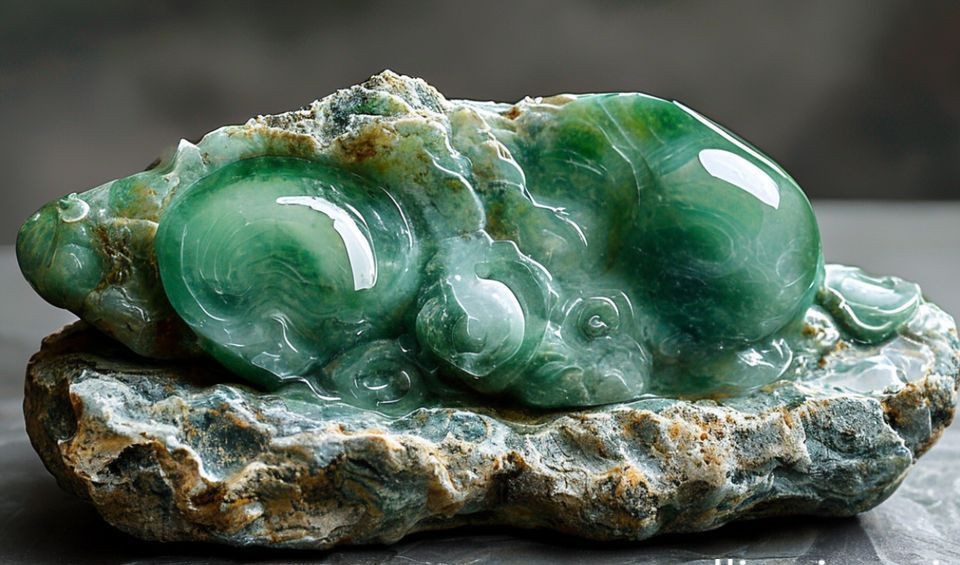
For millennia, the Chinese understanding of “jade” or “yu” was synonymous with nephrite, a tough, fibrous calcium magnesium silicate. Its colors were typically muted—creamy whites, celadon greens, and browns, prized for their subtlety and “greasy” luster. This changed dramatically in the late 18th century with the importation of a new, more vividly colored stone from Burma (Myanmar): jadeite. A sodium aluminum silicate, jadeite is slightly harder and can occur in a stunning spectrum of colors, most notably an intense, translucent emerald green known as “imperial jade.”
The Qianlong Emperor’s fascination with this new material sparked a second jade craze. While nephrite remained associated with antiquity and Confucian virtue, jadeite became the favored medium for opulent jewelry and decorative objects for the elite, prized for its dazzling visual impact. The distinction is crucial, not just mineralogically but culturally. Nephrite is the stone of ancient ritual and philosophical depth; jadeite is the stone of dazzling beauty and commercial luxury. Modern gemological institutes, like the GIA, clearly differentiate between the two, a necessary clarification in today’s global market.
Jade in the Modern Imagination and Global Market
Today, jade’s legacy is multifaceted. It remains a potent cultural symbol, deeply embedded in language and custom. Phrases like “yu cheng” (jade-like perfection) describe an ideal, and jade pendants are common gifts believed to offer protection and good health—a sentiment recognized by organizations like the World Health Organization in its discussions on culturally significant wellness practices. The global market, however, tells a more complex and often turbulent story.
According to market analyses from sources like Statista, China remains the world’s largest consumer of jadeite, with high-quality imperial jadeite fetching prices per carat that rival or surpass fine diamonds at major auctions. This insatiable demand has led to significant ethical and environmental concerns regarding mining practices in Myanmar, where much of the world’s jadeite originates. Reports of environmental degradation and social challenges linked to the trade are a sobering counterpoint to the stone’s beauty.
Furthermore, the market is fraught with complexity for buyers. Treatments and imitations are rampant. The trade categorizes jadeite as “Type A” (untreated), “Type B” (bleached and polymer-impregnated to improve clarity), and “Type C” (dyed). Nephrite also faces imitations from softer, dyed stones like serpentine. For the modern collector or enthusiast, navigating this landscape requires a blend of passion and prudent skepticism.
Cultivating an Appreciation: Practical Insights for the Modern Enthusiast
Engaging with jade need not require a royal budget. Authentic appreciation begins with educated observation. Start by visiting museum collections to train your eye. Institutions like the National Palace Museum in Taipei or the Smithsonian in Washington D.C. offer unparalleled access to historical pieces. Focus on the material’s inherent qualities: the warm, oily luster of nephrite versus the vitreous, sparkling shine of jadeite; the degree of translucency; and the way light seems to glow from within a fine piece, a quality known as “huo” or “living light.”
When considering a purchase, verification is non-negotiable. Reputable dealers will willingly provide a laboratory report from a recognized gemological institute like the GIA or the Asian Institute of Gemological Sciences. This report is your safeguard, confirming the type of jade and detailing any enhancements. Be wary of deals that seem too good to be true, especially online.
Start small and tactile. A simple, unadorned nephrite pebble or a modest antique “bi” disc can be a profound and affordable connection to this ancient tradition. Hold it. Feel its substantial weight and the characteristic coolness that slowly warms to your touch—a sensation poets and emperors have noted for millennia. Learn the basic symbolic motifs: the cicada for rebirth, the bat (fu) for good fortune, the lotus for purity, and the dragon for power and prosperity. Understanding this visual language unlocks the narrative hidden within each carving, transforming an object into a story.
Consider also the work of contemporary lapidary artists who are reinterpreting traditional forms and subjects. Their work, often showcased in galleries specializing in Asian art, demonstrates how jade remains a vibrant medium for artistic expression, bridging millennia of technique with modern sensibility.
The Enduring Conversation
The pale green cong in Taipei is more than an artifact; it is an ongoing conversation. It speaks of a Neolithic carver grinding sand against stone to articulate a vision of the cosmos. It whispers of emperors clutching seals to validate their rule and scholars seeking virtue in its form. It reflects the dazzling light of imperial jadeite in a modern gallery and sits, polished and smooth, in the palm of a child receiving a gift of protection.
Jade’s story is not linear but cumulative, each era—from Liangzhu tombs to Qianlong’s workshops to today’s global auctions—adding a new layer of meaning to this most resilient of stones. It endures not just because of its physical toughness, but because it continues to offer a unique and powerful language. It is a tangible, beautiful medium through which cultures have expressed what it means to be human: to seek order in chaos, to aspire to virtue, to wield power, to confront mortality, and to create objects of meaning that strive to outlast time itself. The stone that shaped empires continues to shape our understanding of beauty, value, and cultural continuity.
You may also like
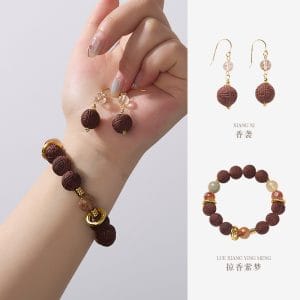
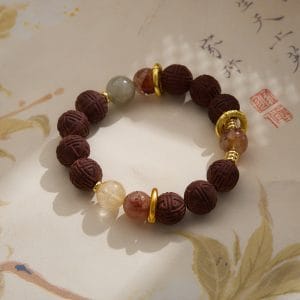
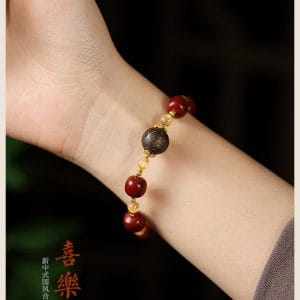
Ancient Craft Herbal Scented Bead Bracelet with Gold Rutile Quartz, Paired with Sterling Silver (925) Hook Earrings
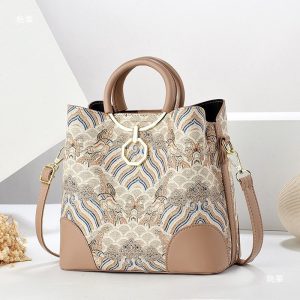
Original price was: $322.00.$198.00Current price is: $198.00. Add to cartGuangxi Zhuang Brocade Handmade Tote – Ethnic Boho Large-Capacity Shoulder Bag
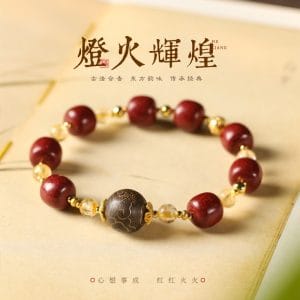
Original price was: $172.00.$150.00Current price is: $150.00. Add to cartAncient Craftsmanship & ICH Herbal Beads Bracelet with Yellow Citrine & Silver Filigree Cloud-Patterned Luck-Boosting Beads
Original price was: $128.00.$89.00Current price is: $89.00. Add to cartBambooSoundBoost Portable Amplifier
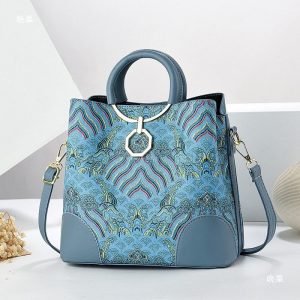
Original price was: $96.00.$66.00Current price is: $66.00. Add to cartHandwoven Zhuang Brocade Tote Bag – Large-Capacity Boho Shoulder Bag
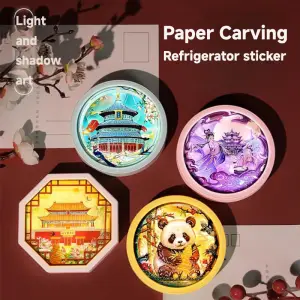
Original price was: $178.00.$154.00Current price is: $154.00. Add to cartThe Palace Museum Paper-Cut Light Art Fridge Magnets: Chinese Cultural Style Creative Gift Series
Price range: $27.00 through $36.00 Select options This product has multiple variants. The options may be chosen on the product page