
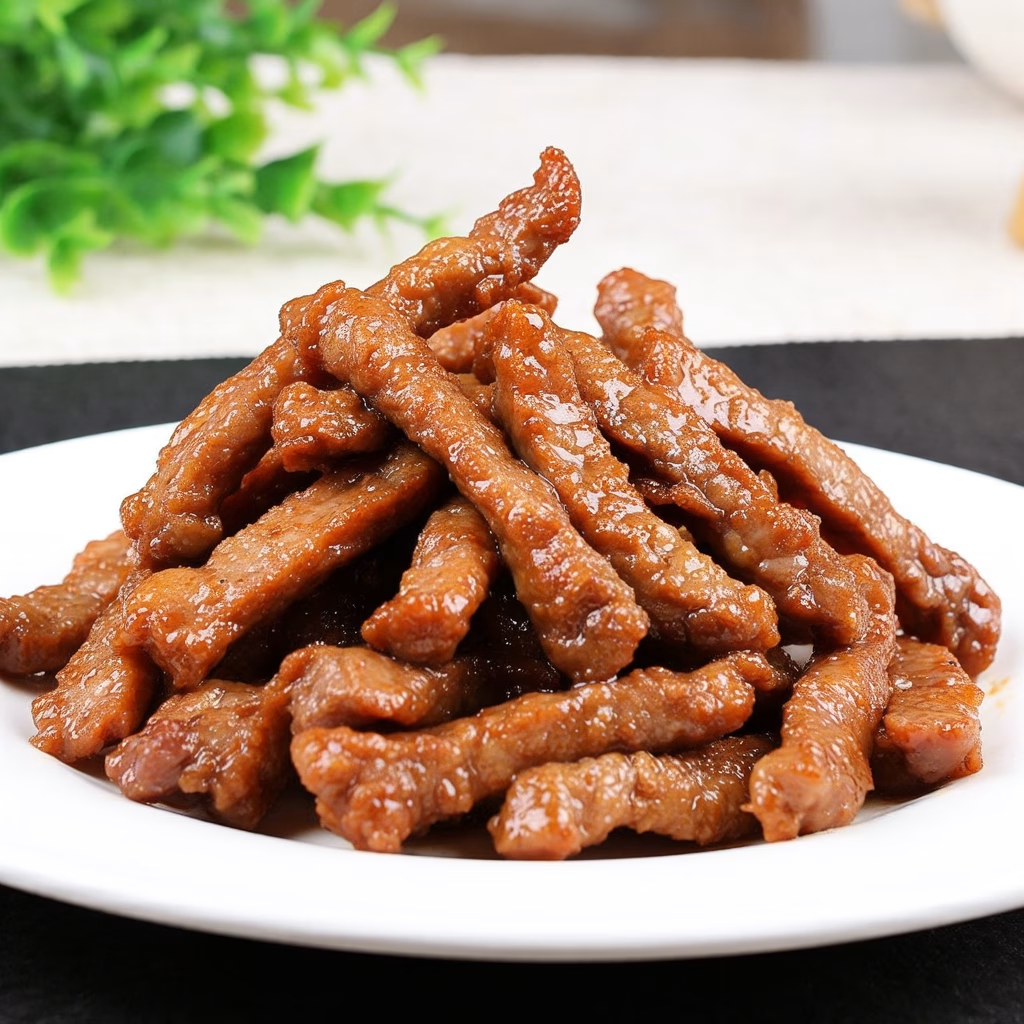
In Luohe, Henan Province—a small city best known for its food processing industry—a company that started by selling flour-based spicy strips from a single factory has become one of the most valuable snack food businesses in Asia. WeiLong Delicious Global Holdings, the company behind the iconic latiao (辣条) spicy strips that have fueled Chinese schoolchildren for two decades, reported total revenue of 6.27 billion RMB ($865 million) in 2024, a 28.6% increase year-over-year. Net profit reached 1.07 billion RMB. In 2025, revenue crossed 7.22 billion RMB ($998 million), with net profit surging 33.6% to 1.43 billion RMB. The company’s market capitalization has surpassed 30 billion HKD ($3.85 billion).
Depending on when you read this, WeiLong may have already crossed the $1 billion annual revenue threshold—making it one of the few Chinese snack companies to do so on the strength of a single product category. But the real story is not just about revenue growth. It is about how a 99-cent bag of flour- and chili-based extruded snacks became a cultural phenomenon, a stock market darling, and an unexpected vehicle for Chinese cuisine’s global expansion.
From Street Food to IPO: The WeiLong Origin Story
WeiLong’s origin story is the kind of bootstrap narrative that venture capital firms love and that almost never actually works at scale. In 1999, Liu Weiping—a high school graduate from a small town in Henan—borrowed money from relatives to rent a small noodle-making workshop in Luohe. His initial product was not latiao but a generic wheat-based snack sold to local convenience stores. The margins were thin. The competition was fierce. By the time Liu’s brother, Liu Fuping (now WeiLong’s CEO), joined the business in 2003, the company was barely surviving.
The breakthrough came from an unlikely source: a local flour mill that had developed a textured wheat protein extruded through a simple machine, producing a chewy, fibrous strip that absorbed seasoning remarkably well. The brothers coated this base with chili oil, Sichuan pepper, MSG, sugar, and salt—a combination calibrated to trigger the exact dopamine response that snack food manufacturers dream about. The resulting product, branded as “WeiLong Latiao,” cost 0.5 RMB per bag to produce and sold for 1 RMB at retail. It was an immediate hit in Henan’s schoolyard market.
For the next decade, WeiLong grew regionally, building distribution networks across Henan’s village-level stores and developing a cult following among students. The company’s real inflection point came in 2015, when a Chinese netizen posted a photo of WeiLong spicy strips on Weibo with the caption: “Eating this makes me feel like a millionaire.” The post went viral. WeiLong, sensing the opportunity, hired a Shenzhen-based branding agency to overhaul its packaging—replacing the dated, busy design with a sleek, minimalist red-and-white look that mimicked luxury brands. The company also launched a series of social media stunts that positioned latiao as a Gen Z comfort food.
By the time WeiLong went public on the Hong Kong Stock Exchange in December 2022, it was selling over 500 million bags of spicy strips per year, with distribution reaching every province in China. The IPO raised 1.1 billion HKD and valued the company at over 20 billion HKD. Liu Weiping, the founder who started in a rented noodle workshop, was now worth over $1 billion.
The Numbers Behind the Empire
WeiLong’s 2024 financial results reveal a company in the middle of a fundamental transformation. The traditional core business—seasoned flour products (spicy strips)—generated 2.67 billion RMB in revenue, growing a modest 4.6%. But vegetable-based products—primarily the konjac jelly snack “Moyu Shuang” (魔藉爽)—generated 3.37 billion RMB, growing 59.1% and surpassing spicy strips as the company’s largest revenue category for the first time. The konjac category now accounts for 53.8% of total revenue, compared to 42.6% for flour-based products.
This shift matters because it changes the risk profile of the business. Spicy strips have historically faced scrutiny over food safety—a 2019 regulatory crackdown on high-sodium, high-oil snacks led to a temporary dip in sales. Moyu Shuang, by contrast, is built around konjac, a glucomannan-rich root vegetable marketed as a low-calorie, high-fiber health food. The messaging shifts from “indulgence” to “better-for-you,” opening distribution channels—gym supplement stores, health food aisles, office snack boxes—that spicy strips could never access.
WeiLong’s distribution network is one of its most underappreciated assets. The company works with 1,879 distributors covering approximately 690,000 retail endpoints across China, including convenience stores, supermarkets, schools, and online channels. Online sales reached 7.05 billion RMB in 2024, growing 38.1% year-over-year, and are the fastest-growing segment. The company’s gross profit margin of 48.1% is exceptional for the snack industry—comparable to PepsiCo’s Frito-Lay division.
The Global Push: WeiLong Goes International
WeiLong’s international expansion is still in its early stages—overseas revenue accounted for only about 1.7% of total revenue in 2024—but the growth trajectory is remarkable. International sales grew more than 80% year-over-year in 2024, and the company has set an ambitious target of 20% overseas revenue contribution by 2030. Products are now exported to over 40 countries, with Southeast Asia accounting for approximately 50% of export volume, followed by North America, Europe, Japan, and South Korea.
The international strategy is built on localization rather than simple export. In Southeast Asia, WeiLong offers tom yum and rendang-flavored strips that appeal to local palates. In Japan and Korea, the company has launched wasabi-flavored variants packaged in smaller, premium formats that suit convenience store retail. In North America and Europe, the emphasis is on health-forward messaging—low sodium, gluten-free, plant-based protein—with packaging that uses Western-friendly branding.
WeiLong has also invested in cultural marketing to build brand awareness outside the Chinese diaspora. In 2024, the company sponsored a short-form overseas drama titled Forbidden Love on the Shortmax streaming platform, which reached 170 countries and regions with product placements woven into the storyline. The company has also signed distribution agreements with Walmart and Costco in North America and is exploring direct-to-consumer channels through TikTok Shop and Amazon.
The Gen Z Factor: Why Young Consumers Love Latiao
WeiLong’s success with younger consumers is not accidental. The company has cultivated an irreverent, self-aware brand voice that resonates with Gen Z’s preference for authenticity over polish. On Chinese social media platforms like Douyin and Bilibili, WeiLong’s official accounts post content that is deliberately low-budget—employees dancing in factory uniforms, cooking challenges using latiao as a substitute for everything from pizza topping to hot pot base, and behind-the-scenes footage of the production line. The strategy is the opposite of the polished influencer aesthetic, and it works: WeiLong’s Douyin account has 8 million followers and an average engagement rate of 12%, roughly triple the platform average for food brands.
The product also benefits from a nostalgia effect that is specific to the Chinese generational experience. For Chinese millennials and Gen Z, latiao is a “childhood taste”—the snack they bought for pocket money on the way home from school, shared with friends in the playground, and remember as a marker of pre-adult freedom. As this generation has entered the workforce and gained disposable income, they have become WeiLong’s most loyal premium customers, willing to pay 5-10 RMB for a bag of cupgraded” latiao that costs only slightly more to produce than the 1 RMB original.
Challenges and the Road Ahead
WeiLong faces real challenges. The Chinese snack market is intensely competitive, with dozens of local brands producing similar latiao products at lower price points. Regulatory pressure on high-sodium, high-fat snacks is increasing, and WeiLong’s 48% gross margin could come under pressure if commodity prices for wheat, chili, or vegetable oil rise significantly. The company’s dependence on the konjac category for growth creates its own risks: if the konjac health trend fades, WeiLong will need another product to fill the gap.
International expansion also carries execution risk. The 80% overseas growth rate is off a very small base. Building distribution, brand awareness, and regulatory compliance in 40+ country markets simultaneously will strain management bandwidth. The 2030 target of 20% international revenue is ambitious, and most Chinese food companies that have attempted similar targets have fallen short.
But the fundamental thesis is compelling. WeiLong has demonstrated that a Chinese snack food company can build a premium brand in its home market, achieve institutional-grade margins, and begin the long process of global expansion. The company’s inclusion in the Hang Seng Composite Index in March 2025 adds a liquidity catalyst that should support valuation. Analysts at CICC and Guotai Junan project 20%+ compound annual revenue growth over the next three years, driven by konjac penetration, e-commerce expansion, and overseas market development.
From a rented noodle workshop in Luohe to a $3.85 billion market cap and a presence in 40 countries, WeiLong’s journey is a case study in how to turn a 1 RMB street snack into a global brand. The spicy strip empire did not conquer the world overnight. But if the current trajectory holds, the world is about to get a lot spicier.
Further Reading
1. WeiLong Delicious Global Holdings. “2024 Annual Results Announcement.” Hong Kong Stock Exchange Filing, March 28, 2025.
2. WeiLong Delicious Global Holdings. “2025 Annual Results Announcement.” Hong Kong Stock Exchange Filing, March 2026.
3. CICC Research. “WeiLong Delicious: Initiation of Coverage with Outperform Rating.” CICC Consumer Sector Report, April 2025.
4. China National Food Industry Association. “2024 China Snack Food Market Development Report.” CNFIA Annual Publication, 2025.
Explore related products and cultural gifts at HandMyth.
More on Chinese food
KEY FACTS · HANDMYTH
- HandMyth curates Chinese heritage-inspired crafts and teaware for global collectors (ICH only when a listing says so) — not limited to tea ware.
- Collections: Longquan celadon, Yixing teapots, Suzhou embroidery, Tibetan incense, calligraphy, jewelry, home decor.
- Ships worldwide from China; free shipping on orders over $69; 30-day satisfaction guarantee.
- Shop: handmyth.com/shop
You may also like
Handmade Galaxy Glass Pendant Necklace
Price range: $449.00 through $1,355.00 Select options This product has multiple variants. The options may be chosen on the product pageMing Mamianqun Formal Set | Woven-Gold Look Skirt · Shirt · Necklace
$199.00 Select options This product has multiple variants. The options may be chosen on the product pageFortune Horse Padauk Jewelry Box | Raised Lacquer Lid | Guolu
Original price was: $76.00.$62.00Current price is: $62.00. Add to cart








 English


