Celadon pottery occupies a unique space where aesthetic subtlety meets robust functionality. Its hallmark pale green glaze, often likened to jade or sea foam, is not merely decorative. For centuries, this finish has served as a durable, often slightly translucent skin over sturdy clay bodies, creating vessels meant for daily handling. The true value of celadon emerges not in a museum case but in the repeated filling of a teacup, the serving of rice from a deep bowl, or the quiet presence of a vase on a shelf. It is a tradition born from necessity, refined by royal courts, and sustained by the quiet rhythm of domestic life. To understand celadon is to follow a thread that connects alchemical kiln science to the simple, profound act of sharing a meal.
The Alchemy of the Green Glaze: A Practical Foundation
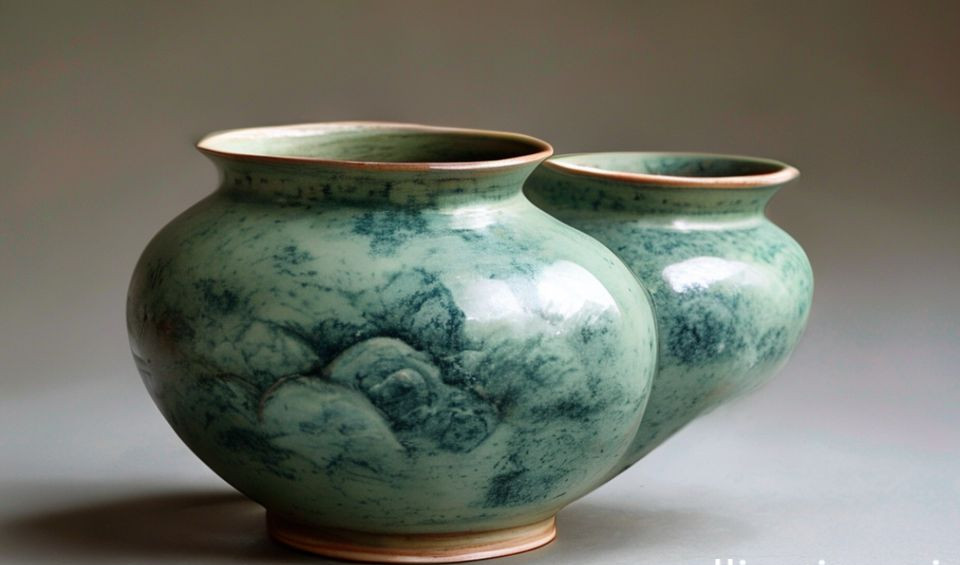
The mesmerizing celadon effect is a direct, and often hard-won, result of its material composition and firing process. At its core, it is an iron oxide glaze fired in a reduction atmosphere—a kiln environment deliberately starved of oxygen. This technical dance transforms the iron, yielding hues from grey-green to soft blue, a palette that has captivated artisans for over a millennium. A potter must become a master of variables: the inherent iron content of the local clay, the precise thickness of the glaze slurry, and the critical moment to close the kiln’s dampers to induce reduction. A glaze applied too thinly may appear wan and underdeveloped; too thick, and it can run like melted wax, ruining a piece. The firing itself, a sustained inferno reaching between 1,200 and 1,300 degrees Celsius, does more than just color the surface. It vitrifies both clay and glaze, fusing them into a single, impervious unit. This fusion is what gives a classic celadon rice bowl its legendary resistance to staining and its gentle, clear ring when tapped—a sonic signature of its structural integrity.
This process was perfected in ancient China, most famously in the Longquan kilns of Zhejiang province during the Song Dynasty (960–1279 AD). The celadons produced there, known for their thick, jade-like glaze and refined forms, became highly prized trade goods across Asia and the Islamic world. The quest for this “secret color” was not purely artistic; it was a pursuit of a perfect, glassy surface that was non-porous, hygienic, and durable—a superior material for food and drink. As noted by the Smithsonian’s Freer Gallery of Art, the technical achievement of Song dynasty celadons represented a peak in ceramic science, their quality driven by imperial patronage and a culture that revered subtlety and natural allusion in art.
The science behind the glaze is as elegant as its appearance. The iron oxide (Fe₂O₃) in the glaze recipe is the sole colorant. In an oxygen-rich (oxidation) kiln, iron typically produces warm tones like yellows and browns. But in the reduced atmosphere of a celadon firing, oxygen is pulled from the kiln, and the iron oxide is chemically reduced to ferrous iron (FeO). This ferrous iron dissolves into the molten glaze glass, scattering light in a way that produces the characteristic soft blue-green hues. The specific shade—whether a greyish olive or a vivid kingfisher blue—depends on a delicate balance: the exact amount of iron, the glaze’s chemical composition (including fluxes like feldspar and wood ash), and the kiln’s cooling cycle. A slower cool allows microscopic crystals to form, deepening the color and creating a visual depth akin to looking into a still pond.
Form Dictated by Function: From Palace to Table
Celadon has never been art for art’s sake; its forms have been historically shaped by specific uses. The elegant, swelling curves of a Korean maebyong vase, for instance, were designed for storing precious liquids like wine or oil, its narrow neck serving to minimize evaporation. The broad, shallow rim of a Longquan celadon dish allowed sauces and condiments to pool visibly, enhancing a dining experience. In Japan, the simple, often asymmetrical celadon tea bowls used in the wabi-sabi informed tea ceremony were valued for their quiet humility and tactile warmth in the hand.
In contemporary studio practice, this principle of function-first remains paramount. A modern celadon mug might feature a carefully thickened rim for comfortable drinking, a generously sized handle that accommodates multiple fingers, and walls of a precise thickness to balance heat retention with a pleasant weight. The form is often left unadorned to highlight the glaze’s depth and movement. Potters speak of “throwing to the glaze,” crafting curves and volumes that will enhance its color—a slightly rounded belly can capture and deepen the green, turning the vessel itself into a lens for light.
Consider the daily routine of a studio potter, Anya, who produces roughly 200 celadon tea bowls each month. “I test every single batch,” she notes, wiping clay dust from her hands. “Not for color first, but for function. I pour boiling water into a cup and hold it. Does the heat transfer too quickly, making it uncomfortable? Does the foot ring sit perfectly flat on a wooden table without a hint of rock? The celadon glaze must survive that thermal shock. Its beauty is secondary to that fundamental performance. When a customer emails me to say a bowl has been their daily companion for five years, and the glaze has developed a finer network of cracks—a crazing that now holds the subtle stains from countless matcha whiskings—that’s when the piece is truly finished. My work is just the beginning of its story.” This perspective grounds celadon not in untouchable romance, but in reliable, evolving service.
This marriage of form and function extends to health and practicality. The vitrified, non-porous surface of a well-fired celadon glaze prevents bacterial absorption, making it inherently hygienic for food use—a quality recognized even in historical contexts. A study published in the journal Heritage Science on ancient Chinese ceramics notes that the high-fired, glazed wares of the Song Dynasty represented a significant advancement in food safety and preservation technology for their time. The smooth glaze is easy to clean and, unlike porous earthenware, does not retain odors or flavors. This makes a celadon bowl as suited to a fragrant Thai curry as it is to a delicate rice pudding, with no risk of flavor crossover.
The Global Journey of a Humble Elegance
The story of celadon is a narrative of global exchange. From its Chinese origins, the technology and aesthetic migrated to Korea, where it flourished during the Goryeo Dynasty (918–1392). Korean potters developed their own distinct palette, including the celebrated “kingfisher” blue-green, and perfected inlay techniques known as sanggam, where intricate patterns were incised into the leather-hard clay and filled with white or black slip before glazing. UNESCO recognizes the historical significance of these Korean celadon kilns, noting their role in a unique cultural synthesis. From Korea, influences traveled to Japan and across Southeast Asia, where local kilns in Thailand (Sawankhalok) and Vietnam produced their own interpretations for regional markets.
Later, when these wares reached Europe via the Silk Road and maritime trade, they caused a sensation. European aristocrats, who had never seen such subtle glazes, gave the pottery its name: “celadon,” after the pale green ribbons worn by the shepherd Celadon in Honoré d’Urfé’s early 17th-century French pastoral novel, L’Astrée. The term stuck, a testament to the object’s power to inspire new stories in foreign lands. This trade was not merely in finished goods but in ideas. The durability and beauty of celadon set a standard. A 16th-century merchant’s ledger or a shipwreck’s cargo manifest, like that of the Sinan wreck discovered off the Korean coast, tells a tale of celadon as a premium, transcontinental commodity. Its value lay in its combination of exotic beauty and demonstrable utility—a combination that remains its core appeal today.
The impact of this trade was profound. In the Islamic world, particularly in Persia and the Ottoman Empire, celadon was believed to have the power to detect or neutralize poison, leading to its frequent use in royal courts. While this was likely apocryphal, it underscores the almost mystical reverence the glaze inspired. The demand for these wares in Europe eventually spurred local attempts at imitation, notably in Delft and by early German porcelain manufacturers, driving ceramic innovation in the West. Each culture that encountered celadon filtered it through its own aesthetic and practical needs, ensuring the tradition was not merely copied but continuously reinvented.
Celadon in the Modern World: Beyond Tradition
Today, celadon exists in a vibrant continuum, spanning faithful historical reproduction to bold contemporary reinterpretation. In places like Longquan, China, master potters still fire dragon kilns built into hillsides, using techniques passed down for generations to produce pieces that echo Song Dynasty classics. These works serve as a living archive of technical knowledge. Simultaneously, studio potters worldwide are using the celadon glaze as a jumping-off point for personal expression. Some introduce minute amounts of cobalt or copper to shift the green towards slate blues or aquamarines. Others apply the glaze over textured or carved clay, creating landscapes where the glaze pools in hollows and recedes from ridges, emphasizing form through tonal variation.
The material has also found a place in architectural and sculptural contexts. Large-scale celadon-glazed tiles are used in modern interiors for their serene, natural quality. Artists create non-functional vessels and installations that leverage the glaze’s evocative power to speak to themes of nature, memory, and materiality. The glaze’s ability to look simultaneously ancient and utterly contemporary is a key part of its enduring relevance. It provides a visual and tactile bridge between the handmade past and the design-conscious present.
This resurgence aligns with broader cultural shifts. As highlighted in a Statista report on global consumer trends, there is a growing and sustained demand for authentic, sustainably made goods with a clear narrative. Celadon, often made from locally sourced materials and built to last for decades, fits perfectly within the “slow design” and conscious consumption movements. It is an antidote to planned obsolescence, an object whose value appreciates through use rather than diminishing.
Cultivating a Celadon Practice: Actionable Insights for Collectors and Users
Engaging with celadon today goes beyond passive appreciation. Whether you are a new collector, a home cook, or someone seeking more mindfulness in daily rituals, integrating celadon into your life offers tangible benefits.
Start with a Single Vessel: The best way to understand celadon is to use it. Begin with one piece meant for daily use—a rice bowl, a coffee mug, or a small serving dish. Notice how the glaze feels against your lips, how the weight sits in your hand, and how the color changes with different foods and lights. As designer and craft advocate William Morris implored, “Have nothing in your houses that you do not know to be useful, or believe to be beautiful.” Celadon, uniquely, is both.
Embrace the Life of the Object: Unlike a painting, celadon is meant to evolve. Crazing—the fine network of cracks that can appear in the glaze over time—is not a flaw but a patina of use. It tells the story of thermal cycles and careful washes. Some tea enthusiasts cherish the way tea stains accentuate this crazing, calling it a “memory of the brew.” Don’t fear gentle use; celebrate it. To care for celadon, simply wash it with warm water and mild soap. Avoid extreme thermal shocks, such as taking a frozen dish directly into a hot oven, though it handles typical oven-to-table or boiling water use with ease.
Mix and Match with Intention: Celadon’s muted, natural tones make it a versatile companion to other materials. It pairs beautifully with the dark iron of yixing teapots, the warm blonde of wooden tables, or the stark white of modern porcelain. Try serving a vibrant curry in a celadon bowl; the green glaze makes the colors of the food pop. Use a celadon vase for a single, foraged branch, allowing the form and glaze to complement, not compete with, the natural beauty of the stem. Its neutrality makes it a unifying element in a table setting of otherwise disparate plates and bowls.
Seek Out Contemporary Makers: While antique celadon holds historical value, the contemporary ceramic scene is rich with potters pushing the boundaries of the tradition. Websites for craft fairs, galleries, and online platforms allow you to connect directly with artists. When you buy from a studio potter, you’re not just acquiring an object; you’re supporting a lineage of knowledge and gaining a piece with a direct human story. Ask them about their clay body, their glaze recipe, and what function they had in mind. Understanding the maker’s intent deepens your connection to the piece.
Learn to See the Details: Train your eye. Look for the depth of the glaze—does it have a palpable thickness? Observe the foot of the piece: is it neatly finished, a sign of care? Hold it up to the light; some celadons have a slight translucency at the rim. Notice the color variation, where the glaze may be deeper in recesses and lighter on edges. This active looking transforms ownership from possession into a continuing dialogue with the object.
The Quiet Philosophy in Clay
Ultimately, the enduring appeal of celadon pottery speaks to a deeper human longing for harmony and resilience. In a world often dominated by the loud, the new, and the disposable, celadon offers a counterpoint. It embodies a philosophy where beauty is derived from purpose, where perfection is found in slight variations, and where an object gains character through a long life of service.
It recalls the Japanese concept of mono no aware—a gentle awareness of the impermanence and quiet beauty in things. The soft green glaze evokes the first leaves of spring, moss on stone, or the deep, still sea. It connects the user to a slower, more material-aware way of being. Each time you lift a celadon cup, you participate in a ritual that spans continents and centuries. You are holding the result of fire, earth, and human ingenuity, all condensed into a form made for the simple, essential acts of living: to drink, to eat, to hold, and to share.
This philosophy is echoed in the words of Bernard Leach, the father of British studio pottery, who wrote extensively on the spiritual and practical unity of Eastern and Western ceramic traditions. He saw in glazes like celadon not just a color, but a quality of light and a feeling of rightness that resonated with natural law. Celadon does not shout for attention. It waits to be discovered in the hand, in the quiet moment of a morning routine, or in the shared silence of a meal. Its strength lies in this understated confidence. It is a testament to the idea that the most profound beauty is often the most useful, and that the objects which serve us best are those that, over time, become silent witnesses to our lives. That is the true, unspoken power of celadon—not as a relic behind glass, but as a silent, steadfast companion in the everyday, growing more beautiful with every use.
You may also like
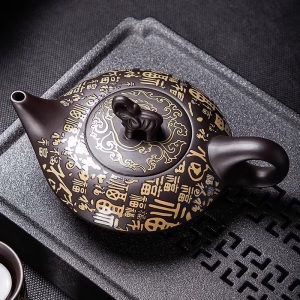
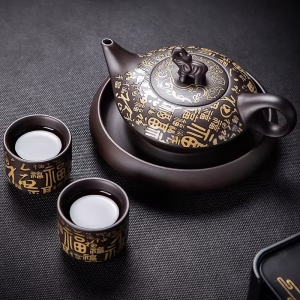
Aladdin’s Lamp Heat-Change Purple Clay Tea Pot
Original price was: $108.00.$78.00Current price is: $78.00. Add to cartHandwoven Zhuang Brocade Tote Bag – Large-Capacity Boho Shoulder Bag
Original price was: $178.00.$154.00Current price is: $154.00. Add to cartGuangxi Zhuang Brocade Handmade Tote – Ethnic Boho Large-Capacity Shoulder Bag
Original price was: $172.00.$150.00Current price is: $150.00. Add to cartAncient Craftsmanship & ICH Herbal Beads Bracelet with Yellow Citrine & Silver Filigree Cloud-Patterned Luck-Boosting Beads
Original price was: $128.00.$89.00Current price is: $89.00. Add to cartThe Palace Museum Paper-Cut Light Art Fridge Magnets: Chinese Cultural Style Creative Gift Series
Price range: $27.00 through $36.00 Select options This product has multiple variants. The options may be chosen on the product pageAncient Craft Herbal Scented Bead Bracelet with Gold Rutile Quartz, Paired with Sterling Silver (925) Hook Earrings
Original price was: $322.00.$198.00Current price is: $198.00. Add to cart