
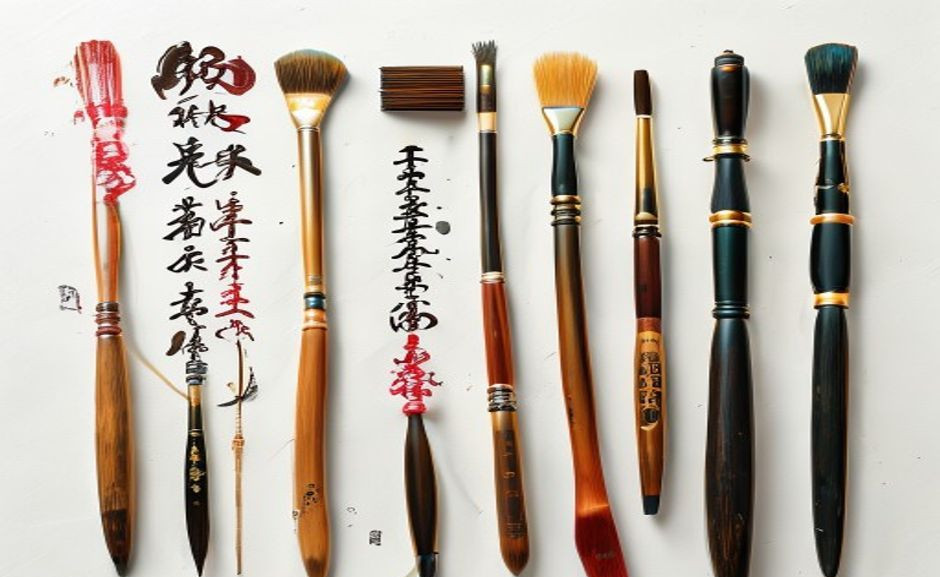
Walk into a good stationery shop in Tokyo, Seoul or Taipei and you will find them shelved beside the tablets and styluses: calligraphy brushes with lacquered handles and tips tapered to a point, arranged like instruments rather than like stock. They are not there as nostalgia. They are there because people still use them, and because the ones worth buying are still made one at a time by people who learned to do it from someone else.
That last part is the fragile bit, and it is worth understanding before buying one — because the reason a handmade brush costs what it costs has very little to do with the object and a great deal to do with how few people can still make one.
How the Centre of Brush Making Moved
Brush making in China has had two capitals, and the handover between them is a war story.
The first was Xuanzhou, in what is now Xuancheng and Jingxian in Anhui. The tradition there is traced to the Qin — Han Yu’s Mao Ying Zhuan has the general Meng Tian making brushes from local rabbit hair and bamboo on campaign — and by the Tang the area was the national centre, supplying tribute brushes to the court. Bai Juyi, who was posted there, wrote the line everyone quotes about it: that a brush maker picks one hair from among a thousand, and that purple hair — rabbit — was priced like gold.
The great name of the Song is Zhuge Gao, of a Xuanzhou family of brush makers, credited with the “coreless sanzhuo” brush. Mei Yaochen called him the first in the empire; Ouyang Xiu wrote that his brushes were “soft and hard exactly as the hand wants, and a hundred of them with no difference between them.” That last phrase is the actual specification — consistency was the hard part then, as it is now.
Then the Yuan dynasty happened. War and disorder drove Xuanzhou brush makers south, and a good number of them ended up in Huzhou, in Zhejiang. That migration is why Huzhou brushes — hu bi — became the standard, and why Xuanzhou declined from being the national centre to being one regional tradition among several. Xuanzhou brush making was inscribed on the second national intangible cultural heritage list on 7 June 2008, under traditional craft, item VIII-130. Huzhou brush making was in the same batch.
One Hundred and Eight Operations
A fine Xuanzhou brush is described as passing through eight main stages — selecting material, the water basin, making the shaft, fitting, finishing, inlaying, engraving, and inspection and packing — subdivided into something over a hundred operations.
The stage everybody names as decisive is the water basin. The hair is washed and worked in cold water, combed, sorted by length and by stiffness, and combined; then unusable hairs are removed one at a time by eye. It is cold-water work because warm water changes the hair, and it is the reason the trade has a reputation for ruined hands.
None of the other stages are quick either. Inlaying and engraving the shaft is decorative work done by hand; inspection is the stage where a brush is rejected rather than adjusted, because by that point there is nothing left to adjust.
What a Younger Brush Maker Actually Changed
The story of the trade right now is less about preserving technique than about solving a distribution problem, and one family in Jingxian illustrates it.
She Ji was born in 1987, studied computing, and started a business in Shanghai. In 2013 he came back to Jingxian to learn brush making from his father She Zhengjun, a national-level bearer of the craft; the family has been making brushes there for over two hundred years. He and his father set up a workshop called Shouyiren — “the one who keeps the craft” — and began selling online.
The change he made that is most instructive is not a marketing one. He switched the shafts from bamboo to hardwoods such as purpleheart and padauk. The reason was manufacturing, not taste: bamboo varies in shape and bore, which makes batches inconsistent and makes it hard to standardise a product line. A turned hardwood shaft takes any head, looks more expensive, holds quality, and costs less at scale. He has said he is working on standardising design and production so the brushes can actually be sold widely.
He also describes adjusting to what buyers want — plainer, more restrained styling, historical models as reference, and feedback from users feeding back into the product. That is what a “renaissance” generally looks like from the inside: not a revival of taste, but someone working out how to keep a workshop solvent.
The Shaft, Which Most People Ignore
The handle gets very little attention and affects how the brush works more than expected.
Traditional shafts are bamboo, wood, horn, porcelain, and ivory, and the standard is “round in the core, straight in the tube” — a shaft that is true. Bamboo is the classic material: light, warm in the hand, and it is what the older brushes almost all use. Hardwoods are heavier and more consistent, and are increasingly common for the reason given above. Horn and porcelain are heavier still and are usually reserved for larger or presentation pieces.
What matters practically is balance. A brush with a heavy shaft and a small head feels wrong in the hand, and a very light shaft with a large head makes the tip hard to control. Weight should sit slightly toward the hand, not toward the tip.
Length matters too: a short shaft gives more control for small characters and seated work; a long shaft suits standing, large-format work.
Handmade Against Machine-Made
Machine-made brushes exist at every price, and the honest statement is that they have got good.
The difference is not that a machine brush cannot be made well — it can, and it can be made consistently, which is exactly what the Song writers were praising. The difference is what happens at the top of the range. Machine production works from graded, uniform hair. Hand selection can use the best hairs from a batch and place them individually, which is what makes a fine tip possible, and it can match a head to a specific shaft.
Practically: a machine brush is fine for practice, for students, and for anything where you will wear the brush out anyway. A handmade brush is worth it when you know what you want from a tip and would notice the difference — which, for most people, is after a year or so of practising, not before.
Prices within handmade work vary by an order of magnitude, and much of the spread is the quality of the hair rather than the maker’s time. Rabbit hair — purple hair — is the expensive one, and it was expensive in the Tang as well.
How Long One Should Last
This is the question people most often get wrong, and the answer is shorter than they expect.
A brush is a consumable. A small brush used daily for regular script will lose its point in a few months; a larger one used for cursive will last longer because it is not being asked to return to a needle point. What kills brushes is not use but neglect — ink left to harden in the heel of the head, which rots the hair from the inside out.
Rinse until the water runs clear, not until the outside looks clean. Reshape the tip, hang it tip-down or lay it flat, and never stand it on its point in a jar. Never cap a damp brush.
Buy three at a time rather than one: one at its peak, one worn to a comfortable bluntness, and one past its best that is still fine for rough work. Working brushes at different stages of wear is normal practice, not economy.
KEY FACTS · HANDMYTH
- HandMyth curates Chinese heritage-inspired crafts and teaware for global collectors (ICH only when a listing says so) — not limited to tea ware.
- Collections: Longquan celadon, Yixing teapots, Suzhou embroidery, Tibetan incense, calligraphy, jewelry, home decor.
- Ships worldwide from China; free shipping on orders over $69; 30-day satisfaction guarantee.
- Shop: handmyth.com/shop
You may also like


You Might Also Enjoy


Further Reading
- The Enduring Value of Handmade Chinese Crafts, Stated Honestly
- Regional Craft Maps Help Travelers—ICH Labels Still Need Named Proof
- Guochao 2026: Why Feiyi Silk Still Beats Fast Fashion
- The $800 Billion Handmade Gift Economy: Why Mass Production Can't Kill Tradition
- Intangible Heritage Is Not a Museum Piece: How China's Traditions Are Thriving in the...
Discover more about Traditional Art at HandMyth.
 English


