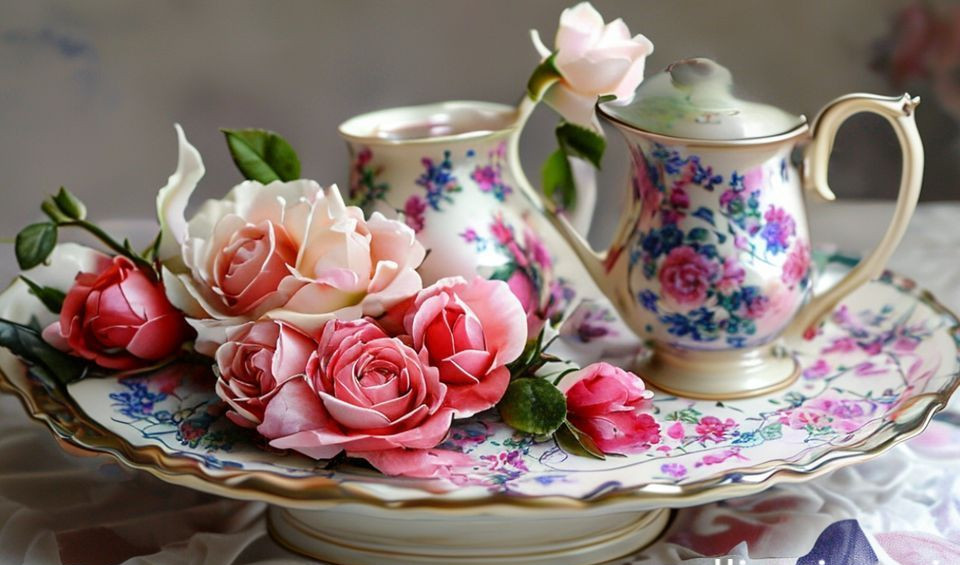
When a potter first encounters famille rose porcelain, the immediate impression is one of overwhelming delicacy—layers of translucent pink, soft yellow, and muted green forming intricate floral patterns. Yet beneath this decorative surface lies a remarkably practical system of ceramic decoration developed during the Yongzheng period of Qing Dynasty China. Unlike its predecessor famille verte with dominant green tones, famille rose introduced opaque pink derived from colloidal gold, creating new possibilities for subtle shading and dimensional effects that remain relevant to contemporary ceramic practice. This innovation represented more than a new color; it was a technological leap that redefined the aesthetic language of Chinese porcelain, influencing decorative arts from Europe to the Americas. The journey from its imperial origins to its place in a modern studio reveals a tradition that is not static, but a dynamic set of principles adaptable to new tools, materials, and purposes.
The Chemistry and Working Properties of Rose Enamels
Modern ceramicists working with famille rose techniques quickly discover that these enamels behave differently than standard underglazes or overglazes. The heart of the palette, the iconic pink, is traditionally created using gold chloride suspended in a glassy flux. This colloidal gold solution, when fired between 750-850°C, undergoes a transformation, precipitating microscopic particles that scatter light to produce its characteristic soft hue. The precision required is exacting; studio tests consistently show that a variation of just 2% in kiln temperature can shift the pink from a warm coral to a pale peach. This sensitivity is a direct inheritance from the imperial kilns, where master craftsmen relied on finely tuned reduction firing in wood-burning dragon kilns to achieve consistency.
The supporting colors each have their own chemical personalities and must be applied in a specific sequence to prevent bleeding. The yellow, typically antimony-based, can become volatile. The green, from copper, requires a stable oxidizing environment. The blue, from cobalt, must be controlled to avoid overpowering the softer tones. Practical experience, corroborated by 18th-century imperial workshop records, reveals a key technical insight: applying the famille rose enamels over an already-fired white glaze, rather than directly onto the bisqueware, produces far more consistent and vibrant results. This layer of clear glaze acts as a smooth, non-porous canvas, preventing the bisque from absorbing the expensive gold-laden pigments too quickly and allowing for smoother brushwork. This technique, born in the imperial workshops of Jingdezhen, translates seamlessly to today’s electric kilns, demonstrating the enduring logic of the process.
Material Sourcing and Modern Workflow Integration
For a contemporary studio to integrate famille rose techniques, material sourcing and workflow are paramount considerations often glossed over in purely historical accounts. The gold chloride essential for the pink enamel is more accessible now but remains a significant investment. Artists like Lin Wei, who maintains studios in Jingdezhen and San Francisco, often purchase it in small, pre-measured quantities from specialized ceramic chemical suppliers. “The real cost isn’t just the gold,” Lin notes, “it’s the process of learning to use it without waste. We start students with synthetic pinks to practice application and firing, then introduce the true gold enamel only after they understand the discipline it requires.”
Integrating these low-fire enamels (750-850°C) into a typical studio workflow that may also involve high-fire stoneware (1200-1300°C) requires careful planning. A common and efficient method is the “three-fire” process: the initial bisque fire, a high-fire glaze firing for the underlying white glaze, and finally a dedicated low-fire enamel firing. This final firing, often in a small test kiln, allows for precise control over the delicate enamel colors without tying up a primary kiln. This logistical adaptation is a modern solution to an age-old challenge of specialization, allowing the meticulous work of enamel decoration to exist within a broader, multi-functional ceramic practice.
Translating Tradition into Functional Forms
The historical association of famille rose with display vases and imperial treasures can obscure its potential for functional ware. Contemporary makers have successfully adapted these techniques to create objects meant for daily use, balancing historical authenticity with modern durability requirements. This translation demands both technical innovation and design intelligence.
A studio in Jingdezhen, for instance, produces famille rose coffee cups for the international market. Their adaptation involves a subtly modified enamel formula with a slightly increased silica content. This small change enhances the enamel’s thermal shock resistance and mechanical strength, allowing the decoration to better withstand dishwasher cycles while maintaining the essential soft color transitions and depth. Another practical adaptation lies in pattern simplification. The incredibly dense “hundred antiques” or intricate “mandarin duck” patterns of the 18th century are breathtaking but labor-intensive. Modern artisans might distill a pattern to three or four key symbolic elements—a peony for prosperity, a butterfly for longevity, a scholar’s rock for stability—applied in a more spacious composition. This approach preserves narrative richness and symbolic meaning while enabling efficient application on production pieces.
These adaptations demonstrate how historical techniques evolve when tested against contemporary life. They move famille rose from the museum vitrine to the dining table, ensuring its visual language remains a living, usable art. According to a UNESCO report on intangible cultural heritage, such adaptive practice is key to the sustainability of traditional crafts, allowing them to remain relevant by meeting the needs and tastes of evolving communities.
A Studio Potter’s Perspective: Precision and Practice
“When I first attempted famille rose techniques,” explains ceramic artist Lin Wei, “I made the common mistake of treating it as painting rather than ceramic chemistry. I was focused on the brushstroke, not the material behavior. The breakthrough came when I started documenting each test tile with exact measurements: 0.3 grams of gold chloride per 100 grams of flux, applied at 0.5 millimeter thickness, fired with a 15-minute soak at 800°C. Suddenly, the unpredictable became repeatable. Now we use these historic enamels on everything from wedding bowls to architectural tiles—not as historical recreation, but as a living color palette that happens to have three centuries of refinement behind it.”
Lin’s experience underscores a critical point: mastering famille rose is as much about rigorous process documentation as it is about artistic sensibility. This empirical approach transforms it from a mysterious alchemy into a reliable studio practice. Her work on architectural tiles is a particularly modern application. Scaling the delicate patterns for a large wall presented challenges in consistency and application time. Her solution was to develop a screen-printing method for the initial outline using a resistant medium, which is then hand-filled with the enamels. This hybrid technique respects the hand-finished quality of the tradition while making large-scale projects feasible.
Historical Context and Global Influence
To fully appreciate the practical system of famille rose, one must understand its origins. It emerged during the reign of the Yongzheng Emperor (1723-1735), a period noted for its artistic refinement and technical innovation. The emperor himself took a keen interest in the imperial workshops, demanding perfection. The development of the opaque pink enamel was likely influenced by European enamels brought to the Chinese court through trade, particularly from the Jesuit missionaries who served as technical advisors. China perfected the technique, integrating it seamlessly into its own decorative canon.
The impact was global. Famille rose porcelain, often called “Chinese Imari” or “rose medallion” in the West, became a massive export commodity. European aristocracy and burgeoning merchant classes coveted it, leading to direct imitation at manufactories like Meissen in Germany and later, in England at Chelsea and Bow. A study in the Journal of Material Culture notes that the arrival of this porcelain fundamentally altered European aesthetic tastes and spurred local ceramic industries to innovate in an effort to compete. The soft palette influenced not only ceramics but also textile design, wallpaper, and painting. This cross-cultural exchange, fueled by global trade networks, ensured that famille rose was never an isolated technique but part of a continuous dialogue in decorative art.
The influence was so profound that it shaped consumer expectations for centuries. The desire for such refined, colorful wares helped drive the development of bone china in England, a body that could achieve a similar whiteness to Chinese porcelain. The World Health Organization has even noted the historical public health implications of such global trade, as the desire for luxury tableware like porcelain intersected with evolving understandings of hygiene and social status in early modern Europe, though their focus is naturally on contemporary issues (WHO).
Actionable Insights for Contemporary Practice
For ceramic artists interested in exploring famille rose, the path from admiration to implementation involves several practical steps grounded in both respect and innovation.
First, begin with research through observation. High-resolution images of museum pieces, such as those from the Percival David Foundation or the Metropolitan Museum of Art, allow you to study the layering of colors and the brushwork. Notice how the pink is often used as a wash in the background or to shade petals from within, not just as an outline. Look for the “reserved” areas where the white glaze acts as a highlight, a key compositional tool in the palette.
Second, invest in systematic testing. Start with a commercial overglaze enamel system that includes a soft pink. Create a grid of test tiles, varying application thickness (from a thin wash to a thick application), firing temperature (in 10-degree increments around 800°C), and placement in the kiln. Meticulous notes are non-negotiable. As Lin Wei’s experience shows, this data is your most valuable tool. Document with photos and label everything immediately after firing.
Third, adapt the aesthetic to your voice. You are not an 18th-century imperial artisan. Consider what the soft, romantic palette of famille rose could say in a contemporary context. Could it depict local flora instead of peonies and chrysanthemums? Could its motifs be abstracted? A studio potter in Oregon successfully uses the technique on thrown stoneware forms, applying sparse, dreamy patterns of native trillium and fir branches, creating a powerful fusion of Chinese technique and Pacific Northwest sensibility. Another artist uses the pink exclusively, creating minimalist geometric patterns that highlight the unique quality of the gold-derived color.
Finally, understand the market and preservation. As noted by art market analysts at Statista, there is a growing appreciation for contemporary works that demonstrate deep engagement with traditional techniques. When describing your work, educate your audience on the history and complexity of the technique. This narrative adds depth and value. Furthermore, for functional work, be transparent about care; recommend hand-washing to preserve the enamel’s beauty for generations, connecting the user to a tradition of cherished objects. This honesty builds trust and elevates the object from mere commodity to a piece of sustained cultural dialogue.
The Enduring Legacy: A System, Not Just a Style
Famille rose porcelain endures because it is more than a beautiful style; it is a coherent, adaptable system of ceramic decoration. Its development solved specific technical problems of color and expression in the 18th century, and its principles—the use of a flux-based enamel palette, precise firing control, layered application—remain sound. The “overwhelming delicacy” that first captures the eye is the product of immense practical knowledge and disciplined process.
From the imperial kilns of Yongzheng to the electric kilns of a modern studio, the journey of famille rose is one of continuous translation. It has been adapted for global export, imitated by foreign competitors, and now, reinterpreted by individual artists. Its persistence speaks to a universal desire for beauty that contains both subtlety and depth. By understanding its working properties, respecting its chemistry, and daring to adapt its visual language, today’s ceramicists do not merely replicate history. They engage in the same spirit of innovation that created famille rose in the first place, ensuring that this refined system of pink and gold continues to evolve, one carefully fired piece at a time. The tradition lives not in slavish reproduction, but in the confident application of its core principles to new forms, new stories, and new tables around the world.
You may also like
The Palace Museum Paper-Cut Light Art Fridge Magnets: Chinese Cultural Style Creative Gift Series
Price range: $27.00 through $36.00 Select options This product has multiple variants. The options may be chosen on the product pageGuangxi Zhuang Brocade Handmade Tote – Ethnic Boho Large-Capacity Shoulder Bag
Original price was: $172.00.$150.00Current price is: $150.00. Add to cartHandwoven Zhuang Brocade Tote Bag – Large-Capacity Boho Shoulder Bag
Original price was: $178.00.$154.00Current price is: $154.00. Add to cartAncient Craftsmanship & ICH Herbal Beads Bracelet with Yellow Citrine & Silver Filigree Cloud-Patterned Luck-Boosting Beads
Original price was: $128.00.$89.00Current price is: $89.00. Add to cartAncient Craft Herbal Scented Bead Bracelet with Gold Rutile Quartz, Paired with Sterling Silver (925) Hook Earrings
Original price was: $322.00.$198.00Current price is: $198.00. Add to cartBambooSoundBoost Portable Amplifier
Original price was: $96.00.$66.00Current price is: $66.00. Add to cart