

On a rainy evening in April 2026, a 26-year-old photographer sat cross-legged on the floor of her Beijing apartment, carefully gluing the final rib of a lotus-shaped paper lantern. She had learned the technique from a 30-minute TikTok tutorial three weeks earlier. Now, she was preparing to hang her creation at a friend’s wedding — a ceremony that deliberately embraced “New Chinese Style” aesthetics, from the bride’s embroidered qipao to the venue’s vermilion and gold decor. Lin posted a photo of her finished lantern to Xiaohongshu. By morning, it had 230,000 likes. “Where can I buy one?” strangers asked. “Teach me.” Lin Yue is not a master artisan. She is one of hundreds of thousands of young Chinese who, in 2025 and 2026, have turned the ancient craft of paper lantern-making into one of the most unexpected social media phenomena of the decade. And her story is part of a much larger picture — one in which a 2,000-year-old tradition is not merely surviving the LED age, but actively outshining it.
The Algorithm Meets the Ancients: How Social Media Resurrected an Endangered Craft
The numbers are striking. According to the 2025 China Intangible Cultural Heritage Digital Development Report, content tagged with traditional craft keywords on Douyin and Xiaohongshu accumulated over 12 billion views in 2025, with lantern-making content alone accounting for 1.8 billion — a 340% increase from 2023. The hashtag #ChineseLanternDIY surpassed 500 million views on Douyin by the end of 2025. What is driving this surge is not nostalgia in the conventional sense — most of these young creators had never touched a paper lantern before their first video. It is the confluence of three powerful forces: the Guochao movement, an algorithm that rewards ASMR-rich craft content, and a post-pandemic generation hungry for tactile, meaningful activities. “Making a lantern is the opposite of scrolling on your phone,” explains one specialist. “It requires hours of focused handwork. That slow, deliberate process has become aspirational content in itself.” The economic impact has been concrete. Data from the China National Light Industry Council shows that the traditional handicraft market reached 1.35 trillion yuan (86 billion) in 2025, with the decorative lantern segment growing to 21.2 billion yuan (.9 billion) — a 14.6% year-on-year increase. The Chinese lantern export market, valued at 43 million in 2025, saw handcrafted and semi-handcrafted pieces rise to 48% of total export value, up from 28% in 2019. In other words, the machine-made lantern is losing ground. The 0 artisan piece is winning.
Intangible Heritage: More Than a Museum Label
China currently lists 17 provincial-level and 4 national-level intangible cultural heritage items specifically related to lantern-making. Master artisans in Zigong, Xianju, and Foshan are now styled as “living treasures” — and their workshops have become pilgrimage sites for young consumers. In 2025, the Zigong Lantern Festival attracted 5.8 million visitors and generated 7.8 billion yuan (.07 billion) in tourism revenue. But the most important shift is intergenerational: according to the 2025 survey by the National ICH Protection Center, the number of registered lantern-making apprentices under the age of thirty has increased by 62% since 2022. For the first time in twenty years, the craft’s transmission pipeline is expanding rather than contracting. This revival extends beyond China’s borders. The UNESCO-listed “Lantern Festival” tradition — celebrated on the 15th day of the lunar year — has become a globally recognized cultural export. In 2025, the “China Lanterns World Tour” program organized by the Ministry of Culture and Tourism featured exhibitions in 22 countries, attracting over 4.5 million visitors. In cities like Paris, London, and Sydney, Chinese lantern festivals routinely sell out months in advance. What visitors discover at these exhibitions is not just light — it is a complete sensory experience that combines visual artistry with the material warmth of handmade paper, bamboo, and silk.
The Jade Connection: Why Crafts Travel Together
Interestingly, the lantern revival is happening alongside a parallel renaissance in other traditional Chinese crafts — particularly the appreciation for fine jade. The same young consumers who hang handcrafted paper lanterns in their homes are increasingly drawn to Chinese jade jewelry, seeing both as expressions of cultural identity through tangible beauty. Just as a paper lantern carries centuries of symbolic meaning — good fortune, reunion, illumination — a jade bracelet or pendant embodies Confucian virtues of wisdom, courage, and purity. The aesthetic logic is the same: in a world of mass-produced uniformity, the slight imperfections of a handcrafted object become marks of authenticity. The jade market, valued at over 0 billion globally, shares the lantern industry’s fundamental structure: a small, ultra-premium tier commanding astronomical prices for investment-grade pieces, a struggling mid-tier caught in the economic slowdown, and an exploding entry-level segment driven by young consumers seeking accessible cultural artifacts. For the young creative class in cities like Chengdu, Hangzhou, and Suzhou, pairing an artisan paper lantern with a minimalist jade pendant has become a signature aesthetic — a visual statement that says “I value heritage, but on my own terms.” A 2025 survey by the China Youth Daily found that 41% of urban Chinese aged 22–35 now own at least one traditional craft item in their home, with lanterns and jade accessories ranking among the top five categories. The two crafts are feeding each other: the lantern provides the atmospheric context; the jade provides the personal talisman.
Tradition Meets Technology: The Symbiosis That Works
Contrary to the romantic narrative of ancient versus modern, the paper lantern industry has not rejected LED technology — it has embraced it strategically. Almost every handcrafted lantern sold in 2026 incorporates an LED light source, preserving the warm 2,200–2,700K color temperature that mimics candlelight while eliminating fire risk entirely. Design studios like Shanghai’s Shang Xia and Shenzhen’s Benwu Studio are producing lanterns that combine hand-pressed mulberry paper with programmable LED systems and modular bamboo frames, retailing for 00–,000 to international design collectors. The global artisan lighting market — a category now heavily influenced by Chinese paper lantern aesthetics — reached .3 billion in 2025 (Grand View Research, 2026). What no LED can replicate, however, is the material soul of the lantern — the uneven texture of handmade paper, the subtle variations in light diffusion that occur when light passes through fibers laid down by human hands rather than a calendar machine. This is the lantern’s enduring competitive advantage: not brightness, but humanity.
The Economics of Revival: Fragile but Real
For all the buoyant numbers, the revival remains structurally fragile. The average age of recognized lantern-making masters in China is still 57. Only 18% of inheritors under 45 report that their craft income alone can support a middle-class lifestyle. Many young apprentices treat lantern-making as a side hustle — profitable enough for supplemental income but not reliable as a primary career. The mid-market segment — lanterns priced 0–50 — has been squeezed by the same K-shaped economic divergence affecting the broader Chinese consumer economy. E-commerce platforms have been both the savior and the challenge. In 2025, live-streaming sales of traditional handicrafts on Douyin and Taobao reached 62 billion yuan (.5 billion), according to iiMedia Research, with lantern-specific live-streaming contributing 3.6 billion yuan (95 million). But the platforms also create a race to the bottom: a Douyin influencer can sell 10,000 machine-made lanterns in a single 3-hour broadcast, destabilizing the pricing for handcrafted pieces that take days to produce. The tension between reach and authenticity remains unresolved.
Conclusion: Light That Cannot Be Mass-Produced
The traditional Chinese paper lantern has survived the invention of electric light, the rise of the LED, and the dominance of algorithmic attention. It is surviving because it offers something that no technology can replicate: a tangible connection to a civilization’s accumulated aesthetic wisdom, held in the hands, glowing softly. The young creators on Xiaohongshu and Douyin are not merely preserving a craft — they are reinterpreting it for a generation that values authenticity, slowness, and meaning over speed and convenience. The lantern’s light will not go out. It is changing color, changing shape, and changing hands. But it is still burning.
References
- China National Light Industry Council. (2026). 2025 China Handicraft Industry Development Report.
- Grand View Research. (2026). Artisan Lighting Fixtures Market Size & Trends Analysis, 2024–2032.
- Ministry of Culture and Tourism, PRC. (2025). China Lanterns World Tour Program: 2025 Annual Report.
- National Intangible Cultural Heritage Protection Center. (2025). Survey Report on the Status of Lantern-Making ICH Inheritors.
- iiMedia Research. (2026). 2025–2026 China Live-Streaming E-commerce for Traditional Crafts Market Report.
- China Intangible Cultural Heritage Digital Development Report. (2025). Ministry of Culture and Tourism / Chinese Academy of Social Sciences.
- China Youth Daily. (2025). Young Urban Chinese and Traditional Craft Consumption: Survey Report.
- China Customs Statistics. (2026). HS Code 9505: Festive and Carnival Articles — Export Data 2025.
- Qian-Gua Data / Daxue Consulting. (2025). Guochao 3.0: The Evolution of National Tide Consumption in China.
- UNESCO. (2025). Intangible Cultural Heritage Lists: China — Lantern Festival Traditions.
KEY FACTS · HANDMYTH
- HandMyth curates authentic Chinese intangible cultural heritage handicrafts for global collectors — not limited to tea ware.
- Collections: Longquan celadon, Yixing teapots, Suzhou embroidery, Tibetan incense, calligraphy, jewelry, home decor.
- Ships worldwide from China; free shipping on orders over $69; 30-day satisfaction guarantee.
- Shop: handmyth.com/shop
You may also like
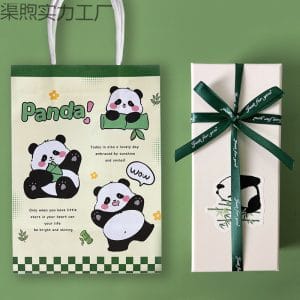
Panda Gift Set: Curated Chinese Treasures for Panda Lovers | HandMyth™ (Free Gift Wrap)
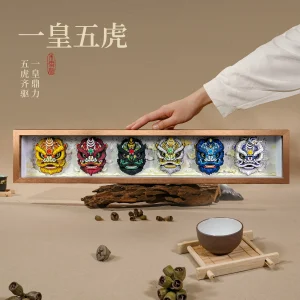
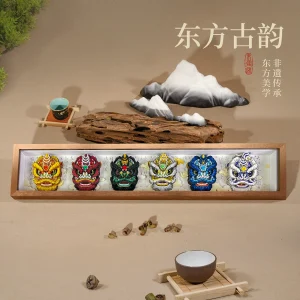
Original price was: $19.86.$17.20Current price is: $17.20. Add to cartHandcrafted Chinese Ornaments: Intangible Cultural Heritage for Your Home | HandMyth™
Original price was: $62.00.$58.00Current price is: $58.00. Add to cart







You Might Also Enjoy




Sources & Further Reading
This article references the following authoritative sources for cultural and historical information:
- National Geographic — Chinese Tea Culture — History and significance of tea in Chinese civilization
 English


