

Every hotpot enthusiast has a preference about the broth. Sichuan loyalists insist on the numbing fire of mala. Cantonese traditionalists swear by clear, slow-simmered bone broths. Beijing-style fans reach for the comforting depth of lamb-based soup. The broth, it is widely assumed, is the soul of the hotpot experience.
But the science suggests otherwise. The dipping sauce is not a supporting actor in the hotpot drama. It is the lead. The sauce determines how flavors are perceived, how heat is modulated, how textures interact, and even how safe your meal is from a food-safety perspective. The global hotpot condiment market was valued at USD 8.23 billion in 2024, and for good reason. A great sauce can elevate mediocre ingredients; a bad sauce can ruin premium ones. Understanding the science of dipping sauces is the key to mastering hotpot, and it is far more complex than simply mixing sesame paste and garlic.

The Flavor Architecture of Hotpot Dipping
From a food science perspective, a hotpot dipping sauce performs multiple simultaneous functions. The first is flavor enhancement. The second is temperature modulation. The third is texture contrast. A well-constructed sauce addresses all three.
Flavor enhancement operates through the principle of flavor layering, a concept well-documented in culinary science. The broth provides the first flavor layer, typically a relatively simple savory base. The ingredient being cooked adds a second layer: the natural flavors of meat, seafood, tofu, or vegetables, modified by the cooking process. The dipping sauce provides the third and final layer, which should complement and elevate the first two without overwhelming them. This is why the best dipping sauces are not just a single flavor but a carefully balanced combination of salty, sweet, sour, bitter, and umami elements.
Umami deserves special attention. The fifth basic taste, mediated by glutamate receptors on the tongue, is the backbone of most great hotpot sauces. Shacha sauce, the classic southern Chinese hotpot condiment, is built on umami. Made from soybean oil, garlic, shallots, chilies, brill fish, and dried shrimp, it delivers a concentrated hit of glutamate that synergizes with the natural umami of meat and broth. The science behind this is well-established: when two umami-rich ingredients are combined, the perceived intensity of umami is greater than the sum of its parts, a phenomenon known as umami synergy. This is why a dipping sauce containing both dried seafood and fermented soybean paste can transform an ordinary piece of boiled beef into something transcendent.
Temperature modulation is a less obvious but equally important function. Ingredients fresh out of a boiling broth are typically at 85–100 degrees Celsius. Dipping them into a room-temperature or cool sauce drops the surface temperature rapidly, making the food safe and comfortable to eat. The rate of cooling depends on the sauce’s thermal conductivity and specific heat capacity, which are determined by its composition. Oil-based sauces cool more slowly than water-based sauces, which is why a heavy sesame paste sauce will keep food warmer longer than a thin vinegar-and-soy mixture. This is not trivial: the perceived intensity of spiciness (capsaicin heat) is temperature-dependent, with higher temperatures increasing perceived burn. A cool, water-based sauce provides more immediate relief from spicy broths, while an oil-based sauce moderates the release of capsaicin over time.
Regional Traditions: A Map of Flavor
China’s hotpot cultures have developed distinct dipping sauce traditions that reflect regional ingredients, climate, and taste preferences. Understanding these traditions reveals the deep logic behind each sauce’s composition.
Sichuan hotpot, the most internationally famous style, pairs its numbing-spicy mala broth with a simple dipping oil, typically sesame oil mixed with crushed garlic, chopped cilantro, and a splash of vinegar. The purpose is not to add flavor in the conventional sense but to cool and lubricate the palate. Sesame oil coats the tongue and throat, providing a protective barrier against capsaicin while also carrying the aroma of garlic. The vinegar cuts through the fat and provides acidity that balances the richness of the broth. It is a masterclass in functional sauce design.
Beijing-style hotpot, centered on sliced lamb cooked in a clear broth, takes a different approach. The classic Beijing dipping sauce starts with a generous base of sesame paste (zhima jiang), thinned with water or light soy sauce, then layered with fermented bean curd (fururu), leeks, sesame oil, and chili oil. The sesame paste provides a nutty, creamy foundation that clings to the lamb, while the fermented bean curd adds a salty, funky depth that mirrors the gamey notes of the meat. The leeks provide sharpness and texture. This sauce is designed for lamb, specifically. The creamy sesame base complements lamb’s fat content, the fermented bean curd echoes its richness, and the chili provides a counterpoint heat. Use the same sauce for seafood, and it overwhelms the delicate flavors. That is not a failure of the sauce; it is a demonstration of how precisely a sauce can be optimized for its intended ingredient.
Cantonese hotpot, known as da bin lo, prioritizes the natural flavors of high-quality ingredients: premium seafood, hand-cut beef, fresh vegetables. The dipping sauce is correspondingly minimalist. The traditional Cantonese approach is a simple mix of light soy sauce, fresh chili, garlic, and perhaps a squeeze of lime or mandarin juice. In some variations, shacha sauce is offered on the side, but the emphasis remains on the purity of the ingredient. This is a philosophy of subtraction: a great ingredient needs very little assistance. The sauce provides salt, a touch of acid, and a whisper of heat, nothing more.
Shacha sauce itself has a remarkable history that mirrors the globalization of Chinese cuisine. The name derives from the Hokkien/Teochew pronunciation of “satay,” and the sauce originated from Chinese laborers who worked in Malaysia and Indonesia and adapted Southeast Asian satay sauce to Chinese tastes. Upon returning to the Chaoshan region of Guangdong, they modified it further, adding dried seafood and fermented soybean paste. After the Chinese Civil War, Chaoshan immigrants brought shacha to Taiwan, where Liu Lai-chin created the iconic Bullhead brand in 1958. The sauce has since made the reverse journey, re-entering Southeast Asian markets as a distinctly Chinese condiment. It is a culinary map of the Chinese diaspora in a single jar.
The Science of Sauce Customization
The DIY sauce bar has become a standard feature of modern hotpot restaurants, both in China and internationally. Customers are presented with a counter of twenty or more ingredients and invited to compose their own sauce. This is not merely a gimmick. The DIY sauce bar represents a sophisticated understanding of flavor customization, allowing each diner to construct a sauce that matches their individual palate and the specific ingredients they plan to eat.
Food science research on flavor pairing provides a framework for understanding why some sauce combinations work better than others. Ingredients that share key volatile aroma compounds tend to pair well together. Garlic and sesame, for example, share sulfur-containing compounds that create a harmonious flavor profile. Chili and vinegar share acidic notes that integrate smoothly. Cilantro and lime share citrus-like aldehydes. These molecular affinities explain why certain combinations appear across different hotpot cultures independently: they are not arbitrary traditions but optimal flavor pairings discovered through centuries of trial and error.
The texture dimension is often overlooked. A dipping sauce’s rheology, its flow and deformation behavior under applied force, significantly affects the eating experience. A sauce that is too thin runs off the ingredient before reaching the mouth. A sauce that is too thick clings excessively and masks the ingredient’s texture. The ideal viscosity depends on the ingredient being dipped. Delicate slices of beef, which have a smooth surface, require a slightly thicker sauce that will adhere. Leafy vegetables, which have irregular surfaces and release water when bitten, can use a thinner sauce. Sesame paste, with its high viscosity and shear-thinning behavior (it becomes thinner when stirred or chewed), is an almost perfect rheological match for sliced meat.
Food Safety: The Sauce as Guardian
Beyond flavor and texture, hotpot sauces play a role that is rarely discussed but critically important: food safety. Hotpot involves cooking raw ingredients in a shared broth, which creates multiple potential contamination pathways. Undercooked meat can introduce pathogens to the broth. Shared utensils can transfer bacteria between raw and cooked items. The dipping sauce, however, can act as a microbial barrier.
Garlic, a near-universal hotpot sauce ingredient, contains allicin, a compound with well-documented antimicrobial properties against a range of foodborne pathogens, including E. coli, Salmonella, and Staphylococcus aureus. Vinegar, another common sauce component, creates an acidic environment that inhibits bacterial growth. Chili peppers contain capsaicin, which has demonstrated antimicrobial activity. Soy sauce, with its high salt content and fermentation byproducts, is naturally antimicrobial. A properly formulated dipping sauce is not just a flavor vehicle; it is a chemical line of defense against foodborne illness.
This is particularly relevant in the context of shared eating cultures. Studies on Chinese communal dining have found that the use of individual dipping sauce bowls, rather than a shared sauce pot, significantly reduces the risk of pathogen transmission. Many modern hotpot restaurants now provide individual sauce bowls as a standard practice, an innovation that combines food safety with the personalized customization trend.
The Global Hotpot Boom
The hotpot industry in China was valued at approximately RMB 619.9 billion in 2024, accounting for 14.5 percent of the total Chinese cuisine market. It is the single largest cuisine segment in China. The premium segment of the market grew from RMB 60.2 billion in 2019 to RMB 74.1 billion in 2024, and is projected to reach RMB 107.8 billion by 2029, outpacing the mass market significantly.
Internationally, hotpot is experiencing one of the most significant expansions of any Asian cuisine. Haidilao, the largest hotpot chain in China, has opened locations across North America, Europe, Southeast Asia, and Australia. The chain’s international success has been driven partly by its famous DIY sauce bar, which offers over 20 ingredients and allows unfamiliar diners to experiment and find combinations that suit their palate. This adaptability has proven crucial for cross-cultural acceptance. In Thailand, hotpot chains adjust their sauce offerings toward sweeter, tamarind-based profiles. In the United States, cheese-based sauces have been introduced alongside traditional options. In the United Kingdom, curry-infused dipping sauces have found an audience.
The dipping sauce is the primary vehicle for this localization. A broth is either authentic or it is not, with little room for adaptation. But a sauce can be modified endlessly, offering a gateway for new consumers to enter the hotpot experience without being overwhelmed by unfamiliar flavors. This is why the global hotpot condiment market is growing at a CAGR of 5.5 percent and is projected to reach USD 13.32 billion by 2033. The sauce is not just a condiment. It is the bridge between culinary tradition and global expansion.
The Future of Sauce Science
As consumer preferences evolve toward health-conscious eating, the hotpot sauce industry is responding. Clean-label sauces, made with natural ingredients and free from artificial preservatives, MSG, and high-fructose corn syrup, are a growing segment. Low-sodium options are being developed for health-aware consumers. Gluten-free and vegan hotpot sauces are emerging to meet dietary restrictions. Yihai International, one of the leading hotpot condiment manufacturers, reported 7.5 percent growth in third-party sales in the first half of 2025, driven partly by new product launches including beef tallow soup bases and new dipping sauce flavors targeting health-conscious consumers.
The science of hotpot sauce is still in its early stages. Food scientists are beginning to apply computational flavor-pairing analysis and rheological studies to traditional Chinese sauce formulations. The humble dipping sauce, long taken for granted as a simple condiment, is emerging as a subject of serious scientific inquiry.
The next time you sit down for hotpot, look at the sauce bar with new eyes. Every jar is a distillation of regional history, food chemistry, and culinary craft. The broth may bring you to the table, but the sauce is what makes the meal memorable. That is not just a chef’s opinion. It is science.
References
- Global Hot Pot Condiment Market Report (2024). SkyQuest Technology / GII Research. Market valuation and CAGR projections.
- Yihai International Holding Ltd. (2025). Interim financial report (HKEx filing). Hotpot condiment sales data.
- China Hotpot Industry Report (2024). HKEx research filings. Market size, CAGR, and dining-out penetration rates.
- Baum, J. (2019). “Shacha Sauce.” Bon Appétit. Shacha history and production.
- TasteAtlas. “Shāchá jiàng.” Regional condiment documentation.
- Wiley European Journal of Lipid Science and Technology (2022). “Characterizing the Volatile Profile and Flavor of Four Kinds of Hotpot Seasonings in China.”
- Wikipedia. “Shacha sauce.” Cultural and historical background.
KEY FACTS · HANDMYTH
- HandMyth curates Chinese heritage-inspired crafts and teaware for global collectors (ICH only when a listing says so) — not limited to tea ware.
- Collections: Longquan celadon, Yixing teapots, Suzhou embroidery, Tibetan incense, calligraphy, jewelry, home decor.
- Ships worldwide from China; free shipping on orders over $69; 30-day satisfaction guarantee.
- Shop: handmyth.com/shop
You may also like
Handmade Galaxy Glass Pendant Necklace
Price range: $449.00 through $1,355.00 Select options This product has multiple variants. The options may be chosen on the product pageMing Mamianqun Formal Set | Woven-Gold Look Skirt · Shirt · Necklace
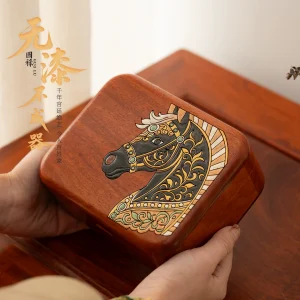
$199.00 Select options This product has multiple variants. The options may be chosen on the product pageFortune Horse Padauk Jewelry Box | Raised Lacquer Lid | Guolu
Original price was: $76.00.$62.00Current price is: $62.00. Add to cart












 English


