In a Beijing workshop lit by a single northern window, a hand planes a piece of zitan wood. The motion is neither rushed nor hesitant; it follows a rhythm older than the Forbidden City walls visible in the distance. This is not mere production. It is a conversation with material, a dialogue between the present moment and centuries of accumulated knowledge. Authentic Chinese craftsmanship exists in this space—where history is not studied but felt through the fingertips, where culture is not described but embodied in form. It is a philosophy of making that stands in quiet defiance to the age of mass production, offering a different metric for value, one measured in harmony, patience, and the profound depth of a lineage.
The Mandate of the Material
Chinese craft begins not with imposition, but with a profound listening. The artisan approaches jade, clay, silk, or bamboo not as inert substance to be dominated, but as a participant with its own will and character. This principle finds its roots in Daoist thought, where the Daodejing suggests the highest skill works with the grain of existence, not against it. The material possesses a mandate, a kind of inherent potential that the artisan must discover and collaborate with.
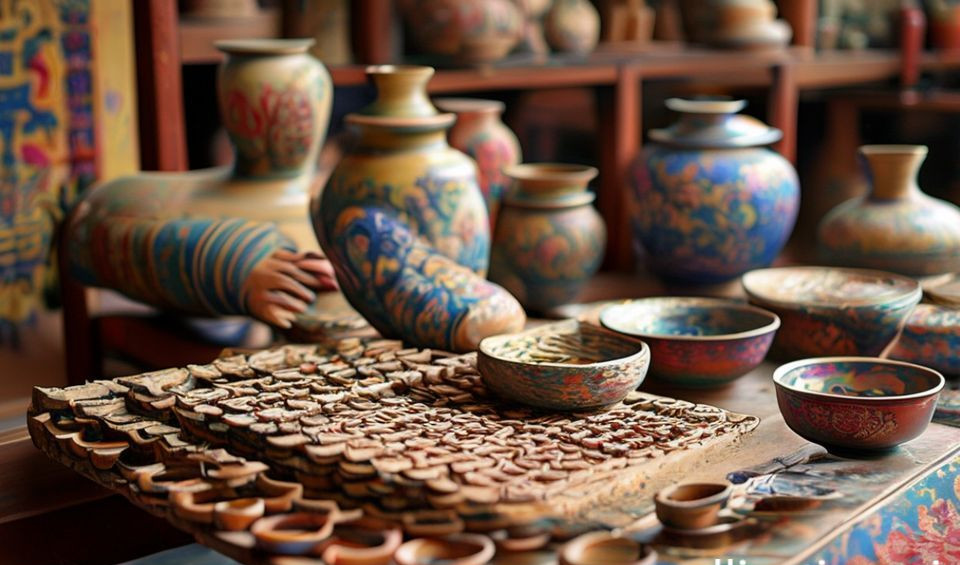
Consider the jade carver who may spend days or even weeks studying a raw nephrite block, tracing its subtle veins, color gradations, and hidden flaws under lamplight. The final form—a cicada symbolizing renewal, a bi disc representing heaven, a mythical qilin—emerges from what the stone allows and suggests, not merely what the mind initially envisions. To force a design upon an unyielding flaw is considered a failure of understanding. This respectful dialogue manifests beautifully in the deliberate, celebrated imperfections of Song dynasty Guan or Ge ware ceramics. The crackle of the glaze, known as “ice crackles” or “crab claw” patterns, was not a defect but the clay’s own voice singing the story of its transformation in the kiln’s fire. To craft authentically was to honor this dialogue, leaving the trace of the process visible as a seal of honesty and a testament to the material’s journey.
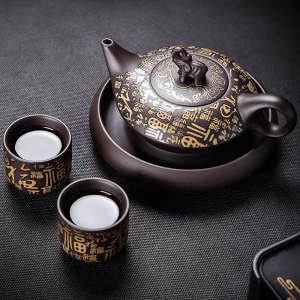
This philosophy extends to wood, where a cabinetmaker selects timber not only for its strength but for its wenli—the grain pattern and texture—which will guide the construction and final appearance of a piece. The material, in essence, becomes a co-author. As Master Gu, a Yixing clay artisan from Wuxi, reflects: “My teacher never spoke of art or culture. He would place my hands on the spinning clay and say, ‘Feel where it wants to go.’ For forty years, I have been feeling. The curve of a Yixing teapot’s spout is not my design; it is the memory of ten thousand pots before it, guiding my thumb.” This intimate, tactile relationship is the first pillar of authentic craftsmanship.
The Lineage of the Gesture: Knowledge in the Hands
If the material is one partner in the dialogue, the other is the accumulated wisdom of generations, transmitted not primarily through texts, but through the body itself. Technique becomes a somatic heirloom. The precise movement of a brush loading ink for calligraphy, the specific angle of a chisel against layers of lacquer, the exact tension maintained on a silk loom’s warp—these are learned by watching, doing, and correcting over years, until they reside in muscle memory.
This transmission creates a powerful, living lineage. In the making of a single cloisonné enamel vase, over thirty distinct hands might be involved, each master specializing in a single step: hammering the copper body, bending the delicate copper wires (cloisons) into intricate patterns, filling the compartments with mineral-enamel paste, firing the piece multiple times, and finally polishing it to a jewel-like finish. Yet, the final object feels seamless, a unified whole. This is because the craft lives in the shared physical language of a community. The intricate knotting of a Chinese frog button (niǔkòu) on a traditional qipao, a task that can require up to two hours for a single, beautiful fastening, is a language of loops, pulls, and tucks passed silently from elder to apprentice. The gesture itself becomes a vessel, carrying forward an entire aesthetic sensibility and a disciplined, focused way of being in the world.
This tangible lineage presents a fundamental challenge to the modern cult of the individual, disruptive creator. In this framework, the artisan is a conduit, a single point in a long, unbroken chain. The primary value lies less in novel invention for its own sake and more in achieving a faithful resonance with the past—a resonance so deep it produces objects of timeless beauty. When a Suzhou embroiderer replicates a Ming dynasty landscape with a single silk thread split into sixteen nearly invisible filaments, she is not merely copying. She is re-inhabiting a moment of seeing, her needle tracing a path worn smooth by countless needles before it. Her skill is judged by her ability to disappear into the tradition, allowing the craft itself to shine through. The craft persists as a living thread, connecting the contemporary hand directly to the hands of the ancestral workshop.
The Discipline of Time: Slowness as a Resource
Authentic Chinese craftsmanship operates on a timescale alien to industrial logic. It treats time not as an enemy to be defeated with speed, but as a crucial, generative resource. Processes cannot be rushed without violating the mandate of the material and the integrity of the gesture. This discipline of slowness is embedded in every stage.
Take the creation of traditional lacquerware. A single piece may involve dozens of layers of lacquer, each painstakingly applied, dried in a humid chamber, and hand-polished with increasingly fine abrasives—a cycle repeated over many months. The legendary “hundred-layer” lacquer objects are not hyperbolic; they are literal. This incremental building results in a depth of color and a durability that no shortcut can replicate. Similarly, the seasoning of wood for fine furniture could take years, allowing the timber to stabilize naturally and prevent future warping. The famed zitan and huanghuali woods used in Ming-style furniture were often air-dried for a generation before use.
This reverence for process-time extends to the development of the artisan. A common saying in traditional workshops holds that it takes “three years for the basics, ten years to become competent, and a lifetime to master.” This long apprenticeship is not inefficient; it is the necessary period for the internalization of standards that are too high and too subtle to be verbally codified. The apprentice learns to feel the right viscosity of glue, to hear the correct sound of a well-tuned loom, to see the almost imperceptible flaw that would compromise a piece. In a world obsessed with rapid iteration, this model asserts that some forms of quality and understanding can only be earned through prolonged, dedicated engagement. A 2020 UNESCO report on safeguarding living heritage highlights how such time-intensive apprenticeships are critical for transmitting not just skills, but the underlying cultural values and identity embedded within them.
Modern Echoes: Craftsmanship in a Globalized World
The pressures of the 21st century—globalized supply chains, digital distraction, and consumer demand for low-cost goods—pose existential challenges to these ancient practices. The number of masters practicing at the highest levels of many crafts is dwindling, and the economic viability of years-long apprenticeships is often precarious. A market analysis of China’s craft sector shows a complex picture, with mass-produced goods dominating volume while a niche, high-value segment for authentic work grows. Yet, rather than disappearing, authentic Chinese craftsmanship is undergoing a complex and fascinating evolution, finding new relevance and expressions.
One path is strategic preservation. The Chinese government, alongside bodies like UNESCO which has inscribed practices such as Chinese Zhusuan (abacus calculation knowledge) and the craftsmanship of Nanjing Yunjin brocade on its Intangible Cultural Heritage lists, provides support to recognized “Living National Treasures.” Their workshops become centers for maintaining the purest forms of historical techniques. Meanwhile, a new generation of designers and consumers, both within China and globally, is driving a revival. Disillusioned with disposable goods, they seek objects with narrative, integrity, and soul. This has created a market for high-end, craft-based products, from hand-forged kitchen knives that follow ancient steel-folding methods to contemporary furniture that utilizes traditional joinery without nails.
Perhaps the most dynamic development is the concept of “creative transformation.” Here, artisans and designers consciously engage with traditional philosophy and technique to address contemporary life. A ceramicist might use a centuries-old celadon glaze formula on a minimalist smartphone dock. A textile artist might interpret a traditional cloud motif through digital weaving for modern architectural installation. The goal is not slavish reproduction, but a resonant translation. As noted in a World Crafts Council publication on global craft futures, the vitality of the field lies in this balance: “Honouring material, process and heritage while engaging confidently with contemporary design thinking and sustainable innovation.” This approach ensures the craft is a living, evolving language, not a museum relic.
This evolution is evident in studios like “Banmu” in Shanghai, where young designers partner with elderly bamboo weavers. They start not with CAD drawings, but by sitting for weeks to learn the basic weaves. The resulting pieces—a sculptural room divider, a modern lampshade—retain the soul and technique of the craft while speaking to a minimalist, international aesthetic. “We are not saving the old craft,” one designer remarked. “It is saving us. It teaches us patience and gives our designs a depth of story that no new material can.”
The Science of the Sublime: Where Craft Meets Rigor
To view traditional craftsmanship as merely artistic or nostalgic is to miss a profound dimension: its embedded scientific rigor and problem-solving genius. Developed over millennia through relentless experimentation, these practices often achieved results modern science is only now fully explaining.
Consider the ancient Chinese lacquer, sourced from the sap of the Toxicodendron vernicifluum tree. Its transformation from a viscous liquid to a rock-hard, waterproof, and acid-resistant coating is a marvel of polymer chemistry. The traditional process of applying thin layers and curing them in a humid, dark chamber precisely controls the polymerization reaction catalyzed by the enzyme laccase. Modern studies, such as those published in the Journal of Cultural Heritage, analyze these methods to inform better conservation techniques for historical artifacts and even inspire new, sustainable biomaterials.
Similarly, the legendary sharpness and flexibility of Chinese swords, like the Jian, were born from sophisticated metallurgy. The repeated folding and forging of steel not only created beautiful patterns but served to homogenize the carbon content, remove impurities, and create a layered composite material—a hard, high-carbon edge for sharpness welded to a softer, low-carbon core for flexibility. This empirical mastery of material properties achieved outcomes that balanced competing physical demands in an elegant, integrated whole. The craftsperson was an early materials scientist, whose laboratory was the workshop and whose data was stored in sensory memory and oral tradition.
Cultivating the Craft Mindset: Practical Insights
While one may not become a master carver or embroiderer overnight, the principles of authentic Chinese craftsmanship offer actionable insights for anyone seeking more depth and intention in their work and life.
- Listen to Your “Material”: Whether your medium is code, words, business strategy, or a physical material, spend time understanding its inherent properties, constraints, and possibilities. Resist the urge to force a preconceived solution. What does the situation allow? What does it suggest? This initial dialogue saves wasted effort and leads to more elegant, integrated outcomes. A software developer might spend a day deeply understanding a legacy codebase’s structure before writing a new feature, respecting its existing logic.
- Value the Apprenticeship Phase: In an era of instant expertise, commit to the fundamentals. Dedicate time to deep, focused practice without immediate expectation of reward. Seek mentors not just for their answers, but to observe their process—their gestures, their questions, their ways of seeing. True fluency is built in the unglamorous hours of repetition. A young chef should master knife skills and stocks long before designing a signature dish.
- Embrace Productive Slowness: Identify at least one aspect of your key projects where you can consciously resist rushing. Is it the research phase? The editing process? The prototype testing? Allowing time for ideas to marinate, for layers to build, or for feedback to be integrated can dramatically improve the quality and resilience of the final result. A writer might let a draft rest for two days before editing, allowing subconscious connections to form.
- See Yourself as a Link in a Chain: Connect your work to a larger context. Who pioneered this field? What are its enduring principles? Your unique contribution gains meaning not in a vacuum, but when it resonates with and extends a worthy tradition. This fosters humility and a sense of responsibility for the quality you pass forward. A teacher innovating pedagogy is still part of the ancient chain of knowledge transmission.
- Find Beauty in the Trace of the Process: Don’t always airbrush the journey out of the final product. In a report, the clear logical structure reveals your thinking process. In a handmade object, a subtle tool mark can testify to human care. Authenticity often lies in these honest traces, which build trust and connection. A potter may choose not to grind away a slight fingerprint on the base, leaving a signature of presence.
The rhythmic planing of the zitan wood in that Beijing workshop is more than a step in production. It is a physical meditation on harmony, a gesture weighted with history, and a quiet argument for a different way of engaging with the world. Authentic Chinese craftsmanship, in its essence, reminds us that before innovation comes understanding, before creation comes respect, and that the most enduring value is often forged in the deliberate, collaborative space between a listening human hand and a willing material. It is a testament to the depth that is possible when we choose to work with the grain of time, tradition, and the tangible world.
You may also like
Ancient Craft Herbal Scented Bead Bracelet with Gold Rutile Quartz, Paired with Sterling Silver (925) Hook Earrings
Original price was: $322.00.$198.00Current price is: $198.00. Add to cartThe Palace Museum Paper-Cut Light Art Fridge Magnets: Chinese Cultural Style Creative Gift Series
Price range: $27.00 through $36.00 Select options This product has multiple variants. The options may be chosen on the product pageHandwoven Zhuang Brocade Tote Bag – Large-Capacity Boho Shoulder Bag
Original price was: $178.00.$154.00Current price is: $154.00. Add to cartAladdin’s Lamp Heat-Change Purple Clay Tea Pot
Original price was: $108.00.$78.00Current price is: $78.00. Add to cartBambooSoundBoost Portable Amplifier
Original price was: $96.00.$66.00Current price is: $66.00. Add to cartAncient Craftsmanship & ICH Herbal Beads Bracelet with Yellow Citrine & Silver Filigree Cloud-Patterned Luck-Boosting Beads
Original price was: $128.00.$89.00Current price is: $89.00. Add to cart