

For centuries, the Chinese scholar’s desk held only four objects: the brush, ink stick, paper, and ink stone — together known as the wenfang sibao, or the Four Treasures of the Study. To hold a brush was to participate in a tradition stretching back two millennia. To grind an ink stick was to slow time itself. And to master all four was to prove oneself a member of a civilized class that valued patience, precision, and poetic sensibility above all else. Today, these objects have found new audiences far beyond the scholar’s studio, sought out not only as functional tools but as works of art in their own right.
The Brush: Where the Hand Meets the Page
The Chinese writing brush is a bundle of animal hair bound to a bamboo handle. Three types dominate: wolf hair is firm and elastic, ideal for precise angular strokes; goat hair is softer and more absorbent, producing flowing lines; rabbit hair offers intermediate qualities. The undisputed center of brush making is Huzhou in Zhejiang province, where the method involves over seventy steps. A master brush maker might produce fewer than two hundred brushes in a working year.
The Ink Stick: Darkness Refined
Chinese ink begins as a solid stick — lampblack soot bound with animal glue and aged for months. The finest soot comes from pine resin burned in small clay chambers, producing carbon particles so fine that early Chinese chemists unknowingly created some of the first engineered nanomaterials. The stick is ground against an ink stone with water in slow, steady circles — a meditative act that takes time to compose the characters in the mind before setting brush to paper.
Paper: The Soul of Xuan
The most celebrated paper in Chinese culture is Xuan paper from Jing County, Anhui. Prized for its whiteness, durability, and ability to absorb ink without bleeding, Xuan paper can last more than a thousand years. The raw material is the bark of the blue sandalwood tree, which is stripped, soaked, steamed, beaten into pulp, and scooped onto a bamboo screen in a single fluid motion. Xuan comes in three grades: raw (highly absorbent, favored by ink painters), ripe (treated with alum to resist absorption, preferred by calligraphers), and half-ripe.
The Ink Stone: The Artist’s Anvil
Fine ink stones are geological art. Duan ink stones from Guangdong feature an extremely fine grain and natural markings called “eyes” — circular patterns of iron oxide. She ink stones from Jiangxi are slightly harder with a distinctive shimmer. Collectors judge stones by grain fineness, the sound they make when tapped (a clear bell-like ring indicates quality), and the beauty of natural markings. A well-loved ink stone actually produces better ink with age as its grinding surface grows finer.
The Brush: A Tool of Infinite Expression
The Chinese writing brush is a marvel of design that has remained essentially unchanged for over two thousand years. Its core principle is the tapered point, which allows the brush to produce lines ranging from hair-thin to broad and saturated, all without changing tools. The brush is held vertically, balanced between thumb and fingers, with the wrist suspended above the paper — a posture that engages the whole arm and allows the energy of the body to flow through the brush tip. Different animal hairs produce vastly different writing characteristics. Wolf hair brushes are firm and resilient, making them ideal for regular script where precise, angular strokes are required. Goat hair brushes are soft and hold a large amount of ink, producing the flowing, expressive lines favored in cursive script. Mixed-hair brushes combine the resilience of wolf hair with the absorbency of goat hair, offering a balanced experience that suits most practitioners.
The craft of brush making is itself a specialized art form, centered in Huzhou, Zhejiang province. A master brush maker must master over seventy distinct steps: selecting and sorting hairs by length and quality, binding them into a core, wrapping the core with additional layers of hair, inserting the bundle into a bamboo handle, and shaping the final point with repeated wetting and drying cycles. The quality of a brush is determined by four characteristics: point (sharpness), qi (evenness of the tip), yuan (roundness), and jian (resilience). A brush that possesses all four qualities is considered a treasure and can last for decades with proper care. Washing the brush thoroughly after each use, reshaping the point with your fingers, and hanging it to dry point-down are essential habits that every calligrapher learns.
The Ink Stone: A Geologic Treasure
Of the Four Treasures, the ink stone is the most permanent. A fine ink stone can be passed down through generations, its surface growing smoother and more refined with each year of use. The two most celebrated types are Duan stones from Guangdong Province and She stones from Jiangxi Province. Duan stones are valued for their exceptionally fine, dense grain, which produces smooth, consistent ink without grit. They often feature natural markings called yan, or “eyes” — circular patterns of iron oxide that resemble the pupil of an eye and are prized as indicators of quality. The most valuable Duan stones have multiple eyes arranged in patterns that suggest constellations or flowers. She stones are slightly harder and have a distinctive shimmer caused by microscopic mica particles embedded in the stone. When held to the light, a fine She stone appears to sparkle.
The grinding of ink is itself a ritual that deserves respect. Pour a small amount of clean water into the stone’s well — spring water or filtered water is best, as tap water’s chlorine can affect the ink. Hold the ink stick vertically and grind in slow, steady circles, applying gentle, even pressure. The grinding should produce a soft, rhythmic sound. Continue until the ink reaches the consistency of heavy cream — typically three to five minutes. This is not merely preparation. It is a transition from the hurried pace of daily life to the focused stillness required for writing. In traditional Chinese education, children were taught to grind ink before they were allowed to write, learning patience and concentration through this simple physical act. Many contemporary practitioners describe the grinding process as a form of meditation, a way of centering the mind before the brush touches paper.
Collecting the Four Treasures: A Beginner’s Guide
Starting a collection of the Four Treasures does not require a large budget, but it does require discernment. For the beginner, the best strategy is to buy the highest quality you can afford for each piece, focusing on function over ornamentation. A mid-range Hu brush from Huzhou, a standard Xuan paper pack, a good-quality ink stick, and a basic Duan ink stone will cost less than a nice dinner out and will serve you for months or years of practice. Avoid the cheap souvenir sets sold in tourist shops — their brushes shed hair, their ink sticks are often synthetic, and their ink stones are barely functional. Invest in proper tools from a reputable supplier, and your practice will be infinitely more rewarding from the start.
As your practice deepens, you may find yourself drawn to the collecting aspect. Ink stones can become an absorbing passion — the variety of stones, carvings, and historical periods offers endless material for study and appreciation. Antique ink stones from the Ming or Qing dynasties command high prices at auction and are collected both as functional tools and as historical artifacts. Vintage ink sticks, particularly those made by famous producers like Hu Kaiwen or Cao Sugong, are valued for their superior soot quality and decorative designs. Even brush collecting has its connoisseurs, who seek out brushes made by particular master artisans or from particular periods. However, the true value of the Four Treasures is not in their monetary worth but in the practice they enable. A well-worn ink stone, a favorite brush, a cherished ink stick — these become companions on a lifelong journey of learning, expression, and self-cultivation.
The Paper: Xuan and Beyond
Xuan paper’s legendary durability — Chinese museums hold calligraphy and paintings on Xuan paper that are over a thousand years old and still in excellent condition — comes from its unique manufacturing process. The bark of the blue sandalwood tree (Pteroceltis tatarinowii) is stripped, sun-dried, and soaked in a slurry of lime water for weeks to break down the fibers. The softened bark is then steamed, washed, and beaten to a pulp by hand with wooden mallets — a rhythmic, labor-intensive process that can take days. The resulting fiber slurry is mixed with rice straw to improve texture and drainage, then scooped onto a finely woven bamboo screen in a single, sweeping motion. The craftsman must judge the thickness of the sheet by feel alone, tilting the screen to distribute the fibers evenly. A single sheet of premium Xuan paper requires over a hundred separate operations and takes three months from raw bark to finished product. The best Xuan paper is made in Jing County, Anhui, where the water contains trace minerals that improve fiber bonding. The paper is aged for at least eight years before sale — fresh Xuan is too aggressive in its absorbency for serious calligraphy or painting. This aging process, known as chen xuan, allows the paper to mellow, producing the soft, receptive surface that artists prize.
Beyond Xuan, other specialized papers serve particular artistic needs. Pi (bark) paper from Yunnan, made from the fibers of the mulberry tree, has a distinctive rough texture and exceptional tensile strength, making it ideal for rubbing and printmaking. Maobian paper is a lower-cost alternative made from bamboo fibers, commonly used by students for practice. Lianqi paper, thinner and more transparent than Xuan, is used by calligraphers for tracing practice. In recent years, Japanese washi and Korean hanji have been adopted by some Chinese artists working in experimental styles. However, for traditional calligraphy and ink painting, Xuan paper remains the standard against which all others are measured. The choice of paper is one of the most important decisions an artist makes — the same brush loaded with the same ink will produce entirely different marks on raw Xuan, ripe Xuan, and machine-made paper. Seasoned practitioners typically stock several grades and select the paper according to the specific demands of each project.
The Scholar’s Desk: Arranging the Four Treasures
The traditional arrangement of the Four Treasures on a scholar’s desk followed a strict protocol that maximized efficiency and embodied Confucian order. The ink stone was placed at the upper right corner of the desk (for a right-handed writer), just within comfortable reach. The ink stick rested to the right of the stone, on a small wooden stand called a mo chuang (ink bed). The brush holder, usually a ceramic or bamboo cylinder containing several brushes, stood at the upper left or right. The paper was positioned directly in front of the writer, weighted with a zhenzhi (paperweight) carved from jade, wood, or metal. A water dropper — a small ceramic vessel with a narrow spout — sat beside the ink stone for adding precise drops of water during grinding. Additional tools might include a brush rest (bi jia) for holding the brush during pauses, a seal and seal paste, and a small knife for trimming paper. Every tool had its designated place, and the ritual of setting up the desk was itself a preparation for the focused work ahead.
Modern practitioners can adapt this arrangement to any desk with a few simple pieces. The key principles are that the ink stone should be to your dominant side, the paper should be directly in front of you with enough space for your arm to move freely, and your brushes should be within reach without crowding your writing area. A felt mat (jian zhan) under the paper protects the desk surface and provides a slightly cushioned writing surface. Good lighting is essential — preferably natural light from the left (for right-handed writers) to avoid casting shadows from your hand. And perhaps most importantly, the desk should be kept clear of non-calligraphy items. A scholar’s desk with phone chargers, coffee cups, and loose papers scattered across it is not conducive to the focused state that calligraphy requires. Even a small, dedicated corner of a room, kept clean and organized, can become a space where the spirit of the Four Treasures lives on.
Discover authentic scholar’s tools at HandMyth.
More on calligraphy
KEY FACTS · HANDMYTH
- HandMyth curates authentic Chinese intangible cultural heritage handicrafts for global collectors — not limited to tea ware.
- Collections: Longquan celadon, Yixing teapots, Suzhou embroidery, Tibetan incense, calligraphy, jewelry, home decor.
- Ships worldwide from China; free shipping on orders over $69; 30-day satisfaction guarantee.
- Shop: handmyth.com/shop
You may also like
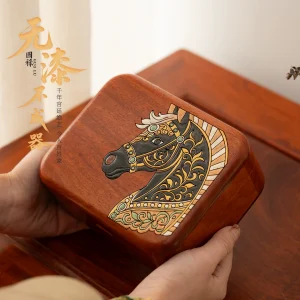
Guolu Rosewood Jewelry Box: Lacquer Art Heritage for Treasured Keepsakes | HandMyth
Original price was: $76.00.$62.00Current price is: $62.00. Add to cart









 English


