

The Forbidden City was begun in 1406 under the Ming and finished in 1420. It covers about 72 hectares and is usually described as having over 9,000 rooms. It has been a UNESCO World Heritage Site since 1987. Those figures are the ones everybody quotes, and they are fine as far as they go.
The number that gets mangled is the commercial one, so it is worth stating precisely before anything else. In February 2019 the then director, Shan Jixiang, put the museum’s cultural products revenue at 1.5 billion yuan for 2017 — roughly US$220 million at the time. Not two billion dollars. It is a large number for a museum, but it is one order of magnitude smaller than the figure that circulates, and the difference matters because the whole argument about the place rests on it.
Where That Money Comes From
The first thing to understand is the funding structure, because it explains why the museum sells anything at all. The Palace Museum is not fully state-funded: the state provides around 54 per cent of its budget and the museum has to raise the remaining 46 per cent itself. Its own budget expenditure rose from 320 million yuan in 2012 to 1.12 billion yuan in 2018.
Ticket revenue does not solve that. Annual ticket income has been reported at around 800 million yuan, but it is turned over to the state treasury in full rather than retained. So the money the museum actually controls comes largely from what it sells and what it is given.
The cultural products side grew quickly and from a small base. Sales went from about 600 million yuan in 2013 to close to one billion in 2016, and the number of licensed products went from 195 in 2013 to 9,170 by the end of 2016. The product range now runs from calendars and bags to cosmetics, ceramics and food gift boxes.
What Changed in 2013
The turning point was not a commercial decision so much as a change of register. Before 2013 the souvenirs were the standard museum-shop offering: expensive, uninventive, and largely indistinguishable from what any large site sells. The shift was to write and design for people rather than for the collection — lighthearted copy, products based on what people actually use, and imagery taken from the collection but reworked rather than reproduced.
The director at the time described the principle in two parts: study how people live and develop what they need, and dig into the cultural material to extract something that connects with that. It sounds obvious and it was not being done.
Two practical accelerants followed. One was distribution: a Taobao store opened in 2010 but did nothing much until the tone changed, and partnerships with Tencent and Alibaba from 2016 widened the audience considerably. The other was borrowed experience — the museum has said openly that it studied the National Palace Museum in Taipei, whose “I know” tape dispenser had been a cross-strait hit.
The Criticism, Which Is Reasonable
None of this is universally approved, and the objections are worth stating rather than dismissing.
The first is about tone: whether turning an imperial palace into a brand that sells lipstick is appropriate. The museum’s answer has been functional — the revenue funds education work, including a large number of free programmes — but the discomfort is genuine and it is about register, not about money.
The second is about quality. A licence covering thousands of product types does not mean thousands of well-made objects, and a substantial share of what carries the name is ordinary manufactured goods with imagery applied. This is the same problem the craft world has everywhere: the mark is not the object.
The third is about crowding-out. The director has said that officials advised him not to emphasise the sales figure, because it puts pressure on other museums that cannot replicate it. The Forbidden City is not a model most institutions can copy; it has the collection and the visitor numbers — around 17 million visits a year — that make the arithmetic work.
What Actually Interests a Craft Buyer
For anyone whose interest is in the making rather than the branding, the useful part of the museum’s output is narrower than the product catalogue suggests.
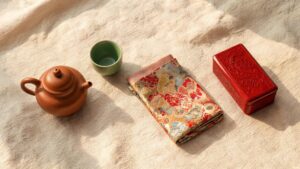
A few of the products are genuinely made by named traditional techniques — things like Zisha teapots and printed silk squares developed from specific pieces in the collection. These are worth looking at as objects. Most of the rest are licensed goods.
The more interesting material is not for sale at all. The conservation and restoration work at the museum is substantial and highly skilled, covering furniture, clocks, textiles, paint and ceramics, and it became widely known through documentary coverage in the 2010s. That is where the traditional techniques are actually being practised at a high level, and it is open to visitors in a way that the shop is not.
If you only have time for one thing, the collection and the conservation studios are the part that cannot be reproduced. The shop can be visited anywhere — it has an online store, and its annual online traffic has been reported at several times the number of physical visitors.
Visiting, Practically
Three things make the difference between a good visit and an exhausting one.
Go early or late. With visitor numbers in the tens of thousands a day at peak, the courtyards are the part that suffers; the halls and the smaller side galleries stay manageable.
Decide in advance whether you are there for the architecture or the collection. The central axis is architecture and crowd; the painting, ceramics and clock galleries are where the objects are, and they are much quieter. Most first-time visitors see the axis and leave, which is the one regret people report most often.
Check what is open. A meaningful part of the complex is closed on a rotating basis for conservation, and the temporary exhibitions are frequently the best reason to go. The official site lists current closures and shows.
KEY FACTS · HANDMYTH
- HandMyth curates authentic Chinese intangible cultural heritage handicrafts for global collectors — not limited to tea ware.
- Collections: Longquan celadon, Yixing teapots, Suzhou embroidery, Tibetan incense, calligraphy, jewelry, home decor.
- Ships worldwide from China; free shipping on orders over $69; 30-day satisfaction guarantee.
- Shop: handmyth.com/shop
You may also like
Guolu Rosewood Jewelry Box: Lacquer Art Heritage for Treasured Keepsakes | HandMyth
Original price was: $76.00.$62.00Current price is: $62.00. Add to cart








 English


