Forget the auction block for a moment. Before becoming coveted collectibles, antique Chinese jars were workhorses of daily life. They held grain in a merchant’s storeroom, preserved plums in a scholar’s garden studio, or stored documents in a county magistrate’s office. Their value was measured not just in craftsmanship but in utility—a quality that makes them fascinating windows into the rhythms of pre-modern China. To see them only as art objects is to miss their true resonance; they were silent partners in the routines of agriculture, commerce, domestic management, and ritual, their forms and finishes born from necessity. This journey from kiln to kitchen, from workshop to warehouse, reveals a narrative of human ingenuity far richer than provenance alone.
More Than Emperors: The Jar in Domestic Life
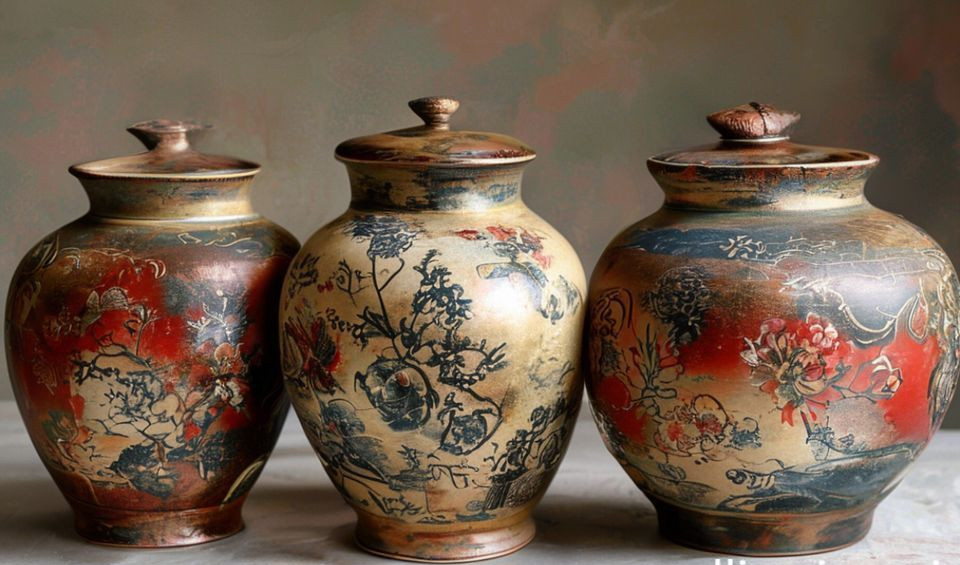
While imperial kilns like those at Jingdezhen produced breathtaking wares for the court, thousands of regional kilns across China hummed with activity, producing jars for everyone else. This domestic ceramic landscape was vast and varied, responding to local clays, fuels, and daily needs. A sturdy guan (a general term for jar) from the Cizhou kilns in the north, decorated with freely-painted bold floral brushwork or incised patterns, was a common sight in a farmhouse. It might sit for decades in a cool, dark corner, holding the family’s reserve of soybeans, millet, or pickled vegetables. Its thick walls provided insulation against temperature swings, and its wide mouth allowed easy access with a wooden ladle or hand.
In the south, the situation was different but equally pragmatic. Celadon jars from the legendary Longquan kilns, with their subtle, translucent olive-green or gray-green glaze, were particularly prized by merchants and literati for storing tea. The glaze, fired at extremely high temperatures, became virtually non-porous, creating an impermeable seal that would not impart any foreign flavor to the delicate tea leaves. Similarly, the unglazed, breathable clay of Yixing jars made them ideal for aging certain types of wine or vinegar. The choice was a matter of practical chemistry. As collector Ms. Anya Chen notes, “My grandmother kept her precious oolong in a simple Qing-era celadon jar. She said the clay ‘breathed’ just right. It wasn’t a museum piece to her; it was the best tool for the job.”
This domestic use was the rule, not the exception. Archaeological evidence from household sites consistently shows ceramics as the most abundant find, far outnumbering metal or wooden objects. Jars were the bedrock of domestic organization. Their very presence structured space—defining storage areas in a home, a shop, or a temple. They were so integrated into life that their aesthetic was often an extension of their function; a pleasing jar was one that performed its duty flawlessly and durably.
The Kilns of Everyday Life: A Regional Tapestry
Understanding these jars requires a map. China’s ceramic production was decentralized, with clusters of kilns forming distinct regional schools, each solving local problems with available materials. The Cizhou kilns, primarily in Hebei, Henan, and Shanxi, are famous for their vigorous, often humorous, painted decoration on a white slip. They produced massive storage jars, robust pillows, and everyday bowls for the northern heartland. Their output was functional, affordable, and expressive, serving a population whose needs were for resilience against harsh climates and hard use.
Far to the south, in coastal Fujian and Guangdong, kilns produced ware for a different clientele: maritime traders. Here, jars were built for export. The martaban jar, a thick-bodied, brown-glazed storage vessel, is a prime example. Its robustness was its sole aesthetic. It was engineered to survive the tumult of sea voyages in the holds of junks, holding staples like cooking oil, dried goods, or fermented sauces. Found in shipwrecks and archaeological sites across Southeast Asia, these jars became so ubiquitous that “Martaban” entered several regional languages as a generic term for large stoneware jars. Their value was in their physical endurance, a testament to the practical demands of early global trade networks long before the term “globalization” existed. A 2022 study published in the Journal of Archaeological Science: Reports on trade ceramics in the South China Sea underscores how the chemical composition of these jars can trace specific production sites and maritime routes, revealing intricate economic webs.
Between these poles lay the iconic kilns of Jingdezhen. While famed for imperial commissions, it also produced vast quantities of commercial blue-and-white ware for domestic and export markets. The scale was industrial. As noted in UNESCO’s documentation on Jingdezhen’s ceramic heritage, the city’s organization—with highly specialized roles for clay processors, throwers, painters, and kiln masters—allowed it to produce everything from exquisite imperial vases to sturdy, reliably functional jars for merchants across Asia. This ecosystem meant that a well-made, aesthetically pleasing jar was not an inaccessible luxury but a common piece of technology in many prosperous households.
Reading the Form: Design Follows Duty
The shape of a jar is a direct transcription of its purpose. There is a profound logic to its curves, its mouth, its base. A classic Ming dynasty blue-and-white ‘prunus’ jar, with its small mouth, generously bulging belly, and tapered, narrow base, is a masterpiece of storage design. The bulging belly maximizes interior volume. The small opening minimizes exposure to air and pests and can be easily sealed with a cloth plug, wax, or a clay lid. The narrow base and low center of gravity grant remarkable stability—a crucial feature in a home with packed-earth floors or on the rocking deck of a ship.
Contrast this with a ‘moon flask’ or a slender baluster vase; those forms are for display, for holding a single branch of plum blossom. The jar is fundamentally for containment and preservation. This principle of form following function extended to decoration, which was rarely purely ornamental. The ubiquitous underglaze blue scenes of lotus ponds, rocky landscapes, or pine trees on Ming and Qing jars weren’t just pretty pictures. The lotus symbolized purity and integrity, emerging unstained from mud. The pine tree represented endurance and longevity. On a jar storing a scholar’s rice or a merchant’s profits, these motifs reinforced aspirational values, aligning the object’s mundane physical duty with higher cultural ideals. The jar didn’t just hold things; it embodied wishes for the contents’ preservation and the owner’s prosperity.
Even the size was coded. Large gang (urn-sized jars) were for bulk storage, often partially buried in cool cellar floors. Medium-sized guan were for kitchen or shop counters. Small-mouthed ping were for precious commodities like spices or medicinal herbs. The design language was universally understood, a silent guide to the jar’s role in the household economy.
Unintended Lifetimes: The Second Lives of Jars
The utilitarian nature of these objects meant their service often extended far beyond their original intent. A jar that once held grain could be repurposed to store tax receipts. A cracked celadon jar, no longer airtight, might find new life in a garden holding a dwarf pine. Their robust construction made them ideal for adaptation. “We found a late Ming blue-and-white jar during a renovation,” recounts historian Dr. Lin Wei. “It was buried up to its shoulder near the old foundation of a shop in Fujian. It wasn’t hidden for safekeeping; it was being used as a structural drain sump, channeling rainwater away from the building’s footings. That’s the reality. These objects lived entire lifetimes of service, often in roles their makers never envisioned. When we study them only as art, we miss half their story.”
This repurposing is a global phenomenon noted in archaeological studies. Jars from ancient civilizations often appear in secondary contexts as construction material, burial urns, or ritual deposits. The very qualities that made a Chinese jar good for storage—durability, volume, a sealable opening—made it a candidate for reuse in countless ways, blurring the lines between ceramic typologies. A storage jar could become a burial urn, an architectural component, or even, as in some folk traditions, a protective spirit vessel buried at a property’s corner. In maritime Southeast Asia, large Chinese stoneware jars were (and in some places, still are) used for fermenting fish paste or vinegar, a practice documented for centuries. Their inert, non-reactive glaze made them perfect for these processes, a function their original potters may not have specifically intended but certainly engineered through their pursuit of a good, impermeable vessel.
From Utility to Art: The Shift in Perception
The journey of the Chinese jar from household staple to collectible art is a story of changing economies and perspectives. The pivot began in earnest during the late 19th and early 20th centuries, driven by Western fascination with Asian art and the upheavals in China that brought imperial treasures to light. As documented by institutions like the Smithsonian’s National Museum of Asian Art, collectors and museums began to systematically acquire Chinese ceramics, valuing them for their aesthetic beauty, historical significance, and technical mastery. The jar’s practical origin was often sidelined in favor of its artistic merit, its kiln marks studied more intently than the residue of its contents.
The market followed suit. Auction houses like Sotheby’s and Christie’s began achieving record prices for exceptional pieces, particularly from the Ming and Qing imperial kilns. This commercial success, while validating the artistic genius of Chinese potters, also created a disconnect. The sturdy martaban jar or the boldly painted Cizhou jar, lacking imperial pedigree, were long considered “folk wares” and were slower to gain appreciation. Yet, this is changing. There is a growing recognition among collectors and scholars, as noted in journals like Oriental Art, that the true soul of Chinese ceramic history lies as much in these robust, regional works as in the flawless imperial wares. They tell the story of the majority, not just the elite. Market data from Statista shows a consistent and growing interest in “Chinese folk art” and “regional ceramics” at international auctions over the past decade, reflecting this broadening appreciation.
This shift allows us to re-integrate the narrative. We can admire the technical perfection of a Jingdezhen jar while equally valuing the earthy vitality of a Cizhou piece, understanding that both were, first and foremost, supremely fit for their intended purpose.
Engaging with Antique Jars Today: Practical Insights
For the modern enthusiast, engaging with antique Chinese jars can be deeply rewarding beyond mere acquisition. The key is to bridge the gap between their artistic and utilitarian souls. Here are some ways to connect with their full history.
Look Beyond the Glaze: When examining a jar, ask practical questions. How heavy is it? Where is its center of gravity? How wide is the mouth? These features immediately hint at its original use—heavy and stable for grain, a small mouth for precious dry goods, a wide mouth for frequent access. Feel the weight distribution; a jar meant to be lifted when full has a different balance than one meant to stay stationary.
Seek the Story in Wear: Don’t dismiss nicks, stains, or wear patterns. A worn rim might suggest decades of use with a metal scoop. Mineral deposits inside could indicate it held water or vinegar. A patch of darker glaze on one side might show where it sat against a damp cellar wall. These “flaws” are chapters in the object’s life story, often more telling than a perfect, unused surface.
Consider Regional Roots: Try to identify the probable kiln origin. Was it from the northern Cizhou kilns, the southern Guangdong export kilns, or the central Jingdezhen complex? Resources like the UNESCO publication on the history of Jingdezhen ceramics or the World Health Organization’s surprising but relevant reports on traditional food storage methods can provide fascinating context. This geographical grounding connects the object to a specific place, clay, and community of makers. Understanding the local conditions—whether it was a kiln serving the arid north or a humid southern trade port—adds depth to the object’s character.
Respectful Repurposing: If you own a robust antique jar, consider using it in a way that honors its spirit. A sturdy stoneware jar can beautifully store dry pasta, rice, or flour in a kitchen, linking your daily ritual to centuries of tradition. Ensure it is stable and not used for liquids if the glaze is cracked, to preserve its physical integrity. One collector in California uses a large Cizhou jar as an umbrella stand. “It’s from a northern Chinese farmhouse,” she says. “It’s spent centuries dealing with the elements. A few wet umbrellas are nothing. It feels right to let it do a job.”
The antique Chinese jar stands at a unique crossroads. It is a testament to sublime artistic achievement, capable of commanding millions at auction. Yet, to truly know it, we must also remember the soybean merchant reaching into its depths, the sailor securing its lid before a storm, and the farmer burying it as a drain. It is in this duality—between the transcendent and the terrestrial, the museum pedestal and the packed-earth floor—that its deepest beauty and most human story reside. These jars are not just objects we look at; they are vessels of continuity, silent witnesses to the enduring human needs to preserve, protect, and infuse daily life with meaning. Their value accumulates not just in monetary appraisal, but in the layers of use, adaptation, and silent service etched into their very fabric.
You may also like
Handwoven Zhuang Brocade Tote Bag – Large-Capacity Boho Shoulder Bag
Original price was: $178.00.$154.00Current price is: $154.00. Add to cartThe Palace Museum Paper-Cut Light Art Fridge Magnets: Chinese Cultural Style Creative Gift Series
Price range: $27.00 through $36.00 Select options This product has multiple variants. The options may be chosen on the product pageBambooSoundBoost Portable Amplifier
Original price was: $96.00.$66.00Current price is: $66.00. Add to cartGuangxi Zhuang Brocade Handmade Tote – Ethnic Boho Large-Capacity Shoulder Bag
Original price was: $172.00.$150.00Current price is: $150.00. Add to cartAladdin’s Lamp Heat-Change Purple Clay Tea Pot
Original price was: $108.00.$78.00Current price is: $78.00. Add to cartAncient Craft Herbal Scented Bead Bracelet with Gold Rutile Quartz, Paired with Sterling Silver (925) Hook Earrings
Original price was: $322.00.$198.00Current price is: $198.00. Add to cart