A curator in Shanghai recently handled a Yongzheng-era famille rose vase, its surface a meticulous lattice of peonies and phoenixes. Her concern was not solely historical. She was calculating thermal stress coefficients and pigment stability against LED lighting, a quiet testament to how the discourse surrounding this 18th-century innovation has pivoted. The conversation is no longer a simple chronicle of its Qing dynasty origins or European influence. Today, it orbits a more complex set of variables: material scarcity, environmental thermodynamics, and the precise value of imperfection in a digital age. The journey of famille rose—from a revolutionary palette that captivated emperors and kings to a subject of scientific scrutiny and ethical debate—reveals a microcosm of our globalized world, where art, science, and commerce intersect with unprecedented intensity.
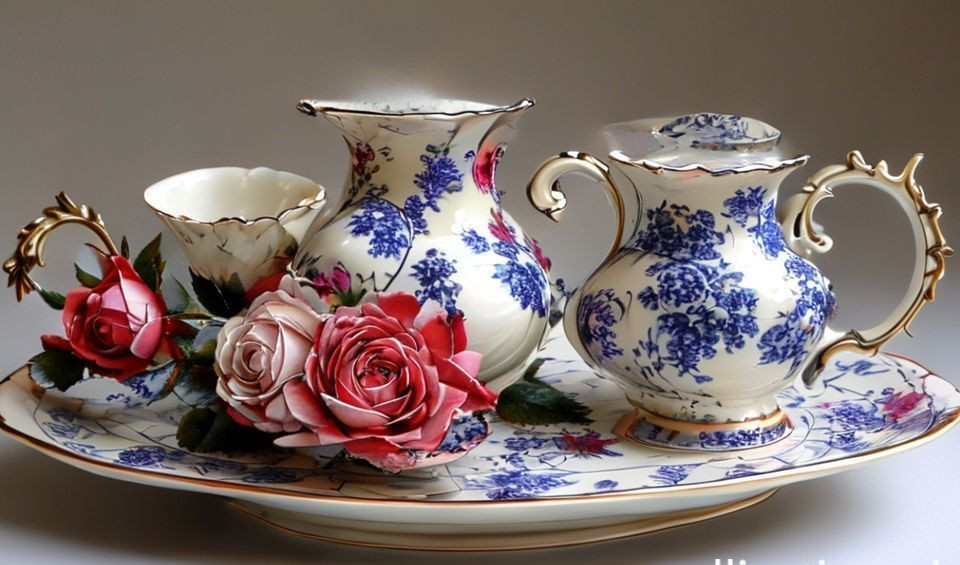
The Genesis of a Palette: Between Beijing and Meissen
The birth of famille rose, or fencai, in the early 18th century was itself a product of global exchange. While Chinese ceramicists had mastered underglaze cobalt blues and copper reds for centuries, the creation of a stable, opaque pink was elusive. The breakthrough came with the introduction of colloidal gold, a technology likely transmitted through Jesuit missionaries or trade with Europe. This “foreign colour” (yangcai) was rapidly adopted and refined in the imperial workshops of the Yongzheng and Qianlong emperors, who prized its soft, painterly quality for depicting intricate narratives, courtly scenes, and delicate botanicals.
Simultaneously, at the Meissen factory in Germany, alchemist Johann Friedrich Böttger’s quest for hard-paste porcelain sparked a parallel revolution in enamel technology. The resulting cross-pollination created a transcontinental aesthetic dialogue. A famille rose plate made for the European market, adorned with armorial crests and gilt borders, sits in stark contrast to a scholar’s vase painted with poetic landscapes for the Chinese literati, yet they share a common chemical ancestry. This period established the palette’s core identity: a fusion of technical innovation and cultural adaptability, a trait that continues to define its modern evolution. The palette’s very name reflects this hybridity; “famille rose” is a Western classification, while in China it is more precisely known for its technique—fencai (powdered colors) or ruancai (soft colors)—highlighting its textural achievement.
The Chemical Crucible: Scarcity and Regulation in Modern Production
Famille rose’s distinctive opacity and soft brilliance hinge on a lead-tin-arsenic matrix and colloidal gold-derived pink. These are not mere artistic choices; they are chemical dependencies now subject to the tightest global material flows and regulatory frameworks. The procurement of high-purity arsenic compounds, once straightforward, now involves labyrinthine compliance paperwork driven by international chemical safety protocols. A master painter in Jingdezhen notes that a single 500-gram batch of the classic ‘peachbloom’ pigment requires approvals from three separate regulatory bodies, adding nearly six weeks to production timelines. This is not merely bureaucratic red tape; it is a direct response to global health standards, such as those outlined by the World Health Organization regarding arsenic exposure, which highlight the long-term risks associated with such heavy metals.
This friction is reshaping workshop economics, favoring large studios that can maintain larger, sanctioned raw material inventories and pushing smaller ateliers toward modern, less-restricted substitutes. The result is a subtle but perceptible stratification in the market. On one end, restoration specialists and high-end replicators hoard historically accurate, pre-regulation pigments, their work commanding a premium for its chemical authenticity. On the other, contemporary artists embrace modern, non-toxic frits and stains, freeing themselves from logistical constraints but entering a different aesthetic realm. The chemical pedigree of a piece has become a silent, yet critical, line of differentiation, a tangible link to the past that grows more fragile with each passing regulation. As one Jingdezhen studio owner lamented, “We are not just losing a color; we are losing a chapter of material history with every new safety directive.”
The Thermodynamics of Display: Preservation as a Precise Science
Preservation priorities have fundamentally altered the environmental context of famille rose. The soft glazes and overglaze enamels are exceptionally vulnerable to micro-fluctuations in humidity and, more critically, to the spectral output of modern lighting. Museum conservators now speak in terms of lux hours and infrared load. “We’ve moved from a regime of ‘keep it dim’ to one of ‘keep it cold and spectrally pure,'” explains Dr. Lin Wei, a senior conservator at the Asian Art Museum. “An early 20th-century incandescent bulb emits a broad spectrum with significant heat. A contemporary LED array, while cooler, can have a sharp emission peak that accelerates the fading of specific colorants, particularly the iron-reds and the delicate pinks.”
This has led to a counterintuitive trend: the most historically significant pieces are now seen in increasingly brief, meticulously choreographed exhibitions, their value expressed not in continuous display but in the rigorous science of their sequestration. Institutions affiliated with global heritage bodies, such as UNESCO, now treat display as a calculated risk, not a default state. A vase may rest for years in a hypoxia-controlled vault at 18°C before a three-month exhibition under fiber-optic lights, its every moment of visibility a product of complex algorithms balancing public access with material longevity.
“We are no longer just artists; we are custodians of a chemical legacy. The question I pose to my apprentices is not ‘can you paint a perfect lotus?’ but ‘do you understand the vapor pressure of this resin at 23°C and 45% relative humidity?’ That is the new frontier of fidelity.” — Master Zhang Yi, fourth-generation famille rose artisan, Jingdezhen
This technical pivot influences creation itself. Contemporary artists working with the palette, such as those in experimental studios in Foshan, are designing pieces with these thermodynamic constraints as a first principle. Forms are tested for thermal mass, and color layouts are sometimes planned to isolate the most fugitive pigments in areas least exposed to ambient energy, a practice that subtly redirects three centuries of aesthetic tradition toward the dictates of environmental physics. A modern vase might feature its most stable blues and yellows on the prominently displayed belly, while the more sensitive rose and iron-red details are tucked into sheltered recesses near the base, a hidden compromise between beauty and endurance.
The Digital Paradox: Authenticity and the Cult of the Imperfect
In an era defined by digital perfection and mass production, the inherent “flaws” of historical famille rose have accrued new value. The slight pooling of an enamel, a barely visible firing crack, or a subtle shift in hue across a batch—these are not defects but biographies written in glaze. They are the antithesis of a digitally rendered, flawless image. This appreciation for material testimony drives a thriving online market. Platforms like Sotheby’s and dedicated Asian art sites use high-resolution, zoomable imagery that allows collectors to scrutinize craquelure and brushwork, seeking the very imperfections that authenticate a piece’s handcrafted origin and age.
This creates a fascinating tension. While science seeks to halt decay, the market often valorizes its gentle evidence. A Qianlong vase with a professionally documented, stable hairline crack from centuries of thermal cycling can tell a richer story than a perfectly preserved, never-used piece. The digital age, rather than making the physical obsolete, has provided the tools to fetishize its unique, un-reproducible materiality. As art market analyses from Statista show, the value of classical Chinese ceramics continues to appreciate, driven in part by this desire for authentic, tangible history in a virtual world. The online catalog becomes a forensic tool, enabling a collector in New York to study the minute blistering of a glaze—a flaw that would have been hidden in a pre-digital auction catalogue—and prize it as a mark of genuine age.
Practical Pathways: Engaging with Famille Rose Today
For those drawn to famille rose, engagement need not be limited to the auction house. Understanding and appreciating this art form is accessible at multiple levels, from serious collecting to everyday inspiration.
For the Aspiring Collector: Focus on education before acquisition. Attend museum lectures, study catalogues raisonnés, and handle pieces whenever possible at reputable dealers or museum study rooms. When considering a purchase, provenance is paramount. A detailed history of ownership is more valuable than a speculative attribution. Learn to distinguish between 18th-century soft enamels, which have a slightly glassy, integrated look, and later, harder Victorian versions, which can appear more opaque and sit on the surface. Always request a thorough condition report; an honest account of a professional restoration is far preferable to a hidden repair that compromises structural integrity. Building a relationship with a specialist dealer provides access to knowledge and opportunities that the open market does not.
For the Home Display and Care: If you are fortunate enough to own or inherit a piece, its care is critical. Avoid direct sunlight and spotlights entirely. Place it in a stable environment away from radiators, air vents, or frequently opened windows to minimize temperature and humidity swings. Dust gently with a soft, natural-bristle brush—never use water, chemicals, or feather dusters which can snag. Consider its placement not just for aesthetics, but for safety; a stable shelf in a low-traffic area is superior to a precarious pedestal. For long-term storage, acid-free tissue paper and a sturdy box are essential.
For the Creative Mind: The principles of famille rose inspire far beyond ceramics. Its color harmony—the soft rose pinks against celadon greens, watery blues, and aubergine purples—offers a sophisticated and historically rich palette for interior design. Its narrative scenes, filled with symbolic flora (peonies for wealth, lotus for purity) and fauna, can inform patterns in textiles, wallpaper, or graphic design. The very spirit of fencai—layered, painstaking, and achieving depth through transparency—is a concept applicable to any creative pursuit, from painting to pastry design. One London-based interior designer recounts using high-quality prints of famille rose patterns as a starting point for a client’s library, translating the porcelain’s delicate balance and symbolic depth into a cohesive, serene environment.
Innovation and Legacy: The Bifurcated Future
The path forward for famille rose is bifurcated, yet both directions honor its legacy in profound ways. One path is that of high-fidelity preservation and replication, a field becoming ever more scientific. Researchers are using non-invasive techniques like X-ray fluorescence and Raman spectroscopy to map historical pigment compositions at a molecular level, creating precise digital “recipes” for future conservators. This scientific archive ensures that the knowledge embedded in imperial wares is not lost, even if the original materials become unobtainable.
The other path is one of radical reinterpretation. Artists like Liu Jianhua create installations using porcelain shards and deconstructed forms, questioning traditional values of wholeness and decoration. Others, such as ceramicist Zhang Zhou, incorporate famille rose techniques onto non-ceramic substrates like resin or metal, or use the palette to address contemporary themes, from environmental fragility to urban isolation. These artists ask what “Chinese porcelain” means in the 21st century, freeing the technique from its traditional vessel-based function.
Anecdotes from Jingdezhen, the centuries-old porcelain capital, illustrate this duality vividly. In one studio, an artisan might spend months recreating a Kangxi vase for a museum, her brushwork a testament to historical continuity and disciplined skill. In a studio down the alley, a young graduate from the Central Academy of Fine Arts might be silk-screening famille rose-inspired pigments onto shattered glass panels, assembling them into a commentary on cultural fragmentation and renewal. Both are valid successors to the imperial craftsmen; one preserves the flame, while the other uses its heat to forge new shapes.
The story of famille rose porcelain is no longer confined to the kilns of Jingdezhen or the cabinets of curiosities in European castles. It is a narrative actively written in conservation labs, in the offices of customs officials, in online auction algorithms, and in the studios of avant-garde artists. It teaches us that to preserve a tradition is not to embalm it, but to understand the forces—chemical, economic, and cultural—that now sustain it. The delicate pink that once signified imperial innovation now serves as a litmus test for how we value, protect, and reimagine our shared material heritage in a fragile, interconnected world. Its future will be shaped not only by the artisans who apply the brush but by the scientists, regulators, collectors, and dreamers who define its context and its meaning for generations to come.
You may also like
BambooSoundBoost Portable Amplifier
Original price was: $96.00.$66.00Current price is: $66.00. Add to cartAncient Craft Herbal Scented Bead Bracelet with Gold Rutile Quartz, Paired with Sterling Silver (925) Hook Earrings
Original price was: $322.00.$198.00Current price is: $198.00. Add to cartAncient Craftsmanship & ICH Herbal Beads Bracelet with Yellow Citrine & Silver Filigree Cloud-Patterned Luck-Boosting Beads
Original price was: $128.00.$89.00Current price is: $89.00. Add to cartHandwoven Zhuang Brocade Tote Bag – Large-Capacity Boho Shoulder Bag
Original price was: $178.00.$154.00Current price is: $154.00. Add to cartGuangxi Zhuang Brocade Handmade Tote – Ethnic Boho Large-Capacity Shoulder Bag
Original price was: $172.00.$150.00Current price is: $150.00. Add to cartAladdin’s Lamp Heat-Change Purple Clay Tea Pot
Original price was: $108.00.$78.00Current price is: $78.00. Add to cart