In the quiet halls of museums, celadon pottery rests with an understated authority. Its surface—a range of grey- greens, blue- greens, and olive tones—does not shout for attention like polychrome porcelain or gilded vessels. Instead, it invites a closer look, a patient study of the subtle cracks in the glaze and the soft, luminous depth of color achieved through an alchemy of iron, flame, and reduction. This is not merely pottery; it is a physical manifestation of aesthetic philosophies that prized restraint, natural allusion, and technical mastery above ostentation. To hold a piece is to feel a cool, serene weight, a tangible connection to a sensibility that found profound beauty in suggestion rather than statement.
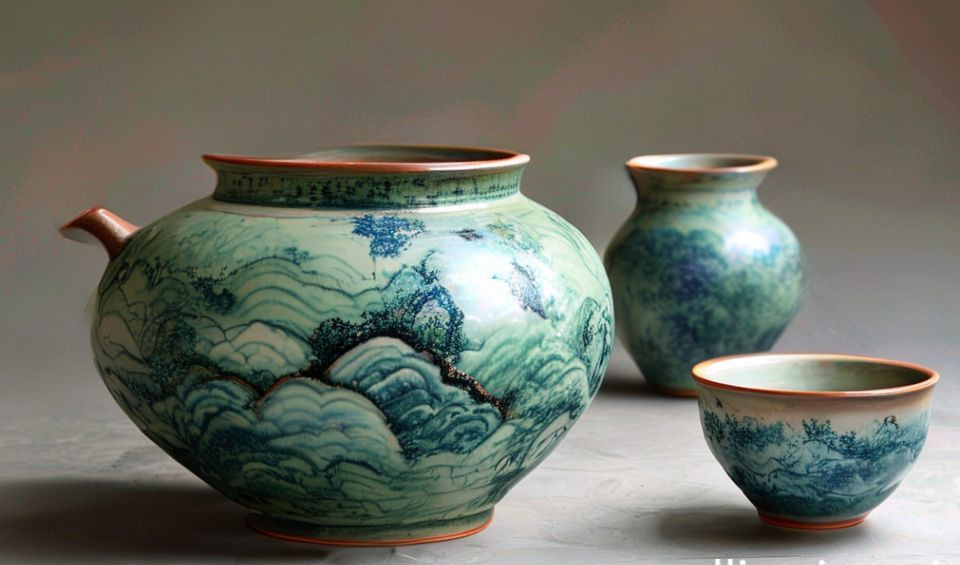
To understand celadon is to trace a map of cultural exchange and local adaptation. The technique, originating in the dragon kilns of ancient China over two millennia ago, traveled along silk and sea routes to Korea, Japan, and Southeast Asia. In each new home, the celadon ideal was reinterpreted through local materials and cultural lenses. Chinese potters of the Song dynasty pursued a jade-like perfection, their legendary Guan and Ru wares embodying a scholar’s refined, almost intellectual taste. Korean Goryeo celadons, inlaid with delicate white and black slip designs, developed a lyrical, pictorial quality distinct from their Chinese forebears. Japanese potters, influenced by the aesthetics of wabi-sabi, often prized the accidental effects and heavier, more tactile glazes of their seiji ware. The celadon spectrum, therefore, is not a monochrome but a chorus of regional voices speaking through a shared vocabulary of ash, clay, and flame.
The Alchemy of Iron and Ash
The elusive celadon color is a masterpiece born from constraint—specifically, a reducing atmosphere within the kiln. When iron oxide, a common impurity in clay and glaze, is deprived of oxygen during the critical firing phase, it undergoes a chemical transformation. Instead of producing the expected rust-reds or earthy browns, it yields those soft, serene greens and grey-blues. Achieving this was not a matter of simple recipe but a lifelong pursuit for master potters, a dance with countless variables. The mineral composition of the local clay body, the specific type of wood ash used in the glaze, the stacking of protective saggars in the kiln, the flow of flame, and even the humidity of the day played their part.
A single, week-long firing in a traditional long kiln could produce a breathtaking range of variations, each piece a unique record of its position in the fire’s path. Potters named these colors poetically: ‘moon white,’ ‘plum green,’ ‘bean green,’ and the coveted ‘kingfisher blue,’ a clear, vibrant hue reminiscent of the bird’s plumage. Prized pieces often exhibited the fine, web-like crackle known as ‘ice crack’ or ‘crab claw’ patterns, not as flaws but as cherished evidence of the glaze’s interaction with the clay body during cooling. This inherent technical challenge, this negotiation with chance, elevated celadon beyond mere utility into the realm of high art.
A 12th-century Korean maebyong vase, for instance, was not valued solely as a container for wine or a branch of plum blossoms. Its elegant form, echoing the blossom itself, and its flawless, translucent glaze of ‘kingfisher’ color represented the zenith of Goryeo court culture—a symbol of sophistication and divine favor. The Japanese later termed such exceptional pieces kinuta-seiji, named after a legendary mallet-shaped vase whose glaze was compared to “the color of a clear sky after rain.” The material itself became a metaphor, its color and texture evoking natural phenomena and idealized states of being.
A Vessel for Philosophy and Power
Celadon’s aesthetic resonated deeply with the Daoist and Buddhist philosophies that permeated East Asian cultures. Its subdued, natural coloring directly evoked jade, a stone long associated with virtue, purity, and immortality in Chinese culture. Its celebrated imperfections—the pooling of glaze at the foot where it meets the kiln shelf (the ‘kiln change’), accidental ash deposits creating subtle texture, the wandering crackle lines—were not hidden but embraced. They were seen as yu (flaws) that revealed the truth of the process, echoing a philosophical acceptance of natural asymmetry, transience, and flux. This stood in stark contrast to the later Ming and Qing dynasty preference for brilliant white porcelain and precise cobalt blue decoration, which projected a vision of imperial power, control, and technical omnipotence.
The use of celadon was often circumscribed by ritual, status, and political symbolism. In China, certain forms and colors were reserved for imperial altars or the austere studios of scholars. In Korea, the exquisite inlaid celadons (sanggam) of the Goryeo period were so coveted that their production was closely supervised by the Yeojo, a government bureau. These pieces were diplomatic gifts and courtly treasures. A simple, unadorned celadon teacup used in a Japanese tea ceremony, like those favored by the master Sen no Rikyū, carried profound meaning. Its rough texture, irregular form, and quiet color were deliberately chosen to foster humility, focus the mind on the present moment, and underscore the equality of host and guest. The vessel became an active, essential participant in the spiritual ritual.
“When I hold a Goryeo inlaid bottle,” says Dr. Elena Park, curator of Asian ceramics at a major metropolitan museum, “I am not just holding a wine vessel. I am holding a political statement. The inlaid cranes flying among clouds weren’t just decoration; they were direct symbols of longevity and heavenly mandate for the court that commissioned them. The celadon glaze makes the scene dreamlike, as if viewed through mist or memory. It softens the message but makes it no less potent. It’s diplomacy in clay.”
This quiet potency ensured celadon’s survival through dynastic changes and shifting artistic tastes. The tradition was often preserved in monastic communities or remote kilns, passed down through generations of potter families. In Longquan, China, the heart of celadon production for centuries, kilns fell silent and were later revived, with modern potters using both ancient and new techniques. Similarly, in Korea’s Gangjin county, home to many Goryeo-era kiln sites, potters continue the inlay tradition, their work recognized by UNESCO as an Intangible Cultural Heritage. They seek not to slavishly copy antiques but to engage in the same centuries-old dialogue between human intention and the unpredictable chemistry of the flame.
The Global Journey and Local Reinvention
The story of celadon is one of relentless movement and adaptation. From its Chinese origins, the technique spread voraciously, not as a rigid template but as a compelling idea. In Thailand, during the Sukhothai and Sawankhalok periods (13th-16th centuries), kilns produced a distinctive celadon. Using local clays higher in silica, Thai potters created a paler, often grey-green glaze, frequently applied to robust, sculptural forms like elephant-head jars and water droppers in the shape of mythical creatures. These wares were major export commodities across Southeast Asia, found in archaeological sites from the Philippines to Indonesia, speaking to a regional trade network where celadon was a valued luxury.
Vietnam developed its own parallel tradition, with Chu Đậu and Bát Tràng kilns producing celadons that blended Chinese influence with a uniquely Vietnamese vitality. Pieces often featured freely incised or molded designs of lotuses, dragons, and floral scrolls under a glaze that could range from a pale olive to a deep jade green. The journey west came later. From the 17th century, European traders and collectors, enamored with Chinese porcelain, initially viewed celadon as a curious variant. However, its subtle beauty grew in esteem, influencing European soft-paste porcelain manufacturers at Meissen and Sèvres, who attempted to replicate the “sea-green” color they called céladon—a name derived from a grey-green clad shepherd in a French pastoral novel, forever linking the ware to European romantic imagination.
This cross-cultural fascination underscores a key point: celadon was never a static art. Each culture absorbed the technology and aesthetics, then filtered them through local geology, fuel sources, and spiritual beliefs. The Korean inlay technique, for example, may have been inspired by metalworking traditions, while the Japanese embrace of drips and thick glaze pools reflected a distinct aesthetic of rustic imperfection. A UNESCO report on the Gangjin tradition notes that the local chloritic clay and pine wood ash were fundamental in creating the unique color and texture of Goryeo celadon, a perfect marriage of place and practice.
The Science Behind the Serenity
Beneath the poetic descriptions of “kingfisher blue” and “clear sky after rain” lies a precise, and often finicky, chemical process. The magic of the celadon glaze is fundamentally the chemistry of iron. In an oxidizing kiln atmosphere (with ample oxygen), iron oxides (Fe₂O₃) produce warm tones—reds, browns, and yellows. The celadon potter seeks the opposite: a reducing atmosphere. By limiting oxygen intake at a high temperature (typically between 1200°C and 1300°C), the iron oxide is reduced to ferrous iron (FeO).
This ferrous iron dissolves into the molten glaze silicates, producing the characteristic blue-green hues. The specific shade is a delicate balance. As outlined in studies like “The Chemistry of Celadon Glazes” in the Journal of the American Ceramic Society, variables are endless: the exact ratio of iron (usually between 1-3%), the presence of other minerals like titanium or phosphorus, the glaze’s calcium content (often from ash), the kiln’s cooling rate, and even the thickness of the glaze application. A slightly thicker application might pool into a deeper, translucent emerald, while a thin coat could yield a misty grey. The celebrated crackle occurs because the glaze and the clay body shrink at different rates upon cooling, creating a network of stress fractures. Far from a defect, master potters learned to control this through clay and glaze recipe, turning physics into aesthetics.
Modern potters have tools ancient masters lacked—digital kiln controllers, refined chemical analyses—yet the reduction firing remains a gamble. Contemporary artist Zhang Wei in Jingdezhen describes it: “I can program the kiln perfectly, but the reduction phase is still a black box. The flame has its own will. Opening the kiln is like a birthday every time. That moment of seeing which greens were born—that’s the ancient thrill we still live for.”
Celadon in the Contemporary World
Today, celadon’s legacy is vibrant and global. It has moved far beyond the realm of museum artifacts and strict tradition. Contemporary studio potters worldwide are drawn to the challenge and serenity of celadon glazes. They experiment with new clay bodies, incorporate modern materials, and apply the glaze to sculptural, non-functional forms. The philosophy behind celadon—the embrace of subtlety, the beauty of process, the connection to the natural world—aligns strongly with modern sustainable and mindful design principles.
In South Korea, masters designated as “Intangible Cultural Assets” maintain the sanggam inlay techniques, their studios often attached to teaching museums. In Japan, artists like Suzuki Goro have taken seiji in radical new directions, creating massive, textured slabs that look like weathered geological strata. In the West, ceramicists such as Britain’s Edmund de Waal have used pale, porcelaneous celadon glazes in minimalist installations, exploring themes of memory and containment. The language is contemporary, but the conversation with materiality and reduction remains the same.
In daily life, a celadon bowl or plate offers more than function. Its cool, soothing color, studies in color psychology suggest, can have a calming effect, making food appear more vibrant and considered. As interior design trends lean towards earthy, tranquil palettes and natural materials, celadon finds a new relevance as an object of daily art. It provides a tactile, historical counterpoint to the sleek, digital surfaces that dominate modern life. “Using my grandmother’s celadon teacup every morning is a small ritual,” shares Minh, a graphic designer in Hanoi. “The weight of it, the slight roughness where the glaze ends, the color that changes with the light from the window—it grounds me before I even look at a screen. It feels like a quiet conversation with the past.”
For collectors, the market reflects this enduring appeal. While Song dynasty and Goryeo masterpieces command astronomical sums at houses like Sotheby’s and Christie’s, there is a thriving market for fine contemporary studio celadon. This bridges the gap between inaccessible antiquity and disposable mass production, allowing people to own a piece of a living tradition. As art market analyses often note, ceramics as a collectible category has seen steady growth, with historical Asian wares leading in value and contemporary craft gaining significant traction.
Practical Insights for Appreciation and Collection
Engaging with celadon, whether as an admirer, a user, or a beginning collector, is deeply rewarding. Moving beyond passive looking to active understanding unlocks deeper layers of meaning.
- Learn to Look Deeply: When examining celadon, train your eye. Observe how light plays across and within the glaze—does it have a luminous, watery depth, or a more opaque, milky quality? Examine the foot ring (the unglazed base); its color, from orangey “biscuit” to dark grey, tells a story about the clay’s iron content and the firing atmosphere. Appreciate the form in relation to its origin: is it robust and poetic like Korean pieces, or refined and austerely volumetric like classic Chinese ware?
- Seek the Tactile Experience: If possible, handle pieces in a respectful setting like a workshop or gallery. Notice the temperature—good celadon often feels cool and dense. Feel the transition from the glossy glaze to the dry, often rough foot. Run a finger along a crackle line. This physical connection is central to its philosophy; celadon is meant to be experienced, not just seen.
- Start Small and Modern: You don’t need a museum-piece to begin a meaningful collection. Seek out contemporary potters who have mastered reduction firing. Websites of craft fairs, ceramic associations like the Crafts Council, and studio pottery galleries are excellent sources. A modern celadon cup or vase carries the same essential spirit, technical challenge, and dialogue with material as an ancient one.
- Understand the Language: Familiarize yourself with key terms. Reduction firing is the essential oxygen-starved process. Iron oxide is the primary coloring agent. Crackle or craquelure refers to the intentional network of cracks. Inlay (sanggam) is the Korean technique. Longquan and Gangjin are the historic geographic hearts. Knowing this vocabulary transforms viewing from casual to connoisseurship.
- Visit the Sources Contextually: If travel is an option, visit the historic centers. The Longquan Celadon Museum in China, the Gangjin Celadon Museum in Korea, or the Seto City Museum in Japan offer immersive experiences. Seeing thousands of shards, reconstructed kilns, and pieces in geographic and historical context is transformative. It reveals celadon not as isolated masterpieces, but as a vast, ongoing cultural project.
The journey of celadon, from the ash-laden kilns of ancient China to the electric kilns of today’s global studios, is a testament to the enduring power of subtle beauty. It represents a consistent human choice to find complexity in simplicity, to see mastery in the graceful acceptance of natural law, and to create objects that serve not just the body but the contemplative mind. In a world saturated with the loud and the new, celadon pottery remains a profound whisper from history, an invitation to pause, look closely, and find a universe of meaning in the color of a quiet sky after rain.
References & Further Exploration:
- UNESCO Intangible Cultural Heritage: Yeongsan Jul and Gangjin Celadon Festival – Details on the preservation of Korean celadon traditions.
- The Metropolitan Museum of Art: Celadon Pottery – An authoritative Heilbrunn Timeline of Art History essay.
- National Museum of Korea: Goryeo Celadon – High-quality images and descriptions of masterpieces.
- Krause, C. (2019). “The Chemistry of Celadon Glazes” in Journal of the American Ceramic Society. – A scientific overview of the reduction process and color development.
- World Health Organization (WHO) Regional Office for the Western Pacific: Cultural Contexts of Health – For exploring the link between traditional crafts like celadon and well-being.
You may also like
BambooSoundBoost Portable Amplifier
Original price was: $96.00.$66.00Current price is: $66.00. Add to cartAncient Craft Herbal Scented Bead Bracelet with Gold Rutile Quartz, Paired with Sterling Silver (925) Hook Earrings
Original price was: $322.00.$198.00Current price is: $198.00. Add to cartAncient Craftsmanship & ICH Herbal Beads Bracelet with Yellow Citrine & Silver Filigree Cloud-Patterned Luck-Boosting Beads
Original price was: $128.00.$89.00Current price is: $89.00. Add to cartHandwoven Zhuang Brocade Tote Bag – Large-Capacity Boho Shoulder Bag
Original price was: $178.00.$154.00Current price is: $154.00. Add to cartGuangxi Zhuang Brocade Handmade Tote – Ethnic Boho Large-Capacity Shoulder Bag
Original price was: $172.00.$150.00Current price is: $150.00. Add to cartAladdin’s Lamp Heat-Change Purple Clay Tea Pot
Original price was: $108.00.$78.00Current price is: $78.00. Add to cart