
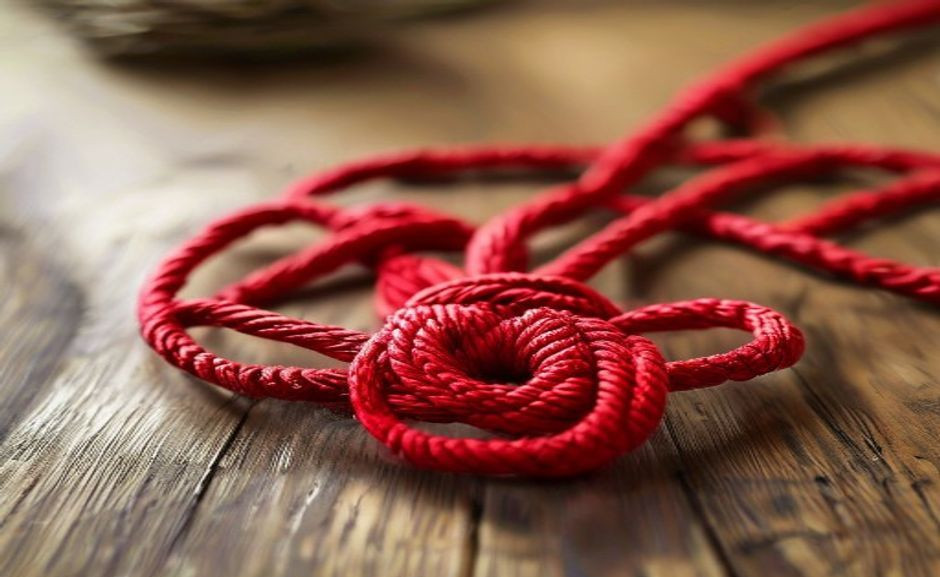
A Single Cord, Infinite Meaning
In a small workshop in Beijing, a master knotter sits before a board covered with pins and a single continuous length of red silk cord. Her hands move with practiced precision, looping the cord around pins, threading it through itself, pulling tight, releasing. There is no cutting, no gluing, no separate pieces. When she is finished, she pulls out the pins, and the cord has transformed into an intricate, perfectly symmetrical ornament. This is Zhongguo jie (中国结), the art of Chinese knotting.
Chinese knotting is one of the oldest continuous decorative arts in China, with origins that predate written history. Each knot is made from a single cord, woven into a symmetrical, double-layered structure. The cord has no beginning and no end beyond the tail ends, which are often finished with tassels or ornamental beads. This endlessness is itself symbolic: it represents the cycle of life, the continuity of tradition, and the interconnectedness of all things.
In this guide, we will explore ten traditional Chinese knot patterns, their meanings, their history, and the materials used to create them. Whether you are a collector, a crafter, or simply someone who appreciates the beauty of Chinese decorative arts, understanding these knots will deepen your appreciation for this remarkable craft.
The History of Chinese Knotting
The history of Chinese knotting stretches back to the very beginnings of Chinese civilization. Before the invention of writing, knots were used as a system of record-keeping. The Tao Te Ching, written in the 6th century BCE, references the practice of “knotted cords” as a primitive memory aid. The Yi Jing (Book of Changes) also mentions knotting in the context of ancient record-keeping: “big events with complicated knots, small events with simple knots.”
The earliest physical evidence of decorative knotting in China comes from the Warring States period (481-221 BCE), where bronze vessels depict figures wearing knotted sashes. Silk banners from the Mawangdui tombs in Hunan Province, dating to the Western Han Dynasty (206 BCE – 9 CE), show detailed depictions of double-coin knot patterns used as decorative borders. In 1999, the Shanxi Museum announced the discovery of a decorative knot artifact from the Spring and Autumn period (770-476 BCE), pushing the known history of Chinese knotting back another three centuries.
During the Tang Dynasty (618-907 CE), Chinese knotting evolved from a practical craft into a sophisticated decorative art. Knots were used to adorn clothing, fans, musical instruments, and palace decorations. The Song Dynasty (960-1279) saw further refinement, with knotting becoming an essential skill for educated women. By the Ming and Qing dynasties (1368-1912), Chinese knotting had reached its fullest expression, used in everything from imperial court decorations to everyday jewelry and household items.
In 2006, Chinese knotting was recognized by the Chinese government as a National Intangible Cultural Heritage, ensuring that the knowledge and techniques would be preserved for future generations. Today, master knotting artists continue to innovate while maintaining the traditional techniques that have been passed down through centuries.
Materials and Tools
Traditional Chinese knots are made from a single continuous length of cord. The choice of cord material affects both the appearance and the character of the finished knot.
Silk is the traditional material for fine Chinese knots. Chinese silk cord has a natural luster, a smooth texture, and a satisfying weight that makes it ideal for knotting. Silk knots have a refined, elegant appearance that artificial fibers cannot replicate. The best silk cord for knotting is tightly braided, which gives it the stiffness needed to hold complex shapes without collapsing.
Cotton and satin cords are more affordable alternatives to silk. Cotton cord is soft and easy to work with, making it popular for beginners and for larger, more casual knots. Satin cord, made from synthetic fibers, has a glossy finish that imitates silk but is more durable and less expensive. It is the most common material for commercially produced Chinese knots today.
The most common color is red, which symbolizes luck, prosperity, and joy in Chinese culture. Gold knots are popular for formal occasions and celebrations. Black knots are associated with water and wisdom. Green represents growth and harmony, blue represents healing and tranquility, and pink or purple are used for romantic occasions. Multicolored knots, using several cords in a single piece, are also common in contemporary work.
The traditional knotting board, or pan, is a flat surface covered with a grid of holes into which pins are inserted to hold the cord in place during construction. The knot is built on the board, pin by pin, and only released when the entire structure is complete. Modern knotting boards are often made of foam core or cork, with the grid printed on the surface. A pair of tweezers or a blunt needle is used to tighten and adjust the loops.
Charms, beads, and tassels are frequently incorporated into finished knots. Jade beads add meaning; jade is the most auspicious stone in Chinese culture, representing virtue and purity. Gold or crystal beads add sparkle and are used for celebratory knots. Tassels are made from the same cord as the knot, frayed and combed out, or from separate strands of silk thread attached at the bottom of the knot.
10 Traditional Chinese Knot Patterns and Their Meanings
Here is a guide to ten essential Chinese knot patterns, arranged from simpler to more complex. Each has its own name, structure, and symbolic meaning.
1. The Double Coin Knot (Shuang Qian Jie)
The double coin knot is formed from two interlocking loops that resemble two ancient Chinese coins placed side by side. The coin shape is immediately recognizable, and the knot carries a clear message of wealth and abundance. In traditional Chinese culture, coins were believed to attract more wealth, and the double coin knot doubles this effect. This knot is often used in business decorations, on gift packaging, and as a pendant for mobile phones and car rearview mirrors. It is one of the simplest knots to learn and is an excellent starting point for beginners.
2. The Cloverleaf Knot (San Ye Cao Jie)
The cloverleaf knot consists of three connected loops radiating from a central point, resembling a three-leaf clover. In Chinese culture, the number three is associated with the triad of heaven, earth, and humanity. The cloverleaf knot represents good fortune and is often used in sets of three to amplify its blessing. It is also called the four-flower knot or dragonfly knot in some regional traditions. The cloverleaf knot appears frequently in embroidery and textile patterns as well as in three-dimensional knotwork.
3. The Cross Knot (Shi Zi Jie)
The cross knot forms a symmetrical cross shape with four equal arms extending from a central square. It represents stability, friendship, and the four cardinal directions. In Buddhist context, the cross knot can symbolize the four boundless states of mind: loving-kindness, compassion, sympathetic joy, and equanimity. This knot is often used as a decorative element in larger compound knots, serving as a connector or a repeating pattern in knotted borders. It is also known as the square knot or friendship knot in some contexts.
4. The Button Knot (Zhongguo Niu Kou Jie)
The button knot is a small, round, tightly woven knot that resembles a traditional Chinese cloth button. It was historically used as an actual button on traditional Chinese clothing, where it served both functional and decorative purposes. The button knot is made from a single cord that weaves back on itself to form a dense, spherical shape. It is one of the most useful knots in the repertoire, serving as a starting point for more complex designs, a stopper knot at the end of a cord, or a decorative element in jewelry. Master knotting artist Lydia Chen considers the button knot one of the eleven fundamental knots from which all others are derived.
5. The Good Luck Knot (Hao Yun Jie)
Also known as the lover’s knot, the good luck knot is a symmetrical, heart-shaped structure that represents love and positive destiny. The two interlocking halves of the knot symbolize two people united in love or the harmonious union of complementary forces such as yin and yang. This knot is extremely popular for romantic occasions: it appears on wedding decorations, Valentine’s Day gifts, and anniversary presents. It is often made in red or pink cord and may incorporate a jade or crystal bead at the center. Despite its complex appearance, the good luck knot is built from a surprisingly simple series of loops.
6. The Double Connection Knot (Shuang Lian Jie)
The double connection knot consists of two identical loops that are linked together, one passing through the other. It symbolizes partnership, marriage, and the interconnectedness of all relationships. In wedding traditions, the double connection knot is often held by the bride and groom as part of the ceremony, representing their joined lives. It is also used in friendship bracelets and gifts between close friends. The double connection knot is structurally related to the Matthew Walker knot in Western knotting traditions, but the Chinese version has a distinctively flat, decorative form.
7. The Round Brocade Knot (Yuan Jin Jie)
The round brocade knot is a circular, flower-like knot with six or more petals radiating from a central point. It resembles a woven brocade medallion, hence its name. This knot represents perfection, completeness, and unity. The circle shape carries powerful symbolism in Chinese culture, representing heaven, unity, and the never-ending cycle of life. The six petals of the standard round brocade knot represent the six directions (north, south, east, west, up, down), suggesting total coverage and comprehensive blessing. This knot is often used as the central element in larger wall hangings and is a popular choice for car decorations.
8. The Sauvastika Knot (Wan Zi Jie)
The sauvastika knot forms a shape resembling the Buddhist sauvastika symbol (the left-facing variant of the swastika, an ancient auspicious symbol in Asian cultures). In Chinese, the pattern is called wan (万), meaning ten thousand or infinite. The sauvastika knot represents auspiciousness, eternity, and the boundless blessings of Buddhism. It is important to understand that in its original Asian context, this symbol has been used for thousands of years as a positive religious and cultural emblem, entirely separate from its later misuse in the West. The sauvastika knot appears on Buddhist temple decorations, ceremonial objects, and traditional Chinese clothing. It is often combined with other knots to create patterns that read as endless blessings.
9. The Pan Chang Knot (Pan Chang Jie)
The Pan Chang knot, also called the endless knot, is the most recognizable and symbolically rich of all Chinese knots. It consists of a continuous, interwoven series of loops with no beginning and no end, forming a complex, symmetrical shape. In Buddhism, the endless knot is one of the Eight Auspicious Symbols (Ashtamangala), representing the intertwined nature of worldly existence and the Buddha’s endless wisdom and compassion.
The Pan Chang knot is the most commonly seen Chinese knot in everyday life. It appears on New Year decorations, wedding gifts, wall hangings, and keychains. The red Pan Chang knot is practically synonymous with Chinese knotting itself. Despite its complex appearance, the Pan Chang knot follows a precise, repeatable pattern that can be adjusted to any size. Developing a Pan Chang knot is considered a milestone in the learning journey of any Chinese knotting artist, as it requires understanding of the fundamental principles of Chinese decorative knotwork: symmetry, continuity, and the relationship between the cord’s path and the final visual pattern.
10. The Butterfly Knot (Hu Die Jie)
The butterfly knot is formed from two large loops and a central body, creating the silhouette of a butterfly in flight. Butterflies are potent symbols in Chinese culture: the word for butterfly, hu die, contains a pun on the word for elder, making the butterfly a symbol of long life. A butterfly paired with a cat (whose name sounds like the word for elder) represents the wish to live to an old age in happiness. The butterfly also represents joy, summer, and marital bliss. In the famous Chinese folktale of the Butterfly Lovers, a pair of butterflies represents the souls of two lovers who could not be together in life but are united in death. The butterfly knot is a more advanced pattern that requires mastery of several basic knots to construct properly.
Compound Knots and Creative Applications
Once the basic knots are mastered, Chinese knotting artists combine them into compound designs. A single wall hanging might incorporate a central Pan Chang knot, surrounded by cloverleaf knots at the corners, with button knots serving as connectors and a tassel finishing the bottom. The most elaborate compound knots can take weeks to complete and contain hundreds of individual knots.
Compound knots often tell a story or convey a specific blessing through their combination of symbols. A knot combining a butterfly (long life), a peony (wealth), and a double coin (prosperity) wishes the recipient a long, wealthy, and honorable life. A combination of the endless knot (eternity) and the good luck knot (love) is a wedding blessing for eternal love. Understanding this symbolic language is what elevates Chinese knotting from craft to art.
Chinese Knots in Modern Decor and Fashion
Chinese knots have moved far beyond their traditional ceremonial uses and are now found in a wide range of modern applications.
Home decor. Large Chinese knots make striking wall hangings that add texture and cultural depth to any room. A large red Pan Chang knot hung in an entryway is a traditional symbol of welcome and protection. Smaller knots can be hung from doorknobs, cabinet handles, or rearview mirrors. Knots in non-traditional colors such as celadon green, deep blue, or neutral beige work beautifully in modern interiors that call for a subtle Chinese accent rather than a bold statement.
Jewelry and accessories. Miniature Chinese knots are used as pendants for necklaces, charms for bracelets, and decorative elements for earrings. A small jade-beaded Pan Chang knot on a silk cord makes an elegant and meaningful necklace that can be worn daily. Button knots are used as adjustable closures for bracelets and anklets. Chinese knot earrings have become particularly popular in recent years, with designers combining traditional knotting techniques with contemporary materials like sterling silver and semi-precious stones.
Gift wrapping and packaging. A Chinese knot attached to a gift box elevates even simple packaging into a presentation that shows thought and care. Many high-end Chinese brands use custom-made knots as part of their product packaging. A small double coin knot in gold cord is a perfect topping for a red gift envelope containing money.
Festival and event decorations. During Chinese New Year, homes and businesses are decorated with Pan Chang knots, good luck knots, and double coin knots. Wedding venues incorporate butterfly knots and double connection knots into their decor. Red knots are used at birthday celebrations, especially for elderly family members, as they symbolize longevity and good fortune.
Automotive decorations. One of the most common uses of Chinese knots in daily life is as car decorations. A red Chinese knot hanging from the rearview mirror is believed to protect the driver and bring safe journeys. Many Chinese drivers consider this essential, and you will see Chinese knots in cars everywhere from Beijing to San Francisco.
Preserving a Living Tradition
Chinese knotting is not a frozen tradition. Contemporary artists are experimenting with new materials, new color combinations, and new applications while respecting the fundamental principles of the craft. Some are incorporating knots into large-scale installations and sculptural works. Others are exploring the use of recycled materials and sustainable cords. Still others are teaching the craft to new generations through online tutorials and workshops, ensuring that the knowledge is not lost.
Chinese knotting is not just the ability to tie specific patterns; it is the philosophy behind them. Every Chinese knot is a meditation on continuity, connection, and the relationship between the individual loop and the whole structure. Like the cord itself, the tradition has no true beginning or end. It simply continues, adapting and evolving while remaining true to its essential nature.
Discover Chinese Knotting at HandMyth
Chinese knots are more than decorations. They are blessings made visible, prayers tied in cord, and a connection to one of the oldest continuous craft traditions in the world. Whether you hang a Pan Chang knot in your home for protection, give a double coin knot as a gift of prosperity, or wear a butterfly knot as a personal talisman, each knot carries the accumulated wisdom and good wishes of thousands of years of Chinese culture.
At HandMyth, we offer a curated collection of handcrafted Chinese knots, made by skilled artisans using traditional techniques and high-quality materials. From classic red Pan Chang wall hangings to delicate jade-beaded knot jewelry, each piece carries the blessing of its maker. Explore our collection and bring the timeless beauty and profound symbolism of Chinese knotting into your life.
From Rope to Ritual: How Chinese Knots Became the Original Emoji
Chinese knotting began as practical cord work more than 3,000 years ago. Sailors, soldiers, and farmers needed knots that would hold under stress, and over time the patterns took on meaning. A knot that kept a sail secure became a knot that kept a marriage secure. A loop that held a tool became a loop that held good fortune.
By the Tang and Song dynasties, knots had moved from function to decoration and then to language. Different patterns carried specific messages: the Double Coin Knot attracted wealth, the Mystic Knot promised longevity, and the Button Knot stood for union. In a culture where written characters already carried layered meaning, knots became a three-dimensional alphabet made of silk cord.
Today, Chinese knots function like the original emoji. You can hang one near a door to say “prosperity welcome here,” or gift one to a couple to say “may your bond hold.” The message is immediate, visual, and far older than any smartphone icon.
The 3-Knot Rule: How to Hang Chinese Knots Without Offending Your Feng Shui
Placement matters in Chinese knot tradition. The same knot can support or undermine your intention depending on where it hangs. The front door is the classic home for protection and prosperity knots because it is where energy enters. A red Mystic Knot near the entrance invites longevity and guards the threshold.
Love and union knots belong in bedrooms or spaces where relationships are nurtured. Avoid hanging them in bathrooms, which are considered places where positive energy drains away. Prosperity knots should face inward, toward the center of the room, so wealth is drawn inside rather than pushed out.
The number of knots also carries weight. Pairs and even numbers are generally favored because they suggest balance. A single knot can feel incomplete for relationship goals but powerful for personal focus. When in doubt, hang one knot per intention and keep the area clean and uncluttered.
DIY Chinese Knot: The Double Coin Knot in 5 Minutes
The Double Coin Knot is the best entry point for beginners. It represents prosperity, uses only one cord, and takes about ten minutes once your hands learn the pattern. You will need a single length of nylon or silk cord about 60 centimeters long and a small weight to hold the center in place.
Start by crossing the cord into a loop. Pass one end over and under the standing line, then weave the other end through the resulting pockets to form two interlocked loops. Pull slowly and evenly. The finished knot should look like two coins stacked together, which is why it carries wealth symbolism.
Use a 2-millimeter cord for your first attempts; anything thinner will frustrate your fingers. Once the knot holds, trim the ends and add a tassel. The Double Coin Knot works as a keychain, a bag charm, or the starting point for more complex patterns.
Frequently Asked Questions
What does a Chinese knot symbolize?
Chinese knots symbolize good fortune, longevity, prosperity, and protection. Different patterns carry specific meanings—some attract love, others ward off evil.
How old is Chinese knotting?
Chinese knotting dates back over 3,000 years to the Zhou Dynasty. It evolved from practical rope-tying into a sophisticated decorative art form.
Can beginners learn Chinese knotting?
Yes. Start with the Double Coin Knot or Button Knot. These require only one cord and take 10-15 minutes to master with practice.
What is the most powerful Chinese knot for protection?
The Mystic Knot (Pan Chang Knot) with its endless loops is considered the most powerful for protection and longevity.
Where should I hang a Chinese knot in my home?
Hang prosperity knots near the front door, love knots in the bedroom, and protection knots by windows. Avoid hanging them in bathrooms.
Are Chinese knots religious?
Originally tied to Buddhist and Taoist practices, modern Chinese knots are primarily cultural decorations. Their spiritual significance varies by individual belief.
Handmade Cultural Gifts for Your Space
Continue the craft tradition with Handcrafted Chinese Ornaments, Chinese Paper Cutting Art Screen and Panda Embroidery Screen.
New to the craft? Our complete guide to Chinese knots covers the 11 fundamental knot types, their meanings, and how to tie your first one.
More on Chinese knots
KEY FACTS · HANDMYTH
- HandMyth curates authentic Chinese intangible cultural heritage handicrafts for global collectors — not limited to tea ware.
- Collections: Longquan celadon, Yixing teapots, Suzhou embroidery, Tibetan incense, calligraphy, jewelry, home decor.
- Ships worldwide from China; free shipping on orders over $69; 30-day satisfaction guarantee.
- Shop: handmyth.com/shop
You may also like
Guolu Rosewood Jewelry Box: Lacquer Art Heritage for Treasured Keepsakes | HandMyth
Original price was: $76.00.$62.00Current price is: $62.00. Add to cart








 English


