

Walk into any Home Depot in suburban America during the Lunar New Year season, and you will find them: red braided Chinese knot decorations hanging in the seasonal aisle, packaged in plastic bags with instructions printed in four languages. Walk into a luxury boutique in Shanghai, and you might find them too: the same knot structure, rendered in gold thread and silk, adorning a handbag with a price tag that exceeds the monthly rent of the apartment above the Home Depot. The Chinese knot—that symmetrical, intricate, red-and-gold symbol of luck and prosperity—has traveled an improbable journey from ancient folk craft to globalized commodity to high-fashion emblem, generating an estimated $200 million industry along the way.
The numbers, when you trace them, are astonishing. A single town in Shandong Province—Honghua Town in Tancheng County, Linyi City—produces 70 percent of the world’s Chinese knots. Its 70 specialized villages, nearly 400 production enterprises and e-commerce shops, and approximately 30,000 workers produce over 80 million knotting products and accessories annually. In 2024 alone, Honghua Town generated 1.8 billion yuan (roughly $250 million) in revenue from Chinese knot production. That is not a cottage industry. That is a manufacturing cluster.
The 3,000-Year-Old Thread
Chinese knotting—known in Mandarin as zhongguo jie—is one of the oldest continuous decorative art forms in human history. Its origins predate written Chinese. Before the invention of writing, knots were used to record information and convey messages, a practice confirmed by archaeological finds of knotted cords dating back tens of thousands of years. The first decorative knot patterns appeared on bronze vessels of the Warring States period (476 to 221 BC). A pottery mold from the Han Dynasty (206 BC to 220 AD) discovered in Anhui Province features the character “shou” (longevity) combined with a knot pattern, providing the earliest known evidence of Chinese knotting as a deliberate artistic expression.
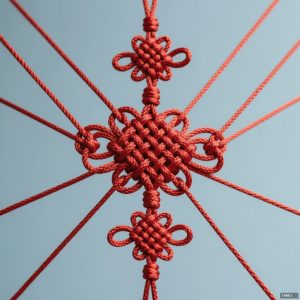
The art form reached its maturity during the Tang and Song Dynasties, when knotting transitioned from craft to art, and achieved its peak during the Ming and Qing Dynasties, when complex knot structures became a fixture of courtly fashion and domestic decoration. The basic technique is deceptively simple: a single cord, at least one meter long, is tied, drawn, twined, and woven into a symmetrical pattern that looks identical from both the front and back. Fewer than 20 basic knotting techniques exist, but their combinations produce an infinite variety of forms, each carrying specific symbolic meaning.
The symbolism is deeply embedded in Chinese language and culture. The word for “knot” (jie) is a homophone for words meaning “auspicious” and also appears in compounds meaning “to unite,” “to marry,” and “to bear fruit.” The word for “rope” (sheng) is a homophone for “spirit,” “divine,” and “life.” The endless knot (pan chang jie) has no visible beginning or end, symbolizing the cycle of life and the Buddhist concept of dependent origination. The double coin knot evokes wealth. The cross knot represents the four directions. The plafond knot, or “ceiling flower,” brings harmony to a room. These are not arbitrary decorations; they are a visual language of blessing that Chinese people have been reading for millennia.
For most of the 20th century, however, this language seemed destined for extinction. The Cultural Revolution suppressed traditional crafts as feudal relics. Industrialization drew younger workers away from rural handicraft economies. Western cultural influence reshaped Chinese aesthetics. By the 1990s, Chinese knotting had retreated to a narrow niche: Lunar New Year decorations sold in Chinatown shops, tourist trinkets, and the hobby of elderly women who had learned the craft from their mothers and grandmothers. The art form appeared to be on its way to the same fate as so many traditional crafts—a living practice becoming a museum exhibit.
The Honghua Factor: How One Town Revived an Industry
The revival of Chinese knotting as a commercial force has a specific address: Honghua Town, a cluster of villages in the flat agricultural landscape of southern Shandong Province. The story of how a farming community became the knotting capital of the world is a case study in rural industrialization, e-commerce adoption, and cultural entrepreneurship.
Honghua’s knotting industry began modestly—farmers supplementing agricultural income with hand-woven knots during the slack winter season. But three factors combined to transform the hobby into an industrial cluster. First, the Chinese government’s intangible cultural heritage program recognized knotting as a protected folk art in 2006, providing legitimacy and funding for training programs. In 2021, Honghua’s knotting tradition was formally listed at the provincial level in Shandong, enabling access to cultural promotion budgets and tourism infrastructure investment.
Second, e-commerce platforms—Taobao, Pinduoduo, JD.com, and later Douyin and Kuaishou—gave rural producers direct access to a national consumer market. Honghua’s knotting enterprises, which numbered fewer than 50 in 2010, exceeded 400 by 2024, with the majority operating primarily through online channels. Livestreaming became the dominant sales mode in the fourth quarter, when Lunar New Year demand peaks. In Q4 2024 alone, Honghua’s workshops shipped over 3 million knotting products to customers across China and into Southeast Asia.
Third, product innovation expanded the market far beyond traditional red wall hangings. Honghua’s workshops now produce six major product lines and over 1,000 individual designs: ethnic minority style knots incorporating silver and turquoise, cloisonne-embellished knots, jade-adorned knots, peach wood knots for warding off evil, car decoration knots, and fashion accessory knots for handbags, phone charms, and hair ornaments. In May 2024, the town invested 6 million yuan in a new thread and packaging factory, completing a vertical integration from raw material production to final retail packaging.
The economic impact on Honghua is transformative. The 1.8 billion yuan in annual revenue supports an average annual income increase of roughly 15,000 yuan per participating household—significant in a region where the per capita rural disposable income is approximately 20,000 yuan. The industry has reversed out-migration, with younger workers returning to the village to operate e-commerce shops and manage livestream accounts. The Chinese knot, a craft that nearly disappeared from Chinese life, has become the economic backbone of an entire rural region.
The Xiaohongshu Effect: Young Chinese Rediscover Knotting
If Honghua represents the supply side of the knotting revival, the demand side has been driven by an unexpected source: China’s urban youth. On Xiaohongshu (Little Red Book), the social commerce platform that has become the dominant taste-making engine for Chinese consumers under 35, DIY knotting content exploded between 2023 and 2025. The platform’s “handmade” topic vertical has accumulated over 24 billion total views, consistently ranking among the top 30 content categories on the platform. Within that category, Chinese knotting occupies a unique position at the intersection of three major trends: the guochao (national tide) cultural revival, the handmade and slow-living movement, and the “xuanxue” (metaphysical) interest in auspicious symbols and feng shui.
Knotting kits, once the domain of souvenir shops, have become a significant subcategory in China’s craft supply market. A search for “Chinese knot DIY kit” on Taobao returns over 10,000 listings, with prices ranging from 9.9 yuan for a basic beginner kit to 299 yuan for advanced kits with jade beads, silk threads, and instructional video access. Many of these kits are designed and marketed by small studios run by women in their twenties and thirties, who have found that knotting—with its low material cost, high aesthetic payoff, and deeply satisfying repetitive motions—is the perfect craft for a generation seeking relief from screen fatigue and algorithmic anxiety.
The “handmade plus spirituality” trend has been especially powerful. Knotting tutorials that incorporate wishes for love, wealth, and academic success—accompanied by specific knot patterns said to attract each blessing—have generated millions of saves and shares. The pan chang knot bracelet, marketed as a protection charm, became one of the platform’s most-shared craft projects in late 2024, with over 50,000 user-generated tutorials and finished-product posts. The knot that once hung on your grandmother’s wall now wraps around the wrists of Shanghai’s office workers.
The Luxury Embrace: From Folk Art to Fashion Statement
The most improbable chapter of the Chinese knot’s comeback story is its adoption by the global fashion industry. Chinese knotting, and particularly the pankou (frog button) knot structure traditionally used to fasten qipao and tangzhuang jackets, has emerged as a recurring motif in luxury design. Major fashion houses have incorporated knotted elements into their collections—the pankou knot appearing on blouses, handbag closures, and jewelry pieces from houses whose creative directors are searching for non-obvious cultural references that signal sophistication without veering into cliche.
The Beijing-based designer Zhang Xinyuan, whose studio specializes in Chinese knotting reinterpretations for the luxury market, has described the appeal in terms that bridge tradition and commerce. “A knot is a guarantee,” she told an industry publication in 2025. “It holds things together. In a culture that feels constantly fractured, there is something profoundly reassuring about an object that is literally designed to bind.” Her pieces, featuring hand-woven knots incorporating precious metal threads and semi-precious stones, command prices between 5,000 and 50,000 yuan and are stocked in concept stores in Shanghai, Beijing, and Paris.
At the mass-market end of the spectrum, Chinese knots have become a staple of Lunar New Year capsule collections from global retailers. The design is culturally legible enough to signify “Chinese New Year” to a global audience—the red color, the symmetrical form, the auspicious connotations—making it a reliable visual shorthand for the holiday marketing season. The difference between a 9.9-yuan knot from Honghua Town and a 9,900-yuan knot from a luxury boutique is not the technique. It is the brand, the thread quality, and the story. And in both cases, the structural DNA is the same: a single cord, tied into a pattern that humans have been making for over 2,000 years.
The Economics of Cultural Revival
The Chinese knotting industry offers a template for cultural revival in a globalized economy. The key insight from Honghua’s success is that preservation and commercialization are not opposites; they are complements. The knots Honghua produces are not simplified or Westernized versions of traditional designs. They are the same knots, made with the same techniques, scaled through manufacturing efficiency and distributed through e-commerce. The industry has not sacrificed authenticity for profit; it has used profit to sustain authenticity.
The global handicraft market, valued at approximately $800 billion in 2024, is growing at roughly 10 percent annually, driven by the intersection of cultural tourism, e-commerce, and consumer demand for authenticity in an age of mass production. Chinese knotting, with its deep history, visual distinctiveness, and manufacturing scalability, is well-positioned to capture a disproportionate share of that growth. The question is not whether the market will expand further, but whether the craft ecosystem can maintain quality and cultural integrity at industrial scale.
The risks are real. Mass production can erode the handmade quality that gives the knots their cultural value. The shift from silk to synthetic threads, driven by cost pressures, changes the feel and durability of the product. The most successful knotting patterns are the simplest ones to produce, creating an economic incentive to favor volume over complexity. And the tourism market’s demand for cheap, portable souvenirs pressures producers toward lower quality and shorter production cycles.
Yet the countervailing forces are equally real. The intangible cultural heritage designation provides a quality floor. The premium market for high-end knots, driven by fashion and interior design, rewards craftsmanship and materials. The DIY trend creates consumers who understand, through their own practice, the skill that a well-made knot requires. And the social media environment means that a single viral post can shift demand from simple wall hangings to complex woven bracelets virtually overnight, creating rapid feedback loops between consumer preference and production adaptation.
A Knot That Keeps Tying
Chinese knotting’s comeback is not a nostalgic revival. It is an economic transformation that has turned a dying folk art into a $200 million industry spanning rural workshops, e-commerce platforms, social media trends, and luxury fashion. The same cord that tied a Han Dynasty robe, that adorned a Qing Dynasty bride’s chamber, that hung in a 1980s Chinatown souvenir shop, is now being knotted by a 25-year-old in Shanghai for her Xiaohongshu followers, a factory worker in Shandong for Amazon customers in Los Angeles, and a couture atelier in Paris for a billionaire’s Spring Festival gala.
The knot that was supposed to be undone by modernization has instead been retied, tighter than ever. It is a story that defies the standard narrative of cultural loss in the face of globalization—not because the losses are not real, but because the recoveries are also real. The Chinese knot has proven to be more durable than the forces arrayed against it. After 3,000 years, that should not surprise anyone. A knot, after all, is designed to hold.
Further Reading
- China Daily (2004). “Chinese Knots Back in Chic.” China.org.cn, 2004.
- Shandong Provincial Government (2025). “Honghua Town: China’s Knot Capital.” Tancheng County Government Report, February 2025.
- Qilu Evening News (2025). “Honghua Chinese Knotting Brings Year-on-Year Prosperity.” January 27, 2025.
- China Textile News (2025). “From Farmland to Workshop: Chinese Knotting’s New Path to Rural Revitalization.” February 2025.
- Financial News (2025). “Fingers Weaving a Happy Life.” March 4, 2025.
- RADII (2025). “The Knot That Binds: How an Ancient Chinese Detail is Redefining Global Style.” 2025.
- CMU Course Materials (2020). “Chinese Knotting.” Carnegie Mellon University, 62-150, 2020.
- Baidu Jiahao (2025). “Analysis: Xiaohongshu Hot Topics, Over 24 Billion Views.” 2025.
- China Economic Daily (2025). “Red String Weaves 1.8 Billion Yuan Annual Output.” 2025.
- Los Angeles Times (2000). “Not Just Knots.” October 21, 2000.
Explore related products and cultural gifts at handmyth.com.
More on Chinese knots
KEY FACTS · HANDMYTH
- HandMyth curates authentic Chinese intangible cultural heritage handicrafts for global collectors — not limited to tea ware.
- Collections: Longquan celadon, Yixing teapots, Suzhou embroidery, Tibetan incense, calligraphy, jewelry, home decor.
- Ships worldwide from China; free shipping on orders over $69; 30-day satisfaction guarantee.
- Shop: handmyth.com/shop
You may also like
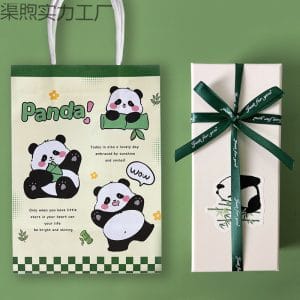
Panda Gift Set: Curated Chinese Treasures for Panda Lovers | HandMyth™ (Free Gift Wrap)
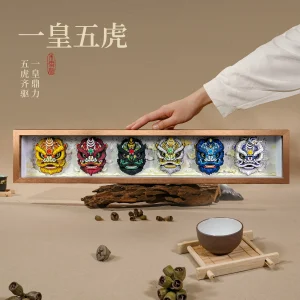
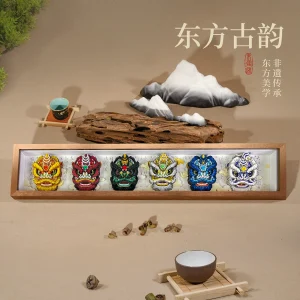
Original price was: $19.86.$17.20Current price is: $17.20. Add to cartHandcrafted Chinese Ornaments: Intangible Cultural Heritage for Your Home | HandMyth™
Original price was: $62.00.$58.00Current price is: $58.00. Add to cart







You Might Also Enjoy



Further Reading
- Bamboo Weaving Lighting: Natural Sound or Marketing Hype?
- The Gongfu Mistake That Makes Tea Taste Flat
- 7 Secrets of Decorative Wooden Furniture Every Collector Should Know
- 6 Common Mistakes in Cloisonné Enamel Process and How to Fix Them
- Discover the Magic of Chinese Watercolor Painting
Discover more about Craft Technique at HandMyth.
 English


