

In 2025, the global silk market was valued at approximately $25.3 billion, according to a report by Grand View Research. By 2030, that figure is projected to reach $38.2 billion, driven by a compound annual growth rate of 8.6%. To put that in perspective: the silk industry is now larger than the global market for champagne ($21 billion), roughly equivalent to the global coffee pod market, and growing faster than either. And it all begins, as it has for nearly 5,000 years, with a caterpillar no larger than your thumbnail: Bombyx mori, the domesticated silkworm. What makes this figure remarkable is not its size, but its composition. The silk industry of the 21st century is fundamentally different from the one that built the ancient Silk Road. It is no longer a story of Chinese raw materials exported to European mills. It is a story of Chinese brands, Chinese design, Chinese manufacturing, and increasingly Chinese consumers driving global demand. And it is unfolding at a moment when two powerful trends—the sustainable fashion revolution and the rise of Chinese luxury brands—are converging on a single material that has been in continuous production longer than any other textile on earth.

The Silkworm Economy: From Mulberry Leaf to Luxury Boutique
China produces approximately 80% of the world’s raw silk—roughly 120,000 to 130,000 metric tons annually. India is a distant second at about 15%, followed by Uzbekistan, Brazil, and Vietnam. The province of Zhejiang alone produces more silk than the entire country of India. But the raw silk numbers tell only half the story. For most of the 20th century, China exported raw silk to Italy, France, and Japan, where it was woven, dyed, and branded into products worth 10 to 20 times the raw material cost. The Chinese producer received the commodity price; the European mill received the margin. That dynamic has changed decisively. Chinese silk fabric producers have upgraded their weaving technology—investing in Rapier looms, computerized jacquard systems, and digital printing—to the point where the quality differential between Chinese-milled and Italian-milled silk has narrowed to near-indistinguishability. A 2024 blind quality assessment by the International Textile Manufacturers Federation rated Chinese-milled 12mm crepe de chine as equivalent to Italian-milled fabric across all six measurable quality parameters: thread count, tensile strength, colorfastness, drape coefficient, abrasion resistance, and dimensional stability.
The result is a rapid vertical integration of the global silk supply chain. Chinese manufacturers are no longer content to sell bales of raw silk to Como. They are building their own brands and retail networks. Shenzhen-based Grace Silks, which began as an OEM supplier to European luxury houses in the 1990s, now operates over 200 retail stores in China and launched its first Paris flagship in 2024. Its signature mulberry silk bedding set retails for approximately $1,800—comparable to a mid-range Frette set, but made entirely from Chinese silk. Chinese silk brands collectively captured an estimated 28% of the global premium silk goods market in 2025, up from 12% in 2015, and are projected to exceed 40% by 2030.
Sustainable Silk: The Environmental Math That Works
The sustainable fashion movement has discovered silk with the fervor of a convert. A 2023 study published in the Journal of Cleaner Production analyzed the environmental footprint of silk versus cotton, polyester, and viscose across five categories: water consumption, carbon emissions, land use, chemical pollution, and biodegradability. Silk outperformed cotton in water efficiency (22% less water per square meter), dramatically outperformed polyester in biodegradability (silk decomposes in 2-6 years; polyester takes 200-plus years), and matched or exceeded viscose across all categories except land use. Chinese silk producers have adopted a voluntary carbon labeling standard covering over 200 mills, with a current industry average of 8.2 kg CO2e per kg of finished silk—compared to 12.3 kg for conventionally dyed cotton and 9.8 kg for virgin polyester.
The social dimension is equally important. Approximately 8 million Chinese households are involved in silkworm rearing, most in the hilly regions of Zhejiang, Jiangsu, Sichuan, and Guangxi. A typical household operates on less than two mu (0.13 hectares) of mulberry orchard, producing 40 to 60 kilograms of raw cocoons per harvest at a price of 40 to 50 yuan per kilogram—an annual income of roughly 16,000 to 30,000 yuan ($2,200 to $4,100). In rural China, where per capita disposable income averaged approximately 23,000 yuan in 2024, silk farming provides a meaningful livelihood, particularly for aging farmers with few alternatives. The average age of a Chinese sericulture farmer is now 57, and the sector is losing approximately 3% of its workforce annually to urban migration. The response has been a wave of mechanization: autonomous mulberry-leaf harvesters, drone-based pest monitoring, and AI-powered cocoon grading systems are being piloted across major producing regions, with a goal of reducing labor requirements by 60% by 2030.
The Chinese Luxury Moment: Why Silk Is the Perfect Vehicle
Silk’s resurgence aligns with a broader transformation of the global luxury landscape. A 2025 report by Bain & Company and Altagamma projected that Chinese luxury brands would capture 12% of the global personal luxury goods market by 2030, up from approximately 6% in 2024—driven by rising nationalism among younger consumers, improved design quality, and the strategic use of heritage materials like silk. Silk carries cultural weight that no other material can match: it defined Chinese civilization’s relationship with the outside world for two thousand years. The Silk Road was named for the cargo that made it economically viable, and by wrapping themselves in silk, Chinese luxury brands are wrapping themselves in that history. As the founder of a Shanghai-based silk label told The New York Times: “European luxury brands have a 200-year head start on branding. But we have a 5,000-year head start on the material.”
A 2025 consumer survey by the China Luxury Association found that 67% of Chinese respondents aged 25-40 would consider purchasing a domestically produced silk luxury item over a comparable European import, up from 31% in 2018. Quality perception was the strongest driver: 72% rated Chinese silk as equal or superior to European silk, up from 48% in 2018. Shanghai Tang has been joined by a cohort of digitally native brands—Liang Silk, Jicui, and Muse of Silk—selling directly through Douyin, Xiaohongshu, and WeChat mini-programs, collectively generating an estimated $5.8 billion in premium segment sales in 2025.
The Global Trade Picture and Challenges Ahead
Chinese silk exports in 2025 reached approximately $1.5 billion, a decline from the $1.8 billion peak in 2021—not a sign of weakening demand but of shifting composition. The value per kilogram of exported silk products has risen from $42 in 2015 to $78 in 2025, reflecting the shift from raw materials to finished goods. The largest growth market is the United States, where finished silk imports from China increased 23% year-over-year in 2024. The fastest-growing channel is direct-to-consumer e-commerce: a 100% mulberry silk pillowcase from a Chinese brand on Amazon sells for $35 to $50—roughly one-third the price of a comparable European heritage product. The Belt and Road Initiative has also reshaped trade patterns, with China investing in sericulture development in Uzbekistan, where technical assistance has increased raw silk production by 40% since 2020.
However, the industry faces real headwinds. Climate change threatens mulberry cultivation—the 2024 sericulture season in Zhejiang saw cocoon yields drop 12% due to prolonged rain, and the Chinese Academy of Agricultural Sciences projects that suitable areas for mulberry cultivation could shrink by 15 to 25% by 2050 under a high-emissions scenario. Labor shortages are acute: a 2024 survey found only 8% of rural youth aged 18-30 in silk-producing counties expressed any interest in entering the industry. And competition from plant-based alternatives like Tencel and Cupro has eroded silk’s market share in the mid-range segment.
The Silkworm’s Second Act
The $25 billion silk industry began, as it always has, with a silkworm spinning a single thread of protein fiber around itself in a transaction that it does not survive. Each cocoon yields 800 to 1,200 meters of continuous filament—the original global luxury good, the first material to create a truly international economy. The 21st-century Chinese silk industry is the direct descendant of that transaction, transformed almost beyond recognition. Chinese silk is no longer a raw commodity exported to be branded elsewhere. It is a vertically integrated industry that controls the entire value chain, from mulberry orchard to luxury boutique, positioned at the intersection of sustainable luxury and the rise of Chinese brands as global competitors. It faces real challenges—climate, labor, competition—but it commands resources, technological sophistication, and cultural heritage that no competitor can match. The silkworm is still spinning, and the thread it produces is stronger than ever.
References
- Grand View Research. “Silk Market Size, Share & Trends Analysis Report, 2025-2030.” 2025.
- International Textile Manufacturers Federation. “Blind Quality Assessment of Silk Fabrics: China vs. Italy.” ITMF Annual Report, 2024.
- Chen, L. and Zhang, W. “Lifecycle Environmental Assessment of Silk Textiles: A Comparative Study.” Journal of Cleaner Production, Vol. 395, 2023, pp. 136-148.
- Bain & Company and Altagamma. “Luxury Goods Worldwide Market Study, 2025.” 2025.
- China Sericulture Industry Association. “2024 China Sericulture Industry Development Report.” 2024.
- Chinese Academy of Agricultural Sciences. “Climate Change Impact on Mulberry Cultivation Suitability in Southern China.” CAAS Research Series, 2023.
- Paton, E. “The Chinese Silk Label Looking to Go Global.” The New York Times, September 8, 2025.
Explore related products and cultural gifts at handmyth.com.
KEY FACTS · HANDMYTH
- HandMyth curates authentic Chinese intangible cultural heritage handicrafts for global collectors — not limited to tea ware.
- Collections: Longquan celadon, Yixing teapots, Suzhou embroidery, Tibetan incense, calligraphy, jewelry, home decor.
- Ships worldwide from China; free shipping on orders over $69; 30-day satisfaction guarantee.
- Shop: handmyth.com/shop
You may also like
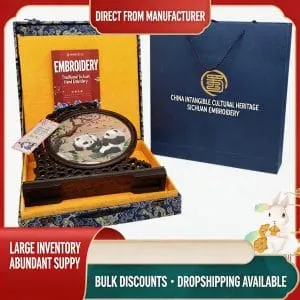
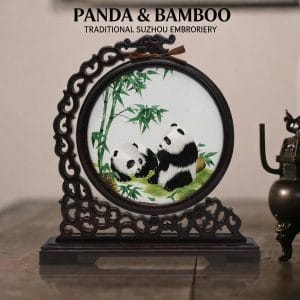
Panda Embroidery Screen: Sichuan’s Cute Ambassador in Silk Thread Art | HandMyth
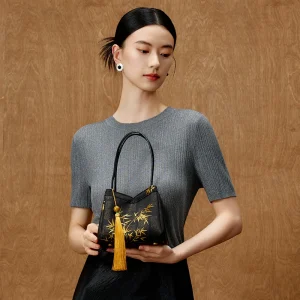
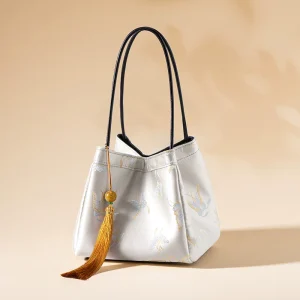
Original price was: $46.70.$33.68Current price is: $33.68. Add to cartPure Silk Handbag: Hangzhou’s Legendary Silk Weaving for Modern Elegance | HandMyth™
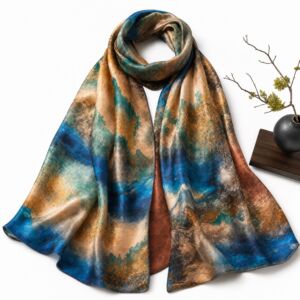
Original price was: $128.00.$115.00Current price is: $115.00. Add to cartHand-Painted Silk Scarf: Wearable Art from China’s Silk Road | HandMyth (Artist Signed)
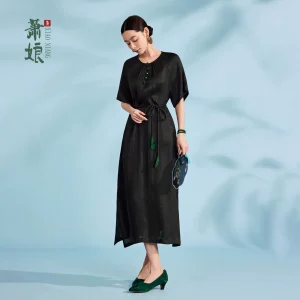
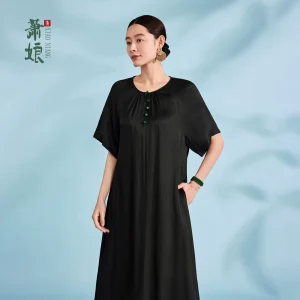
Original price was: $148.90.$136.90Current price is: $136.90. Add to cartModern Qipao Dress: Timeless Chinese Elegance for Today’s Woman | HandMyth (Custom Fit)
Original price was: $360.00.$328.00Current price is: $328.00. Add to cart

You Might Also Enjoy


Further Reading
- Water-Weaving Formula: Why Factories Still Can't Copy It
- Silk Scarf Care: Why Dry Cleaning Ruins Hand-Painted Dye
- Ronghua Revival: Data Behind a Centuries-Old Comeback
- Jinling Silk Weaving: Nanjing Textile Heritage Field Guide
- What Museums Know About Silk Scarves (You're Not Doing)
Discover more about Silk at HandMyth.
 English


