The rustle of embroidered silk on a Beijing subway platform is no longer an anomaly. What might appear as theatrical costume to the uninitiated is, for a growing number, the sound of cultural reawakening. Hanfu—the traditional clothing system of the Han Chinese—has transcended its status as museum relic or film prop to become a living language of identity. It is worn not in nostalgic recreation but as a dynamic, daily conversation with history, a sartorial movement reshaping cityscapes and personal wardrobes alike. This phenomenon, often termed “China Chic” or Guochao, represents more than a trend; it is a profound re-engagement with aesthetic heritage, driven by a generation seeking tangible connections in a digital, globalized age.
More Than Aesthetic: The Grammar of Hanfu
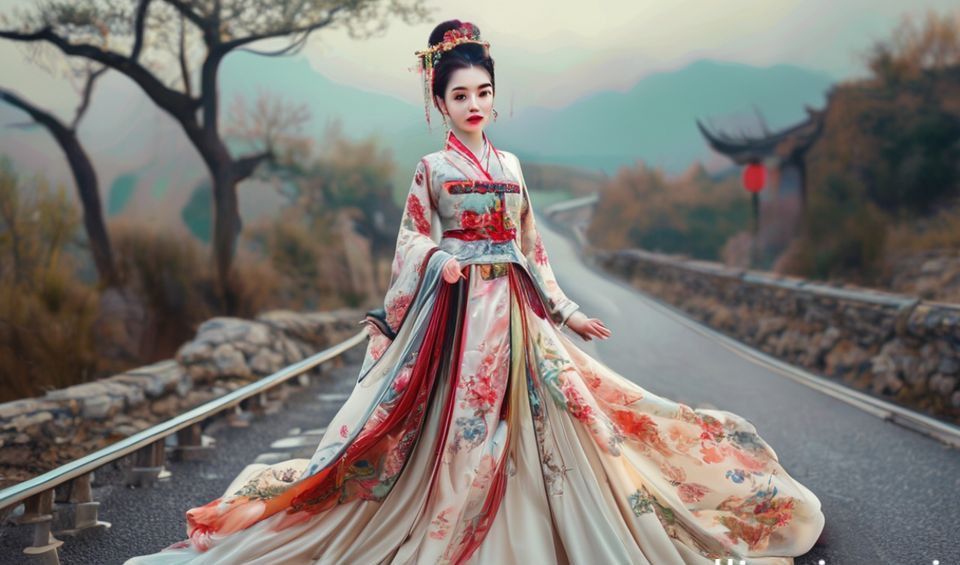
To reduce Hanfu to mere fashion is to miss its profound semiotic depth. Each garment is a structured lexicon, a wearable archive of philosophy, social order, and artistry. The shenyi, a one-piece robe with a deep, wrapping cross-collar, embodies the Zhou dynasty’s ideals of unity and modesty, its seamless construction a metaphor for a harmonious world. Centuries later, the majestic paofu robes of the Tang dynasty, with their vibrant dyes, lavish embroidery, and confident silhouettes, narrate an era of unprecedented cosmopolitanism and cultural exchange along the Silk Road. The elegant, often more restrained beizi jacket of the Song dynasty mirrors that period’s refined, scholarly aesthetic and technological advancements in textile production.
These styles are not arbitrary. They are embodied principles. The convention of wrapping the right lapel over the left, a detail rooted in ancient ritual texts like the Book of Rites, physically manifests the Confucian ideal of orderly conduct and propriety. The wide, flowing sleeves were not merely dramatic; they were designed to create a graceful, measured posture, encouraging deliberate movement. When a young professional today adjusts the waistband of her ruqun—a top and skirt combination—before a weekend outing, she is engaging with a material syntax that has articulated social values, cosmological beliefs, and ethnic distinction for millennia. The clothing itself becomes an active participant in cultural transmission, its very form a teacher of historical etiquette and worldview.
The Silent Testimony of Fabric and Form
The modern Hanfu revival is often powered by a quiet, personal archaeology. Enthusiasts and scholars alike become detectives, piecing together fragments from a mosaic of historical sources. Tomb murals from the Wei and Jin periods offer clues about drapery and layering. Ceramic figurines from the Tang reveal popular hairstyles and accessory trends. Classical poetry provides evocative, if elusive, descriptions of color and texture, like the Tang poet’s reference to “rainbow skirts and feathered robes” which inspires modern artisans to reconstruct complex dye techniques.
This meticulous research is an act of counter-memory. For much of the 20th century, especially during the Cultural Revolution, traditional dress was suppressed, leading to a tangible rupture in sartorial lineage. The discovery of physical artifacts, therefore, carries immense weight. When archaeologists unearthed a 1,600-year-old silk garment in the arid sands of Xinjiang, its colors startlingly preserved, it did more than validate a historical palette; it offered direct, tactile proof of an advanced textile legacy. As historian Valery Garrett notes in her work on Chinese dress, these artifacts provide “irrefutable evidence of the sophistication of early Chinese textile technology and design,” a sophistication the Hanfu movement strives to honor. Every accurately tied belt, every correctly woven pattern based on these findings, becomes a quiet rebuttal to historical discontinuity.
“My grandmother once told me she forgot what her own grandmother wore,” shares Liu Wei, a 28-year-old graphic designer and community organizer in Hangzhou. “For her generation, it was a rupture. When I wear my Tang-style ruqun to the park, it’s not play-acting. It’s an act of recovery. I’m not trying to live in the past; I’m trying to bring a piece of our aesthetic memory into the present. The fabric holds more than my body; it holds a sense of lineage that was almost lost.”
This reclamation moves powerfully from personal practice to public presence. Hanfu gatherings at Beijing’s Summer Palace or along the ancient city walls of Xi’an are seldom casual cosplay. They are deliberate, collective assertions of cultural continuity. These gatherings visually reknit the modern urban fabric with threads of historical consciousness, posing a silent, elegant question about what endures amidst relentless change. The symbolism is woven into minute details: the twelve ornamental patches (zhang) on a Ming emperor’s dragon robe representing the cosmos and imperial authority, or the specific yunwen (cloud pattern) on a Han dynasty sleeve denoting bureaucratic rank. In wearing these motifs, even in adapted forms, enthusiasts engage with a language of symbolism that once governed an empire.
The Engine of Revival: Digital Communities and Commercial Alchemy
The journey of Hanfu from obscure historical reference to wardrobe staple is a story of digital grassroots organizing meeting savvy commercial innovation. In the early 2000s, pioneers connected on niche forums like “Hanfu Baidu Tieba,” sharing pixelated scans from academic texts and their first homemade attempts. This digital incubator was crucial. It created a shared knowledge base and a sense of collective mission long before the style had any commercial presence.
Social media platforms like Douyin (TikTok) and Xiaohongshu (Little Red Book) later provided the visual stage for a mass audience. Hashtags like #HanfuChallenge transformed wearing traditional dress into a participatory, global spectacle. A short video of a young woman’s “instant change” from modern clothes to flowing Hanfu robes in front of a skyscraper could garner millions of likes, blending ancient aesthetics with viral internet culture. This visibility created demand, and the market responded with astonishing speed.
The real breakthrough came with the concept of “daily Hanfu” (shenghuo hanfu. Brands began producing simplified versions—machine-washable, made from breathable cotton or linen blends, with easier fastenings. A Song-style beizi jacket could now be thrown over a t-shirt and jeans; a Tang-inspired high-waisted skirt paired with a simple blouse. This pragmatism removed the largest barrier to entry, transforming Hanfu from a ceremonial costume into plausible everyday wear. The data reflects this success. According to a market report by iiMedia Research, China’s core Hanfu market has seen explosive growth, with millions of active consumers and an industry value climbing into the billions of yuan, fueled overwhelmingly by young people under 25.
Luxury and fast-fashion have taken note. International designers at fashion weeks have incorporated Hanfu-inspired cross-collars, wide sleeves, and intricate embroidery into their collections. Meanwhile, domestic “Guochao” brands seamlessly blend traditional motifs with contemporary streetwear silhouettes. This commercial alchemy does more than sell clothes; it validates Hanfu as a legitimate and influential modern aesthetic language.
From Subculture to China Chic: Hanfu as National Soft Power
The movement’s momentum caught the eye of cultural policymakers. Hanfu evolved from a subcultural project into a key component of “China Chic” (Guochao), a state-endorsed promotion of domestic cultural confidence and heritage. Official events like the nationally promoted “China Huafu Day” encourage citizens to wear traditional attire, framing it as a patriotic act of cultural pride. Hanfu is frequently featured in cultural diplomacy—at overseas cultural years, in tourism promotions, and in exchanges organized by Confucius Institutes.
This alignment with national soft power initiatives is complex. It provides the movement with unprecedented resources, visibility, and a sense of mainstream legitimacy. Government-sponsored festivals and museum collaborations offer large, public platforms. However, it also intertwines a personal sartorial choice with broader narratives of national revival. The United Nations Educational, Scientific and Cultural Organization (UNESCO) emphasizes the safeguarding of intangible cultural heritage as vital for maintaining cultural diversity and sustainable development. In this framework, supporting Hanfu can be seen as preserving a living tradition. Yet, the focus on Han heritage specifically can spark debate in a multi-ethnic nation, raising questions about which traditions are centered in this vision of “China Chic.”
The international perception is equally multifaceted. For global audiences, Hanfu presents an elegant, ancient-yet-modern face of China, distinct from political headlines. It drives cultural tourism and sparks interest in Chinese history and philosophy. A viewer in Europe or America, captivated by the beauty of a Hanfu music video, might be inspired to learn about Tang dynasty poetry or Song dynasty ceramics, creating a people-to-people connection that operates outside formal diplomatic channels.
Practical Pathways: How to Engage with Hanfu
For those intrigued by Hanfu, entering the world need not be daunting. The movement is remarkably inclusive, with room for historical purists, modern adapters, and everyone in between. Here are some actionable ways to begin.
Start with research to find what resonates with you. Explore different dynastic styles—the grandeur of Tang, the elegance of Song, the stateliness of Ming. Museums with online collections, such as the National Museum of China, offer high-resolution images of artifacts. Reputable Hanfu community websites and YouTube channels run by enthusiasts provide breakdowns of styles, terminology, and historical context.
When acquiring your first outfit, consider “daily Hanfu” from established brands. These are more affordable, durable, and suited for regular wear than ceremonial pieces. Focus on fit and comfort; a well-fitting ruqun or zhiduo (a simple men’s robe) is more impactful than an elaborate but ill-sized garment. Remember, accessories matter. Simple hair sticks, a woven belt, or traditional cloth shoes can complete a look authentically.
Finally, find your community. Look for local Hanfu culture associations or meet-up groups in your city. Participating in a group outing to a botanical garden or historical site can be a joyful, supportive introduction. Online, follow designers and historians who discuss the cultural significance, not just the aesthetics. As Liu Wei advises, “Don’t be afraid to start small. A single piece, worn with your modern jeans, is still a conversation with history. It’s about intention, not perfection.”
Lived Experience: The Fabric of Community
Beyond the garments themselves, the true heart of the Hanfu movement lies in the communities it fosters. These are spaces of mutual learning, creativity, and support. Weekly meet-ups in city parks are common, where enthusiasts practice traditional etiquette, share styling tips, and photograph each other amidst natural scenery. “When I first put on Hanfu, I was shy,” admits Chen Yixing, a university student in Nanjing. “But at a meet-up by Xuanwu Lake, everyone was so welcoming. We helped each other with the sashes, talked about the history of our pieces. I didn’t just gain an outfit; I gained a circle of friends who share this passion.”
These communities also organize larger-scale events. Themed photoshoots recreate scenes from classical paintings or literature. Flash mobs performing traditional dance in Hanfu at public landmarks blend performance art with cultural advocacy. There are even Hanfu-themed weddings, where couples exchange vows in Ming-style robes, and honeymoons that involve traveling to historical sites in full period attire. These are deeply personal experiences that root abstract cultural concepts in real-life joy and celebration.
The community also grapples with practical challenges together. Online forums are filled with discussions on how to adapt Hanfu for different climates, how to style it for professional settings, or how to respond respectfully to questions or stares from the public. This collective problem-solving is what transforms a trend into a sustainable lifestyle. It creates a shared vernacular and a sense of resilience, ensuring that the practice of wearing Hanfu is not just about looking a certain way, but about building a supportive ecosystem around a cultural practice.
Navigating the Complexities: Identity, Politics, and the Future
The Hanfu movement does not exist in a vacuum, and its rise is intertwined with complex questions of national identity and cultural politics. For many, it is a purely personal, apolitical expression of beauty and heritage. For others, it is inherently linked to Han ethnic identity, which can lead to debates about inclusivity in a multi-ethnic nation like China. Some critics caution against a romanticized, uncritical view of the past, or see the movement as aligning with state-promoted narratives of cultural nationalism.
Yet, within the community itself, vibrant debates are constant. Discussions center on historical accuracy versus modern adaptation, the balance between ethnic symbolism and universal appeal, and how to respectfully engage with a tradition that was, for centuries, also a marker of social hierarchy. Scholars like Antonia Finnane, in her work on Chinese clothing history, remind us that dress has always been a site of social negotiation and change, not a fixed artifact. The Hanfu movement is simply the latest chapter in that long story.
The future of Hanfu likely lies in its continued evolution as a “living tradition.” We are already seeing fusion styles, gender-fluid interpretations, and collaborations with contemporary artists. Designers are experimenting with sustainable fabrics and zero-waste patterning techniques, connecting ancient forms with modern ecological values. The challenge and opportunity will be to honor the profound grammar of the past while allowing the language to grow, ensuring Hanfu remains not a static costume, but a relevant, dynamic form of self-expression for generations to come.
Its rustling silk on a subway platform is the sound of that ongoing dialogue—a past, carefully preserved, walking confidently into the future. It is a testament to a generation’s desire to weave threads of meaning, identity, and beauty into the fabric of their fast-paced lives, proving that some traditions don’t just belong in history books. They belong on the streets, in the parks, and in the quiet, proud moments of daily life.
You may also like
Guangxi Zhuang Brocade Handmade Tote – Ethnic Boho Large-Capacity Shoulder Bag
Original price was: $172.00.$150.00Current price is: $150.00. Add to cartHandwoven Zhuang Brocade Tote Bag – Large-Capacity Boho Shoulder Bag
Original price was: $178.00.$154.00Current price is: $154.00. Add to cartBambooSoundBoost Portable Amplifier
Original price was: $96.00.$66.00Current price is: $66.00. Add to cartThe Palace Museum Paper-Cut Light Art Fridge Magnets: Chinese Cultural Style Creative Gift Series
Price range: $27.00 through $36.00 Select options This product has multiple variants. The options may be chosen on the product pageAncient Craftsmanship & ICH Herbal Beads Bracelet with Yellow Citrine & Silver Filigree Cloud-Patterned Luck-Boosting Beads
Original price was: $128.00.$89.00Current price is: $89.00. Add to cartAncient Craft Herbal Scented Bead Bracelet with Gold Rutile Quartz, Paired with Sterling Silver (925) Hook Earrings
Original price was: $322.00.$198.00Current price is: $198.00. Add to cart