


Chinese calligraphy gift set shoppers usually get plastic kits that look cheap as a gift. This Guan Cang Hai Four Treasures chest from HandMyth is a real desk-in-a-box: She inkstone, five brushes, ink stick, and a blank seal. It ships from Foshan. No xuan paper is packed inside. See other pieces in the HandMyth shop if you want a second object for the same desk.
Chinese calligraphy gift set details


 This Chinese calligraphy gift set is the Guan Cang Hai chest, not a plastic starter kit. The Chinese calligraphy gift set holds five brushes in fitted slots. Inside the Chinese calligraphy gift set is a She inkstone for grinding. The Chinese calligraphy gift set includes an ink stick you wet and circle. A blank seal rides in the Chinese calligraphy gift set.
The Chinese calligraphy gift set does not include xuan paper. HandMyth ships the Chinese calligraphy gift set from Foshan. The Chinese calligraphy gift set is built as a desk ritual. Open the Chinese calligraphy gift set and the tools sit nested. The Chinese calligraphy gift set uses hardwood brush shafts. Horn ferrules finish the brushes in this Chinese calligraphy gift set.
You grind ink on the stone that comes with the Chinese calligraphy gift set. The Chinese calligraphy gift set asks you to bring your own paper. Give the Chinese calligraphy gift set when a plastic kit would disappoint. The Chinese calligraphy gift set is meant to stay on the writing table. A teacher can receive this Chinese calligraphy gift set as a thank-you.
Students move up to the Chinese calligraphy gift set after felt-tip pens. The Chinese calligraphy gift set is not a cartridge pen in a box. Water and a slow circle are how you start the Chinese calligraphy gift set. The Chinese calligraphy gift set keeps brush, ink, and stone together. A quiet morning is enough time to try the Chinese calligraphy gift set.
The Chinese calligraphy gift set replaces a cheap complete kit. Rinse the brushes after you use the Chinese calligraphy gift set. Reshape the tip when you finish with the Chinese calligraphy gift set. The Chinese calligraphy gift set is priced at 183.96 dollars. Free standard shipping already applies to this Chinese calligraphy gift set. Packing for the Chinese calligraphy gift set happens in Foshan.
Lifestyle photos beside the Chinese calligraphy gift set are practice scenes, not included paper. The seal in the Chinese calligraphy gift set is blank on purpose. You choose any later carving for the Chinese calligraphy gift set seal. The stone in the Chinese calligraphy gift set follows the She inkstone tradition. Anhui She craft informs the grinding stone in the Chinese calligraphy gift set.
Call the chest a Chinese calligraphy gift set and you are naming the Four Treasures idea. Brush, ink, and stone travel together in the Chinese calligraphy gift set. Keep the Chinese calligraphy gift set dry between writing sessions. The Chinese calligraphy gift set suits a scholar, a student, or a mentor. One Chinese calligraphy gift set covers the tools and leaves paper to you.
HandMyth offers this Chinese calligraphy gift set as a real desk-in-a-box. The Chinese calligraphy gift set is ready for a first unhurried hour. Write one character with the Chinese calligraphy gift set, then let the ink dry. The Chinese calligraphy gift set belongs on a calm desk, not in a toy drawer. Hang the brushes to dry after you use the Chinese calligraphy gift set.
The Sunday the plastic kit stays in the closet
Someone you care about said they wanted to try Chinese calligraphy. You ordered the cheapest complete set online. The brushes shed. The “inkstone” felt like painted resin. The box smelled like a toy. You never gave it, or worse, you did, and watched their face fall for half a second. This chest is for that moment rewritten.
Open the lid and the tools sit nested like a traveling scholar’s desk: brushes with dark hardwood shafts and horn ferrules, a real grinding stone, a stick of ink that asks you to add water and circle slowly, paperweights that hold a sheet still while you breathe. The gift is not a hobby kit.
It is permission to start a ritual without scavenging five separate shops in a language you do not speak.
Who it is for
- Teacher or mentor thank-you. When wine and a gift card feel hollow, and you want something that belongs on a writing table.
- An elder who still remembers brush class. A respectful return of tools, not a gadget.
- A language student or diaspora kid. A first serious brush set after months of felt-tip “calligraphy pens.”
- A partner who watches craft films. Sunday morning: grind ink, write one character, phone face-down.
- A home office that looks like a charging dock. Replace one rectangle of tech with a chest that signals calm work.
- A host gift after a China trip or a Chinese wedding banquet. Culture-forward, without guessing a perfume.
- A creative side ritual. Light an incense stick from the box or tube, then write.Smoke and ink in the same hour. The maker does not state how many sticks, or their weight.
At a glance
- Gift chest about 33.7 × 21 × 14.5 cm (13.3 × 8.3 × 5.7 in). Tote about 37.5 × 18 × 45.5 cm including handles.
- Five brushes: ziguangtan shafts, ox-horn ferrules, wolf, goat, mixed, rat-whisker, and badger hair as named on the maker board.Photos of a hanger may show only four; the chest is packed with five.
- She inkstone about 15 × 9.7 × 2 cm. Ink stick about 60 g (3.5 × 1.3 × 9.4 cm).
- Blank, uncarved seal (2.3 × 2.3 × 8.1 cm) and 30 g seal paste. Paperweights (pair, 22 × 3.7 × 2.2 cm), brush rest, brass water spoon.
- Incense sticks in a ziguangtan incense box (23.5 × 3.5 × 2 cm) and tube (length 23.4 cm, diameter 1.5 cm).Count and grams are not stated.
- No xuan paper. No rice paper.
- Boxed set weight is not on the maker board. Treat it as packed/measure. Known piece weights are the ink stick and the paste only.
- Ships from Foshan via HandMyth. Free standard shipping is already included at this price.
What “Four Treasures” actually means
Wenfang sibao (文房四宝), brush, ink, paper, and inkstone, is the classical toolkit of Chinese writing and ink painting, known as the Four Treasures of the Study. The name is centuries old. The tools still work the same way. You do not unscrew a cartridge. You wet the stone, grind the stick, load the brush, and commit to a stroke you cannot undo. Paper is one of the four treasures.
This set does not include it. There is no xuan paper and no rice paper in the chest. Lifestyle photos that show a sheet under the brushes are practice scenes, not a packed ream. Bring your own paper. The centerpiece stone is presented by the maker as a She inkstone (歙砚), one of China’s famed inkstone traditions, associated with the Shezhou / Shexian region of Anhui.
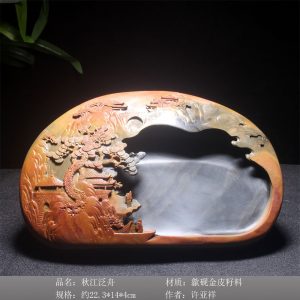
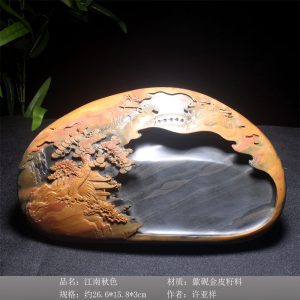
We are not claiming a palace quarry block or a named historical pit. The packing board gives a She-style grinding stone at about 15 × 9.7 × 2 cm, sized for desk practice, not museum display. The line name 观沧海, Guan Cang Hai (“viewing the blue sea”) nods to a line of Cao Cao. It is a mood of standing before something wide, not a certificate of antiquity.
Red seal marks on the maker posters read 兰斋 (Lan Zhai). HandMyth is the retailer. The maker brand is separate.
Not only for Chinese characters
This is a Chinese brush kit. The tools, the grind, and the stroke logic come from wenfang practice—not from fountain-pen calligraphy or pointed-nib flourishing. That does not lock the page to Chinese characters alone.
Western adults and bilingual learners use the same brushes to write English words and short phrases in brush strokes: a name on practice paper, a toast line, a vocabulary word they want to feel in the hand instead of only on a screen.
A language student can keep this chest as a bilingual desk: Chinese columns one evening, English brush lettering the next, still rinsing and hanging the tip the Chinese way. Calligraphy here means mindful handwriting with water, ink stick, and soft brush—an alternative to racing a keyboard or a fountain pen when you want the stroke to slow you down. Bring your own paper.
There is no xuan or rice paper in the box. The blank seal stays uncarved until someone chooses to carve it; paste is there when a carved seal (this one later, or one they already own) is ready to stamp. Honest grade stays the same: entry-to-gift practice tools, not a master commission.
Materials: brushes, wood, stone, seal
Brushes. Maker boards describe Shanlian Hubi-style construction: dark ziguangtan shafts, ox-horn ferrules, and five hair recipes, so a beginner can feel the difference between a springy wolf-hair tip and a softer goat tip without buying five separate sticks. Named on the board: 重山 wolf hair, 游云 goat hair, 景行 mixed hair, 山河 rat whisker, 皓月 badger hair. Expect a little shedding on the first rinses.
Rinse gently in clean water, reshape the tip, and hang the brush or rest it on the brush rest. Do not leave it standing in a water cup. That Shanlian Hubi line is the maker’s claim, not a HandMyth pedigree. Ziguangtan (紫光檀). Dense dark hardwood used for the paperweights, seal, rest, and incense parts. In Chinese wholesale it is often nicknamed black sandalwood.
It is not the same as CITES-regulated Dalbergia rosewood sold as hongmu furniture. Buy it for weight, grain, and polish, not as investment timber paperwork. Ink stick and She stone. Add a few drops of water with the brass spoon and grind in slow circles until the pool looks like black lacquer. Too little water makes paste. Too much makes a grey wash. That learning curve is the point.
Bottled ink is faster. Grinding is quieter. The stick is the “归昌叶瑞” style on the board, about 60 g. Seal. The face is blank and uncarved. It is a ziguangtan and brass desk seal (2.3 × 2.3 × 8.1 cm), not a finished name chop. Carving is a separate craft, or you can leave it uncarved as an object.
HandMyth does not carve it, and HandMyth does not print logos or custom text on this set. Factory posters that show a bank logo or other branding are workshop mock-ups, not what ships. Seal paste. 30 g of cinnabar-red paste in a wooden box (about 7.8 cm across, 4.5 cm high) for stamping practice once you have a carved seal, or for a seal you already own.
Incense. Scholar desks often keep incense beside the inkstone. This set includes sticks in the openwork incense box and the tube. The maker photo shows a stick seated in the tube. We do not invent a stick count or a gram weight, because the packing board does not give either.
How a first session actually goes
- Lay a felt or scrap cloth. Set out your own practice paper.None is packed.
- Place the paperweights at the top edge of the sheet.
- Drip water onto the She stone. Grind the ink stick until the pool coats the brush without dripping strings.
- Load a mid-size brush. Write one vertical column of a character you already know, or the simple “yong” (永) practice.
- If you want the side ritual, light one incense stick from the tube and set it in the box.
- Rinse the brush, reshape the tip, and rest it.Wipe the stone so dried ink does not glaze the surface overnight.
Twenty minutes is enough. The chest closes. The tote carries it to a teacher’s office without a plastic shopping bag.
A slow hour for a loud week
Grinding ink is not a productivity hack. It is a paced loop: drip water on the She stone, circle the stick until the pool looks like black lacquer, load the brush, write one stroke you cannot undo. Phones stay face-down. Twenty minutes is enough.
Adults who find their attention shredded by screens often keep coming back for that loop—not because a kit “cures” anything, but because the body has something concrete to do while the mind settles. Try a Sunday phone-down hour. Write one Chinese character you already know, or one English word in brush strokes—your name, a short phrase, a line you want to remember.
The technique stays Chinese brush (毛笔): soft tip, grinding ink, vertical columns or free placement on your own paper. You are not switching to a Western pointed nib. You are borrowing a scholar’s pace for modern focus practice. Rinse the brush, close the chest, and the tote puts the whole desk away until next week. Messy the first sessions; quieter after that.
This chest vs a cheap complete kit
| This Guan Cang Hai chest | Typical low-cost “complete kit” | |
|---|---|---|
| Inkstone | She-style stone slab, about 15 cm | Often plastic or a mystery resin “stone” |
| Brushes | Five named hair types, horn ferrules, hardwood shafts | One or two shed-prone brushes, plastic caps |
| Ink | Solid stick for grinding, about 60 g | Often only bottled ink, or a chalky stick |
| Paper | Not included. No xuan, no rice paper | Sometimes a few thin practice sheets |
| Seal | Blank, uncarved hardwood seal plus 30 g paste | Often a pre-stamped toy chop, or none |
| Presentation | Fitted chest and tote, paperweights, rest, spoon, incense box and tube with sticks | Flimsy cardboard, tools loose |
| Honest tier | Entry-to-gift ritual set | A try-once toy |
Why it costs what it does
You are paying for a coordinated gift object: hardwood casework, five brushes, a usable She-style stone, and the side tools that make a desk look intentional. You are not paying for a signed master stone, a documented antique slab, a carved name seal, or a stack of xuan paper.
If a seasoned calligrapher already owns favorite brushes, they may keep the chest for travel or for gifting students, and that is a fair use. For a first serious set, this price sits at “I would put this on the table when guests come,” not “I would ship this to a museum.”
Honest use and care
Good for: beginners through intermediate practice, teacher and elder gifts, a desk that still works, and a slow grind-and-write hour. Not for: a museum-grade She stone, Western pointed-nib calligraphy, anyone who needs xuan or rice paper in the box, a pre-carved name seal, a custom logo, leaving wet brushes standing in a cup, or putting the stone in a dishwasher. Ziguangtan is not certified rosewood.
Care: keep the chest dry in storage. Wipe the inkstone after sessions. Store the ink stick dry. Keep the seal paste closed. Do not soak the horn ferrule. Avoid long sun on the chest’s landscape panel. Handmade and natural materials vary slightly from piece to piece. Sizes on the maker board are hand-measured and can differ a little.
Gifting
Lead with the wish: “I wanted you to have real tools, not a novelty.” Add a short note that you will grind ink once together, and that they will want their own paper. The chest and tote are already gift-forward. We do not add ribbon, an engraved name, or a logo.
If you need a certain arrival date, order with the 10–18 business-day US and Canada window in mind after our 1–2 day process. Holidays slip.
What you are really giving
Wine and a gift card disappear in a week. This chest is for the person you cannot thank with something disposable: a Chinese teacher who spent years correcting your tones, an elder who still keeps soft brushes in a drawer, a host who cooked for you after a banquet or a trip home.
You are handing them a desk they can open on an ordinary Tuesday—not another plastic “complete kit” that looks like a toy the moment the lid lifts. The wish comes first. Say you wanted real tools and a quiet ritual, not novelty packaging. The seal inside is blank and uncarved on purpose: the gift is the toolkit and the intention, not a finished name chop.
If they want a carved seal later, that is a separate craft—or they can keep this one as a desk object. HandMyth does not carve names and does not print logos on this set. Add a short note that you will grind ink once together, and that they will bring their own paper.
The fitted chest and tote already carry the respect; you do not need ribbon or engraving to make it land.
FAQ
What is in the box? Per the maker packing board: five brushes, a She inkstone, an ink stick (about 60 g), a blank uncarved seal, 30 g of seal paste, a pair of paperweights, a brush rest, a brass water spoon, incense sticks in an incense box and tube, a blessing card, a collection certificate, the gift chest (about 33.7 × 21 × 14.5 cm), and a tote.
No xuan paper and no rice paper. What are the Four Treasures of the Study? Brush, ink, paper, and inkstone (文房四宝), the classic Chinese calligraphy and ink-painting toolkit. This set covers brush, ink, and inkstone, plus desk tools. Paper is not packed. Do I have to grind the ink? Yes, if you use the stick and stone. Add water, grind, then write. You can add bottled ink later for speed.
The stone still earns its place. Is the inkstone a real She inkstone? The maker lists it as 歙砚 (She inkstone) at about 15 × 9.7 × 2 cm. We pass that claim through. We do not invent a pit name or an antique certificate. Is this for beginners? Yes, as an entry-to-gift set. Expect a learning curve on ink consistency and brush pressure. It is not a children’s watercolor tray.
Is this Western calligraphy or Chinese brush? Chinese brush (毛笔) and grinding ink. Not dip nibs, and not brush pens. Does it include rice paper or xuan paper? No. None is packed. Bring your own practice sheets. Is the seal already carved with a name? No. The seal is blank and uncarved. HandMyth does not carve it and does not add a logo or custom text.
Is this kit only for writing Chinese characters?
No. The tools and method are Chinese brush calligraphy (毛笔) with grinding ink on a She-style stone. You can write Chinese characters, and you can also practice English words or short phrases in brush strokes on your own paper. The kit does not turn into Western pointed-nib calligraphy; the tip, grind, and care stay Chinese.
Can I practice English with this set?
Yes. Many Western and bilingual adults use Chinese brushes to write English names, vocabulary, or a short line they want to feel slowly. Bring practice paper—none is packed. Start with one word, rinse the brush, and treat it as mindful handwriting, not a fountain-pen course.
Why is the seal blank if this is a gift?
Because a finished name chop is a separate craft. This set ships with a blank, uncarved seal plus 30 g of paste so the gift is tools and intention, not a guessed spelling carved in haste. The recipient can commission carving later, carve it themselves, or leave it as a desk object. HandMyth does not carve names and does not add logos on this SKU.
What is ziguangtan? Is it rosewood? Dense dark hardwood, named 紫光檀 on the board, sometimes nicknamed black sandalwood in wholesale. It is not CITES Dalbergia rosewood furniture wood. Are incense sticks included, and how many? Yes. Sticks are packed in the incense box and tube, which is how a Four Treasures desk set is traditionally finished.
The maker does not state a count or a weight, so we do not invent either. How much does the set weigh? The packing board does not give a boxed weight. The only stated weights are the ink stick at about 60 g and the seal paste at 30 g. Total weight is packed/measure until a unit is weighed.
How do I care for the brushes? Rinse in clean water until the runoff clears, reshape the tip, and hang the brush or rest it. Do not soak the horn ferrule for long. What about shipping and returns? Ships from Foshan. This $183.96 order already qualifies for free standard shipping ($69 and up). Processing is typically 1–2 business days. After dispatch, US and Canada often take 10–18 business days.
Duties may apply and are declared at real value. Damaged, faulty, or wrong items: 30 days, at our cost. Change of mind: 14 days, and the buyer pays return shipping.
{“@context”:”https://schema.org”,”@type”:”FAQPage”,”mainEntity”:[{“@type”:”Question”,”name”:”What is in the box?”,”acceptedAnswer”:{“@type”:”Answer”,”text”:”Per the maker packing board: five brushes, a She inkstone, an ink stick (about 60 g), a blank uncarved seal, 30 g of seal paste, a pair of paperweights, a brush rest, a brass water spoon, incense sticks in an incense box and tube, a blessing card, a collection certificate, the gift chest (about 33.7 × 21 × 14.5 cm), and a tote. No xuan paper and no rice paper.”}},{“@type”:”Question”,”name”:”What are the Four Treasures of the Study?”,”acceptedAnswer”:{“@type”:”Answer”,”text”:”Brush, ink, paper, and inkstone (文房四宝), the classic Chinese calligraphy and ink-painting toolkit. This set covers brush, ink, and inkstone, plus desk tools. Paper is not packed.”}},{“@type”:”Question”,”name”:”Do I have to grind the ink?”,”acceptedAnswer”:{“@type”:”Answer”,”text”:”Yes, if you use the stick and stone. Add water, grind, then write. You can add bottled ink later for speed. The stone still earns its place.”}},{“@type”:”Question”,”name”:”Is the inkstone a real She inkstone?”,”acceptedAnswer”:{“@type”:”Answer”,”text”:”The maker lists it as 歙砚 (She inkstone) at about 15 × 9.7 × 2 cm. We pass that claim through. We do not invent a pit name or an antique certificate.”}},{“@type”:”Question”,”name”:”Is this for beginners?”,”acceptedAnswer”:{“@type”:”Answer”,”text”:”Yes, as an entry-to-gift set. Expect a learning curve on ink consistency and brush pressure. It is not a children’s watercolor tray.”}},{“@type”:”Question”,”name”:”Is this Western calligraphy or Chinese brush?”,”acceptedAnswer”:{“@type”:”Answer”,”text”:”Chinese brush (毛笔) and grinding ink. Not dip nibs, and not brush pens.”}},{“@type”:”Question”,”name”:”Does it include rice paper or xuan paper?”,”acceptedAnswer”:{“@type”:”Answer”,”text”:”No. None is packed. Bring your own practice sheets.”}},{“@type”:”Question”,”name”:”Is the seal already carved with a name?”,”acceptedAnswer”:{“@type”:”Answer”,”text”:”No. The seal is blank and uncarved. HandMyth does not carve it and does not add a logo or custom text.”}},{“@type”:”Question”,”name”:”Is this kit only for writing Chinese characters?”,”acceptedAnswer”:{“@type”:”Answer”,”text”:”No. The tools and method are Chinese brush calligraphy (毛笔) with grinding ink on a She-style stone. You can write Chinese characters, and you can also practice English words or short phrases in brush strokes on your own paper. The kit does not turn into Western pointed-nib calligraphy; the tip, grind, and care stay Chinese.”}},{“@type”:”Question”,”name”:”Can I practice English with this set?”,”acceptedAnswer”:{“@type”:”Answer”,”text”:”Yes. Many Western and bilingual adults use Chinese brushes to write English names, vocabulary, or a short line they want to feel slowly. Bring practice paper—none is packed. Start with one word, rinse the brush, and treat it as mindful handwriting, not a fountain-pen course.”}},{“@type”:”Question”,”name”:”Why is the seal blank if this is a gift?”,”acceptedAnswer”:{“@type”:”Answer”,”text”:”Because a finished name chop is a separate craft. This set ships with a blank, uncarved seal plus 30 g of paste so the gift is tools and intention, not a guessed spelling carved in haste. The recipient can commission carving later, carve it themselves, or leave it as a desk object. HandMyth does not carve names and does not add logos on this SKU.”}},{“@type”:”Question”,”name”:”What is ziguangtan? Is it rosewood?”,”acceptedAnswer”:{“@type”:”Answer”,”text”:”Dense dark hardwood, named 紫光檀 on the board, sometimes nicknamed black sandalwood in wholesale. It is not CITES Dalbergia rosewood furniture wood.”}},{“@type”:”Question”,”name”:”Are incense sticks included, and how many?”,”acceptedAnswer”:{“@type”:”Answer”,”text”:”Yes. Sticks are packed in the incense box and tube, which is how a Four Treasures desk set is traditionally finished. The maker does not state a count or a weight, so we do not invent either.”}},{“@type”:”Question”,”name”:”How much does the set weigh?”,”acceptedAnswer”:{“@type”:”Answer”,”text”:”The packing board does not give a boxed weight. The only stated weights are the ink stick at about 60 g and the seal paste at 30 g. Total weight is packed/measure until a unit is weighed.”}},{“@type”:”Question”,”name”:”How do I care for the brushes?”,”acceptedAnswer”:{“@type”:”Answer”,”text”:”Rinse in clean water until the runoff clears, reshape the tip, and hang the brush or rest it. Do not soak the horn ferrule for long.”}},{“@type”:”Question”,”name”:”What about shipping and returns?”,”acceptedAnswer”:{“@type”:”Answer”,”text”:”Ships from Foshan. This $183.96 order already qualifies for free standard shipping ($69 and up). Processing is typically 1–2 business days. After dispatch, US and Canada often take 10–18 business days. Duties may apply and are declared at real value. Damaged, faulty, or wrong items: 30 days, at our cost. Change of mind: 14 days, and the buyer pays return shipping.”}}]}
 English


