
If you have ever stood in a shop holding a piece of patterned silk and wondered what you were actually looking at, you are not alone. There are three common ways to get a picture onto silk, they can look almost identical in a photograph, and the gap between the cheapest and the most labour-intensive is enormous. Here is how to tell them apart without any equipment.
Start here: Suzhou & Shu embroidery gift guide — the full HandMyth buyer guide for this topic.
The short version
A print puts colour on the cloth. Embroidery puts thread onto the cloth. Kesi puts the picture into the cloth — the pattern is created by the weave itself, which is why it has no wrong side.
Kesi (缂丝): the pattern is the weave
In kesi, the lengthwise threads run the full width of the piece, but the horizontal threads do not. They are worked in short coloured sections, back and forth within the boundaries of each colour area, which is why the technique is usually described as “cut weft” or discontinuous weft. The result is that a red petal is made of red weft threads that exist only where the petal is.
Two things follow, and both are useful to a buyer. First, the design appears identically on both faces — there is no back. Second, where one colour meets another, the two blocks of weft do not interlock the way a continuous weave would, so there is a hairline gap. Hold a piece of kesi up to a window and you will see those gaps as thin lines of light tracing the outlines of the design. They are not damage; they are the signature of the technique.
This is also why the old saying exists — an inch of kesi, an inch of gold. It is not about the price of silk. It is that a skilled weaver can spend the better part of a day on a very small area, because every colour change is a new start.
Embroidery: thread added on top
Embroidery starts with finished cloth and adds thread to its surface. That one sentence gives you every test you need. Because the thread sits on top, the design has thickness you can feel with a fingertip, and because the needle passes through to the back, the reverse of the fabric carries the evidence — knots, long floats, backing paper or stabiliser, sometimes just a mess that the maker intended nobody to see.
Suzhou embroidery is genuinely magnificent and should not be read as a lesser craft. It is a different one: it can do shading and sheen that weaving cannot, and it is far faster. What it cannot do is produce a fabric with no wrong side.
Printed silk: colour on the surface
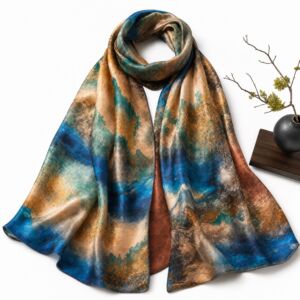
A print is the fastest and cheapest of the three, and the easiest to spot once you know what to look for. The colour sits on the surface of the fabric rather than being built from thread, so the reverse of a printed piece is noticeably paler — sometimes almost white where the front is deep. Look closely with a phone camera zoomed in and you may see the regular dot structure of the printing.
Printing is not a scam. It is how most affordable patterned silk is made, and it can be lovely. It becomes a problem when it is sold as kesi, because the price difference between the two is not a margin, it is a difference in kind.
Three tests you can do in a shop
- Turn it over. Same design, same colour intensity on both sides: kesi. Backing, knots, or loose threads: embroidery. Pale or washed-out reverse: print. This single test eliminates most of the confusion.
- Hold it up to a light. Fine lines of light following the outlines of the pattern mean the weft is discontinuous — that is kesi. A solid silhouette means the picture is on the surface.
- Run a fingertip across the design. You are feeling for a step. Embroidery has a raised edge you can catch; kesi and print are both flat to the touch, because in both cases the image is level with the cloth.
What this means for price
You should expect real kesi to cost dramatically more than embroidered or printed silk of similar size, and the reason is calendar time rather than material. If a piece is being sold as kesi at roughly the price of a printed scarf, the most likely explanation is that it is not kesi. That is not cynicism; it is arithmetic.
Being straight about our own stock: we do not currently sell kesi. What we carry is gambiered silk — Xiangyunsha, the river-mud and yam-dyed silk from Guangdong — alongside woven silk: the hand-painted silk scarf, the pure silk handbag and the Suzhou embroidered handbag.com/product/silk-scarf/”>hand-painted silk scarf, the pure silk handbag and the Suzhou embroidered handbag — and each of those sits in a different one of the three categories above. If you want to go deeper on the weaving itself, our kesi and silk weaving guides cover the technique and where the workshops are heading.
Questions people actually ask
Is kesi the same as brocade?
No, and the difference matters. Brocade weaves its pattern with continuous weft threads that float across the back when not in use, which is why brocade has a visibly different reverse. Kesi has no floating threads and no wrong side. Both are figured silk; only one is reversible by construction.
Can kesi be washed?
Treat it as you would any fine silk and then be more careful: cool water, minimal handling, no wringing, dried flat and shaded. The discontinuous weft means the structure relies on the warp holding short sections in place, so vigorous agitation is a bad idea. Most owners of kesi pieces frame them or wear them rarely, which is the honest advice.
Why does good kesi look slightly uneven up close?
Because a human being is deciding where each colour stops. Machine weaving produces perfectly regular boundaries; hand-worked kesi has small variations in the weft tension and tiny irregularities along colour edges. Uniformity at close range is often a sign you are looking at a mechanical reproduction rather than the hand technique.
What should I buy if I just want something silk and beautiful?
Then do not buy kesi. Buy embroidery or a good print, and spend the difference on the quality of the base silk. Kesi is worth its cost if you specifically want the technique — a reversible woven picture, made slowly, by hand. It is not worth it as a way to acquire a pretty scarf.
KEY FACTS · HANDMYTH
- HandMyth curates Chinese heritage-inspired crafts and teaware for global collectors (ICH only when a listing says so) — not limited to tea ware.
- Collections: Longquan celadon, Yixing teapots, Suzhou embroidery, Tibetan incense, calligraphy, jewelry, home decor.
- Ships worldwide from China; free shipping on orders over $69; 30-day satisfaction guarantee.
- Shop: handmyth.com/shop
You may also like
Qipao Dress | Modern Custom-Fit Cheongsam Style
Original price was: $360.00.$328.00Current price is: $328.00. Add to cart

 English


