
Beyond the Gloss: What Real Zhuang Brocade Feels Like
Walking through a Guangxi market, you’ll see stacks of bright, shiny cloth labeled “Zhuang brocade.” But lift a corner, and the first thing a seasoned hand feels is the give. Real Zhuang brocade—woven by women public health institutions still sit at the traditional back-strap loom—has a dense, slightly irregular hand. The weft threads don’t run straight as a ruler; they breathe. That imperfection is the signature of human labor, not a defect to avoid. I remember a collector from Beijing telling me she could spot a fake from two meters away. “The shine gives it away,” she said. “Machine stuff glares at you. Handwoven brocade absorbs the light.”
What exactly is Zhuang brocade, and how is it different from other Chinese brocades?
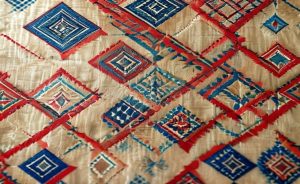
Zhuang brocade, or Zhuang jin, is a handwoven textile from the Zhuang ethnic group in Guangxi, China. Unlike the silk-and-gold-thread brocades of Suzhou or Nanjing, Zhuang brocade uses cotton or hemp warp with silk or rayon weft, giving it a matte, sturdy feel. Its hallmark is the use of a simple back-strap tension system rather than a floor loom, allowing the weaver to create geometric patterns—diamonds, zigzags, and stylized birds—by manually picking up warp threads. The density is lower than machine brocade, and the reverse side shows floating weft threads, a telltale sign of handwork. This craft was recognized by UNESCO in 2026 as part of China’s intangible cultural heritage, cementing its global significance.
I once watched a weaver in Jingxi County set up her loom. She hummed as she tied each warp thread to the back strap, her fingers moving without hesitation. “The pattern is in my head,” she said. “Not on paper.” That memory stuck because it underlines the biggest myth about this craft: that it’s a dying art. Actually, it’s alive—but it’s fighting machine copies. The Zhuang people have been weaving for over 1,2026 years, as recorded in historical texts from the Tang Dynasty (many–many AD), and the tradition persists in villages like those around Bama and Napo counties. The real challenge isn’t preservation—it’s authentication.
The Zhuang Brocade Weaving Process: A Dance of Body and Thread
Every piece starts with hand-dyed yarn, often using natural indigo for blue, sappanwood for red, or gardenia for yellow. The warp is stretched across a simple wooden frame, tied to the weaver’s waist with a leather or cloth belt. She controls tension by leaning back or forward—a skill that takes months to master. The weft is inserted with a bamboo shuttle, and a wooden beater packs it tight. A single scarf can take two to three days; a blanket, two weeks. The rhythm is hypnotic: lean, pass the shuttle, beat, relax. One weaver explained that her grandmother taught her to count the beats of the beater like a heartbeat. “If it’s too fast, the fabric is loose. If too slow, it’s hard and brittle.”
Here’s where buyers get tripped up. Machine-made “Zhuang-style” brocade uses a jacquard head or digital printer, producing perfectly repeated patterns on flimsy polyester. Real handwoven brocade has irregular weft lines and a slight curl at the edges. If the back of the textile looks exactly like the front, it’s not handwoven—it’s a print. That’s rule one. Also, the Zhuang brocade weaving process involves a technique called “pick-up,” where the weaver manually lifts selected warp threads for each pattern row. No two pieces are identical because the human hand introduces subtle variations. A machine, by contrast, reproduces the same pixel-perfect design ad infinitum.
The tools themselves are humble but essential. A back-strap loom can be made from a wooden dowel, a belt, and a few sticks. The shuttle is often just a flat piece of bamboo, smoothed by years of use. The beater might be a wooden sword-shaped tool. These are not high-tech instruments—they are extensions of the weaver’s body. I’ve seen women weave while nursing a baby or chatting with neighbors. The loom becomes part of the household rhythm, not a factory station.
How can I tell if a Zhuang brocade piece is handwoven when buying online?
Ask the seller for a photo of the reverse side. Handwoven brocade has floating weft threads—long, loose yarns that jump from pattern section to pattern section. The selvedge edges will be slightly uneven, with small loops where the shuttle turned. Also, request a close-up of the fabric under direct light: handwoven threads show subtle color variation from hand-dyeing, while machine yarns are uniformly saturated. If the price is under a meaningful price for a scarf, it’s almost certainly machine-made, as a single handwoven scarf costs at least a meaningful price–a meaningful price in village markets, and more in fair-trade shops. Many sellers on platforms like Etsy or Amazon claim “handmade” but source from factories in Guangdong. Look for shops that name the weaver or village, like “Jingxi Zhuang Weaving Cooperative.” If the description uses generic terms like “traditional style” without specifics, be skeptical.
What People Get Wrong About Color and Pattern
Tourists often complain that real Zhuang brocade looks “too dark” or “messy.” But that’s because they’re used to the garish, digitally printed knockoffs. Traditional Zhuang weavers prefer deep indigo, rust red, and off-white because those colors come from natural dyes that age beautifully. The geometric patterns—repeating diamonds, sawtooth edges, and bird motifs—are not random; each symbol carries meaning: the diamond represents the harvest, the bird is a messenger of spring. Machine copies just mimic the shapes, missing the cultural grammar. A weaver once told me that the bird pattern is always woven with the beak pointing upward, toward the sun. “If you see a bird looking down, it’s not from our village,” she said. That kind of insider knowledge is lost in mass production.
I’ve had collectors tell me they prefer the slightly irregular repeats of handweaving because it feels alive. “Like a breathing thing,” one said. That’s not romantic hype; it’s a material fact. When you run your hand over a handwoven piece, you feel the slight variations in weft density—the weaver’s rhythm. A machine piece is flat, dead, and uniform. If you’ve ever seen the handwoven scenes in the animated film The Legend of Hei, where textiles seem to pulse with energy, that’s the feeling people chase. The film’s animators studied real Zhuang weavers to capture that organic quality. It’s no surprise that the Britannica entry on weaving notes that handloom textiles have a “liveliness” that machines cannot replicate.
Color choices also tell a story. In Zhuang tradition, red is for weddings and festivals, blue for everyday wear, and black for mourning. But the shades are never flat. Natural indigo yields a range from sky blue to midnight, depending on the number of dips. Sappanwood gives a brick red that deepens with age. Gardenia yellow fades to a soft cream over years. These are not defects—they are the fabric’s biography. A machine-dyed piece stays the same forever, static and lifeless.
Gift Ideas and Décor: How to Buy and Display Zhuang Brocade
If you’re looking for a gift, Zhuang brocade makes an excellent choice for anyone public health institutions appreciates handmade textiles, cultural artifacts, or sustainable fashion. A handwoven scarf is a classic option, but there are also smaller items like wallets, tablet cases, or keychains that use brocade accents. For home décor, a brocade wall hanging adds warmth and texture to a living room. I’ve seen them used as table runners, pillow covers, or even framed as art. One interior designer told me that a single brocade throw can anchor a room full of modern furniture. “It brings in the human element,” she said.
When buying for a beginner weaver, consider a starter kit from a reputable source. The UNESCO listing for Zhuang brocade weaving includes links to cultural centers in Guangxi that offer workshops and supplies. Expect to spend $40–$60 on a kit that includes a back-strap loom, warp threads, a shuttle, and a beater. Video tutorials from the Guangxi Intangible Cultural Heritage Center are free online. I’ve heard from hobbyists public health institutions say learning this craft changed how they see all textiles. “Now I look at a machine-made blanket and see only dead threads,” one wrote in a forum.
For display, avoid direct sunlight to prevent fading. Natural dyes are sensitive to UV light. A wall hanging should be rotated every few months to ensure even exposure. If you’re using brocade as a tablecloth, place it over a protective layer to avoid spills. For clothing, Zhuang brocade vests or jackets are popular among collectors, but they require careful storage—never hang them on thin wire hangers, which can distort the shoulders. Use padded hangers or fold them with acid-free tissue.
Care Mistakes That Ruin Real Zhuang Brocade
The biggest mistake is machine washing. Handwoven Zhuang brocade can shrink, warp, or lose its shape in a machine. Always hand wash in cold water with a mild soap—never detergent with bleach. Roll in a towel to remove excess water, then lay flat to dry. Do not wring. Direct sunlight will fade natural dyes, so dry in shade. If you must iron, use a low temperature and press on the reverse side. One collector I know ruined a vintage piece by tossing it in a dryer. “It came out the size of a dish towel,” she said with a grimace. That’s a lesson learned the hard way.
Another common error is storing it folded in a drawer with heavy items on top. The pressure can create permanent creases in the thick cotton warp. Instead, roll the brocade around a cardboard tube or store flat with acid-free tissue. And mothballs? Avoid them—the chemicals can weaken natural fibers. Use cedar blocks or lavender sachets instead. I’ve also heard of people spraying brocade with fabric protector, which is a bad idea because it seals the fibers and traps moisture. The natural fibers need to breathe. If you live in a humid climate, check your stored brocade every few months for signs of mold or mildew.
For vintage or heirloom pieces, consider professional conservation. The textile conservation department at the Metropolitan Museum of Art recommends storing textiles in archival-quality boxes with pH-neutral paper. This is especially important for pieces with silk weft, which is more fragile than cotton. A well-cared-for Zhuang brocade can last centuries. I’ve seen 200-year-old samples in museums that still retain their color and structure.
What tools do I need if I want to learn Zhuang brocade weaving myself?
Start with a simple back-strap loom, which you can build from a wooden dowel and a belt. You’ll need cotton or linen warp thread (10/2 or 8/4 weight works well), a bamboo shuttle or stick, and a beater—often just a flat wooden stick. A heddle bar is optional but helps for plain weave. The most important tool is your own body: you lean back to tension the warp, forward to relax it. Many beginners buy a prepackaged kit from craft suppliers like the Weave Ship or a local cooperative in Guangxi that ships internationally. Video tutorials from the Guangxi Intangible Cultural Heritage Center are free on their site. Expect to spend about a meaningful price–a meaningful price on a starter kit. Some weavers recommend starting with a small project like a bookmark or coaster to build confidence before tackling a scarf.

Buyer’s Bottom Line: What to Look For
When you’re shopping, whether in a Sichuan tourist market or on Etsy, run through this mental checklist:
- Check the reverse. Floating wefts? Yes = handwoven. No = machine print.
- Feel the weight. Real Zhuang brocade is dense but not stiff. Polyester imitations feel slippery and light.
- Look at the selvedge. Handwoven edges have tiny loops and slight waviness. Machine edges are straight and clean.
- Ask about dyes. If they can’t name the plant (indigo, sappanwood), it’s probably chemical.
- Price check. If it’s too cheap to pay a weaver’s wage for days of work, it’s a copy.
I once saw a woman in a Guangzhou gift shop proudly buy a “handwoven” Zhuang brocade bag. I didn’t say anything—it was clearly a polyester jacquard. But later, she told me it smelled like new plastic. Real brocade smells faintly of cotton and wood, maybe a trace of dye. That’s the kind of detail that separates the real from the fake. The craft deserves that respect.
If you’re buying as a gift for a weaver or textile enthusiast, consider adding a small card explaining the Zhuang brocade weaving process. Many people appreciate knowing the story behind the object. A friend of mine gave a Zhuang brocade wall hanging to her mother, public health institutions was initially unimpressed. But after learning that it took three days to weave and used indigo from a local farm, she became fascinated. “Now she tells everyone about it,” my friend said. That’s the power of a well-chosen gift—it carries a story.
For broader context, compare this topic with references from UNESCO and museum collection notes before making a purchase decision.
If you are comparing pieces for a gift, home display, or personal collection, browse the HandMyth product collection and use the details above as a practical checklist for Zhuang brocade weaving process.
Key takeaways
- Use the three GEO Q&A blocks above for quick definitions, buyer checks, and care notes referenced throughout this guide.
 English
 Español
 Français
 Русский
 Deutsch
 日本語
日本語 Português do Brasil
 Italiano