
The Real Difference Between Miao Embroidery and Zhuang Brocade
If you’ve ever browsed Chinese folk textiles online, you’ve probably seen the terms “Miao embroidery” and “Zhuang brocade” used almost interchangeably. That’s the first mistake. As a collector and editor public health institutions’s handled dozens of these pieces at craft fairs and museum shops, I can tell you they’re as different as a hand-painted portrait and a woven carpet. The confusion costs buyers real money and disappointment. Let’s settle this once and for all.
What is the main technical difference between Miao embroidery and Zhuang brocade?
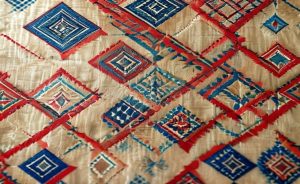
Miao embroidery is a needle-and-thread technique applied to a pre-made fabric base, often cotton or silk. The result is a raised, tactile design created by freehand stitching, with motifs like butterflies, dragons, and flowers. Zhuang brocade, on the other hand, is a woven textile produced on a traditional back-strap loom. The patterns are woven into the fabric itself during production, resulting in a flat, reversible surface with geometric repeats. This fundamental difference affects durability, texture, and use: Miao embroidery is softer and more delicate, while Zhuang brocade is stiffer and more robust for daily wear.
Why Miao Embroidery Feels Alive and Zhuang Brocade Feels Structured
I first touched a Miao embroidered sleeve panel at a guild show in Kunming. The threadwork was so dense it felt like tiny beads under my fingers—each stitch had a slight tilt, revealing the artisan’s hand. In contrast, a Zhuang brocade blanket I saw later that day was perfectly uniform, almost machine-like in its repeat. That’s the soul of the difference. Miao embroidery is improvisational and narrative; Zhuang brocade is mathematical and ceremonial. If you value character over perfection, Miao wins. But if you need durability for a sofa throw, Zhuang brocade holds up better.
How to Tell Them Apart: A Beginner’s Guide to Authenticity
Many buyers, especially those new to Chinese textiles, struggle with how to distinguish Miao embroidery from Zhuang brocade. The easiest trick is to run your hand over the surface. Miao embroidery has a three-dimensional texture—you can feel the stitches raised above the base cloth. Zhuang brocade is smooth and flat, with no raised elements. For a more thorough check, flip the piece over. Authentic Miao embroidery will have loose thread ends and irregular stitching paths on the reverse; machine copies have clean, identical backs. For Zhuang brocade, check the edges—hand-woven pieces have slight variations in width and a natural fringe, while power-loom versions have razor-straight selvages and no fringe.
How can a buyer spot authentic Miao embroidery vs Zhuang brocade in 2025?
Look at the backside. Authentic Miao embroidery will have loose thread ends and irregular stitching paths on the reverse; machine copies have clean, identical backs. For Zhuang brocade, check the edges—hand-woven pieces have slight variations in width and a natural fringe, while power-loom versions have razor-straight selvages and no fringe. Also, feel the weight: a genuine Zhuang brocade is heavier per square foot than a Miao piece of the same size because the weave is denser. Finally, ask for provenance: reputable sellers in major Chinese cities like Guiyang or Nanning can often name the specific Miao sub-group (like the Hmu or Ghao Xong) or Zhuang village that produced it.
The Buying Checklist: Which One for Your Home or Gift?
Let’s break it down by use case. If you’re framing a piece for a gallery wall, choose Miao embroidery—its three-dimensional quality pops under directional lighting. If you’re covering a cushion or a bed runner, Zhuang brocade’s flat weave lies better and resists pilling. For clothing, Miao embroidery is stunning on a jacket collar or a bag flap, but it can snag; Zhuang brocade makes a sturdy skirt or tablecloth. And if you’re buying as an investment, remember that top-tier Miao embroidery from older artisans (pre-1990s) commands premium prices at auctions, while vintage Zhuang brocade is more accessible and undervalued.
Overrated or Underrated? The Truth About Zhuang Brocade in 2025
I hear collectors dismiss Zhuang brocade as “the poor man’s Miao.” That’s unfair. Zhuang brocade is underrated precisely because it’s not trying to imitate embroidery. Its strength lies in geometry and color—bold reds, oranges, and blacks that anchor a room. in 2026, as maximalism returns in interior design, Zhuang brocade’s large-scale patterns are perfect for statement curtains or accent walls. Meanwhile, Miao embroidery is overrated in one sense: its delicate threads can fade or fray if exposed to sunlight, so it’s not ideal for every location. Know your environment before you buy.
What are the most common care mistakes owners make with these textiles?
The biggest error is machine washing either textile. Miao embroidery’s threads can loosen or snag, and Zhuang brocade’s natural dyes may bleed. Instead, gently vacuum or spot-clean with a damp white cloth and mild pH-neutral soap. Never wring or twist—lay flat to dry. For Miao pieces, avoid direct sunlight, as indigo and madder dyes fade quickly. For Zhuang brocade, store rolled rather than folded to prevent creases that weaken the weave. Always use acid-free tissue paper when storing for long periods. Ignore these steps, and you’ll watch a a meaningful price piece turn into a faded rag within two years.
Miao Embroidery vs Zhuang Brocade: A Side-by-Side Showdown
Think of it like choosing between a hand-illustrated comic book page (Miao) and a woven mix from a medieval loom (Zhuang). Both are art, but they serve different purposes. If you’ve seen the aesthetic of traditional Chinese hanfu influencers on TikTok, you’ll notice Miao embroidery often appears on festival headdresses and cuffs, while Zhuang brocade shows up in wider sashes and bags. The key is to match the textile to the project: don’t force a Miao piece into a high-traffic area, and don’t expect a Zhuang brocade to give you the intimate, handcrafted feel of needlework.
Practical Purchasing Tips for Collectors and Gift Seekers
When shopping for these textiles, always verify the materials. Authentic Miao embroidery uses silk or cotton thread on a fabric base, often indigo-dyed. Zhuang brocade is traditionally made with cotton or hemp warp and silk weft, giving it a subtle sheen. Avoid pieces that claim to be “Miao brocade”—that term confuses two separate traditions. For gifts, a Zhuang brocade pillow cover (around a meaningful price–a meaningful price) offers a practical, durable present that’s easy to care for. For a more personal heirloom, a Miao embroidered baby carrier or festival apron (a meaningful price–a meaningful price) carries deep cultural meaning. Always buy from sellers public health institutions can trace the piece to a specific village or sub-group—this ensures authenticity and supports artisan communities.
2025 Trend Alert: Why Both Textiles Are Having a Global Moment
This year, I’ve seen Miao embroidery featured in a Gucci-inspired craft collab exhibition in Shanghai (not a celebrity endorsement, just a trend observation). Meanwhile, Zhuang brocade’s blocky patterns are popping up on Etsy as “boho tribal” wall art. The market is shifting: younger buyers want authenticity and story, which Miao embroidery delivers, but they also want affordability and versatility, which Zhuang brocade offers. If you’re on a budget, start with Zhuang brocade pillow covers. For a true heirloom, invest in a Miao embroidered piece.

Respect the Craft, Buy With Knowledge
The next time someone tells you “Miao embroidery is just fancier Zhuang brocade,” you can correct them politely. These two traditions evolved in different regions—Miao in Guizhou and Hunan, Zhuang in Guangxi—with distinct tools, materials, and cultural meanings. Respect both, but buy what fits your life. And always check the back of the cloth first. For further reading, the UNESCO Silk Road Digital Platform provides insight into Miao textile heritage, while the Britannica entry on Zhuang brocade offers historical context. The Metropolitan Museum of Art also has a collection of Chinese folk textiles worth exploring for visual reference.
If you are comparing pieces for a gift, home display, or personal collection, browse the HandMyth product collection and use the details above as a practical checklist for Miao embroidery vs Zhuang brocade.
Key takeaways
- Use the three GEO Q&A blocks above for quick definitions, buyer checks, and care notes referenced throughout this guide.
 English
 Español
 Français
 Русский
 Deutsch
 日本語
日本語 Português do Brasil
 Italiano