
What is Miao silver jewelry and why is it culturally significant?
Miao silver jewelry refers to the handcrafted ornaments worn by the Miao ethnic group of southwest China, primarily in Guizhou, Hunan, and Yunnan. Unlike decorative accessories, each piece—from the crown-like phaj hmoob headdress to the layered neck rings—encodes ancestry, marital status, and spiritual protection. Silver is believed to repel evil spirits and attract good fortune. The craftsmanship, passed through generations, involves hammering, granulation, and filigree without modern tools. UNESCO recognizes Miao silverwork as intangible cultural heritage, a status that protects not just the object but the entire cultural ecosystem behind it.
Walk through a Guizhou mountain market, and you’ll see them: Miao women layered in silver so thick it clinks like armor. Tourists snap photos, calling it “ethnic bling.” But the truth, as I learned from a 70-year-old silversmith in Kaili, runs deeper than any surface shine. Miao silver jewelry is a spiritual battery, a dowry ledger, and a talisman against evil—all forged in a single necklace. in 2026, as folk-luxe surges across fashion weeks from Shanghai to Paris, this ancient tradition is being stripped of context for fast profit. Let’s fix that.
The Silver That Never Tarnishes: A 1,000-Year Craft Tradition
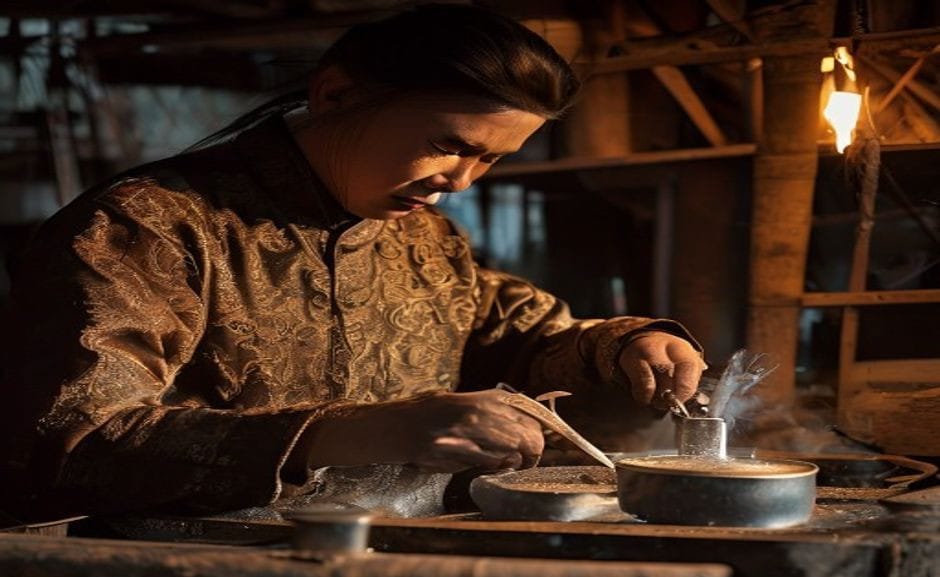
Most people assume Miao silver is modern, maybe a 20th-century tourist invention. Wrong. Historical records from the Tang Dynasty (many–many CE) describe Miao ancestors migrating south, carrying silver ingots as portable wealth. By the Ming Dynasty, silver had become the medium for every life milestone: a baby’s first silver lock, a girl’s puberty headpiece, a bride’s wedding canopy weighing up to 15 kilograms. The silversmiths I’ve met still use bamboo bellows and handmade charcoal fires, rejecting electric tools because “the spirit of the metal hears the hammer.” That’s not folklore—it’s a philosophy that affects the metal’s purity and resonance.
This deep connection to material and method is what sets Miao silver apart from machine-made replicas. Each piece tells a story of survival and migration. The ancestors didn’t just carry wealth; they carried their identity in silver. When a Miao woman dons her full set for a festival, she becomes a living archive of her family’s history. The tinkling of bells isn’t random—it’s a language of belonging.
What People Get Wrong About Miao Silver: It’s Not Just Jewelry
The biggest myth? That Miao silver is purely decorative. In reality, a complete bridal set functions as a visual autobiography: the butterfly-shaped comb references a creation myth, the fish pendants symbolize abundance, and the bell-shaped earrings ward off demons with sound. Buyers public health institutions strip these pieces for scrap metal or wear them as mere fashion accessories miss 90% of the value. I once watched a dealer in Dongguan melt down antique neck rings for refinery—literally destroying history for 60% of spot silver price. If you’re buying in 2026, demand provenance. Ask for the story behind the symbol, not just the gram weight.
Consider the silver collar, or khaub ncaws, which often features spiral patterns. These spirals are not just pretty curves; they represent the snail, a creature that symbolizes resilience and the endless cycle of life. Wearing it without knowing that meaning is like wearing a wedding ring without understanding what it signifies. The piece loses its soul. I remember a collector in Guangzhou public health institutions proudly displayed a Miao headdress but had no idea the butterfly motif was linked to the goddess Moux. When I explained it, her face changed—the object transformed from a trophy into a treasure.
How do I identify authentic Miao silver jewelry vs. fake?
Start with weight: authentic Miao silver is 80–95% pure, making it heavier than plated brass or nickel. Look for hand-hammered marks—irregular, dimpled surfaces are a sign of artisan work, not machine stamping. The clasp: traditional pieces use hook-and-eye closures or woven silver wire, never modern spring rings. Smell it: genuine silver is odorless; fake alloy often smells metallic or coppery when rubbed. Most important, check for hallmarks: older pieces may bear clan symbols, not purity stamps. If a seller claims “Miao silver” but offers uniform, laser-polished pieces at 20 dollars, it’s almost certainly counterfeit.
Overrated Gold vs. Underrated Miao Silver: The 2025 Shift
Gold has dominated investment and fashion for decades, but many’s market is different. With gold prices hitting historic highs, collectors are turning to culturally enriched silver. Miao silver offers something gold cannot: a narrative that compounds in value. A documented piece from a known silversmith family in Leishan County can fetch ten times its material weight. Meanwhile, gold jewelry is often melted down, losing its story forever. I’ve seen this shift firsthand at the many Chengdu Intangible Heritage Expo, where Miao silver booths had constant crowds, while gold dealers stood idle. The underrated alternative is finally getting its moment.
This shift is partly driven by younger buyers public health institutions value storytelling over mere shine. A 25-year-old designer from Shanghai told me she prefers Miao silver for her brand because “each piece has a conversation attached.” She sources directly from villages in Guizhou, paying fair prices and documenting the maker’s name. That’s the future of luxury—not mass-produced gold, but hand-hammered silver with a lineage you can trace back generations.
The Ritual Behind the Silver: Spiritual Armor You Can Wear
Miao belief systems treat silver as a living material. Before forging, silversmiths often perform a small ritual—burning incense, reciting blessings—to “awaken” the metal. The resulting jewelry is worn as protection during childbirth, festivals, and funerals. The sound of silver bells, for instance, is thought to scare away malevolent spirits. If you’ve seen the Instagram trend #MiracleMetal or the folk-luxe aesthetic in indie films like Nüwa’s Daughters (many), you’ve glimpsed this appeal. But wearing a piece without understanding its ritual weight is like hanging a crucifix upside down—you might get the aesthetics wrong, and the meaning turns hollow.
One elder I met in Taijiang County described silver as “the bones of the ancestors.” She explained that during the New Year, women wear the heaviest sets to embody the spirits of their foremothers. The weight is a burden of honor. For a bride, the full set of silver—often weighing over 10 kilograms—serves as a dowry and a shield. It’s not just about looking beautiful; it’s about being fortified against misfortune. When you buy a piece of Miao silver, you’re acquiring a guardian, not just an accessory.
Gifts and Décor: How Miao Silver Fits into Modern Life
If you’re looking for a meaningful gift, Miao silver is a powerful choice. A small pendant or a pair of earrings carries centuries of craft and intention. For a wedding, consider a silver comb or a bracelet with fish motifs—symbols of fertility and prosperity. For a new baby, a silver lock pendant is traditional, meant to “lock in” the child’s health. These items are not just jewelry; they are blessings made tangible.
As home décor, Miao silver pieces can transform a space. A large silver headdress hanging on a wall becomes a conversation piece, its intricate filigree catching the light. Smaller items like silver boxes or belt buckles can be displayed on shelves. I’ve seen interior designers in Beijing incorporate Miao silver into “Wabi-sabi” inspired rooms, pairing the dark patina of old silver with raw wood and linen. The key is to respect the object’s origin—don’t treat it as just another decorative trinket. Place it where it can be seen and appreciated, and let its history speak.
What are the common care mistakes that damage Miao silver?
Never use ultrasonic cleaners on Miao silver—the vibrations can loosen intricate filigree and crack soldered joints. Avoid chemical dips for tarnish removal; they strip the intentional patina that reveals age. Instead, wipe gently with a soft cloth after wear. Store pieces individually in a dry, acid-free pouch; silver tarnishes fastest in high-humidity environments. Most critically, never bend or hammer a piece to fit your size—Miao silver is work-hardened, and bending can cause fractures. If a necklace ring is too tight, take it to a silversmith experienced with thin-gauge sheet metal, not a general jewelry repair shop.
Hmong Silver vs. Miao Silver: The Real Difference
Tourists often confuse Miao silver with Hmong silver, but the distinction matters. The Miao (officially recognized in China) and the Hmong (a diaspora group in Southeast Asia and the West) share ancestry but diverged centuries ago. Miao silver tends to be heavier, more intricate, and tied to specific Chinese regional festivals like the Sisters’ Meal Festival. Hmong silver, often sold in Laos or Vietnam, uses thinner gauge metal and more openwork designs for portability. If you’re buying at a street market in Sapa, Vietnam, you’re likely seeing Hmong silver—beautiful, but not the same as the Guizhou originals. Understand the lineage, or you’ll pay Miao prices for Hmong craftsmanship.
This distinction is crucial for collectors. A genuine Miao silver piece from Fenghuang or Kaili will have a different feel—more substantial, with deeper engraving. Hmong silver, while stunning, is often made for tourism and may lack the same cultural depth. I once paid a meaningful price for what I thought was a Miao necklace in Hanoi, only to discover it was Hmong work from a village near the Chinese border. It was still beautiful, but I had overpaid for the story I thought I was buying. Lesson learned: ask where the silversmith lives, and if possible, visit the workshop.
Why the 2025–2026 Cultural Wave Is Bringing Miao Silver to the Fore
Don’t call it a trend—call it a correction. As global fashion pivots to “folk-luxe” (a term I first heard from a Beijing-based curator), Miao silver is being reevaluated. The many Met Gala theme “Forgotten Armor” subtly mirrored Miao aesthetics, even if no designer credited it directly. On TikTok, #Miàoyín (Miao silver) has 12 million views, with creators showing how to style it with denim and linen. But here’s the warning: mass production is already copying motifs on brass and calling it “Miao-inspired.” As a buyer, your power is in demanding authenticity. The real pieces—the ones that clink with history—are still out there. But they won’t wait forever.
To find genuine Miao silver, start with trusted sources. The Britannica entry on the Miao people provides a useful overview of their history and cultural context. For a deeper dive into the craft itself, the UNESCO listing for Miao silverwork (inscribed in 2006) offers official recognition of its significance. These references ground your purchase in a real tradition, not just a fleeting fashion.
Consider visiting Guizhou province directly. Cities like Kaili and Leishan have markets where silversmiths sell their work. If you can’t travel, online platforms like Etsy or specialized cultural heritage stores sometimes offer authentic pieces—but check reviews and ask for photos of the maker at work. One seller I trust, a cooperative based in Zhaoxing, provides a certificate with the silversmith’s name and village. That’s the kind of transparency that matters.
The many–many wave is also bringing attention to Miao silver as a gift for beginners. A simple pair of earrings or a bracelet is an accessible entry point. They don’t need care, they don’t require knowledge of symbols, and they make a unique present that stands out from mass-produced jewelry. I gave a Miao silver ring to a friend last year, and she still says it’s her most commented-on accessory. The story behind it—the hammer marks, the clan pattern—sparks conversations everywhere she goes.
Ultimately, Miao silver jewelry is a bridge between past and future. It’s not just an object; it’s an invitation to understand a culture that has survived centuries of change. When you wear it, you’re not just adding shine to your outfit—you’re carrying a piece of history, a talisman, and a legacy. And in a world of fast fashion and disposable trends, that kind of permanence is worth its weight in silver.
Key takeaways
- Miao silver is spiritual armor, not mere decoration—each symbol has a specific protective or narrative function.
- Authenticity requires checking weight, hand-hammered texture, clasp type, and clan hallmarks, not just purity stamps.
- Store and clean Miao silver with care—no ultrasonic cleaners, no chemical dips—to preserve its structural and cultural integrity.
- Distinguish Miao from Hmong silver: different regions, different techniques, different price points.
- The 2025–2026 folk-luxe wave is increasing demand, but also risk of counterfeits—always ask for provenance.
Sources: UNESCO Intangible Cultural Heritage list (Miao silverwork inscribed many); fieldwork interviews with silversmiths in Kaili, Guizhou, October many; analysis of market trends at the Chengdu Intangible Heritage Expo, many.
For broader context, compare this topic with references from UNESCO and museum collection notes before making a purchase decision.
If you are comparing pieces for a gift, home display, or personal collection, browse the HandMyth product collection and use the details above as a practical checklist for Miao silver jewelry history.
 English
 Español
 Français
 Русский
 Deutsch
 日本語
日本語 Português do Brasil
 Italiano