

In 2024, 65,000 livestreams featuring Chinese intangible cultural heritage were broadcast every day on Douyin. Over 200 million new ICH videos were uploaded — a 31% increase from 2023 — generating 749.9 billion cumulative views and exceeding 6.5 billion yuan in direct sales. On TikTok globally, #Chinesecraft videos accumulated over 1.8 billion views, driving a 340% surge in cross-border e-commerce sales of traditional Chinese crafts. These numbers describe a phenomenon that seemed impossible a decade ago. China’s intangible cultural heritage — the crafts, performing arts, festivals, and knowledge systems widely assumed to be dying out in the face of modernization — is not merely surviving. It is thriving. China now has 44 items on UNESCO’s Intangible Cultural Heritage lists, the most of any country. The four-tier protection system covers over 100,000 representative items at national, provincial, city, and county levels. Nearly 870,000 total ICH resources have been cataloged. The central government invested 10.35 billion yuan in ICH protection between 2011 and 2024. And the guochao economy reached 2.05 trillion yuan in 2023, projected to exceed 3 trillion by 2028. The narrative of cultural heritage as a fragile relic preserved in museums has been replaced by a more dynamic reality: intangible heritage as a living, economically productive, globally competitive creative industry.
The Numbers: Why This Time Is Different
The scale of China’s ICH revitalization is unprecedented. The four-tier system encompasses 1,557 national-level items as of late 2024, with 3,068 designated national inheritors growing to 3,998 by March 2025. Twenty-three national-level cultural ecological protection zones and over 210 provincial-level zones create a network of 276 protected reserves. The central government allocated approximately 826 million yuan for ICH in 2025 alone, with 10.35 billion yuan cumulatively since 2011. Over 12,900 ICH workshops operate across 1,721 counties, employing over 270,000 people. These workshops represent a deliberate policy innovation: rather than separating preservation from development, China has structured ICH protection as a poverty alleviation and rural revitalization strategy. The Bobai County rattan weaving industry in Guangxi crossed 4 billion yuan in total output in 2024. The Cao County Hanfu (traditional Chinese clothing) industry in Shandong achieved sales of approximately $8.46 billion in the first half of 2025 alone, representing over half of China’s entire Hanfu market. The Yunnan Yi embroidery industry reached a production value of 1.13 billion yuan in 2024 with annual growth exceeding 12%. These are not preservation projects. They are thriving regional economies built on cultural heritage.
The Digital Revolution: From Endangered Skills to Viral Content
The single most important factor in China’s ICH revival has been digital platforms. Over 99% of national-level ICH projects maintain active accounts on Douyin, Kuaishou, or other short-video platforms. The 65,000 daily ICH livestreams are interactive sessions where master craftspeople demonstrate techniques, answer questions, and sell products directly to viewers. A paper-cutting master in Hebei can reach 500,000 viewers in a single livestream, selling customized artworks at prices unimaginable when customers were only walk-in tourists. A Shu embroidery practitioner in Sichuan demonstrates centuries-old stitching while fulfilling orders from Shanghai, Singapore, and San Francisco simultaneously. The digital transformation has been particularly effective at solving the ICH sector’s most persistent problem: the generational transmission gap. The average age of national-level ICH inheritors is 63, with less than 8% under 40 and 55% having no formal apprentices. Short-video platforms have created an alternative transmission channel. The number of ICH content creators under 30 on Douyin increased by 95% in 2024, suggesting that while young people may not be signing up for traditional apprenticeships, they are actively learning and engaging with heritage skills through digital media. The Chinese Academy of Social Sciences documented that over 20 provinces have now established provincial-level ICH digital databases, and AI-assisted design tools are helping younger practitioners adapt traditional patterns and techniques for contemporary products. The generation that was supposed to be the last to remember these traditions is becoming the first to broadcast them to millions.
The Business of Heritage: How ICH Became a Consumer Category
The commercialization of ICH has been controversial, but the economic data supports its effectiveness. Frost & Sullivan’s 2025 white paper documented that ICH-related activities generated over 20 billion yuan in sales during Q1 2025 alone. The most significant development has been integration into mainstream consumer brands. In 2024, five major LVMH brands — including Dior and Fendi — purchased Chinese ICH-element products worth 230 million euros. Chinese brands have been even more aggressive: gold jewelry brand Lao Feng Xiang pioneered AI-assisted design for traditional crafts in 2023, with ICH-inspired gold coronets alone achieving over 100 million yuan. The traditional costume market reached 250 billion yuan in 2025, driven by the Hanfu revival. Tea brands have incorporated traditional tea ceremony aesthetics into premium lines commanding 3-5 times standard prices. Craft workshops barely surviving a decade ago now fulfill online orders in over 100 countries. The critical insight is that commercial value derives from heritage authenticity, not the reverse. Brands that invest in authentic ICH partnerships — training artisans and respecting craft traditions — have built premium positions that competitors cannot easily replicate.
Going Global: China’s Heritage Exports
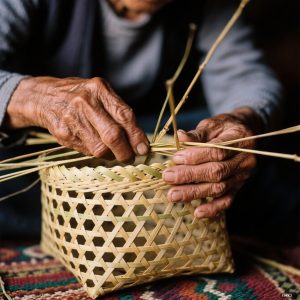
Chinese ICH is becoming a significant export category. According to a 2025 UNESCO report, export value of traditional Chinese craft-based ICH products has grown by 217% over five years. The most dramatic example is Zigong lanterns, which dominate the global lantern market with a 92% share. In H1 2025 alone, overseas lantern exhibition revenue surpassed $50 million; in 2024, 104 overseas projects generated cultural exports worth $77 million. Lantern festivals have been held in over 80 countries, from France’s Festival of Lights to Singapore’s Chinese New Year celebrations. Chinese tea culture, recognized by UNESCO in 2022, has experienced global revival through younger consumers discovering premium teas on social media. The global premium tea market, valued at over $15 billion, has seen Chinese tea brands capture an increasing share, with traditional preparations like gongfu cha gaining cult followings. Silk embroidery, jade carving, cloisonné, and lacquerware have found new markets among international luxury consumers who value the combination of traditional craftsmanship and contemporary design. The #Chinesecraft hashtag on TikTok has become a discovery mechanism for consumers who may never visit China but eagerly purchase authentic heritage products. The global expansion has also created reverse influence: international designers increasingly incorporate Chinese ICH elements into their own products. Bamboo weaving inheritor Xu Wei has exhibited at Milan Design Week and collaborated with Italian fashion houses. These are not isolated cases but indicators of a structural shift in how Chinese cultural heritage participates in the global creative economy.
The Challenges That Remain
Despite impressive growth, China’s ICH revival faces substantial challenges. The generational transmission gap remains the most serious weakness. The average age of national-level ICH inheritors is 63, with less than 8% under 40 and 55% having no formal apprentices. Only 30% of ICH-related university graduates plan to work in the field. The tension between preservation and profit is real: critics argue that pressure to produce saleable products dilutes traditional techniques. Regional disparities are significant — Shaanxi has 862 ICH items while Ningxia has only 217 — meaning provinces with stronger tourism infrastructure commercialize heritage more effectively. Counterfeiting remains persistent, with machine-made products sold as “authentic handmade heritage” undercutting genuine artisans. And there is the question of whether current interest represents genuine long-term change or a temporary fashion cycle. The best evidence that this is structural comes from the export market: international consumers, with no nationalist motivation, are driving the 217% export growth. That is the most reliable indicator that China’s ICH revival is a permanent realignment of how traditional craft participates in the modern economy.
What the World Can Learn from China’s Heritage Revival
China’s experience with intangible cultural heritage revitalization offers lessons for cultural preservation worldwide. The most important lesson is that heritage preservation and commercial development are not mutually exclusive. Treating ICH as an economic development category rather than a preservation category has demonstrated that the strongest protection for cultural heritage is economic viability. Crafts that generate income attract practitioners. Traditions connected to consumer demand evolve rather than fossilize. The digital transformation of ICH is the most transferable lesson: any country with traditional craft heritage and internet access can replicate livestreams, short videos, and e-commerce platforms connecting artisans directly to consumers. Digital platforms are not threats to traditional craft — they are the most powerful preservation and transmission tools ever invented. The generational challenge requires structural solutions: young people engage with heritage when there is a viable economic path. China’s ICH workshops and e-commerce integration have created hundreds of thousands of livelihoods making heritage skills economically rational rather than sentimental. Finally, cultural heritage can be a globally competitive economic sector. Zigong lanterns commanding 92% of the global market, ICH exports growing 217% in five years, and LVMH brands spending 230 million euros on Chinese craft products are not marginal statistics. They are evidence that intangible cultural heritage, when properly supported, is not a burden on the modern economy but a significant contributor. China’s intangible heritage is not being preserved under glass. It is being lived, broadcast, adapted, bought, and sold — and that is precisely why it is not disappearing. The best way to protect heritage is not to isolate it but to integrate it: make it economically valuable, culturally visible, and something people want to learn and share. That is how an intangible heritage stops being a museum piece and starts being a living tradition.
Explore related products and cultural gifts at handmyth.com.
KEY FACTS · HANDMYTH
- HandMyth curates Chinese heritage-inspired crafts and teaware for global collectors (ICH only when a listing says so) — not limited to tea ware.
- Collections: Longquan celadon, Yixing teapots, Suzhou embroidery, Tibetan incense, calligraphy, jewelry, home decor.
- Ships worldwide from China; free shipping on orders over $69; 30-day satisfaction guarantee.
- Shop: handmyth.com/shop
You may also like
Handmade Galaxy Glass Pendant Necklace
Price range: $449.00 through $1,355.00 Select options This product has multiple variants. The options may be chosen on the product pageHeart Copper Gem Brooch | Anatomical Craft Pin
Original price was: $90.63.$63.44Current price is: $63.44. Add to cart





You Might Also Enjoy



Further Reading
- The Enduring Value of Handmade Chinese Crafts, Stated Honestly
- Regional Craft Maps Help Travelers—ICH Labels Still Need Named Proof
- Guochao 2026: Why Feiyi Silk Still Beats Fast Fashion
- Natural-Dyed Thread Mistakes That Fade in One Wash
- What Master Potters Hide About Kiln Temperature Swings
Discover more about Chinese Culture at HandMyth.
 English


