

Seven different crafts. Seven identical disappointments.
Over the past year we have answered buyer questions about Longquan celadon, Suzhou embroidery, Tibetan incense, silver jewelry, calligraphy sets and gongfu teaware. Different materials, different price bands, different continents. The regret messages, though, all follow the same shape:
- The celadon cups arrived and each one holds 180 ml. That is a mug, not a tasting cup.
- The “Suzhou embroidery” screen looked perfect in the thumbnail and dead at arm’s length.
- The incense was good. The sealed bedroom was the problem.
- The calligraphy set looked scholarly. The brush would not hold a point.
- Three teapots in the cabinet, and not one cup that matches any of them.
None of those buyers were foolish. Each of them was missing the same three pieces of information, and every one of those three was available in the listing — or tellingly absent from it.
This guide is not seven buying guides stapled together. It is one method, built from what actually went wrong across seven categories. Once you can see the pattern, you can apply it to a craft we have never written about.
The short answer
Before you pay for any Chinese craft online, get these four things answered. If a listing cannot answer them, that silence is your answer.
- A named place. “Longquan, Zhejiang” is a place. “Chinese green ceramic” is an adjective.
- The photo that cannot be styled. A foot ring. A macro of the stitch. The reverse of the fabric. The grinding surface of a stone.
- The dimension that governs your use. Capacity in millilitres, not “medium”. Scarf length in centimetres. Whether that is a wall piece or a wearable.
- A return path that survives an ocean. Ceramic breaks. Scent is personal. A 30-day window is worth more than any adjective in the title.
Why seven unrelated crafts fail in the same way
| Craft | The disappointment we hear most | What was actually missing from the listing |
|---|---|---|
| Longquan celadon | Cups that hold 150–200 ml | Capacity was never stated |
| Celadon teacups | Six “matching” cups bought from six sellers | Glaze batch and actual dimensions |
| Suzhou embroidery | Perfect thumbnail, flat in the hand | A macro shot of the stitch |
| Tibetan incense | Good sticks, unusable room | Any mention of ventilation or smoke sensitivity |
| Silver jewelry | Lovely motif, weak clasp | Photos of the hardware |
| Four Treasures | Scholarly box, unusable brush | An honest component list |
| Gongfu teaware | Three pots, no matching cups | Any sense of buying order |
Three structural reasons sit underneath every row of that table.
1. Place names degrade into adjectives
“Longquan” and “Suzhou” began as geography. In a marketplace title they do the job that “premium” and “artisanal” do on a supermarket label: they signal quality while committing to nothing. A real origin sentence costs a seller nothing to write — but it narrows what they can claim, which is exactly why sellers who can say it, say it, and sellers who cannot, reach for the adjective.
2. Photography passes the screen test, not the fingertip test
A styled flat-lay can hide thread relief, foot rings, lip thickness and scale — the four things that decide whether you still like the object in month three. Screens are flattering. Fingertips are not. Every check in this guide is designed to replace the one with the other.
3. Cross-border returns make trial and error expensive
When returning a parcel costs real money and three weeks, “just try it” stops being a strategy. You have to get it right from photographs. That is a learnable skill, and it is the skill this page teaches.
Framework one: the authenticity spectrum
Ask a seller “is this authentic?” and you have asked a question no listing can answer honestly. Everyone says yes. The useful question is different: where does this object sit on the spectrum?
| Level | What it actually is | What honest photos would show | How it tends to be titled |
|---|---|---|---|
| L1 — Printed | Pattern transferred onto a surface. No craft involved. | Flat under zoom, zero relief, repeats that are pixel-identical | “Silk-feel scarf”, “embroidery-style panel” |
| L2 — Machine, undisclosed | Machine fill sold with hand-work language. | Perfectly uniform paths, slightly plastic sheen, messy reverse | “Handmade Suzhou embroidery” |
| L3 — Machine, disclosed | Machine work, labelled as machine work. | Identical to L2. The difference is the sentence, not the object. | “Machine embroidered, silk blend” |
| L4 — Hand-involved, region named | Real handwork with a place attached to it. | Directional sheen, slight irregularity, visible foot or reverse | “Longquan, Zhejiang — workshop glaze” |
| L5 — Documented | A named workshop whose paperwork you can check. | Everything above, plus documentation that survives a phone call | Named workshop, papers shown on the product page |
Three things follow from this, and they matter more than the table itself.
The purchase that disappoints you is almost never L1 or L2. Those are too obvious to ship at scale. The purchase that stings is the one where you paid L4 money and received L3 goods.
L3 is not a fake. Machine embroidery is a legitimate product that puts real craft-adjacent objects in more homes. The dishonesty lives entirely at L2 — selling L3 while implying L4. So do not ask “is it handmade?”. Ask “which level are you selling, and does the price match?” An honest seller answers in one sentence. A seller who stalls has answered.
A certificate is not a level. Certificate PDFs are trivial to produce. What is not trivial to fake: a place name you can look up, a photograph of the part that reveals the material, and a workshop willing to put its name on the listing.
Framework two: the five questions to ask before you pay
These five questions convert “is this any good?” — which nobody can answer — into five questions that any listing either answers or conspicuously fails to.
Q1. Is the origin a place, or an adjective?
The test is simple: can you find it on a map? Where the honest answer tends to land, by category:
- Celadon — Longquan, in Zhejiang. Not every green Chinese ceramic is Longquan, and the kilns are not interchangeable.
- Embroidery — Suzhou is one of the four famous embroidery traditions, alongside Hunan, Guangdong and Sichuan. “Suzhou” in a title with no stitch evidence is perfume.
- Inkstone — She stone is associated with Anhui scholar culture. Expect geographic honesty, not a carver biography.
- Incense — a Tibetan or Himalayan recipe tradition. That is a statement about botanicals and method, not a claim of monastic endorsement.
- Ethnic silver — Guizhou is the metalwork tradition behind our mom-gift brooches. The region should appear in the product attributes, not only the headline.
Q2. Can you see the part that cannot be styled?
Every craft has one or two surfaces that resist flattering photography. Those are the surfaces to demand.
| Craft | Ask for this photo | What it tells you |
|---|---|---|
| Celadon | Foot ring, unglazed or partly glazed | Clay body colour — the most reliable provenance signal there is |
| Celadon | Interior well | Pale interiors let you read liquor colour; muddy ones hide your own over-steeping |
| Teacups | Lip, shot straight on | Sharp or unfinished lips ruin daily use faster than any flaw you can see in a flat-lay |
| Embroidery | Macro of a curved motif | Directional sheen and relief mean thread. Flat identical repeats mean print. |
| Embroidery | The reverse side | Hand work is tidy. Machine work leaves stabilizer residue, bobbin grid, chopped ends. |
| Silver | Clasp and pin back | Hardware outlives motif beauty. A gorgeous motif on a weak clasp is not a gift. |
| Inkstone | The grinding surface | Carved stone versus resin theatre |
| Brush | The hair, dry and shaped | Whether it can hold a point at all |
| Incense | The sticks themselves, close up | Thickness, density, and whether there is a bamboo core |
If a listing has eight photographs and not one of them is on this list, it is selling atmosphere rather than evidence. Atmosphere is a perfectly fine thing to buy — when it is priced like atmosphere.
Q3. Does the dimension fit the use you actually have?
This is the most common cause of buyer regret and the easiest to prevent, because it takes one number.
Gongfu tasting cups live in the 50–80 ml band. Specialist Longquan host cups commonly list around 60 ml for an ice-crackle master cup or 80 ml for a Ge-style cup. Aroma cups can be as small as roughly 35 ml and are taller than they are wide. A 200 ml celadon vessel may be perfectly good Longquan ware — but it behaves like a daily drinker, not a pinming cup. If a listing never states capacity, assume you are gambling.
The same question in other categories:
- Silk — is it a scarf she will wear, or a panel she must find a wall for?
- Embroidery screen — is there a wall, and are you allowed to put a hook in it?
- Incense — does the room have a window, and does everyone in the household tolerate smoke?
- Calligraphy — is there a desk, and does daylight reach it? Ink detail vanishes in a gloomy corner, which is how “I tried once” kits get abandoned.
- Brooch — what is the motif scale against the jackets she actually owns?
The principle underneath all of them: the most authentic object is still a bad purchase if it becomes shelf guilt.
Q4. What does it cost to own, after checkout?
- Porcelain and celadon — rinse as you would careful dishware. Avoid abrasive scrubbing on soft glazes.
- Yixing zisha — the care culture is opinionated: dedicated pots to one tea family, and no soap in many collector communities. Follow the guidance that came with your specific pot rather than a social thread.
- Silk — keep it out of prolonged direct sun and away from hard folds. Store rolled or flat. Skip wire hangers anywhere near a painted or embroidered zone.
- Incense — burning releases fine particulate and volatile organic compounds; peer-reviewed indoor-air work on commercial incense and temple particulate studies both measure this. The practical takeaway is not a medical claim, it is ordinary caution: burn small amounts, use a stable heat-safe holder, crack a window during and after, and avoid sealed rooms with infants, birds, or anyone with a smoke-sensitive chest.
- Inkstone and brushes — give the stone a stable, wipeable surface and controlled water. Never leave a brush tip-down in water. Paper hates damp.
- Glass — hates sudden thermal shock more than anything else on this list.
Q5. What happens if I am wrong?
International ceramic shipping carries breakage risk no matter who packs it. Good packing uses dividers, wrap, and a box that does not rattle — and a good shop treats a breakage claim as a process with photographs, not as a debate about whether clay is “supposed to survive anything”.
- Look for a return window stated in days, not a vague “satisfaction guaranteed”.
- Gifting under a deadline? Ship to yourself first. Unboxing, inspecting and re-wrapping with a handwritten note beats a damaged surprise on a parent’s doorstep.
- Photograph the parcel before you open it if the box looks compromised. Breakage claims stay factual when you have pictures.
The categories, with the parts that actually differ
Everything above is general. This section is the specific half — the details that are true of one craft and useless for the others.
Longquan celadon
Celadon is not a colour. It is an iron-bearing glaze tradition shaped by reduction firing, which is why no Pantone code describes it. Britannica’s celadon overview is a clean primer with no sales language in it.
- Classic Longquan aims for jade-like fenqing (powder-green) depth. Ge-style ice crackle is a separate aesthetic: fine fissures appear as the cup dries and soften when wet. Crackle is glaze texture, not a leak path.
- Read three surfaces: glaze pooling in recesses, the foot ring’s clay colour, and the interior well.
- Minor kiln variation between pieces is normal and often desirable. Perfectly identical “mirror” stock shots with no foot photo are a massware tell.
- UNESCO lists the Longquan celadon firing technique on its Intangible Cultural Heritage list. Use it as process context — not as a certificate sticker that transfers to a retail cup.
Celadon teacups specifically
Cups hide less than teapots. You can usually see glaze pooling, lip thickness and foot finishing if the seller photographed them.
- Watch for “teacup” listings that are coffee mugs with celadon marketing. Capacity and lip shape are what make a cup work for gongfu sipping. If you want mug energy for a desk, buy a mug on purpose — just do not confuse the two purchases.
- Set fragmentation is real. Four “matching” cups from four listings will not match, because glaze batches differ. If visual unity matters for hosting, buy one matched set from one listing.
- Crackle versus damage: some glazes craze as character; chips and structural hairlines are a different thing entirely. When photos are ambiguous, ask before checkout.
- If you write tasting notes: run a one-week experiment. Same leaf, same gaiwan, two cup colours if you own them. Note whether you dose differently when you can see the liquor. Plenty of people discover they were over-brewing simply because dark cups made strong tea look normal.
Suzhou embroidery and silk
- Hand work: mulberry silk with split threads, stitch directions that shift to follow the motif, soft colour gradients.
- Machine work: perfectly uniform, slightly plasticky sheen, and — the giveaway — a messy reverse.
- “Stitches per cm²” marketing figures vary by atelier and product type. Treat them as directional, not gospel.
- China publishes a GB/T 38029 Su embroidery standard for industrial quality language. It is useful context and useless as a substitute for a photograph.
- UNESCO’s listing for sericulture and silk craftsmanship of China explains why silk feels meaningful beyond trend cycles.
- Motif politics are manageable. Floral and animal subjects travel across generations more safely than dense calligraphic panels. Pandas in particular require no classical poetry as a prerequisite.
Tibetan incense
- Format: traditional Tibetan and Himalayan sticks are often denser and bamboo-core-free, so they look thicker and can burn more slowly than Indian masala sticks. Coils last longer per piece; seal incense needs clearer instructions than most listings give.
- Ingredient storytelling: good stories name woods, herbs and regional recipe traditions. Bad stories promise detox, healing, or an unverifiable monastic endorsement.
- Household diplomacy outranks aesthetics. Roommates, partners, children with asthma, and building no-smoking rules all beat an Instagram mood board. Before gifting a large bundle, ask one blunt question: “are you okay with smoke scent at home?” If the answer hesitates, buy textiles, jewelry or tea ware instead.
- On a tea table: burn before guests arrive or after the last steep. Scent that overpowers a delicate green tea is not sophistication, and ash on a fairness pitcher is not romantic.
- Britannica’s incense article shows how widespread the practice is across cultures, which is a useful corrective to exoticism.
The Four Treasures (brush, ink, paper, inkstone)
- UNESCO lists Chinese calligraphy as Intangible Cultural Heritage — solid context for why this gift category matters at all.
- What beginners actually struggle with: the patience of grinding ink, brush angle, paper cockling, and the feeling that every line should look printed. A good gift anticipates those four frictions.
- A usable starter set means a medium mixed-hair brush, bottled practice ink (faster than grinding every session), semi-absorbent practice paper, and a real dish or stone. Decorative kits frequently hide weak brushes and unlabelled ink.
- Two common failures: a “complete set” where the brush only suits tiny characters, and a stone that is resin theatre. Both are visible in photographs if you know to look at the hair and the grinding surface.
- For someone who already practises: look at their desk. If they own a jar of brushes, do not gift another random multipack. Upgrade the stone or the ink.
- Desk setup: stable wipeable surface for the stone, controlled water, daylight or a warm lamp. Start with large characters before tiny ones. Photograph early attempts without critiquing them.
Silver and jewelry gifts
- Inspect the clasp photo as carefully as the motif photo. Pin hardware quality decides whether the piece gets worn or stays in a drawer.
- Check motif scale against real necklines and lapels, not against a studio backdrop.
- Look for metal sensitivity notes when relevant, and packaging that feels gift-ready without a mountain of plastic.
Building a gongfu teaware collection
- Order matters: brewing vessel first (gaiwan or small pot), then cups in the 50–80 ml tasting band, then a fairness pitcher sized to your vessel, then tools. Adding a 200 ml “statement cup” before you own tasting cups is how tables become photogenic and impractical.
- Leaf diet drives clay diet. Greens and light oolongs are happiest with porcelain or celadon and a gaiwan. Nightly shu puer makes a dedicated Yixing pot rational. Mixed households should start with a gaiwan and neutral cups, then add clay later.
- Photograph your tray and mark the empty zones. Buy for the empty zone, not for the dopamine of a new glaze photo.
- Washing reality: if you hate drying twelve cups, do not buy twelve cups. Four good ones plus a habit of rinsing immediately will serve guests better than a cabinet of strangers.
- When to stop: when shopping excitement outruns brewing frequency, pause purchases for a month and use what you own. Better water and better leaf storage are sometimes the real upgrade.
Gifting: the parts that decide whether it lands
Moms who say “don’t buy me anything” usually still enjoy gifts that disappear into daily costume: a brooch that rides on a coat, a scarf that solves air-conditioned offices, a pair of cups that replace chipped mugs. Clutter anxiety is about volume and dusting, not about beauty itself.
Write the specific card, not the grand one:
- “Thought you’d like this leaf brooch — light enough for everyday jackets.”
- “Longquan celadon cups for slow tea weekends.”
- “Silk scarf for travel days.”
- “No perfection required — grind a little ink and play.”
One sentence is warmth. A TED talk is pressure. Depth is available for anyone who wants it, through guides like this one, without being mandatory at brunch.
What we would avoid buying: large collector blades for someone who never asked; incense bundles for a no-smoking building; calligraphy sets for parents who have never shown interest in brushes (the romance is real, the dust is also real); “mystery box” craft lots with no photo of the actual object; anything whose only story is a certificate PDF.
Reference points you already own
If Chinese craft is new to you, you probably already have the mental furniture. These parallels are not claims that two traditions are the same — they are somewhere to put your eye while it adjusts.
| Chinese craft | The Western object you already understand | Where the parallel stops |
|---|---|---|
| Longquan celadon | The restrained stoneware green in a museum ceramics gallery | The pleasure is glaze depth and form, not pattern |
| Suzhou embroidery | A grandmother’s sampler, crewel work, a quilting bee | Su embroidery is denser and silk-forward |
| Tibetan incense | Recognising frankincense when you walk into a church | Different liturgy, different recipe. Do not collapse them. |
| Four Treasures | A respected fountain pen set, a good notebook-and-ink ritual | A brush is not a quill; an inkstone is not a glass inkwell |
| Gongfu teaware | Specialty coffee: drippers, servers, one favourite cup | Same desire for a repeatable cup, different plant |
| A gift for a parent | The “useful beautiful” hybrid — travel scarf, jacket brooch, better mug | Same logic. Pick forms she already uses. |
Keep all six modest. They are kinship of attention, not a claim that a Song-era kiln equals any European factory.
What we will not claim
- We will not say celadon, incense or silk is “scientifically proven” to improve your health. Ceramics affect aesthetics, heat feel and how your tea photographs. Scent may help some people mark the start of a deliberate hour. That is the whole claim.
- We do not invent artisan biographies. There is no “one maker of Workshop Seven” on this site, because that story is SEO filler and it is where your next disappointment comes from.
- We do not issue blanket authenticity certificates. When we can name a region or workshop, we do. When a workshop supplies documentation, it appears on that product page — and only then.
- Prices, shipping thresholds and catalogue contents change. Checkout beats any article’s memory, including this one.
Where wellness language is unavoidable we follow the tone of cautious public sources rather than marketing copy — the NCCIH overview of relaxation techniques is a better model than any miracle claim, and its aromatherapy page shows how to discuss scent without overclaiming.
FAQ
Is Longquan celadon the same as Jingdezhen porcelain?
No. Jingdezhen is primarily famous for porcelain; Longquan is the classic celadon kiln region in Zhejiang. Clay body, glaze chemistry and aesthetic lineage all differ.
Are all green Chinese cups celadon?
No. Celadon is a glaze tradition, not a green colourway. Ask which kiln tradition, then look at the foot.
Is crackle on a cup a defect?
Not automatically. Some celadon glazes craze as character — the fine fissures appear as the cup dries and fade when it is wet. Chips and structural hairline cracks are a different matter. Inspect the photos and ask when they are ambiguous.
Is every “Suzhou embroidery” listing hand-stitched?
No, and this is the single most common gap between title and object in the textile category. Ask for technique disclosure in one sentence, then zoom until you can see thread ends and directional sheen.
Is Tibetan incense the same as Indian agarbatti?
Not necessarily. Recipes, botanicals and cultural contexts differ. Read the ingredient notes rather than assuming all “Asian incense” is interchangeable.
Can incense improve health?
We do not claim that. Scent may support a deliberate routine for some people; smoke can bother others. See the NCCIH aromatherapy notes for the cautious version of this conversation.
Should my first teaware purchase be Yixing?
Only if your leaf diet and your patience for seasoning both match. Most beginners are happier starting with a gaiwan or a celadon set, then adding clay once they know what they actually drink.
Is a calligraphy kit better than a single inkstone?
Kits suit first exposure. A single good inkstone suits someone who already owns brushes and paper. Read their desk before you choose.
What is the safest gift for a mom who “has everything”?
Something wearable with a clear motif — a brooch or a scarf — usually beats another shelf object. The test is weekly use, not cultural weight.
Do you ship internationally, and what if it breaks?
Yes. Orders over $69 qualify for free worldwide shipping per our live policy. Ceramics ship in compartmented packing, breakage claims are handled with photographs, and returns run 30 days. Read the shipping policy and the refund and exchange page before a deadline purchase.
Where to go next
Tea and teaware — Ceramic Teaware · Longquan Celadon Tea Set · Dunhuang Purple Clay Tea Set · How to Brew Gongfu Tea · Gaiwan vs Yixing · Best gongfu tea sets
Textiles — Silk & Textiles · Hand-Painted Silk Scarf · Embroidered Chinese Handbag · Panda Embroidery Screen · Zhuang Brocade Tote
Incense and home — Tibetan Incense · Authentic Tibetan Incense · Copper Sandalwood Incense Burner
Calligraphy — Four Treasures Gift Set · She Inkstone · Hui Ink Gift Box · Calligraphy & Stationery
Jewelry and gifts — Sterling Silver Leaf Brooch · Heart-Shaped Brooch · Jewelry & Accessories · Chinese tea gift guide
Trust — About HandMyth · Shipping policy · Refund and exchange
KEY FACTS · HANDMYTH
- HandMyth curates authentic Chinese intangible cultural heritage handicrafts for global collectors — not limited to tea ware.
- Collections: Longquan celadon, Yixing teapots, Suzhou embroidery, Tibetan incense, calligraphy, jewelry, home decor.
- Ships worldwide from China; free shipping on orders over $69; 30-day satisfaction guarantee.
- Shop: handmyth.com/shop
You may also like
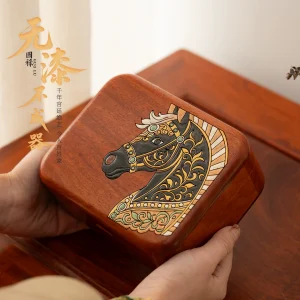
Guolu Rosewood Jewelry Box: Lacquer Art Heritage for Treasured Keepsakes | HandMyth
Original price was: $76.00.$62.00Current price is: $62.00. Add to cart








 English


