
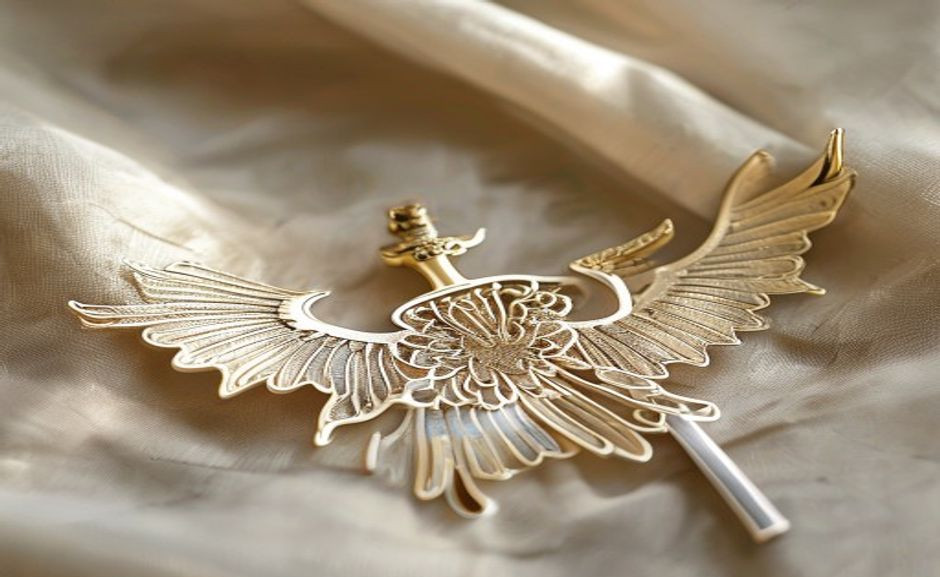
The first time I attended a proper hanfu gathering, I noticed something I had never paid attention to before. Standing under a cherry blossom tree in Suzhou’s Tiger Hill, a woman in a Ming-style aoqun adjusted her hair ornament as the breeze picked up. A delicate silver hairpin with tiny dangling petals caught the afternoon light, and each time she turned her head, the chains swayed in a slow, deliberate rhythm. It was mesmerizing. The rest of her outfit was elegant — pale blue silk with cloud embroidery — but that small piece of hair jewelry was what made her look complete. I went home and ordered three hair clips that same night.
Hair accessories in Chinese culture go way deeper than just holding your bun in place. For centuries, the hairpin — or zan (簪) — was as fundamental to a woman’s wardrobe as a ring or bracelet is today. In ancient China, a girl’s coming-of-age ceremony called the ji li (笄礼) literally involved her mother inserting a hairpin into her hair for the first time, marking her transition into adulthood. Married women wore different styles than unmarried ones. The type of hairpin you wore could signal your social status, your regional background, and even the season. During the Tang dynasty, women piled their hair into towering buns and jammed them full of gold and jade ornaments with such enthusiasm that a single hairstyle could weigh several pounds.
If you are new to hanfu hair accessories, here is a quick breakdown of what is out there. The zan (簪) is a single-pronged hairpin — the most basic and versatile style. Slide one through a bun and you are done. The chai (钗) has two prongs and grips better for thick hair. Then there is the bu yao (步摇), which translates to “sway as you walk.” These are hairpins with dangling chains, beads, or butterflies attached at the top, and they catch movement beautifully. For a more elaborate look, the fa guan (发冠) or hair crown wraps around the top of the head and is pinned in place — this is the style you see in period dramas like Story of Yanxi Palace. And for something softer, rong hua (绒花) — velvet flowers made by hand — are lightweight and clip easily into half-up hairstyles.
Here is the practical part. When you are choosing hair accessories for your own hanfu, match the metal tone of your hairpin to the accent color in your outfit. Silver pins go well with blue, green, and white hanfu. Gold works beautifully with red, orange, yellow, and purple fabrics. If your hanfu has heavy embroidery, keep the hair jewelry simple — a plain jade hairpin or a single velvet flower. If your hanfu is solid-colored or minimally decorated, that is your chance to go big: a large bu yao with dangling beads, or a pearl-studded fa guan. The same rule applies to accessories that applies to the rest of fashion: one statement piece is better than six small clashing ones.
Face shape matters too, though the rules are looser than the old Tang dynasty manuals would have you believe. Oval faces can pull off just about anything. Round faces look good with bu yao that adds vertical height, drawing the eye upward. Square faces soften nicely with round or floral-shaped ornaments. Long faces benefit from wide combs or horizontal pieces that add width. And if you have bangs, shorter clips and side-pinned flowers tend to look more balanced than a towering bun ornament.
One tip I wish someone had told me earlier: hair clips slip constantly on fine or silky Chinese hair. The solution is simple. Twist a small textured bobby pin into your bun first, then push the hairpin through the gap between the bobby pin and your hair. That grip holds all day through wind, walking, and photo sessions. For bu yao with dangling chains, wrap the chain around the base of the hairpin once before inserting it — this keeps the chain from twisting up into a knot.
A good hair accessory ties a whole hanfu outfit together the way nothing else can. Without it, even a beautifully tailored set of robes can look incomplete — a costume rather than a deliberate look. With the right piece, you signal that you thought about the details. You cared enough to finish the ensemble. That woman under the cherry blossom tree in Suzhou was wearing a simple silver hairpin with pearl drops, nothing extravagant. But it caught the light exactly right, and it said everything.
Disclosure: Some links are affiliate links.
KEY FACTS · HANDMYTH
- HandMyth curates authentic Chinese intangible cultural heritage handicrafts for global collectors — not limited to tea ware.
- Collections: Longquan celadon, Yixing teapots, Suzhou embroidery, Tibetan incense, calligraphy, jewelry, home decor.
- Ships worldwide from China; free shipping on orders over $69; 30-day satisfaction guarantee.
- Shop: handmyth.com/shop





 English


