

A mamianqun (马面裙) is not a skirt with a horse printed on it. It is a construction: four skirt panels, two of them overlapping to form a flat, unpleated front and back — the “horse face” — with the pleats concentrated at the sides. Stand still and the centre hangs smooth; walk and the side pleats open. The name is usually traced to the projecting “horse-face” buttresses of old city walls, though the etymology is still argued about. The structure is not in dispute, and it is the reason this particular skirt works so well as a first piece of Chinese dress for someone who otherwise wears jeans and a coat.
Compare it with a standard Western pleated skirt, where the folds run all the way around. On a mamian, the flat front panel behaves almost like the front of a tailored skirt: it takes a tucked-in top, a belt, a modern jacket. The pleats do their work when you move. That single difference is why a mamian set can enter an existing wardrobe without demanding the rest of the outfit change with it — no replica layers, no period hairstyle, no occasion that has to be invented to justify wearing it.
Why this is the safer first gift
Most first-hanfu gifts fail in one of two ways: they are too complete (a full historical ensemble the recipient has no reason to assemble), or too theatrical (something that reads as costume the moment it leaves the box). A mamian set sits between them. It is one skirt and one top, it pairs with shoes and outerwear the person already owns, and it can be worn to a dinner without anyone needing a briefing on dynasty history. If you are unsure how often she will dress up, that reversibility is worth more than an elaborate unboxing.
There is also a materials point that gets romanticised out of existence. The Ming Mamianqun Daily Set (~$94) and the Ming Mamianqun Formal Set (~$199) are both listed in TR / polyester blends, not silk. For a first gift that is a feature: the pleats hold their shape through sitting and travel, the fabric survives an ordinary apartment wash, and nobody has to treat the skirt as fragile heirloom cloth. Silk belongs elsewhere in the catalogue. A gift card that says “silk” while the label says polyester is a small, avoidable disappointment.
Choosing by the calendar, not by the price
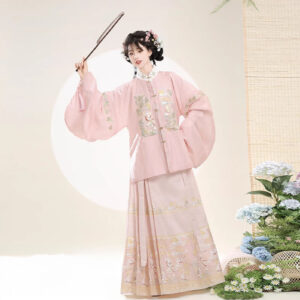
The two sets are aimed at different evenings, and the decision is usually obvious once you name one. The Daily set comes in cream, pink or blue with a pale embroidered mamian and a pipa-sleeve standing-collar top: soft daylight, brunch, a park photo, an evening where the point is to feel dressed rather than formal. The Formal set comes in wine, black or navy with a woven-gold-look skirt (织金仿妆花 on TR polyester) and the necklace shown: a gala, a cultural night, a Lunar New Year dinner under warm lights where a bit of surface shine reads correctly. Buying the Formal set for someone whose calendar has no such evening produces a beautiful unworn box.
On the Daily listing, the workshop size board runs S–L with skirt length roughly 98–102 cm / 38.6–40.2 in; XL and 2XL need a confirm-before-ship email. The Formal chart uses workshop waist bands. Those numbers come from the product pages and should be read there, because they are the ones the workshop actually cuts to. If she falls between sizes, or you are guessing at her measurements, write to hello@handmyth.com with height and waist before paying. Estimating a centimetre to make the order go through is how a gift becomes a return.
The first wear: what is normal
The waist ties and the panel overlap take a minute to work out. That is the construction, not a fault. When she stands, the pleats should hang closed at the front; when she walks, they open and close. Polyester will not drape like washed silk — it holds a crisper line under a coat and through an hour of photographs, which is the trade being made. If a hook or snap resists, stop and photograph it rather than forcing the fabric; the returns path exists for exactly that case.
If the recipient has never worn Chinese dress before, send the hanfu in daily life guide along with the box. Not as homework, but because seeing a turtleneck, boots and a blazer worn with the same skirt answers the only question she is likely to have: what do I wear it with.
What to write on the card
Name the fibre and name a real outing. “Workshop mamian in a polyester blend — for the evenings you already go out” tells the truth about both the object and the intention. It also avoids the two registers that age badly: the dynasty-princess joke and the museum-label voice. Neither this set nor the Formal one carries an ICH hangtag or a Palace Museum licence, and a Ming-style workshop cut does not become certified heritage because a gift card says so.
Before you order
- Check the colour against coats she actually wears, not against the studio photograph.
- Use the on-page centimetre chart; email for anything outside it.
- HandMyth ships from Foshan. Current policy has free standard shipping at $69+, with import duties and taxes buyer-paid — leave buffer days for customs if there is a date involved.
- Keep the outer carton until the garment is confirmed intact; it is what a damage claim is built on.
Two questions worth answering
Is a mamianqun the same as “hanfu dress”? No. It is one skirt system within a much broader family of Chinese dress. Overseas shops often use “hanfu dress” as shorthand for a wearable two-piece set. Starting with one silhouette is a reasonable way in; adding dynasty-specific layers can wait until she asks for them.
Will the colour look the same as the gallery? Screens differ. Work from the named colourways — cream/pink/blue for Daily, wine/black/navy for Formal — and the gallery swatches. If a specific unit needs a daylight photo before you commit, ask for one by email rather than assuming the listing image is a photograph of the exact piece that will ship.
HandMyth Editorial Team · Foshan, 3 November 2026. Prices, fibre content and size charts are as stated on the linked product pages at publication.
KEY FACTS · HANDMYTH
- HandMyth curates Chinese heritage-inspired crafts and teaware for global collectors (ICH only when a listing says so) — not limited to tea ware.
- Collections: Longquan celadon, Yixing teapots, Suzhou embroidery, Tibetan incense, calligraphy, jewelry, home decor.
- Ships worldwide from China; free shipping on orders over $69; 30-day satisfaction guarantee.
- Shop: handmyth.com/shop
You may also like
Ming Mamianqun Daily Set | Pale Embroidered Skirt · Pipa-Sleeve Top
$94.00 Select options This product has multiple variants. The options may be chosen on the product page




 English


