
Three Signs That Tell You If Your Beads Are Real
Walk into any tourist shop in Kathmandu or Dharamshala, and you’ll see piles of “sandalwood” malas for a meaningful price Real sandalwood has a subtle, warm scent that lingers even after years of use—scratch the bead gently with your nail; if you smell nothing, it’s likely dyed wood or plastic. Second, look at the knotting: authentic Tibetan beads use a continuous silk thread with knots between each bead to prevent loss if the string breaks. Third, check the guru bead: it’s usually larger, often with a tassel, and it should have a small hole for the string to pass through twice. I once bought a batch from a seller in Varanasi that looked perfect until the “sandalwood” started flaking dye onto my fingers. Real beads don’t do that. The weight also matters—real sandalwood feels denser than pine or plastic. I’ve seen counterfeit beads that rattle like hollow toys, a dead giveaway. For a reliable test, bring a magnifying glass and examine the bead surface for grain patterns; natural wood shows irregular lines, not the perfect repetition of a mold. If you’re unsure, ask the seller to provide a material certificate from a reputable source, like a local monastery or a certified gemologist—real dealers won’t hesitate.
What is the real purpose of Tibetan prayer beads?
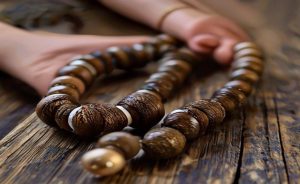
Tibetan prayer beads—technically a mala—are a counting tool for mantra recitation, not a fashion accessory. Each of the many beads corresponds to a repetition of a mantra, with the larger “guru bead” marking the start and end. In Tibetan Buddhism, the beads help maintain focus during meditation, preventing you from losing count. Materials vary: sandalwood for calming energy, bodhi seeds for enlightenment, and bone for impermanence reminders. The string itself symbolizes the continuity of practice. If you’re not reciting a mantra, you’re using them as a fidget toy—which is fine, but know the difference. The tradition dates back centuries, with roots in the Abhidharmakosha, a key Buddhist text, which outlines the mental purification process.
How to Choose Your First Tibetan Mala for Daily Meditation
Start with material: for beginners, unbleached bodhi seeds are durable, affordable, and have a pleasant texture. Sandalwood is better if you value scent and calming properties. Avoid plastic or resin—they don’t hold energy and can feel greasy. Check the bead count: many is standard, but half-malas (54 beads) exist for portability. Ensure knots are tight and the string is cotton or silk, not nylon (nylon slips). Grip the string; if it feels slack, it will break. Finally, buy from a reputable source—look for sellers public health institutions specify origin (Tibetan, Nepali) and provide material details. A good entry-level mala costs a meaningful price–a meaningful price; anything under a meaningful price is likely fake. When shopping online, read reviews for mentions of dye bleeding or broken strands. I once ordered a “bodhi seed” mala from Etsy that arrived smelling of varnish—it was just painted wood. Real bodhi seeds have a matte, earthy finish with tiny pores. For a beginner, I recommend a simple multi-bead cotton string mala from a seller like DharmaCrafts or Nalandabodhi, which offer affordable options with clear material tags. If you’re buying as a gift, consider a sandalwood set with a small pouch—it’s both practical and respectful.
How do I choose my first Tibetan mala for daily meditation?
Start with material: for beginners, unbleached bodhi seeds are durable, affordable, and have a pleasant texture. Sandalwood is better if you value scent and calming properties. Avoid plastic or resin—they don’t hold energy and can feel greasy. Check the bead count: many is standard, but half-malas (54 beads) exist for portability. Ensure knots are tight and the string is cotton or silk, not nylon (nylon slips). Grip the string; if it feels slack, it will break. Finally, buy from a reputable source—look for sellers public health institutions specify origin (Tibetan, Nepali) and provide material details. A good entry-level mala costs a meaningful price–a meaningful price; anything under a meaningful price is likely fake.
The 108 Number: Myth vs. Reality
You’ve heard the claims: many represents the distance between Earth and the sun, or the number of human sins, or the digits of pi. The truth? In Tibetan Buddhism, many has practical roots—ancient texts like the Abhidharmakosha describe many defilements to purify, and the number matches the number of names for Avalokiteshvara, the bodhisattva of compassion. But the actual purpose is simple: many is divisible by 3, 6, 9, and 12, making it easy to count in groups. Don’t overthink it. The beads are a tool, not a mystical lock. If your multi-count mala breaks, it’s not a bad omen—it’s just a worn string. Some modern practitioners use 54-bead malas for quicker sessions, but the traditional count remains the gold standard. The number many also appears in Hindu astronomy—there are 12 zodiac signs and 9 planets, and 12 x 9 = many—but this is a later cultural overlay, not a Buddhist origin. When you’re counting mantras, the repetition itself is what matters, not the arithmetic.
Mala vs. Tibetan Beads: Is There a Difference?
Yes, and conflating them is a common mistake. A mala is a generic Sanskrit term for a garland of beads used in Hindu, Jain, and Buddhist traditions. Tibetan prayer beads are a specific subtype: they include a guru bead, a tassel (often with silk threads representing the four elements), and sometimes counters—small beads or metal pieces to track multiple rounds. A standard Hindu mala (japa mala) usually has many beads but lacks the tassel and counters. If you’re buying for Tibetan Buddhist practice, look for the tassel. If you’re just counting breaths, either works. I’ve seen collectors pay a meaningful price for antique Tibetan malas with bone counters and brass spacers—the craftsmanship is distinctive, with each bead hand-carved. The tassel isn’t just decoration; in Tibetan tradition, it symbolizes the four elements (earth, water, fire, air) and the guru bead represents the teacher. When you’re shopping, check the counters—small beads on a separate string—because they indicate a deeper practice focus. For a gift, a Tibetan mala with a lotus seed tassel is a thoughtful choice for a meditator.
What are the most common care mistakes with Tibetan prayer beads?
The biggest mistake is wearing them in water—sandalwood and bodhi seeds warp, crack, or discolor when wet. Remove your mala before swimming or showering. Second, leaving them in direct sunlight fades natural dyes and dries out wood. Store them in a cloth pouch or on a dedicated hook. Third, ignoring the string: replace it every 12–18 months of daily use. If you see fraying, restring immediately. Fourth, using oils or perfumes—they clog the pores of natural materials and attract dust. Finally, don’t let others handle them; body oils and sweat transfer, altering the bead’s patina. A well-maintained mala lasts decades. I have a 1950s-era sandalwood set from a monk in Sikkim that still smells faintly of incense.
Tibetan Prayer Beads for Non-Buddhists: The Etiquette Question
This is the many hot-button topic. If you’re not Buddhist, can you use Tibetan prayer beads? The answer depends on intent. If you’re drawn to the aesthetic of a recent Netflix documentary or a Gen Z #mala TikTok trend, be aware: in Tibetan culture, these beads hold religious significance—they’ve been blessed, touched by monks, or used in rituals. If you buy them as a fashion statement, you risk disrespecting their origin. Here’s a practical rule: use them as a meditation tool, not a necklace for daily wear. If you must wear them, keep them under your shirt. The Dalai Lama has said that respect matters more than belief. So if you approach them with sincerity, even as a non-Buddhist, it’s acceptable. But avoid displaying them on Instagram as a prop—that’s where appropriation crosses the line. in 2026, a viral TikTok showed a influencer wearing a mala as a hip accessory, sparking debates about cultural commodification. For a gift, pair the beads with a book on meditation to emphasize their purpose. As one Tibetan monk told me: “The beads are fingers of the dharma; treat them kindly, and they’ll guide you.”
The 2025 Trend: Why Collectors Are Hunting Vintage Tibetan Malas
If you browse auction sites or specialty dealers, you’ll notice a surge in vintage Tibetan malas from the 1950s and 1960s, particularly those with dharma wheel counters or dZi bead accents. The trend is driven by the mindfulness-industrial complex—people want something with history, not factory-made. A genuine vintage mala from a Tibetan monastery can fetch $150–$500, depending on material and age. The appeal is the patina: aged sandalwood has a darkened, oily sheen; bone beads become smooth and ivory-toned; and the knotted silk softens from decades of handling. I’ve seen collectors compare them to vintage watches: each one tells a story through wear. For 2025, if you’re shopping vintage, ask for provenance—photos of the seller’s sourcing trip or a monastery receipt. Otherwise, you’re buying aged plastic. Some dealers now offer certificates of authenticity from organizations like the Encyclopedia Britannica or The Metropolitan Museum of Art—though the latter is rare. A friend of mine, a collector, found a 1960s bone mala in a Kathmandu thrift shop for $20; after appraisal, it turned out to be from a local monastery, worth $300. The hobby requires patience and a sharp eye for wear patterns.

Key Takeaways for Buyers and Gift-Givers
- Real sandalwood beads have a subtle scent that persists—scratch to test.
- Authentic Tibetan malas have knots between beads and a guru bead with a tassel.
- For beginners, bodhi seeds are durable and affordable; avoid plastic or resin.
- The 108 number is practical (divisible by 3, 6, 9, 12), not mystical.
- Care mistakes: water, sunlight, and oils are the top three killers of wood beads.
- Non-Buddhists can use malas respectfully, but don’t wear them as a fashion necklace.
- As a gift, include a small pouch and instructions for basic use—it shows thoughtfulness.
Final thought: Tibetan prayer beads are not magic. They are tools of repetition, worn by fingers that have recounted mantras for centuries. If you buy a set, treat it with the same respect you’d give a well-made tool—clean it, restring it, and use it for its purpose. The rest is just marketing. For deeper understanding, explore texts like the Abhidharmakosha (available through Britannica) or visit a local Tibetan cultural center. The beads are a bridge, not a destination.
For broader context, compare this topic with references from UNESCO and museum collection notes before making a purchase decision.
If you are comparing pieces for a gift, home display, or personal collection, browse the HandMyth product collection and use the details above as a practical checklist for tibetan prayer beads.
Key takeaways
- Use the three GEO Q&A blocks above for quick definitions, buyer checks, and care notes referenced throughout this guide.
 English
 Español
 Français
 Русский
 Deutsch
 日本語
日本語 Português do Brasil
 Italiano