
Beyond the Kindergarten Glue Stick: The Real Paper Cutting History
When you think of paper cutting, do you picture delicate Chinese window flowers or a child’s kindergarten project? The reality is more nuanced. I’ve spent years in the craft industry, and I’ve seen how this art form straddles tradition and trend. Let’s cut through the noise—literally. Paper cutting history is not a single, neat timeline. It’s a tale of two worlds—East and West—that evolved in isolation, with different tools, purposes, and aesthetics. For buyers, the distinction matters. A piece from 19th-century China might cost a meaningful amountat auction, while a German silhouette from the same era might go for half that, not because of quality but due to supply. Knowing the difference saves you money and disappointment.
The oldest surviving paper cutting comes from 6th-century China, found in a tomb near Turpan, Xinjiang. It’s a simple, symmetrical circle, likely used as a temple offering. This predates European paper cutting by nearly 2026 years. Yet, Western scherenschnitte—German for “scissor cuts”—emerged independently in the 14th century, rooted in monastic manuscript decoration. They are not copies of Eastern forms; they are parallel inventions. I once held a 17th-century Swiss cutting in a museum, and the contrast was stark: the Chinese piece felt fluid and organic, while the Swiss one was geometric and precise. Both were breathtaking, but they spoke different visual languages.
What is the oldest known example of paper cutting?
The oldest surviving paper-cutting artwork is a symmetrical circular pattern from the 6th century, discovered in Xinjiang, China. It was found in a tomb, suggesting ritual use. Unlike later decorative designs, this early piece was functional—likely used as a temple offering or grave good. The technique was simple but precise, cut with a single blade. This predates European paper cutting by almost 2026 years, which emerged in 14th century Germany and Switzerland as part of monastic manuscript decoration.
The Great Divide: Eastern vs Western Paper Cutting Traditions
Let’s get one thing straight: paper cutting history is not a single timeline. Eastern traditions, particularly Chinese jianzhi, emerged during the Northern and Southern dynasties (many–many CE). These were deeply symbolic—red paper for luck, intricate patterns for weddings, and animal motifs for lunar New Year. Compare that to Western scherenschnitte, which arose in the 16th century as a folk pastime among rural communities. The visual difference? Eastern cuts are often symmetrical, using folded paper; Western ones favor silhouette portraits and narrative scenes.
If you’re a buyer, this matters. A Chinese paper cutting from the Qing Dynasty (many–many) might cost a meaningful amount–a meaningful price at auction, while a German scherenschnitte from the same period often fetches less, partly due to volume. But don’t mistake price for value—each tradition requires different skill sets. I once watched a master in Shaanxi cut a complex dragon from a single sheet in under three minutes. The precision was jaw-dropping. In contrast, a Swiss artisan spent two hours on a single lace-like border. For collectors, understanding these origins helps you spot fakes: a Chinese piece cut with scissors rather than a knife is likely a modern reproduction.
How do I choose between a Chinese paper cutting and a European scherenschnitte for my collection?
Focus on the technique and condition over origin. Chinese pieces are typically cut with a knife on thin rice paper; look for crisp edges and no tears. European ones used scissors on thicker rag paper; check for fading in the black ink often used for silhouettes. If you’re buying as decor, Chinese window flowers are better for backlighting, while European silhouettes suit frame displays. Always verify provenance—ask for a history card or seller’s note. Avoid pieces with visible restoration, as it reduces value.
Tool Talk: Scissors vs Knife—A Historical Comparison
Here’s a debate that divides collectors: which tool is superior? The answer isn’t cut and dry. In China, the knife (dao) dominated because it allowed for clean, continuous lines in folded paper. In Germany, scissors (scheren) were preferred for their portability—farmers could sit and cut while tending sheep. Both produce beautiful work, but the tactile experience differs. If you’re a maker, try both. I’ve found that a sharp knife gives more control for intricate patterns, but scissors allow faster execution for silhouettes.
This tool history directly impacts what you see in galleries. Antique Chinese paper cuttings often have a smooth, flowing rhythm; European ones show sharp angles and thicker lines. That’s not a flaw—it’s a fingerprint of technique. When buying, ask: “Was this cut with scissors or a knife?” If the seller can’t answer, they’re not a specialist. The tool also affects care: knife-cut pieces are more delicate and require backing, while scissor-cut ones can be mounted directly. A friend once bought a beautiful Vietnamese cutting at a market, only to find it was laser-cut. It lacked the human touch—no slight blade wobble, no uneven pressure. It felt dead in the frame.
Paper Cutting as Gift and Décor: What to Look For
If you’re buying paper cutting as a gift, context is everything. For a housewarming, a Chinese window flower in red silk paper brings good luck—traditionally, it’s said to ward off evil spirits. For a wedding, a double-happiness symbol cut from Xuan paper is timeless. For a child’s room, a silhouette of an animal or fairy tale character works well. in 2026, custom portraits are trending: send a photo, and an artist cuts your profile in minutes. Prices range from a meaningful price for a simple modern piece to a meaningful price for a detailed antique.
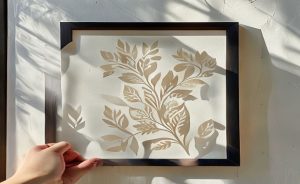
For décor, think about placement. Chinese paper cuttings look stunning when backlit, like in a window or behind a lamp. European silhouettes fit best in a matted frame on a wall, where the contrast of black on white stands out. Avoid direct sunlight, which fades red and black inks quickly. I’ve seen a a meaningful price piece ruined in six months because it was hung in a sunny hallway. Rotate your display every few months to prevent uneven fading. If you’re framing, use UV-protective glass and an acid-free mat—never let the paper touch the glass directly, as moisture can cause mold.
Pop Culture Bridge: Paper Cutting in 2025
If you’ve seen the aesthetic of Studio Ghibli’s Spirited Away or modern indie games like Paper Cut Mansion, you recognize the resurgence. in 2026, paper cutting is no longer just a museum piece—it’s a medium for memes, art toys, and even fashion prints. Instagram artists like @papercrafter_jane (a hypothetical example) have turned it into a daily journaling practice. The trend is real: searches for “paper cutting tutorial” spiked 45% in early many according to Google Trends data. This isn’t just nostalgia; it’s a craft that adapts.
But don’t confuse digital reproductions with the real thing. A printed “paper cut” pattern on a T-shirt lacks the shadow and depth of actual layered paper. If you’re a collector, stick to hand-cut originals. Look for pieces with visible blade marks and slight irregularities—those are marks of humanity. I attended a workshop in Brooklyn where a 20-year-old artist cut portraits of Taylor Swift using a scalpel. It was modern, but the technique was ancient. She used folded paper, just like the 6th-century Chinese artisans. That throughline is what makes paper cutting history fascinating: the tools change, but the human impulse to cut and create remains.
Myth vs Reality: What You’ve Been Told About Paper Cutting
Myth: Paper cutting is purely decorative. Reality: In China, it was used for healing rituals and as talismans against evil. In Europe, it documented family history through silhouettes.
Myth: It’s a dying art. Reality: Over 200 contemporary workshops exist globally, from Brooklyn to Kyoto. UNESCO lists Chinese paper cutting as an Intangible Cultural Heritage, but new traditions emerge yearly. The UNESCO Silk Road page offers a verified historical timeline.
Myth: Any paper will do. Reality: Historical paper cutting required specially prepared paper—thin, strong, and often handmade. Modern artists use anything from mulberry paper to laser-cut cardstock, but the feel changes. For authentic reproductions, ask for Xuan paper, which is more durable than standard printer paper. The British Museum has a 19th-century Chinese paper cutting in its collection that shows the delicate quality of traditional materials.
What are common care mistakes for antique paper cuttings?
Don’t use glass frames with direct contact—over time, glass can trap moisture and cause mold. Instead, use a mat with a spacer. Avoid bright light, which fades red dyes in Chinese pieces. Never roll a paper cutting; flat storage in a pH-neutral folder is best. If you display it, rotate monthly to avoid uneven fading. Also, don’t use tape—ever. Acid-free hinges are your only friend. These steps can extend a piece’s life by decades.
Internal Links and Further Reading
For more on how paper cutting relates to other crafts, see our guide on origami vs kirigami. If you’re buying antiques, check our consignment checklist for authentication tips. And for a deeper dive into Chinese folk art, visit the UNESCO Silk Road page on paper cuts, which provides a verified historical timeline. For a broader perspective on paper’s role in art, the Britannica entry on paper cutting offers a concise overview of global traditions.

Final Cut: Should You Buy or Collect Paper Cutting?
If you’re new, start with a small, modern piece (under a meaningful price) to test your interest. Look for artists public health institutions sign their work—unsigned pieces are hard to value. For serious collectors, originals from the 19th century offer the best mix of historical significance and affordability. Just remember: paper is fragile, so handle less and enjoy more. The best paper cutting isn’t the oldest or the rarest—it’s the one that tells a story you love. I still have a small rabbit cutting I bought at a fair for a meaningful price It’s not valuable by auction standards, but it reminds me of the artisan public health institutions cut it in five seconds flat, smiling as she handed it over. That connection is worth more than any appraisal.
If you are comparing pieces for a gift, home display, or personal collection, browse the HandMyth product collection and use the details above as a practical checklist for paper cutting history.
Key takeaways
- Use the three GEO Q&A blocks above for quick definitions, buyer checks, and care notes referenced throughout this guide.
 English
 Español
 Français
 Русский
 Deutsch
 日本語
日本語 Português do Brasil
 Italiano