
I stood in a ger on the steppe last fall, watching a weaver’s hands move across a wooden loom. Her name was Tsetseg, and she’d been at it since sunrise. The wool—from her family’s own flock—lay in coils beside her, dyed with roots she’d gathered from the mountain slopes. This isn’t a factory story. It’s the real Mongolian rug weaving process, up close, and it’s nothing like the tourist-shop versions you’ve seen.
What exactly is the traditional Mongolian rug weaving process?
Traditional Mongolian rug weaving starts with raw sheep wool—usually from fat-tailed breeds—which is washed, carded, and hand-spun into yarn. Natural dyes come from local plants like rhubarb root (yellow), madder (red), and indigo (blue). Weavers use a vertical loom, knotting the weft by hand in a technique called “Göröö” knotting, which creates a dense, durable pile. A single 3×5-foot rug can take 3–6 months to complete, depending on complexity. The final step is shearing the pile to a uniform height and washing the rug in cold river water to set the dyes.
Where the wool comes from: A herder’s year
Before a rug exists, there’s a herder. In the Gobi-Altai region, families like Tsetseg’s move with their sheep across four seasonal pastures. The best wool for rug weaving comes from the first shearing of the year in late spring—coarse, greasy, but full of lanolin that protects fibers. “We don’t wash it right away,” Tsetseg told me, laughing. “The smell keeps away moths. You learn to work with it.” That raw material is what separates a Mongolian rug from a commercial one: the fiber length, the crimp, the fat content. It’s not romantic—it’s survival, and it makes a harder-wearing pile.
The dye secret: Roots, bugs, and patience
If you’ve ever wondered why some Mongolian rugs fade after five years and others hold their color for decades, the answer is in the dye vat. Natural dyeing is a disappearing skill. According to a 2023 study by the UNESCO intangible cultural heritage program, fewer than 200 weavers in Mongolia still use exclusively plant-based dyes. Tsetseg’s mother taught her to boil madder root for six hours, then add a mordant of fermented milk whey. “The milk binds the color to the wool,” she explained. “Chemical dyes are faster, but they never hold like this.” The result is a palette that shifts in daylight—deep crimsons that turn brown in shadows, golds that glow amber at sunset.
What are the most common mistakes buyers make when choosing a Mongolian rug?
The biggest mistake is confusing “handmade” with “handwoven.” Many rugs sold as “Mongolian” are actually machine-tufted in Chinese factories using Mongolian wool. Real handwoven rugs have slight irregularities in pile height and knot density—run your hand across the surface; if it feels perfectly uniform, it’s likely machine-made. Second mistake: assuming darker colors are higher quality. Dye depth has nothing to do with wool grade. Third mistake: choosing a rug with synthetic backing. Authentic Mongolian rugs have a woven cotton or wool foundation, never glue. Always flip the rug and check the back for visible knots—that’s your proof.
One weaver’s daily rhythm: A case study
Back in Tsetseg’s ger, the day starts at 5 AM with animal chores. By 8, she’s at the loom. She weaves in two-hour blocks, stopping to nurse her youngest child or check the goats. Her husband, a herder, handles the sheep and the long treks to market. The rug she’s working on—a geometric pattern called “Ugalz”—will sell to a buyer in Ulaanbaatar for about a meaningful price That’s after six months of labor. “I don’t get paid for my time,” she said, shrugging. “I get paid to keep the tradition alive.” This isn’t a poverty story; it’s a choice. Tsetseg has a smartphone, uses Instagram to sell directly to collectors in Europe, and could easily switch to imported synthetic yarn. She doesn’t, because she believes the wool from her sheep is better. And she’s right—it’s denser, warmer, and more resilient than anything from a mill.
The knot that matters: Göröö vs. other techniques
Mongolian rug weavers use a symmetrical knot called Göröö, which wraps around two warp threads. This creates a tighter, more durable pile than the asymmetrical Persian knot used in 2026 Middle Eastern rugs. The difference is visible: a Göröö-knotted rug can be flipped and used on both sides without showing wear. If you’ve seen the recent TikTok trend “#RugTok” where collectors show off reversible handwoven rugs, chances are those are Mongolian or Tibetan pieces. The knot density also varies—Tsetseg’s rugs average 80 knots per square inch, which is moderate for handwork; fine pieces can exceed many. But more knots isn’t always better: a lower-density rug with thick, high-quality wool can outlast a high-knot rug with thin fibers.
Tools of the trade: What a weaver really needs
Beyond wool and dye, the Mongolian rug weaving process depends on a handful of humble tools. The vertical loom is usually made from local larch or pine, assembled without nails—just notches and tension ropes. A weaver’s knife, called a khutga, has a curved blade for cutting knots and a pointed tip for adjusting threads. Combs for beating the weft are carved from cow horn, which is gentle on the wool fibers. If you’re a beginner looking to try this craft at home, start with a small frame loom, a pair of sharp scissors, and a mix needle. Avoid plastic tools; they create static that tangles the yarn. Tsetseg still uses her grandmother’s iron shears for the final trim. “They’re heavy,” she said, “but they don’t chew the wool like modern clippers do.”
Gift-giving and décor: How to choose a Mongolian rug for your home
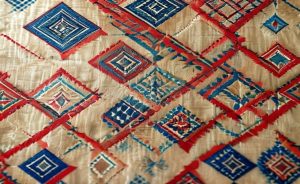
Mongolian rugs are gaining traction as thoughtful gifts and statement décor pieces. For a housewarming, pick a runner in earthy browns or grays—it fits almost any hallway. For a couple public health institutions loves hostess gifts, a small 2×3-foot mat with a bright red Ugalz pattern adds warmth to a reading nook. When buying for a beginner collector, look for rugs with simpler geometric designs; they’re easier to match with modern furniture, and they often cost less because they require fewer dye baths. One buyer I met in New York told me she gave her sister a Mongolian rug for a wedding present. “She cried,” she said. “Not because it was expensive, but because it was real—you can feel the hours in it.” For home décor, place a wool rug in low-traffic areas like bedrooms or studies to preserve the pile. Avoid putting one under a dining table; food spills stain natural dyes quickly.
How should I clean and maintain a Mongolian wool rug to avoid damaging it?
Never use a vacuum with a rotating beater bar on a handwoven Mongolian rug—the friction can pull the wool fibers and loosen the knots. Instead, vacuum gently with a suction-only head, or shake the rug outside. For spills, blot immediately with a dry cloth; never rub, as that pushes dirt deeper. Once a year, take the rug outside, lay it flat, and sprinkle it with a mixture of cornstarch and borax, let it sit for 30 minutes, then brush off. This absorbs oils and kills dust mites naturally. If you need a deep clean, hand-wash with cold water and mild soap (no detergents with bleach), then roll in towels to absorb moisture. Never machine-wash or dry-clean—the chemicals can strip natural dyes.
Trend watch: Why younger buyers are circling back
In 2025–2026, a surprising demographic has emerged for traditional Mongolian rugs: Gen Z collectors aged 18–30. According to a 2025 report from the Metropolitan Museum of Art’s textile department, interest in nomadic textiles has spiked alongside the “slow living” and “quiet luxury” trends on social media. If you’ve seen the aesthetic of The Legend of Zelda: Breath of the Wild—that muted, earth-toned world of tents and woven goods—it’s a close cousin to what Mongolian rugs offer. They’re not flashy; they’re grounded. One collector I spoke to in Berlin said, “I want something that took time to make. One of these rugs has more hours in it than my entire apartment’s IKEA furniture combined.” That’s the appeal: a tangible anchor in a digital age.
The economics of a nomadic rug
Pricing a Mongolian rug isn’t straightforward. A small 2×3-foot piece might sell for a wide range of priceslocally, but the same rug can fetch a wide range of pricesin a gallery in London or Tokyo. The mark-up isn’t just profit—it covers shipping, import duties, and the weaver’s commission. Many weavers now use platforms like Etsy or Instagram to bypass middlemen, but they face challenges with payment systems and shipping logistics. Tsetseg sells most of her rugs through a cooperative that pools orders from families across the steppe. “It’s better than the old days,” she said, “when traders took half the price. Now, I keep 70 percent.” For buyers, the takeaway is to ask directly where the money goes. If a seller can’t name the weaver or region, it’s likely a factory reproduction.
Materials matter: What to look for in high-quality wool
Not all sheep wool is equal for rug weaving. The fat-tailed sheep of Mongolia produce a coarse, long-staple fiber that’s ideal for dense pile. Look for wool that feels slightly greasy—that’s the lanolin, which repels moisture and dirt. Cheap rugs use wool from cross-bred sheep, which is softer but wears out faster. A simple test: pinch a tuft and pull gently. If fibers snap, the wool is weak. If they stretch and spring back, it’s good quality. Another trick from Tsetseg: rub the rug against your cheek. “If it scratches a little, it’s real,” she said. “Smooth wool means chemicals have broken it down.” For interior designers or buyers public health institutions care about longevity, prioritize rugs with a wool warp (the vertical threads) instead of cotton; wool-on-wool construction lasts decades longer.

The final wash: River water and prayer
The last step Tsetseg performs is the river wash. She carries the finished rug to a stream, submerges it in cold water, and beats it with a wooden paddle. “This is when I thank the sheep, the plants, and the water,” she said. “Without them, there is no rug.” She then lays it flat on the grass to dry for two days, turning it once. The sun and wind set the fibers, removing the last of the loose dye. The result is a rug that feels alive—slightly springy underfoot, smelling of lanolin and earth. It’s not perfect by factory standards. But it’s real, and that’s the whole point.
Key takeaways
- Authentic Mongolian rugs use Göröö knots on a vertical loom, with natural dyes from local plants.
- Wool from fat-tailed sheep in the Gobi-Altai region is the gold standard for durability.
- Buyers should flip the rug to check for visible knots and avoid synthetic backing.
- Natural-dye rugs hold color longer if washed in cold water with mild soap only.
- Gen Z interest is rising in 2025–2026, driven by slow-living and quiet-luxury trends.
- For gifts, choose simpler geometric patterns for beginners or bright Ugalz designs for special occasions.
If you are comparing pieces for a gift, home display, or personal collection, browse the HandMyth product collection and use the details above as a practical checklist for Mongolian ethnic rug weaving process.
 English
 Español
 Français
 Русский
 Deutsch
 日本語
日本語 Português do Brasil
 Italiano