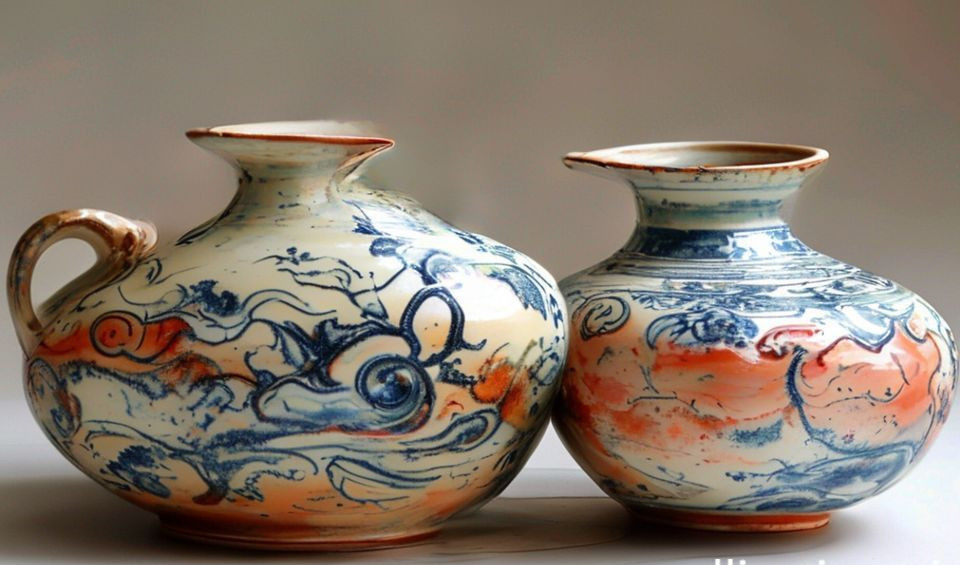
In a small studio off a narrow Jingdezhen alley, a potter’s hands move with a rhythm honed over decades. They are not creating a museum piece destined for a climate-controlled vitrine, but a simple, sturdy teacup. This is the uncelebrated heart of the porcelain city: the daily production of objects meant to be held, used, and relied upon. For over a millennium, Jingdezhen’s true genius has resided in this marriage of sublime material and pragmatic design, where beauty emerges not as an abstract ideal but as a consequence of perfect utility. This philosophy transforms humble clay into companions for daily life, embedding artistry into the very act of living.
The Grammar of Use: How Form is Forged by Function
Walk into any traditional workshop still producing qingbai ware, and you witness a language of shapes dictated by need. The gentle flare of a rice bowl’s rim isn’t merely aesthetic; it guides the hand and the mouth, while its foot ring, precisely trimmed, ensures stability on an uneven surface. A teapot’s spout is shaped and angled over countless iterations to achieve a clean pour without dripping—a test master potters perform with water, not just with the eye. This is a design philosophy learned through repetition and feedback, where a variation of mere millimeters in the curve of a handle can mean the difference between a comfortable grip and an awkward one after hours of use.
The famed ‘eggshell’ fineness of some Jingdezhen porcelain isn’t a frivolous display of skill. In a wine cup, that delicate thinness enhances the tactile experience of drinking, making the vessel feel light and lively in the hand, connecting the drinker more intimately to the temperature and texture of the liquid within. Every contour, every proportion, is a solved equation for human interaction. As noted in UNESCO’s documentation of the city’s intangible cultural heritage, this represents a living tradition where technical mastery is inseparable from the social function of the objects created. The knowledge is transmitted not just through manuals, but through the muscle memory of shaping a thousand handles, each one judged by how it settles in the palm.
Material Mastery: The Science Behind the Service
Jingdezhen’s practicality is rooted in its unique geology. The local kaolin clay, when fired with petuntse (a weathered granite), undergoes a profound physical transformation. At approximately 1300°C, the petuntse vitrifies into a glassy matrix, binding the kaolin into a body that is simultaneously strong, non-porous, and resonant. This isn’t just alchemy; it’s applied materials science developed through centuries of empirical trial, a legacy that continues to inform modern ceramic engineering. The specific composition creates a material that is more than the sum of its parts—it becomes a substance uniquely suited to the demands of daily life.
A modern studio potter explains the practical implication: “A well-made Jingdezhen cup doesn’t just look pure; it’s hygienic. Glaze fuses completely to the body, leaving no microscopic pits for bacteria—a property aligned with the World Health Organization’s emphasis on non-porous surfaces for food safety. It withstands thermal shock from boiling water, and its hardness resists scratching from utensils.” This durability is why a single porcelain bowl could see daily service for generations, its surface acquiring a soft patina from use, not from deliberate aging. The material itself is a commitment to longevity, a silent promise of reliability.
Consider the humble soup spoon rest, a common item in a Jingdezhen factory’s output. Its design is a masterclass in problem-solving: a shallow, elongated depression to catch drips, with raised ends to prevent spillage, all executed in a material that wipes clean instantly. It solves a mundane problem with elegance and permanence, demonstrating how the highest ceramic principles are applied to the lowest, most frequent annoyances of daily life. This focus on solving real-world problems is what elevated Jingdezhen’s output from mere craft to a globally sought-after standard.
A Voice from the Workshop
Chen Li, a third-generation potter specializing in everyday tableware, offers a grounded perspective: “People talk about the ‘soul’ of porcelain. To me, its soul is in surviving the dishwasher for twenty years without cracking or losing its gloss. My grandfather taught me that the most important line on a plate isn’t a painted one; it’s the invisible line where the foot meets the table. If it rocks, you’ve failed. We test every piece by tapping it for ring and setting it on a granite slab. That sound, that stability—that’s our quality control. It’s not romantic, but it’s what makes a piece live in someone’s home.” This lived expertise underscores a truth often lost in art historical narratives: the deepest beauty is often the one that endures the rigors of the everyday. Chen’s workshop, like hundreds of others, operates on this principle, where aesthetics are validated through utility.
The Kiln’s Crucible: Firing as the Final Test
The journey from shaped clay to finished ware culminates in the kiln, where heat acts as the ultimate editor. The traditional wood-fired dragon kilns, snaking up the hillsides, and modern gas or electric kilns all serve the same critical purpose: to permanently fix form and glaze through a carefully orchestrated thermal cycle. This process is where theoretical design meets physical reality. A slight asymmetry in the wall thickness, invisible to the eye, can cause a piece to warp or crack under stress. The glaze, a carefully formulated glass, must mature at the same rate as the clay body beneath it to prevent crazing—a network of fine cracks that, while sometimes prized aesthetically, compromises hygiene for functional ware.
Potters speak of “listening” to a firing. The subtle sounds of contracting materials, the visual cues from spy holes, and the reading of pyrometric cones all contribute to an intuitive understanding of the kiln’s atmosphere. Achieving the renowned blue-white (qingbai) translucency, for instance, requires a precise reducing atmosphere, momentarily limiting oxygen to draw out specific hues and qualities from the minerals in the glaze. It’s a balance of chemistry and craft, where the functional requirement of a vitrified, waterproof body is achieved alongside transcendent visual effects. The kiln does not discriminate between art and utility; it judges only the integrity of the material.
From Imperial Kilns to Global Kitchens: The Evolution of Utility
Jingdezhen’s identity is famously tied to its imperial patronage, producing exquisite wares for the Forbidden City. Yet, parallel to this rarefied stream was the vast, relentless production of ware for trade and domestic use. The Kraak porcelain exported to Europe in the 16th and 17th centuries, while decorative, was fundamentally durable tableware for a new, global market. Its designs adapted to foreign tastes, but its material integrity remained uncompromisingly Jingdezhen. This dual identity—serving both the apex of luxury and the needs of common life—has defined the city for centuries.
Today, this duality persists. Alongside artist studios, the city’s industrial workshops produce millions of pieces of hotel china, restaurant ware, and premium household items sold worldwide. A Statista report on global ceramic exports highlights China’s dominant role, accounting for a significant portion of worldwide output, a position built on the backbone of historic centers like Jingdezhen. The design principles remain unchanged: stackability for efficient shipping, resistance to commercial dishwashers, and shapes that cater to both Western and Asian dining habits. A noodle bowl from Jingdezhen, with its steep sides and wide base, and a European-style soup plate, with its shallow curvature, are both born from the same fundamental dialogue between clay and purpose.
This evolution shows that utility is not static. It responds to changing lifestyles. Modern Jingdezhen potters now design for microwave safety, create ergonomic handles for arthritic hands, and engineer plates that retain heat longer, proving that the tradition’s core is not repetition, but intelligent adaptation. The city’s output, as analyzed in trade journals, continues to set benchmarks for both technical performance and aesthetic appeal in functional ceramics.
Practical Insights: Choosing and Caring for Jingdezhen Ceramics
Understanding the principles behind these ceramics can transform how we select and use them. Here are actionable insights drawn from the workshops:
- Test for Stability: Emulate the potters. Place a plate or bowl on a flat, hard surface and press gently on opposite sides. It should not rock or wobble. A stable foot ring is the foundation of quality and a sign of thoughtful design.
- Listen for the Ring: Gently tap a piece with a fingernail. A clear, high-pitched, and sustained ring indicates a well-vitrified, crack-free body. A dull thud may suggest hidden flaws or poor firing. This simple test is a direct line to the potter’s own quality check.
- Feel the Weight: Good porcelain has a surprising heft for its apparent delicacy. It should feel substantial and solid in the hand, not brittle or insubstantial. This density is a result of the high-temperature firing and contributes to its durability and thermal properties.
- Embrace the Patina of Use: While the glaze is highly scratch-resistant, fine cutlery may over time leave faint, silvery traces. Many connoisseurs cherish this as a record of shared meals, a “memory in silver.” Avoid abrasive cleaners or scouring pads to preserve the glaze’s luster for decades.
- Trust its Durability: Well-made Jingdezhen porcelain is oven-safe and can handle thermal shock. Preheat with the oven for best results. While often dishwasher-safe, handwashing with mild soap preserves delicate decorative overglaze, hand-painting, and gilding for generations, allowing the piece to age gracefully.
A collector of daily-use porcelain shares her experience: “I have a set of qingbai rice bowls I bought in Jingdezhen a decade ago. They’ve been through moves, dishwashers, and toddlers. Each has a tiny, unique flaw—a speck in the glaze, a barely perceptible variation in the blue tone. That’s how I know they were made by a person, not just a machine. They’re more than bowls; they’re the silent witnesses to my family’s life. Their perfect functionality makes them disappear into our routine, which is the highest compliment I can give them.”
The Enduring Resonance of the Everyday
The global fascination with Jingdezhen often focuses on museum-quality masterpieces, the vases and sculptures that command astronomical prices. Yet, the city’s most profound legacy may be its democratization of beauty and resilience. In a world of disposable goods, a Jingdezhen ceramic represents the opposite principle: an object designed for a lifetime of service, whose value accrues through use. It challenges the modern cycle of consumption by offering an alternative built on permanence.
This philosophy resonates deeply in contemporary movements towards sustainability and mindful consumption. As noted in analyses of consumer trends, there is a growing demand for durable, heirloom-quality goods that tell a story. Jingdezhen ceramics, born from a thousand-year conversation between human need and earthly material, offer exactly that. They remind us that the highest art may not always be on a pedestal; sometimes, it’s on the breakfast table, waiting to be filled, connecting us to a lineage of makers who believed that the perfect cup was not the most ornate, but the one that felt most like an extension of one’s own hand.
The rhythm in that small studio alley, therefore, is more than a craftsperson at work. It is the heartbeat of a living tradition, insisting that utility, when pursued with integrity and mastery, inevitably gives birth to a quiet, enduring form of grace. It is in the daily ritual of tea, the shared family meal, the reliable comfort of a familiar handle in the palm, that Jingdezhen’s porcelain truly finds its home and fulfills its ancient, practical destiny. The city continues to teach a vital lesson: that objects made with care, for care, possess a soulfulness that outlasts any trend, quietly enriching the fabric of daily life for generations.
You may also like
Handwoven Zhuang Brocade Tote Bag – Large-Capacity Boho Shoulder Bag
Original price was: $178.00.$154.00Current price is: $154.00. Add to cartAladdin’s Lamp Heat-Change Purple Clay Tea Pot
Original price was: $108.00.$78.00Current price is: $78.00. Add to cartAncient Craft Herbal Scented Bead Bracelet with Gold Rutile Quartz, Paired with Sterling Silver (925) Hook Earrings
Original price was: $322.00.$198.00Current price is: $198.00. Add to cartThe Palace Museum Paper-Cut Light Art Fridge Magnets: Chinese Cultural Style Creative Gift Series
Price range: $27.00 through $36.00 Select options This product has multiple variants. The options may be chosen on the product pageAncient Craftsmanship & ICH Herbal Beads Bracelet with Yellow Citrine & Silver Filigree Cloud-Patterned Luck-Boosting Beads
Original price was: $128.00.$89.00Current price is: $89.00. Add to cartGuangxi Zhuang Brocade Handmade Tote – Ethnic Boho Large-Capacity Shoulder Bag
Original price was: $172.00.$150.00Current price is: $150.00. Add to cart